What Does Angel Number 4 Mean for Structure and Discipline?
How modern numerology, Cheiro's Chaldean system and angel-number writers read 4, why 13, 22 and 1111 reduce to it, and where the Pythagoreans and the Bible put their fours
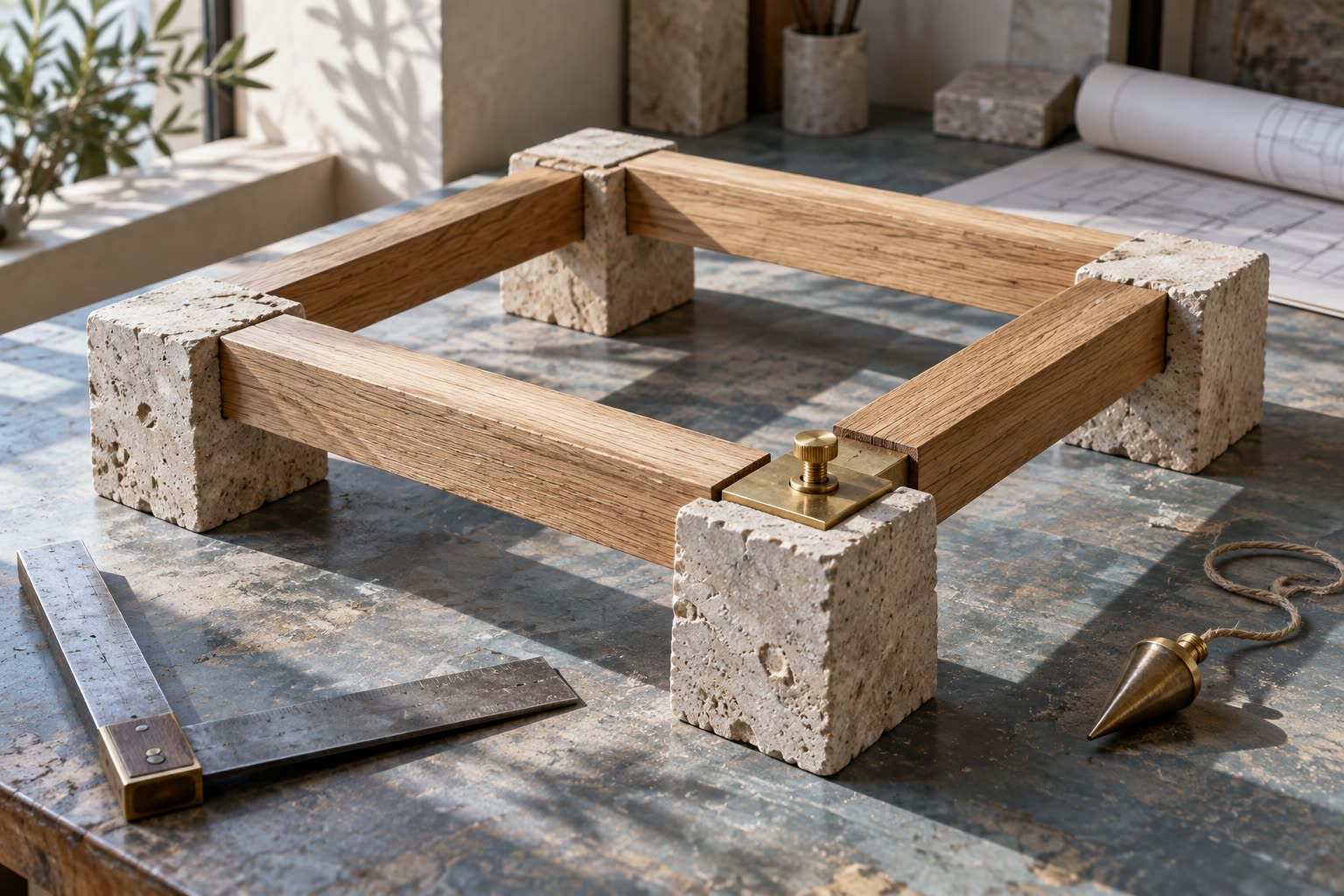
Readers who look up angel number 4 mostly find it described as a prompt about foundations: routine, reliability and work that holds up over time. That reading belongs to modern numerology.
Decoz names the 4's chief characteristics as "dependability, productivity, punctuality and obedience", and Numerology.com describes a "no-nonsense number with a heads-down approach to life and work". The claim that 4s mean the angels are near is a separate spiritual layer, and it dates from Doreen Virtue's number list of 1999.
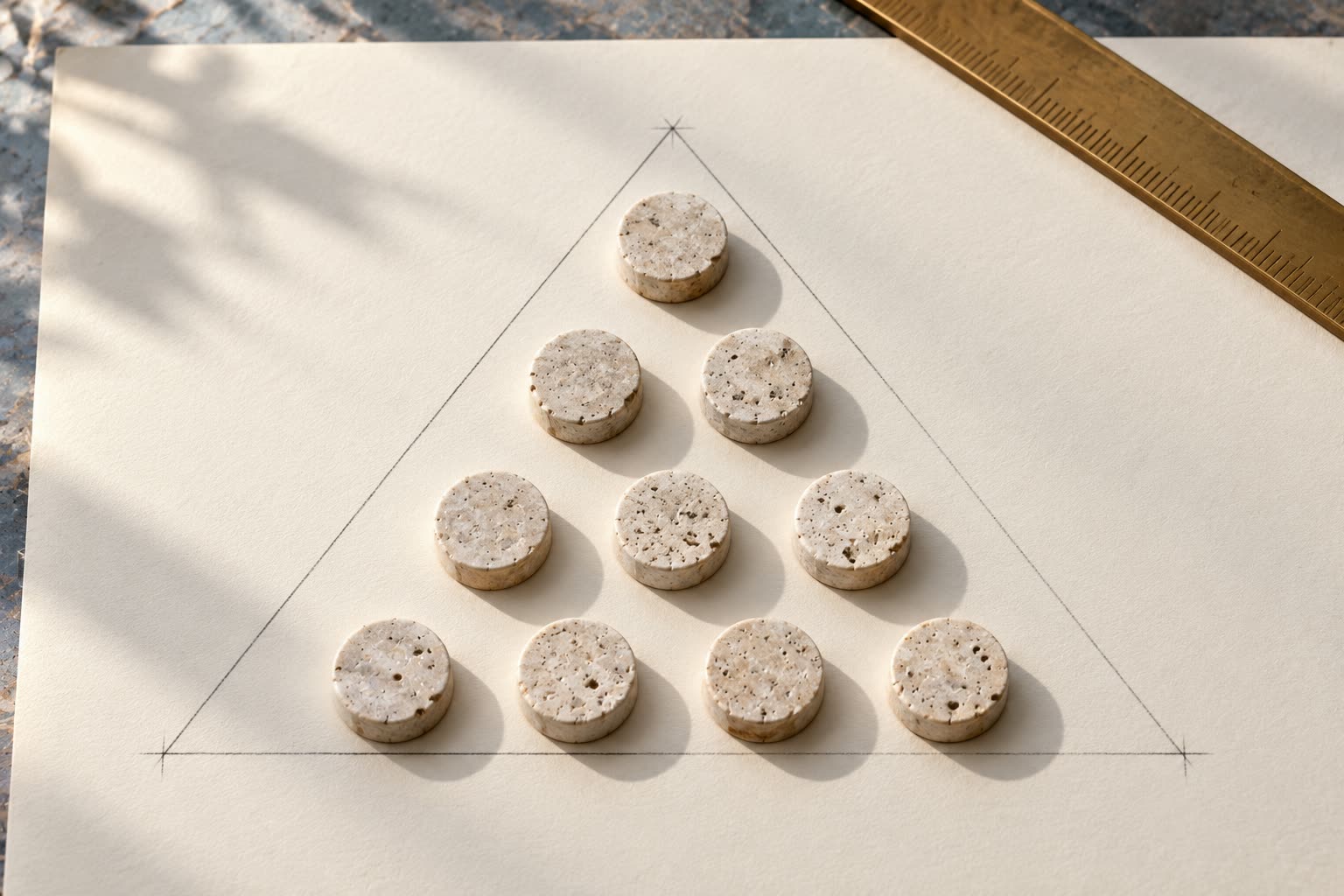
The digit has a longer and less settled history than either reading suggests. The Pythagoreans built their sacred figure, the tetractys, on a base row of four points.
Cheiro's numerology of the 1920s made 4 the number of Uranus and of people who "instinctively rebel against rules and regulations". In Chinese, Japanese and Korean, the word for four sounds like the word for death.
Quick Facts
- Numerology profile
- Practicality, hard work, discipline and responsibility (Numerology.com)
- Weak side
- Dogmatic, dull and rigid
- Chaldean reading
- Cheiro (c. 1926): Uranus, opposition to rules
- Angel-number reading
- Angels are near (Doreen Virtue, 1999)
- Numbers that reduce to 4
- 13, 22, 31, 40, 1111
- Pythagorean figure
- The tetractys: 1 + 2 + 3 + 4 = 10 points
How does numerology describe the number 4?
Modern numerology treats 4 as the digit of effort that lasts. Numerology.com builds its profile on "practicality, hard work, discipline, and responsibility": the 4 is realistic and slow to follow new trends, loyal and willing to work long days to prove it, and drawn to service.
Decoz calls it "without a doubt the most stable, grounded number". The weaknesses on the same profile grow out of those strengths, since the 4 can be dogmatic, dull and so inflexible that it is "hard for the number 4 to be a team player".
Read as an angel number, 4 points to whatever in a reader's life runs on routine: a budget, a training schedule, the upkeep of a house, the habits of a long relationship. The profile covers both the dependable version of that routine and the version that has stopped adjusting, and a sighting on its own does not say which is in play.
The life path 4 is a separate calculation from a birth date and describes a lifelong temperament rather than a moment of noticing a number.
Why does Cheiro's Chaldean numerology call 4 a rebel?
The older Chaldean-style system reverses the modern profile. In Cheiro's Book of Numbers, published around 1926 by William John Warner (1866-1936), the number 4 "stands in its symbolism for the Planet Uranus".
Number 4 people, he writes, "appear to view everything from an opposite angle to everyone else", take the other side in an argument, and "instinctively rebel against rules and regulations". He describes them as drawn to social reform, indifferent to piling up wealth, and devoted to the few friends they make, always inclined to take the part of "the under-dog".
Some pages give 4 to Saturn, the planet of limits and slow reward, and use that pairing to explain its discipline. In Cheiro's table Saturn belongs to 8, so the Saturn reading of 4 does not come from him.
The disciplined 4 and the rebellious 4 are therefore not two sides of one tradition: the first comes from modern numerology in the Pythagorean line, the second from Cheiro's planetary scheme, and the Pythagorean and Chaldean systems also differ in how they turn names into numbers.
Why do angel-number writers say 4s mean the angels are near?
The angel reading of 4 comes from the same source as most angel-number meanings. In Healing with the Angels (1999), Doreen Virtue glossed 444 as "The angels are surrounding you now, reassuring you of their love and help", and her entry for 3s and 4s together keeps the pairing, saying that "both the ascended masters and the angels are here".
Later writers carried the reading down to the single digit. Joanne Walmsley's Sacred Scribes blog describes 4 through "hard work, security, practicality, productivity" and adds that the angels offer "support and inner-strength" toward the reader's goals.
The angelic meaning of 4 is therefore a late-twentieth-century addition to a numerology profile that says nothing about angels. Virtue renounced her New Age teaching after her baptism in 2017, yet the reading most people meet for 444 still repeats her 1999 wording.
| Source system | Owner | Reading of 4 |
|---|---|---|
| Modern numerology | Numerology.com and Hans Decoz | Practical, disciplined, dependable and at risk of rigidity |
| Chaldean-style numerology | Cheiro | Uranus, opposition to rules and the reformer's viewpoint |
| Angel-number writing | Doreen Virtue and Joanne Walmsley | Angelic support added to the modern work-and-stability profile |
Which numbers reduce to 4, and why is 22 the master builder?
Adding digits until one remains makes 4 the root of every number whose digits sum to 4, 13, 22, 31 or 40, and in those readings the 4 supplies the structure under whatever the visible digits describe.
| Number | Addition | Root |
|---|---|---|
| 13 | 1 + 3 = 4 | 4 |
| 22 | 2 + 2 = 4 | 4, or kept as master number 22 in a chart |
| 31 | 3 + 1 = 4 | 4 |
| 40 | 4 + 0 = 4 | 4 |
| 1111 | 1 + 1 + 1 + 1 = 4 | 4 |
| 44 | 4 + 4 = 8 | 8 |
The 22 is the case numerologists single out. Decoz calls it "the Master Builder" and describes it as two sensitive, cooperative 2s that add up to "a determined, pragmatic, grounded, no-nonsense" 4, so the master number keeps both the doubled 2 and the practicality of its root.
He counts master number 22 only when it appears among the core numbers of a personal chart, such as the Life Path or Expression number; a 22 seen on a ticket is read through its digits and its root.
The same arithmetic explains why runs of the digit drift away from 4. Two 4s reduce to 8, three to 3 through 12 and four to 7 through 16, so each length of the repeating fours is read through a different root.
What is the tetractys, and why is four a foundation?
The tetractys is a triangle of ten points set out in four rows of one, two, three and four, so that 1 + 2 + 3 + 4 = 10. The Pythagoreans treated it as sacred, and the tradition about them reads its rows as a progression of dimensions: one point for position, two for a line, three for a plane, and four for the first solid, the tetrahedron.
Four is the row the figure stands on, and it is the first count of points that encloses a body with depth.
Greek natural philosophy supplied a second four. Empedocles, in the fifth century BCE, held that everything is a mixture of four roots, earth, water, air and fire, and Aristotle credited him with being the first to separate those four elements clearly.
The modern numerology profile describes a temperament and does not depend on either figure, but both show how long four has been tied to what is physical and solid.
Why does the Bible count the world in fours?
No verse gives the digit 4 a meaning of its own, but scripture often uses four when it describes the whole created world.
The sun, moon and stars are made on the fourth day (Genesis 1:14-19); the river leaving Eden is "parted, and became into four heads" (Genesis 2:10); Ezekiel sees four living creatures, each with four faces and four wings (Ezekiel 1:5-6); and in Revelation 7:1 four angels stand "on the four corners of the earth, holding the four winds of the earth".
Early Christian writers made the pattern explicit. Irenaeus of Lyon, writing Against Heresies around 180, argued that there could not be more or fewer than four Gospels, "since there are four zones of the world in which we live, and four principal winds", and he matched them to the four faces of the cherubim.
Four therefore has a documented Christian association with the created world and its corners; connecting that to an angel number on a clock is a later, personal application rather than a biblical teaching.
Does 4 point to a steady partner or a stubborn one?
In relationships the modern 4 is the partner who keeps promises. Numerology.com says it "prides itself on being dependable" and "will put great effort into creating secure, long-lasting relationships".
The rigidity named in the same profile shows up in a couple as rules one partner set and the other has outgrown: the fixed Sunday visit, the budget that never changes, the split of housework agreed years ago. Cheiro's rebel 4 describes a different partner, devoted to a few people but quick to take the opposite side of an argument.

At work, Numerology.com's 4 advances "in a more conservative way" and "sticks to what is tried-and-true", a fit for long projects, maintenance and trades where mistakes are expensive. Cheiro expected his number 4 people to be "seldom as successful in worldly or material matters" as others and largely indifferent to money.
Neither profile carries information about a particular employer or partner, so a decision about either rests on the facts of that job or that relationship.
Why does a 4 show on nearly a third of clock readings?
A 4 is hard to avoid on a clock. On a 12-hour digital display the whole hour from 4:00 to 4:59 shows one, and in each of the other eleven hours fifteen minutes do (:04, :14, :24, :34, :40 to :49 and :54), which makes 225 of the 720 minutes, nearly a third of the day's readings, show a 4 somewhere.
A reader who has started watching for 4s will find them often for that reason alone.
Attention does the rest. Arnold Zwicky, a linguist, called the effect the frequency illusion in 2005, meaning that something newly noticed seems to happen "all the time".
Once a reader has learned that 4 carries a message, each 4 registers and the other digits on the same display do not. In East Asia the same attention can run the other way, because four sounds like death in Mandarin, Cantonese, Japanese and Korean and many buildings leave out a fourth floor, so a reader raised with that convention may notice 4s as unwelcome.
Neither reaction is evidence about what follows a sighting.
Frequently Asked Questions
Why is 4 avoided in some East Asian buildings?
In Chinese, Japanese and Korean, the word for four sounds like, or the same as, the word for death, so some buildings omit a fourth floor. Western numerology gives 4 no unlucky meaning; both are conventions, and neither predicts events.
Is angel number 4 a warning?
Virtue and Walmsley present 4s as reassurance. The caution numerologists attach to 4 is about rigidity, such as a plan still followed after it has stopped working; it describes a tendency and forecasts nothing.
Is 4 linked to Saturn?
Not in Cheiro's Chaldean system, where Saturn is the planet of 8 and 4 belongs to Uranus. The Saturn pairing appears on some modern pages as an explanation for the discipline of 4, but it does not come from Cheiro's table.
Why does 444 reduce to 3 while a single 4 stays at 4?
A single 4 is already a root, while 444 adds to 12 and then reduces to 3, so numerology reads the longer form through expression as well as through its visible 4s. The angels-are-near reading attached to 444 comes from Doreen Virtue's 1999 list.
When does 4's dependability turn rigid in a relationship?
Numerology.com describes the 4 as a dependable partner who works for secure, long-lasting relationships, while the same profile warns about rules that stop adapting. The distinction rests on whether the routine still serves both people; a sighting cannot decide that for a couple.
Why can a digital clock show 4 so often?
On a 12-hour digital clock 225 of the 720 minutes show a 4 somewhere, nearly a third of the day's readings. Once a reader starts watching for 4s, the frequency illusion that Arnold Zwicky named in 2005 makes each one stand out.
Sources
- (n.d.). Number 4 Meaning in Numerology. Numerology.com. Link
- (2026). The Numerology Meaning of Single Digit Numbers 1-9. World Numerology (the 4). Link
- (2026). Master Numbers 11, 22, 33. World Numerology (master number 22 and where master numbers count). Link
- (c. 1926). Cheiro's Book of Numbers. Herbert Jenkins, London; chapter VI, "The Number 4", pp. 46-47, and chapter X, "The Number 8", p. 58 (Internet Archive scan). Link
- (2026). Cheiro. Wikipedia (William John Warner, 1866-1936). Link
- (2008). Number Sequences from the Angels. Spirit Library, posted August 18, 2008, from Healing with the Angels (entries for 444 and for 3s with 4s). Link
- (2026). Doreen Virtue. Wikipedia (Healing with the Angels, 1999; 2017 baptism and renunciation). Link
- (2010). Angel Numbers - Number Sequences - Repeating 4's 4 44 444 4444. Sacred Scribes. Link
- (2026). Tetractys. Wikipedia (the four rows and the point, line, plane and solid). Link
- (2019, revised 2024). Empedocles. Stanford Encyclopedia of Philosophy (the four roots; Aristotle, Metaphysics 985a31-33). Link
- (1611). Genesis 1:14-19; Genesis 2:10; Ezekiel 1:5-6; Revelation 7:1. Bible Gateway. Link
- (c. 180). Against Heresies, Book III, chapter 11, section 8. Translated by Alexander Roberts and William Rambaut, New Advent. Link
- (2026). Tetraphobia. Wikipedia (pronunciation of four and skipped floors). Link
- (2019). Frequency illusion in the OED. Language Log, on Arnold Zwicky's 2005 term. Link
About Our Editorial Process
Every KnowTheAngels guide separates calculation method, tradition context, and personal reflection. We cite where interpretations come from, present more than one view, and never present symbolic reading as prediction.
Read our editorial policy