What Does Angel Number 777 Mean, and Why Is It Associated With Luck?
Three sevens in numerology, the reduction to 3, where the jackpot association came from, and the sevens of Genesis and Revelation
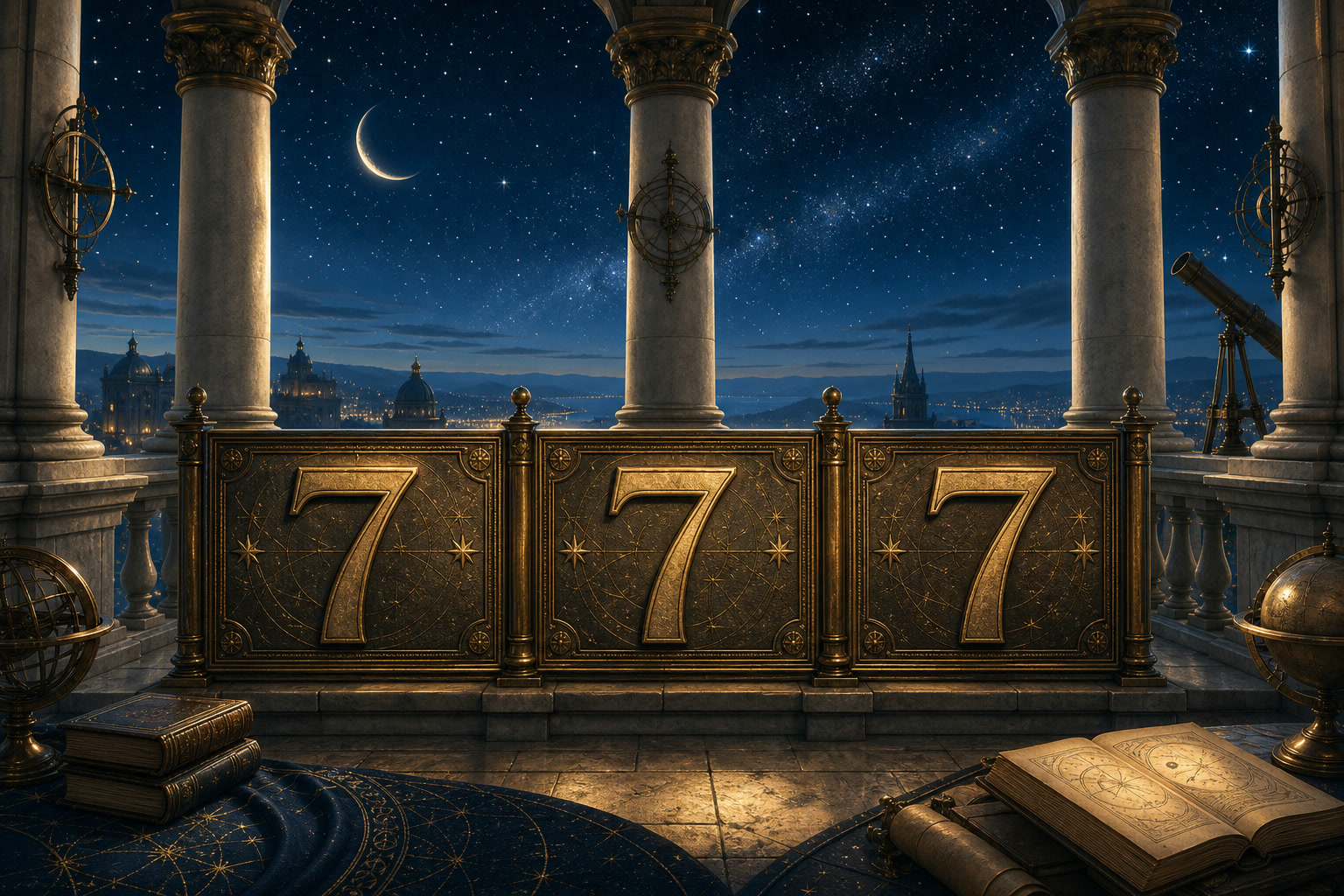
Numerology reads angel number 777 as the digit 7 three times: the number of study, analysis and time alone, repeated until it describes a long period of inner work. Its sum, 7 + 7 + 7 = 21, reduces to 3, the digit of speaking, writing and sharing, so the reading moves from private insight toward saying what was found.
Most people meet 777 first as a jackpot. That meaning comes from casino reels and dice tables, and it is a claim about chance. The numerology reading is a claim about temperament and timing, and the two share nothing but the digits.
Quick Facts
- Digit sum
- 7 + 7 + 7 = 21, and 2 + 1 = 3
- Root digit
- 7: the seeker, thinker and analyst (Decoz)
- Reduction digit
- 3: expression, and right-place, right-time luck (Decoz)
- In the Bible
- Lamech's lifespan, 777 years (Genesis 5:31)
- Casino link
- Three sevens as the reel jackpot; the first slot machine paid on three bells
- Esoteric use
- Title of Aleister Crowley's 1909 book of Qabalistic tables
Three sevens in numerology: the seeker's digit, tripled
Decoz describes the 7 as "the seeker, the thinker, the analyst, and the eternal searcher of truth," a number that "enjoys long periods of solitude" and prefers inner exploration to outside stimulation. Its weaknesses are the same traits pushed too far: a 7 can turn cynical and "emotionally detached," even "oblivious to the emotional suffering of others."
Tripling the digit gives that inward temperament more weight. Numerologist.com opens its 777 reading with the line "a long phase of inner work is complete. It is not a luck sign," and modern angel-number writers generally place 777 at the end of a period of study, prayer or reflection. The practical question follows from the 7's weak point: whether the reflection has produced something usable, or has become a reason to stay apart from other people.
| Number | Digit sum | Final digit | How numerology frames it |
|---|---|---|---|
| 7 | 7 | 7 | Study and reflection in plain form |
| 77 | 7 + 7 = 14 | 5 | Reflection meeting change and movement |
| 777 | 7 + 7 + 7 = 21 | 3 | Reflection that turns into expression |
| 7777 | 7 + 7 + 7 + 7 = 28 | 1, by way of 10 | Reflection that turns into a first act |
Each form lands on a different final digit, so 77 is not a smaller 777. The four-seven form 7777 passes through 28 and 10 to reach 1, the number of beginnings, which is why its readings centre on a first visible act instead of on communication.

What does reducing 777 to three say inward work is for?
Adding the digits gives 21, and 2 + 1 gives 3. In Decoz's account the 3 carries a "passionate need to express feelings, ideas, and vision," along with charm, wit and sociability; its weak side is scattered focus and projects left unfinished.
Set under three sevens, the 3 answers the question the 7 leaves open. The 7 gathers insight in private, and the 3 wants it said, written, taught or shared. Read that way, 777 describes study that is ready to leave the notebook: a thesis that should be submitted, a lesson that could be taught, or an understanding that the people closest to you have not yet heard.
The middle step, 21, has its own association. Card XXI of the tarot's Major Arcana is The World, and numerologist.com reads the 21 in 777 as a completed cycle that comes before the 3's creative start.
A Life Path 3 carries the expressive 3 as a lifelong trait calculated from a birth date. In 777 the 3 appears only as the end of a sum, pulling seven-style reflection toward speech.
Is 777 just a lucky number? Where the slot-machine jackpot came from
Decoz's description of the 3 holds the only luck numerology gives 777: a "tendency to be 'lucky,' or rather, to be in the right place at the right time." That is luck as timing and social ease, the useful meeting that happens because someone was out among people. It says nothing about odds.
The jackpot meaning has a separate history. Charles Fey's Liberty Bell, built in San Francisco in the 1890s, carried five symbols (horseshoes, diamonds, spades, hearts and a bell) and paid its biggest prize, ten nickels, for three bells. Fruit symbols and the BAR came later, from Mills machines with gum-vending attachments whose reels showed the gum's flavours and a stick of gum. Stylised sevens joined that classic set afterwards, and three sevens became the standard jackpot line on most American machines.
Seven was already a winning number at the dice table. In craps a 7 on the come-out roll wins, and 7 is the most common total of two dice, turning up in 6 of the 36 possible combinations. The reel and the dice both run on chance, and a spin that stops on three sevens pays because of how the machine is set, not because of anything about the player's path or timing.
Slot-machine luck and the numerology of 777 are therefore different claims. The casino promises a payout on a random spin; the numerology describes a person whose study is ready to be shared and who may meet the right people by sharing it. Reading a 777 sighting as a signal to gamble credits the casino's meaning to the numerology.

Seven in Genesis and Revelation, and Lamech's 777 years
The Bible's weight falls on seven rather than on 777. Genesis 2:2-3 ends the creation account with God resting on the seventh day, blessing it and hallowing it, and Exodus 20:11 grounds the Sabbath in that seventh day.
Revelation, where the number of the beast is 666, is built on sevens: letters to seven churches (1:4), a scroll sealed with seven seals (5:1), and seven bowls (15:7). Its seven angels who stand before God receive seven trumpets (8:2).
The number 777 itself appears in Genesis 5:31, where "all the days of Lamech," the father of Noah, "were seven hundred seventy-seven years." The text makes nothing further of the figure. Some modern Christian writers set 777 against 666 as threefold completeness against the beast's number, but Revelation never writes 777, so that pairing is a later devotional contrast.
The number also has a documented esoteric use. In 1909 the occultist Aleister Crowley anonymously published a book titled 777, a set of tables that match each point of the Qabalistic Tree of Life with correspondences drawn from many religions, for use in ritual magic. None of these sources treats 777 as lucky; that meaning arrived with the casinos.
Seven's solitude in love and work: what 777 readings ask
The 7's taste for solitude shapes relationship readings of 777. Decoz notes that a 7 can seem aloof and detached, so the numerology question in a partnership is whether someone who has done a great deal of private thinking has told their partner any of it. The 3 in the reduction points to that conversation: a decision reached alone, a change of belief, or a need worked out in a journal and never said aloud.
At work, the 7 is the researcher's and analyst's digit in Decoz's account. Nitya Rao's 2026 guide for Mental Floss reads the number as a nudge to act on goals when opportunities arise; the numerology supports a narrower version, since the 3 asks for finished work to be shown, submitted or taught.
Money readings are where 777 and 888 part ways. In numerology the 8 is the number of material results, while the 7 describes study and reflection, so a 777 sighting carries no forecast about income or a win.
Why 777 keeps turning up, and how to test the sightings
777 is printed on slot-machine artwork, lottery tickets and casino advertising, and it turns up in prices such as $7.77, so a person who has started watching for it will find it often. Arnold Zwicky's term for this is the frequency illusion: attention picks out the number once it matters, and memory keeps the hits while the ordinary numbers in between are forgotten.
- Log where it appears. A casino app, a receipt, a page number: a week of entries separates sightings you went looking for from ones you did not.
- Name the study behind it. Write down what you have been reading, researching or thinking through on your own for months.
- Find the 3. Pick one thing from that study that nobody else has heard yet, and tell, write or teach it within the week.
- Leave the jackpot out. Sightings that began around gambling belong to the casino's symbol, and the numerology reading does not apply to them.
A meditation practice fits the 7 side of this test, giving the private reflection a regular time; the 3 side is only met when something from that reflection reaches another person.
Frequently Asked Questions
Is 777 a lucky number?
In casinos, yes: three sevens is the standard slot-machine jackpot. Numerology's only luck for 777 comes from its reduction to 3, which Decoz ties to being in the right place at the right time, not to winning by chance.
What does 777 mean in the Bible?
The Bible stresses seven, from the seventh day of Genesis 2 to Revelation's seals, trumpets and bowls. The figure 777 appears as Lamech's age at death in Genesis 5:31, and Revelation never uses it.
What does 777 mean in love?
Numerology reads the 7 as private and reflective, so 777 in a relationship asks whether one partner's inner work has been shared. The 3 in its reduction points to a conversation that has not happened yet.
Why does 777 reduce to 3?
7 + 7 + 7 = 21, and 2 + 1 = 3. The 3 is numerology's number of expression, so the reduction turns the 7's private study toward speaking, writing or teaching.
Does 777 mean money is coming?
Numerology gives 777 no money forecast. Its digits describe study and reflection, and the 8, not the 7, is numerology's number of material results, which is why money readings belong more to 888.
How is 777 different from 666?
666 reduces to 9 and its numerology concerns care and control, with Revelation 13:18 behind its reputation. 777 reduces to 3 and concerns reflection that is ready to be shared.
Why do I keep seeing 777?
777 is common on casino and lottery material and in prices, and the frequency illusion makes a number feel more frequent once it matters to you. A week-long log shows whether the sightings follow a real pattern.
Sources
- . Numerology Meaning of number 7. World Numerology. Link
- . Numerology Meaning of number 3. World Numerology. Link
- (2026). Angel Number 777: It Means Victory, Not Luck. Numerologist.com. Link
- (2026). The Spiritual Meaning of Angel Number 777. Mental Floss. Link
- (2021). Genesis 5:28-31 (New Revised Standard Version Updated Edition). Bible Gateway. Link
- (2021). Genesis 2:1-3; Exodus 20:11; Revelation 1:4; 5:1; 8:2; 15:7 (NRSVUE). Bible Gateway. Link
- (2026). Slot machine (history: Liberty Bell and Operator's Bell). Wikipedia. Link
- (2026). 777 (number). Wikipedia. Link
- (2026). Craps (come-out roll and dice probabilities). Wikipedia. Link
- (2026). 777 and Other Qabalistic Writings of Aleister Crowley. Wikipedia. Link
- (2026). Frequency illusion. Wikipedia. Link
About Our Editorial Process
Every KnowTheAngels guide separates calculation method, tradition context, and personal reflection. We cite where interpretations come from, present more than one view, and never present symbolic reading as prediction.
Read our editorial policy