How Do You Keep a Guardian Angel Journal for Prayer and Reflection?
Pick the kind of entry that fits the day, start with a few plain lines, and keep letters, thanks, prayers, and notes in one labeled notebook

A guardian angel journal is a notebook where someone who believes in a guardian angel keeps prayers, letters, thanks, and short notes about their days. Writing in it does not open a line of contact with an angel; the pages hold your words and your reading of events.
Most of these notebooks mix several kinds of entry. This page covers the notebook as a whole: which entry suits which need, prompts to begin with, one book or several, and how Christians can keep it as a prayer journal addressed to God.
Quick Facts
- What it holds
- Letters, thanks, prayers, dream notes, and notes about things you noticed, each labeled
- To begin
- A dated page, a few plain lines, and five to ten minutes
- One book or several
- One notebook with a label on each entry suits most beginners
- Christian form
- Prayer addressed to God that thanks Him for the guardian angel (Directory on Popular Piety, no. 216)
- Writing research
- 146 randomized studies showed a small average benefit from expressive writing (Frattaroli, 2006)
- What it cannot do
- Show that an angel read, wrote, or answered an entry
What is a guardian angel journal for?
It gives one home to the writing a believer already does around that belief: a morning prayer copied out, a letter about a hard week, thanks after a near miss on the road, or a dream that stayed all morning.
Catholic teaching supplies the belief many of these notebooks start from.
The Catechism of the Catholic Church says that "from infancy to death human life is surrounded by their watchful care and intercession" (no. 336), and a journal keeps that belief in view on days when nothing unusual happens.
What the notebook holds is still the writer's own work. A letter that opens "Dear guardian angel" shows whom you meant to address.
It cannot show that anyone else read it, and the pages stay useful without settling that question.
In New Age angel writing, the journal is often presented as a way to receive guidance through free writing.
This page treats that as a belief some practitioners hold, and it describes the notebook in terms any reader can check: what you wrote, when, and what happened afterward.
Letter, thanks, prayer, or note: which entry fits today?
Choose the entry by the need you sat down with. A grieving writer, a grateful one, and one puzzled by a repeated number are doing different work on the page, and each kind of entry has its own shape.
| What you need | Kind of entry | What the page holds |
|---|---|---|
| To say something you cannot say elsewhere | Letter | Your concern in your own words, and a plain note if nothing came to mind afterward |
| To mark something good | Thanks | The event first, then the thanks, then anyone to thank in person |
| To pray | Prayer | A traditional text copied out or your own words to God, with the date |
| To keep something you noticed | Noticed | What you saw, where, and when, before any meaning |
| To hold on to a dream | Dream | The scene as you woke with it, before interpretation |
| To close the day | Day | One thing to be thankful for and one worry with a next step |
The notebook borrows its methods from practices that each have fuller instructions on this site.
Letters, and any reply you imagine after them, need the separate labels used in angel communication journaling, so that your words and a later interpretation never merge.
Thanks entries keep the event and the prayer on separate lines, the order set out for a gratitude journal that thanks God or an angel.
Prayer entries can be as short as the date and one sentence. If praying to your guardian angel is part of your tradition, the notebook is also a place to copy the prayer you say most often.
A "Noticed" entry about a number uses the fields of an angel number journal, with the exact display written before any meaning. A feather or coin gets the same treatment: the scene first, as in the review of signs of nearness readers often record.
Dream entries follow dream journaling practice, written soon after waking and before interpretation.
A "Day" entry resembles the Ignatian examen used in evening angel meditation, which pairs thanks with one worry and a next step.
How do you start a guardian angel journal as a beginner?
Start with any notebook you will actually open, a pen, and ten minutes.
A ruled exercise book works as well as a leather journal, and a private note on your phone works if paper will not come with you.
Write the date at the top of the first page and one line about why you are starting. "I want somewhere to put my prayers for Mum while she is in hospital" gives the notebook a purpose you can check it against months later.
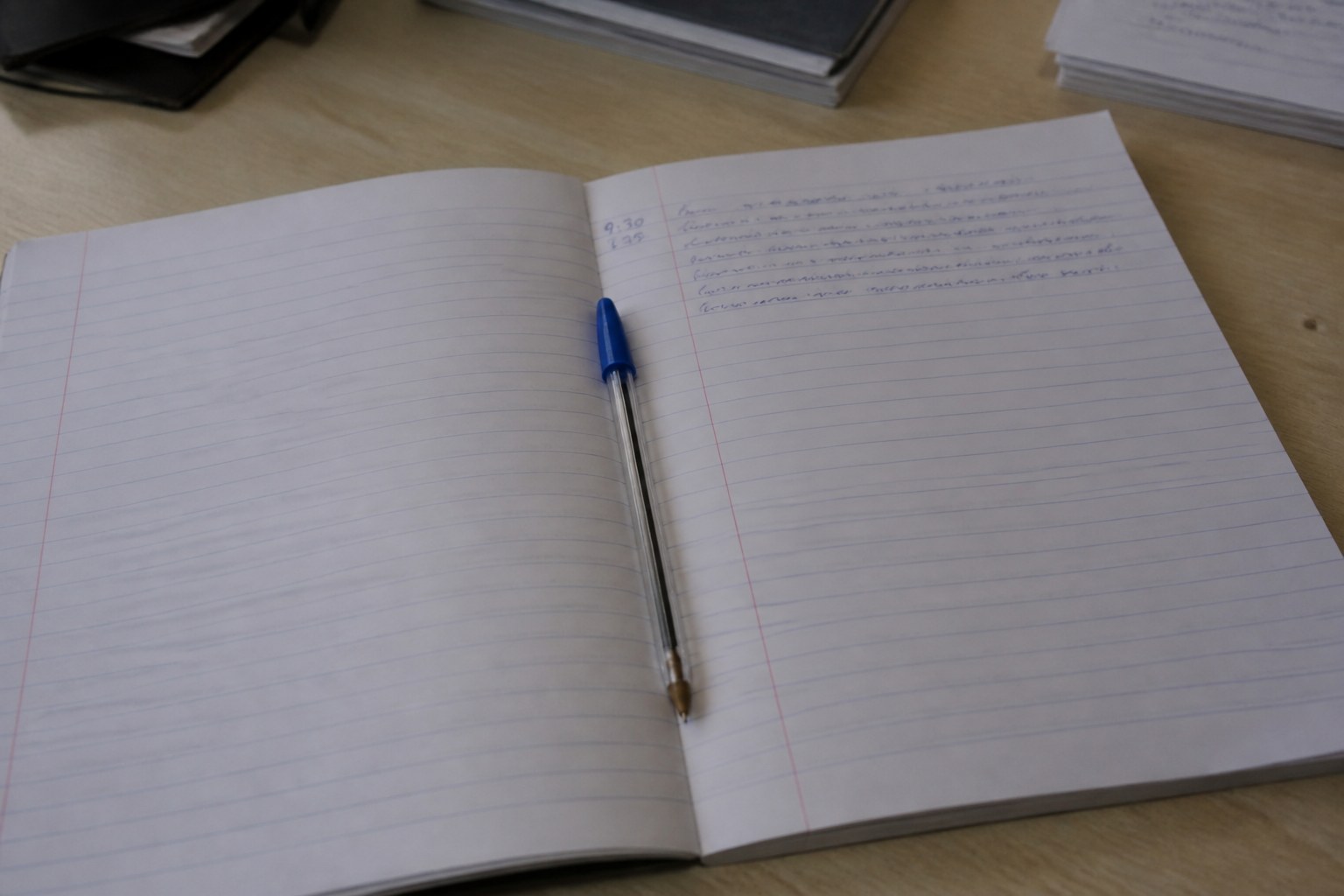
Then write one entry of whatever kind fits the day, three to six lines long. Beginners often stall because they think the first page has to sound spiritual; "Tired, worried about Thursday's scan, said the Angel of God in the car" is a complete entry.
Decide now where the notebook lives and who may read it.
In Joanne Frattaroli's 2006 review of 146 writing studies, those that gave people more privacy while writing found larger benefits for psychological health. That is one practical reason to keep the book somewhere only you open it.
Labels help from the first day.
A single word at the start of each entry, such as Letter, Thanks, Prayer, Noticed, Dream, or Day, lets you find a kind of entry later without rereading the whole book.
What prompts can you use in a guardian angel journal?
The prompts below are grouped by the situation you are writing from. They are starting lines written by our editors, and any of them can be shortened, reworded, or addressed to God instead of an angel.
- First page. Why am I starting this notebook now, and what do I hope it helps me remember?
- An ordinary day. Where did I feel looked after today, and by whom? What did I do that I would be glad for someone watching over me to see?
- A hard day. What am I carrying tonight that I cannot fix before morning, and whom can I ask for help tomorrow?
- Grief. What would I like to tell the person I miss, and what would I like to ask God for them?
- A decision. What do I already know about this choice, what am I only hoping, and who could give me advice?
- A time you felt protected. What happened, step by step, and who else was there?
- When nothing comes. Today I have nothing to say except this one sentence.
The protected-time prompt asks for the steps before the meaning on purpose.
Writing "the car ahead braked, I stopped a foot short, my hands shook for ten minutes" keeps the event on the page, and any thanks to God or an angel can follow on its own line.
The grief and hard-day prompts can leave you lower for a while after writing, which the research below also found.
A one-sentence entry on an empty day still counts. It keeps the habit alive, and a run of short pages is easier to return to than a gap you feel you have to explain.
Should you keep one notebook or several?
One notebook with labeled entries suits most beginners, because a single book lets you see a letter, a prayer, and a hard week side by side in the order they happened.
| Setup | Works well when | Watch for |
|---|---|---|
| One notebook, labeled entries | You write a few times a week and want everything in date order | Notes about signs slowly crowding out prayers and letters |
| Two books: prayer and everything else | You pray on paper daily and want those pages kept apart | Losing track of which book an entry belongs in |
| Separate books for dreams or numbers | You keep a bedside dream log or record numbers several times a day | Treating a long log as proof because it is long |
| Digital notes | You write on the move or want to search by label | Edits silently replacing the first version of an entry |
The main risk in a single book is drift. When most entries become notes about feathers and numbers, the notebook starts crediting every good day to the angel, the habit the Directory on Popular Piety and the Liturgy criticizes when it warns against ascribing "all success to the Guardian Angels" (no. 217).
A quick count every month or two shows whether that is happening.
If prayers and letters have almost disappeared, moving the sighting notes to a small second book gives the main journal back its first purpose.
Digital notes need one extra habit. Add any change below the original entry instead of typing over it, so the first version stays readable when you look back.
How can Christians use it as a prayer journal to God?
For many Christians the simplest form is a prayer journal written to God that mentions the guardian angel inside the prayer.
Catholic guidance describes devotion to the angels in that order, as "devout gratitude to God for having placed these heavenly spirits of great sanctity and dignity at the service of man" (Directory on Popular Piety and the Liturgy, no. 216).
An entry in that form might read: "October 3: Lord, thank you for bringing Dad home safely from the night shift, and for the angel you have set beside him." The prayer goes to God, and the angel appears inside it as part of what the writer is thankful for.
The same Directory calls the Angele Dei, known in English as the Angel of God prayer, "especially popular" and says families often recite it at morning and evening prayers. Copying it at the top of a page and writing your own lines to God beneath it joins a received prayer to a personal one.
The Directory also discourages giving names to angels other than Gabriel, Raphael, and Michael, the three named in Scripture (no. 217). Anyone who has tried to learn their guardian angel's name should know that a Catholic journal following that guidance writes "my guardian angel" instead.
Many Christians in Protestant churches pray to God alone and do not address angels.
For them the journal can stay a conversation with God, with thanks for the care described in passages such as Psalm 91:11, "he will command his angels concerning you to guard you in all your ways."
Keeping a written record of prayer has a long Christian precedent.
Ignatius of Loyola kept a spiritual diary from February 1544 to February 1545 while deciding whether the churches of the young Society of Jesus should have fixed incomes, noting what he experienced in prayer day by day.
The diary is not a record of steady answers. A Jesuit study guide to it traces several crises, one of them a stretch of "total desolation," before the decision was made, so dry pages in a prayer journal are part of the practice rather than a sign of failure.
Does writing in a journal actually help?
Writing about personal experience shows a modest, measurable benefit in controlled studies. None of that research tested guardian angel journals, prayer journals, or letters to angels.
The first controlled study, published by James Pennebaker and S. K. Beall in 1986, asked 46 students to write for four consecutive days. Those who wrote about both the facts and the feelings of a traumatic event had higher blood pressure and worse mood right after writing, yet made fewer doctor visits over the following six months than students who wrote about trivial topics.
Frattaroli's 2006 meta-analysis pooled 146 randomized studies of this kind of writing and found a positive but small average effect, an r of .075.
Studies with at least three sessions, and sessions of at least 15 minutes, tended to show larger effects.
What the writing studies can and cannot tell a journal keeper
The evidence concerns expressive writing in general. It says nothing about angels.
What the evidence supports
- A small average benefit
Across 146 randomized studies, writing about personal experience had a positive average effect (Frattaroli, 2006).
- Several sessions
Three or more sessions, each at least 15 minutes, were linked to larger effects than shorter or fewer ones.
- Facts and feelings together
In the 1986 study, only students who wrote both the facts and their feelings showed fewer doctor visits later.
What remains limited
- A modest effect
An average r of .075 is small, and it describes groups rather than promising a result for one writer.
- A short-term dip
Writing about an upsetting event raised negative mood right after the session in the 1986 study.
- Not about angels
No study here tested prayer or letters to angels, and none can show that an angel read a page.
Pennebaker and Joshua Smyth describe the method for general readers in Opening Up by Writing It Down (third edition, 2016), which, according to its publisher, also covers when the approach may not be helpful.
For a guardian angel journal, the practical lesson is about timing. Because a grief or fear entry can leave you lower for an evening before it helps, a daytime slot is a sensible choice for the hardest pages.
How often should you write, and when should you reread it?
A few short entries a week is enough to keep a journal going.
No church teaching sets a frequency, and a daily quota can turn the notebook into a chore that ends within a month.
Reread on a date you set in advance rather than whenever you feel anxious.
Catholic readers could use October 2, the Memorial of the Guardian Angels listed in the Directory (no. 215), for a yearly read-through, and the first Sunday of each month works as well for anyone.
When you reread, look for what repeats in your own life: the same worry, a person you keep praying for, a kind of day that tends to go badly. Those patterns concern you and the people around you, and they are often the most useful thing a year of pages holds.
Put the journal down for a while if you catch yourself checking it for answers, rereading one page again and again, or losing sleep over it. If the writing leaves you more distressed over several weeks, talk to someone you trust, such as a pastor, a spiritual director, or a doctor, and bring the pages if that helps.
When a notebook is full, date the last page and store it. Some writers burn old letters as a private ritual; nothing in church teaching asks for that, and a kept book lets you see later how a worry actually turned out.
Frequently Asked Questions
Is it okay to write letters to my guardian angel?
Many Catholic and Orthodox Christians address prayers to their guardian angel, and a letter is a written form of that prayer. Many Protestants prefer to address God alone, and in either case the letter records your words without establishing a reply.
Can I give my guardian angel a name in my journal?
Catholic guidance discourages naming angels other than Michael, Gabriel, and Raphael (Directory on Popular Piety, no. 217). Writers outside that tradition sometimes use a name, but it remains a name they chose or received in reflection.
Should I write by hand or type?
Either works. Paper suits a book you keep out of reach, and typed notes are easy to search; if you type, add changes below the first version instead of overwriting it.
Can children keep a guardian angel journal?
Yes, with simple prompts, such as copying one line of the Angel of God prayer and writing or drawing one good thing from the day. Keep a child's journal about prayer and thanks rather than looking for signs.
What if I am not religious?
The same notebook works as a reflective journal addressed to no one in particular. The writing studies cited here tested ordinary expressive writing, not religious practice.
Can a journal prove my guardian angel is real?
No. A journal records what you wrote and noticed, while belief in a guardian angel rests on faith and tradition that the pages can support but not settle.
Sources
- (1993). Catechism of the Catholic Church, no. 336. Libreria Editrice Vaticana. Link
- (2001). Directory on Popular Piety and the Liturgy: Principles and Guidelines, nos. 215-217. Holy See. Link
- . Psalm 91:11. New Revised Standard Version Updated Edition, Bible Gateway. Link
- (2024). The Spiritual Diary of Ignatius of Loyola: class materials. Jesuit Formation. Link
- (1986). Confronting a Traumatic Event: Toward an Understanding of Inhibition and Disease. Journal of Abnormal Psychology 95(3), 274-281. Link
- (2006). Experimental Disclosure and Its Moderators: A Meta-Analysis. Psychological Bulletin 132(6), 823-865. Link
- (2016). Opening Up by Writing It Down: How Expressive Writing Improves Health and Eases Emotional Pain, 3rd edition. Guilford Press. Link
About Our Editorial Process
Every KnowTheAngels guide separates calculation method, tradition context, and personal reflection. We cite where interpretations come from, present more than one view, and never present symbolic reading as prediction.
Read our editorial policy