Who Is Gamaliel, and Why Does the Name Mean Three Things?
A teacher in Acts, an attendant in the Gnostic codices, and a rank of impure powers in Kabbalah all carry it.

Search this name and you will be told, in the same handful of results, that Gamaliel was a respected Jewish teacher, a heavenly minister who carries souls upward, and an order of unclean powers.
All three are true of something. None of them is true of the same thing.
Gamaliel was an ordinary Hebrew name, and three unconnected bodies of literature picked it up independently. This page separates them, then shows why the story most often used to reconcile them has no source behind it.
Quick Facts
- Hebrew name
- גַּמְלִיאֵל, God is my reward
- In the New Testament
- Acts 5:34 and 22:3, a Pharisee and teacher
- In the Hebrew Bible
- Numbers 1:10, a prince of Manasseh
- In Gnostic texts
- A Sethian attendant serving the four luminaries
- In Kabbalistic demonology
- An order of qliphoth, not an individual
- Connections between them
- None recorded in any source
Which Gamaliel is a search actually returning?
Three unrelated figures carry this name, and a search will mix all of them on the first page of results. Sorting them takes one question about the source rather than any knowledge of the traditions involved.
| Figure | Where he appears | What he is |
|---|---|---|
| The Pharisee | Acts 5:34 and 22:3 | A human teacher of the law in Jerusalem |
| The Gnostic minister | Sethian codices from Nag Hammadi | A heavenly attendant who carries souls upward |
| The qliphothic order | Later Kabbalistic demonology | A rank of impure powers, not an individual |
The third row is the one that catches people out.
The practical consequence arrives immediately. A reader who searches this name will be told, by sources that are each accurate about their own material, that Gamaliel was a revered teacher, a heavenly servant, and a rank of unclean powers.
The same name is a helper in one system and a class of unclean powers in another, which means a page can call Gamaliel benevolent or malevolent and cite a real source either way.

None of the three is a corruption of the others. They are independent uses of a normal Hebrew name, and the confusion is a modern filing problem rather than an ancient one.
The name was common enough for this to be unremarkable. Numbers 1:10 already gives it to a prince of Manasseh, centuries before any of the three uses discussed here.
Who was the Gamaliel in the Book of Acts?
He is the best documented of the three by a wide margin, and he is not an angel. Acts 5:34 introduces him as a Pharisee and a teacher of the law held in honour by all the people.
His moment in the narrative is a speech. The council is ready to kill the apostles, and Gamaliel argues for leaving them alone on the grounds that a movement of human origin will collapse by itself.
The argument he makes is a procedural one rather than a theological verdict. He does not say the apostles are right, only that time will settle the question more reliably than the council can.

If this plan or this undertaking is of men, it will fail; but if it is of God, you will not be able to overthrow them.
Acts 5:38-39, in a standard English rendering
Acts 22:3 adds the detail that most affects later reception, having Paul describe himself as brought up at this man's feet.
Jewish tradition knows a teacher of the same name and period, Rabban Gamaliel the Elder, and the two are usually identified with one another. The identification is reasonable and widely held, though it rests on the coincidence of name, place and generation rather than on any text that makes it.
That distinction is worth keeping for the same reason the rest of this page exists. A likely identification and a stated one are different kinds of claim.
That connection made Gamaliel a famous name in Christian literature and kept it in circulation for centuries. It is also why a modern reader who half-remembers the name may associate it with holiness and then meet it on an angel list without noticing the jump.
What does Gamaliel do in the Gnostic texts?
This is the angelic Gamaliel, and he belongs to a specific body of material. He appears in Sethian works recovered at Nag Hammadi, including the Gospel of the Egyptians and the Apocalypse of Adam.
The Sethian cosmos is populated by ranks of heavenly beings arranged around four luminaries. Gamaliel is named among the attendants who serve them, and his function is to receive and carry upward those who belong to the elect.
The four luminaries have names of their own: Harmozel, Oroiael, Daveithai and Eleleth. Gamaliel is usually attached to the second of them, which places him in a fixed position rather than leaving him a free-floating helper.
He also turns up beyond those two works. Zostrianos and the tractate named for Melchizedek both carry the name, which is a wider spread than most figures in this literature manage.
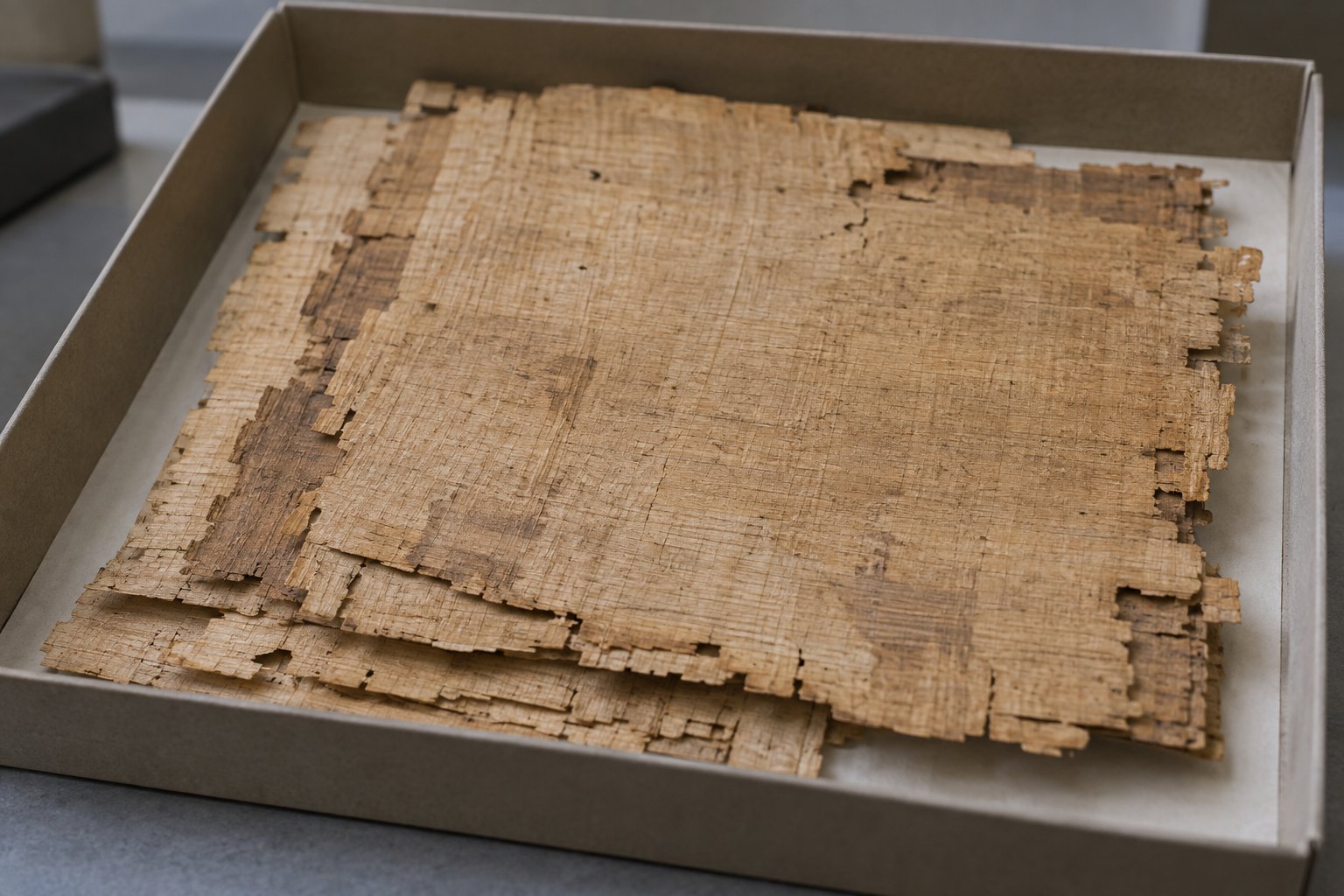
These texts survive because of a single find. A jar of codices unearthed near Nag Hammadi in 1945 preserved Coptic translations of works that were otherwise known only from the hostile summaries of their opponents.
Where he sits in the Sethian scheme
A minister attached to a structure, rather than a free-standing figure.
Fourth-century Coptic manuscripts of earlier Greek works
Gabriel, Samblo and Abrasax appear in the same lists
Receiving souls and bringing them up through the spheres
He is defined entirely by the structure he serves
The company he keeps is worth noticing, because Gabriel stands in the same lists.
A tradition placing a familiar biblical name beside three unfamiliar ones is telling you it drew on Jewish and Christian material and then built something of its own, which is exactly how the Sethian texts treat scripture generally.
Why do Gnostic texts borrow Jewish and Christian names?
The presence of Gabriel beside Gamaliel in a Sethian list is not an accident, and it is not a disguise either. These texts were written by people who knew the scriptures well and were arguing with them.
Their method is recognisable once you have seen it. Familiar names and episodes are kept, and the framework around them is replaced, so that the result reads as a correction of a story the audience already knows.
| Element | In the source tradition | In the Sethian version |
|---|---|---|
| Angel names | Gabriel and others from scripture | Retained, and placed in a new structure |
| Creation | The work of God | The work of a lesser and mistaken power |
| Salvation | Covenant and redemption | Knowledge, and the recovery of origin |
| Human beings | Made from dust | Carrying a spark that does not belong to this world |
Gamaliel belongs to the first row. His name is ordinary Hebrew and his office is invented for the new structure, which is exactly the mixture the whole literature runs on.
That explains something a reader may find puzzling. A figure can be entirely absent from Jewish and Christian angelology and still carry a name that sounds as though it should be there, because the name was chosen precisely for that resonance.
It also sets a limit on what the name can be used to argue. A figure invented for one cosmology cannot testify about another, however familiar the name sounds in it.
This is the difference between a shared name and a shared tradition. The Sethian writers were reading Jewish and Christian scripture closely, and disagreeing with it, which is not the same as belonging to it.
Why is Gamaliel also listed among demonic powers?
Because a later and unrelated system used the name for something else entirely. In some Kabbalistic accounts of the qliphoth, the shells or impure counterparts of the sefirot, Gamaliel names an order rather than a person.
The qliphothic scheme mirrors the sefirot deliberately. Each divine emanation is given a shadow, and the orders attached to those shadows carry names of their own.

The mirroring is structural rather than narrative. An order in that system is defined by which emanation it shadows, which is why these names describe ranks rather than characters with histories.
How one name holds both valences
Two systems, neither aware of the other's use.
What the evidence supports
- Both uses are documented
The Sethian minister and the qliphothic order each appear in real texts.
- The name is ordinary Hebrew
Gamliel means something like God is my reward or God has dealt fully with me.
- Reuse is expected
A common name being used twice by unconnected systems needs no explanation.
What remains limited
- They are not the same figure
Nothing connects the Gnostic attendant to the Kabbalistic order beyond spelling.
- Neither is the Pharisee
The man in Acts has no relationship to either heavenly use.
- No source reconciles them
The idea that one fell or changed sides appears in no text.
Pages that describe a fall from grace are inventing a bridge between two systems that never met. That story is more satisfying than the truth and it has no source at all.
What does the name Gamaliel mean?
It is a straightforward Hebrew formation, and it was a normal human name long before any of the three uses above. The Bible has a fourth Gamaliel at Numbers 1:10, a prince of the tribe of Manasseh.
The elements are the verb gamal and the divine element El. Gamal covers dealing with, recompensing and rewarding, which is why translations of the name vary between God is my reward and God has dealt bountifully with me.
Nothing in it points upward or downward.
It is a name a Jewish parent could give a child, and three of the four Gamaliels discussed on this page are or were exactly that. The heavenly uses are borrowing an ordinary name, not revealing a hidden one.

That is a useful corrective for a reader who expects angel names to encode offices. Most Hebrew names ending in the divine element are statements about God, and they were carried by people first.
How should you cite Gamaliel without mixing the three?
One habit does nearly all the work. Name the body of literature before naming the figure, and the ambiguity disappears in a single clause.
Four checks that identify which Gamaliel is meant
Each points at the shelf the claim came from.
- Is Acts cited?
Then it is the Pharisee, a human teacher, and no angelic claim follows from it.
- Are luminaries or the elect mentioned?
Then it is the Sethian minister from the Nag Hammadi material.
- Are qliphoth or shells mentioned?
Then it is an order in Kabbalistic demonology, not an individual at all.
- Is a fall or a betrayal described?
That narrative bridges two unconnected systems and appears in no source.
Applied honestly those questions will resolve almost every disagreement between two pages about this name. Most such disagreements are not disagreements at all, but two writers describing different figures without saying which.
The habit generalises beyond this name. Most angel-name disputes on the open web are two writers describing different figures, and naming the literature first resolves them before any argument about the figure begins.
What survives the sorting is a good deal more interesting than a single composite. One ordinary Hebrew name was picked up independently by a Pharisee's parents, by a Gnostic cosmology and by a Kabbalistic demonology, and none of the three had the others in mind.
Frequently Asked Questions
Is Gamaliel an angel?
In Sethian Gnostic texts a heavenly being of that name serves the four luminaries and conveys the elect upward.
The better known Gamaliel, the one in Acts, is a human teacher, and a third use of the name in Kabbalistic demonology refers to an order rather than a person.
Who was Gamaliel in the Bible?
Acts 5:34 introduces him as a Pharisee and teacher of the law who persuades the council not to kill the apostles.
Acts 22:3 has Paul describe himself as brought up at his feet, which is why the name stayed famous in Christian literature.
What does the name Gamaliel mean?
It joins the verb gamal, covering dealing with and rewarding, to the divine element El.
Translations run from God is my reward to God has dealt bountifully with me, and it was an ordinary human name long before any heavenly use.
Why is Gamaliel called a demon?
Some Kabbalistic accounts of the qliphoth, the impure counterparts of the sefirot, use the name for one of those orders.
That system is unrelated to the Gnostic material and describes a rank rather than an individual.
Did Gamaliel fall from grace?
No source says so. The account of a fall exists to reconcile the Gnostic attendant with the qliphothic order, and the two belong to systems that never refer to one another.
A common Hebrew name being reused needs no narrative to explain it.
Where do the Gnostic references come from?
From a group of Coptic codices unearthed near Nag Hammadi in 1945, which preserved translations of earlier Greek compositions.
The relevant works include the Gospel of the Egyptians and the Apocalypse of Adam, both of which list him among the attendants of the luminaries.
Sources
- (1st century). Acts 5:34-39 and 22:3. New Testament
- (3rd to 4th century). Sethian lists of the ministers of the luminaries. Nag Hammadi codices
- (2nd to 4th century). Gamaliel among the heavenly attendants. Nag Hammadi codices
- (ancient). Numbers 1:10, Gamaliel prince of Manasseh. Hebrew Bible
- (medieval and later). The qliphothic orders mirroring the sefirot. Jewish mystical literature
About Our Editorial Process
Every KnowTheAngels guide separates calculation method, tradition context, and personal reflection. We cite where interpretations come from, present more than one view, and never present symbolic reading as prediction.
Read our editorial policy