What Does Hasmal Mean in Ezekiel, and How Is It Linked to Angels?
The colour at the centre of the chariot vision, the rabbinic reading that turned it into an angel, and the route from Ezekiel to the modern Hebrew word for electricity

Three times in one book, a prophet describing what he had seen reached for a word that nobody since has translated with confidence.
Ezekiel is by a river in exile when the vision opens, and at its centre is something he can only approach by comparison: it looked like chashmal, out of the middle of the fire.
What that word meant was already unclear when the earliest translators met it, and it has stayed unclear for two and a half thousand years.
The interesting part is what happened next. A word nobody could translate became a rank of angels, then a byword for dangerous knowledge, and finally the ordinary Hebrew word you would use to talk about a light switch.
Quick Facts
- Hebrew word
- חַשְׁמַל (chashmal)
- Where it appears
- Ezekiel 1:4, 1:27, and 8:2, and nowhere else
- Septuagint rendering
- elektron, the gold and silver alloy
- Rabbinic reading
- A class of angels, in Hagigah 13a-b
- Rank in Maimonides
- Hashmallim, fourth of ten
- Modern Hebrew
- The everyday word for electricity
What is chashmal in Ezekiel's vision?
The word appears three times, all in Ezekiel, and all in descriptions of the same overwhelming appearance.
And I looked, and behold, a stormy wind came out of the north, a great cloud with brightness around it, and fire flashing forth continually, and in the midst of the fire, as it were the colour of chashmal.
Ezekiel 1:4, in a literal rendering
Notice the grammar of the sentence. The prophet does not say the thing was chashmal; he says it looked like the appearance of chashmal, which is already a comparison at one remove.
The other two occurrences work the same way. At 1:27 the figure on the throne is described from the waist up as having that appearance, and at 8:2 the same comparison returns, so the word is reserved for the most difficult part of the vision each time.
That reservation is the first clue about its meaning. Whatever chashmal named, Ezekiel used it where ordinary colour words had already failed him.
Open three Bibles and you will find three different substances, and each choice rests on different evidence.
| Rendering | What it rests on | The difficulty |
|---|---|---|
| Electrum | The Septuagint reads elektron, a gold and silver alloy | A translator's guess, though the earliest one we have |
| Amber | Elektron in later Greek also means amber | Amber does not gleam from within fire |
| Gleaming or burnished bronze | Context: the vision is full of fire and metal | Reads the sense from the setting rather than the word |
| A precious shining stone | The Akkadian cognate elmesu names a brilliant stone | Cognates narrow a range; they do not fix a meaning |
The Akkadian row is the most useful for a reader. Elmesu describes a stone with the characteristic sparkle and brilliance of fire, which supports brightness rather than a specific colour.
That is probably as close as the evidence allows. The word names an intense, fiery radiance whose exact material referent was lost early.

How did a colour word become the order called Hashmallim?
Rabbinic tradition solved the problem differently. Rather than identifying a substance, it read the word as a compound and let the parts explain themselves.
That reading turns a description into a description of beings, and once the word names beings it can name an order of them. It is a wordplay rather than an etymology, and the tradition is not shy about that.
What makes it more than a pun is that it answers the difficulty in the verse. Ezekiel used the word where language failed, and the rabbinic reading makes the word itself about the alternation of speech and silence.

Once chashmal named a class of beings, the class needed a place, and the best-known placement comes from Maimonides in the twelfth century. His scheme has ten ranks, and the Hashmallim sit fourth.
| Rank | Order | Note |
|---|---|---|
| 1 | Chayot ha-Kodesh | The living creatures of the chariot vision |
| 2 | Ophanim | The wheels of the same vision |
| 3 | Erelim | From a term in Isaiah 33:7 |
| 4 | Hashmallim | From Ezekiel's chashmal |
| 5 | Seraphim | From Isaiah 6 |
| 6 to 10 | Malakhim, Elohim, b'nei Elohim, Cherubim, Ishim | The remaining orders in descending sequence |
Two things follow from that table. The top four ranks all come from a handful of prophetic visions, and three of them come from Ezekiel's chariot alone.
It also places the Hashmallim above the Seraphim, which surprises readers who know only the Christian hierarchies, where the seraphim stand first. The two systems are counting different things and should not be merged.
Sources differ on whether Hasmal names an individual or a group, and both readings have something behind them.
Singular figure or angelic order
The plural is better attested; the singular is not baseless.
What the evidence supports
- The plural is standard
Hashmallim is the form used in the rank lists and in most rabbinic discussion.
- The word is a description
It names an appearance, which lends itself to a class rather than a person.
- Its neighbours are plural
Chayot, Ophanim, Seraphim, and Erelim are all orders.
What remains limited
- Angel dictionaries list a singular
Compilations do give Hasmal as an individual name, which is where most modern usage comes from.
- Chief-of-the-order language exists
Later material sometimes names a leading Hashmal, in the way orders often acquire a head.
- No text settles it
Ezekiel's word is grammatically singular and describes a thing, not a being.
The safest formulation is that Hashmallim is an order and Hasmal is how compilers have listed it as a name. A page treating Hasmal as a personal angel with a role and a colour has moved two steps from the source without marking either one.
Why was studying chashmal treated as dangerous?
The same Talmudic discussion attaches a warning to the word, and it is one of the sharpest in rabbinic literature about the limits of study.
A child was once reading the book of Ezekiel in his teacher's house, and he understood what chashmal was, and fire went out from chashmal and consumed him.
Babylonian Talmud, Hagigah 13a, in the traditional rendering
The story is told to explain why the chariot vision was restricted, and why the sages sought to withdraw the book of Ezekiel from circulation.
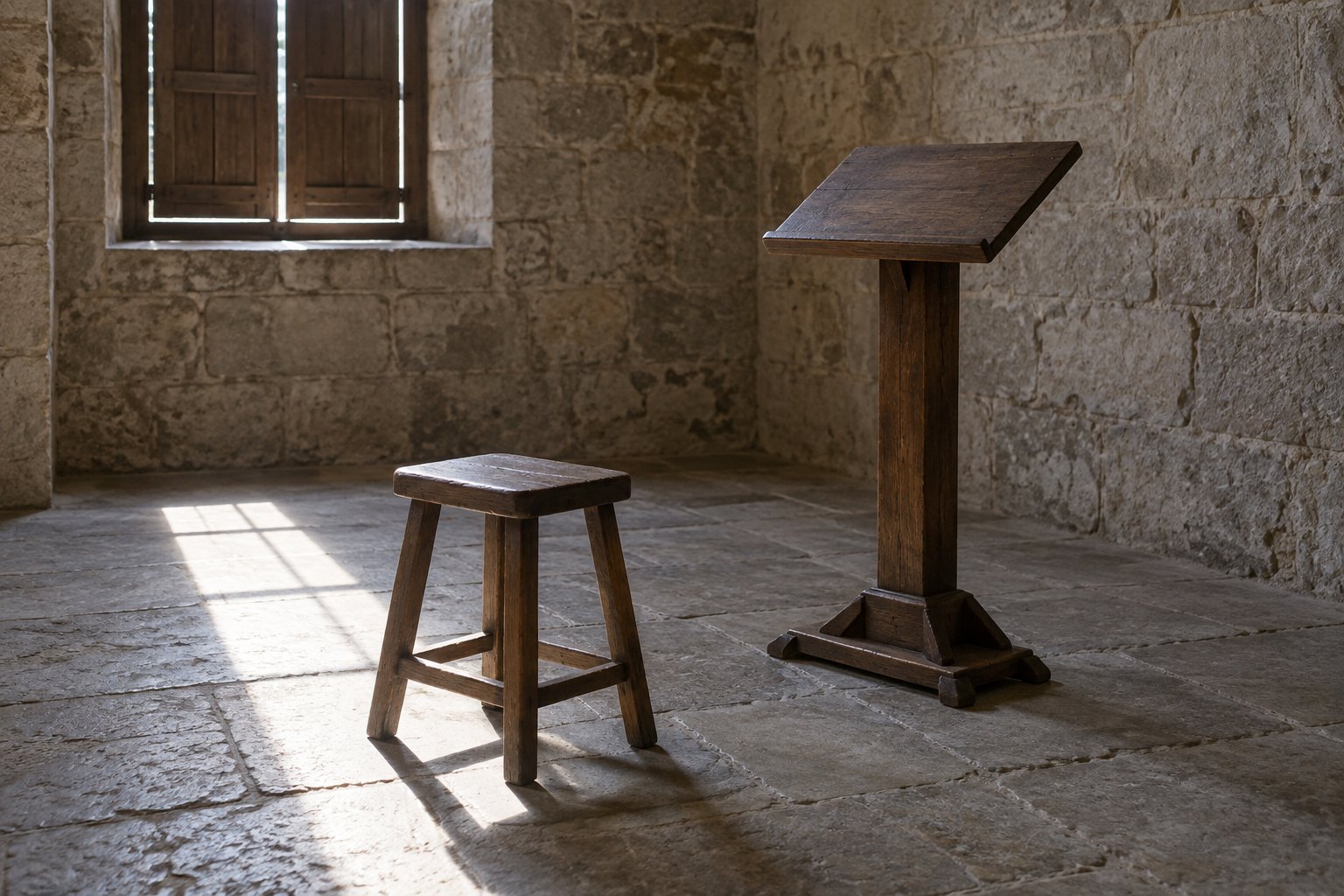
It is not a claim about a historical child. The function is to mark a boundary: this material is taught to one student at a time, only to those already able, and the word at its centre carries the danger of the whole vision.
For a modern reader the useful part is the register. A tradition that treats a word as hazardous is not offering it as an angel to be invoked, which is a long way from how the name is used on most contemporary pages.
The story about the child is told inside a larger discussion, and that discussion is about whether the book should have been available at all. Rabbinic tradition records that the sages sought to suppress the book of Ezekiel because its opening chapters were considered dangerous and because parts of it appeared to conflict with the Torah.
The chapter was kept, and the reason given is specific. A figure named Hananiah ben Hezekiah is credited with reconciling the difficulties, at the cost of three hundred jars of oil burned through the nights he spent on it.
For a page about this word, the restriction is the most important context available.
A term that a tradition surrounded with warnings, and taught one student at a time, is not being offered as a name to invoke. It is being handled as material that could injure the unprepared.
The warning tale does not stand on its own. It illustrates a rule that rabbinic literature states formally, and the rule is stricter than most readers expect.
The Mishnah restricts three subjects, and the chariot vision is the most restricted of them.
- Forbidden sexual relations: not expounded before three students.
- The work of creation: not expounded before two.
- The chariot: not expounded even before one, unless that student is wise and understands of his own knowledge.
The last line is the sharpest restriction in the list, and it is unusual in a body of literature built on public teaching. A subject that cannot be taught even privately, except to someone who could already work it out alone, is being treated as something closer to a hazard than a curriculum.
That is the frame the chashmal story sits inside, and it changes how the story should be read.
The child is not a cautionary anecdote about curiosity in general. He is the illustration attached to a specific ruling about one word in one vision, which is why the two are transmitted together.
Why does chashmal appear only three times in scripture?
A word this consequential appears three times in the entire Hebrew Bible, and all three are in one book by one prophet.
That concentration is itself evidence. A term in ordinary use would turn up in narrative, law, or poetry, and this one does not.

Two explanations are usually offered.
Either the word was rare and technical, naming a specific material that simply had no other occasion to appear, or Ezekiel reached for an unusual term precisely because the ordinary vocabulary would not do.
What the rarity suggests
Neither explanation excludes the other.
Fits the Akkadian cognate for a brilliant stone
Fits the reservation of the word for the hardest moments
Would explain both the rarity and the early uncertainty
A colour in daily use would appear elsewhere
The last row is the most useful for a reader comparing translations. Whatever chashmal is, it is not the ordinary Hebrew word for any common colour, because those words are well attested elsewhere.
The uncertainty in every English Bible is therefore not carelessness. It reflects a genuine gap in the evidence that has been open since antiquity.
How did chashmal become the modern Hebrew word for electricity?
The last chapter of this word's history is the most unexpected, and it happens in the nineteenth century. Modern Hebrew needed a word for a new phenomenon, and the poet Judah Leib Gordon proposed chashmal in 1878, drawing on the Septuagint's elektron and the electrical sense the Greek word had acquired in European languages.

One word, three lives
Each stage borrows from the one before and changes the sense completely.
- 6th century BCEEzekiel uses chashmal for a fiery radiance
A comparison at the hardest point of the vision.
- 3rd to 2nd century BCEThe Septuagint renders it elektron
Ties the Hebrew word to the Greek term for amber and electrum.
- Talmudic periodRead as a compound naming a class of angels
Turns a description into the Hashmallim.
- 1878Revived by Judah Leib Gordon for electricity
Modern Hebrew's everyday word, via elektron and its European sense.
The route is genuinely circular. Greek elektron gave English electric, and the Hebrew word that had been translated by elektron was then recruited to name the thing English had named from the same root.
It is worth stating firmly that this tells you nothing about Ezekiel. A page that describes the chariot vision as electrical is reading an 1878 decision back into a sixth-century text.
Is Hasmal an angel, and which spelling should you trust?
Contemporary pages tend to present Hasmal as an angel with attributes, and it is worth tracing how a difficult word acquires a colour, a stone, and a day of the week. The route runs through the compilations rather than through the sources.
Angel dictionaries assembled in the twentieth century list Hasmal as a name, and once a name is on a list it becomes available for the correspondence systems that assign each angel a planet, a metal, and a direction.
What modern attributes rest on
The name is genuine; most of what is attached to it is not from the sources.
What the evidence supports
- The name is real
Chashmal is in Ezekiel, and the rabbinic reading of it as beings is genuinely ancient.
- The order is real
The Hashmallim appear in Jewish rank lists including Maimonides.
- The radiance is real
Whatever the word means, it describes brightness at the centre of a vision.
What remains limited
- No colour is assigned
Ezekiel gives a comparison, not a colour chart, and the tradition assigns none.
- No planet or day
Those come from later correspondence systems applied to every name on a list.
- No invocation
The rabbinic handling is restrictive, and no tradition offers a Hasmal prayer.
A reader who wants the correspondence material can have it, provided the label stays attached to it.
Presenting a planetary attribution as though it came from Ezekiel is the specific error, and it is common enough on this name to be worth checking for.
The spellings vary because the Hebrew opening letter has no clean English equivalent, and each convention signals a different kind of source.
- Chashmal: follows the Hebrew het with ch, and usually signals a Jewish or academic source working from the text.
- Hashmal: the common scholarly transliteration, and the form used in most rank discussions.
- Hasmal: a simplified form frequent in angel compilations and English-language lists.
- Hashmallim: not a variant but the plural, and the form the rank is actually named by.
Only the last of those changes what is being talked about. The first three are one word arriving through different transliteration habits.
Checking which form a page uses is a fast way to predict its sources, because a page writing chashmal will usually cite Ezekiel and the Talmud, while one writing Hasmal will usually cite an angel dictionary.
Neither is wrong. They are answering different questions, and only one of them is answering the question of what Ezekiel saw.
Frequently Asked Questions
What does chashmal mean in Ezekiel?
It names a fiery radiance at the centre of the chariot vision, and its exact referent was already uncertain by the time of the Septuagint. Translations include electrum, amber, and gleaming bronze, and the Akkadian cognate suggests brilliance rather than a specific colour.
Is Hasmal an angel?
Rabbinic tradition reads the word as naming a class of beings, the Hashmallim, by splitting it into parts meaning silent and speaking.
In Ezekiel itself the word describes an appearance, not a being.
Where do the Hashmallim rank among angels?
In Maimonides' ten ranks they stand fourth, above the Seraphim. That ordering belongs to a Jewish scheme and should not be merged with Christian hierarchies, where the seraphim come first.
Is chashmal really the Hebrew word for electricity?
Yes. The poet Judah Leib Gordon proposed it in 1878, working from the Septuagint's elektron and the electrical sense that Greek root had acquired in European languages.
It says nothing about what Ezekiel saw.
Why was the book of Ezekiel restricted?
The chariot vision was treated as hazardous material taught only to advanced students one at a time. The Talmud tells of a child who understood chashmal and was consumed by fire from it, a story told to mark that boundary.
How is Hasmal spelled?
Chashmal follows the Hebrew het and usually signals a source working from the text, Hashmal is the common scholarly transliteration, and Hasmal is the simplified form frequent in angel compilations.
Hashmallim is not a variant but the plural, and it is the form the rank itself is named by.
Sources
- (6th century BCE). Ezekiel 1:4, 1:27, and 8:2. Hebrew Bible
- (3rd to 6th century). Hagigah 13a-b. Rabbinic literature
- (12th century). Mishneh Torah, Hilchot Yesodei HaTorah 2:7. Jewish legal and philosophical writing
- (1906). A Hebrew and English Lexicon of the Old Testament, entry chashmal. Clarendon Press
- (1878). The proposal of chashmal for electricity. Modern Hebrew revival
About Our Editorial Process
Every KnowTheAngels guide separates calculation method, tradition context, and personal reflection. We cite where interpretations come from, present more than one view, and never present symbolic reading as prediction.
Read our editorial policy