What Do the Cherubim and Wheels in Ezekiel's Vision Mean?
The living creatures and wheels of chapters 1 and 10, the man in linen of chapter 9, the bronze guide of chapters 40 to 48, and the cherub of Tyre
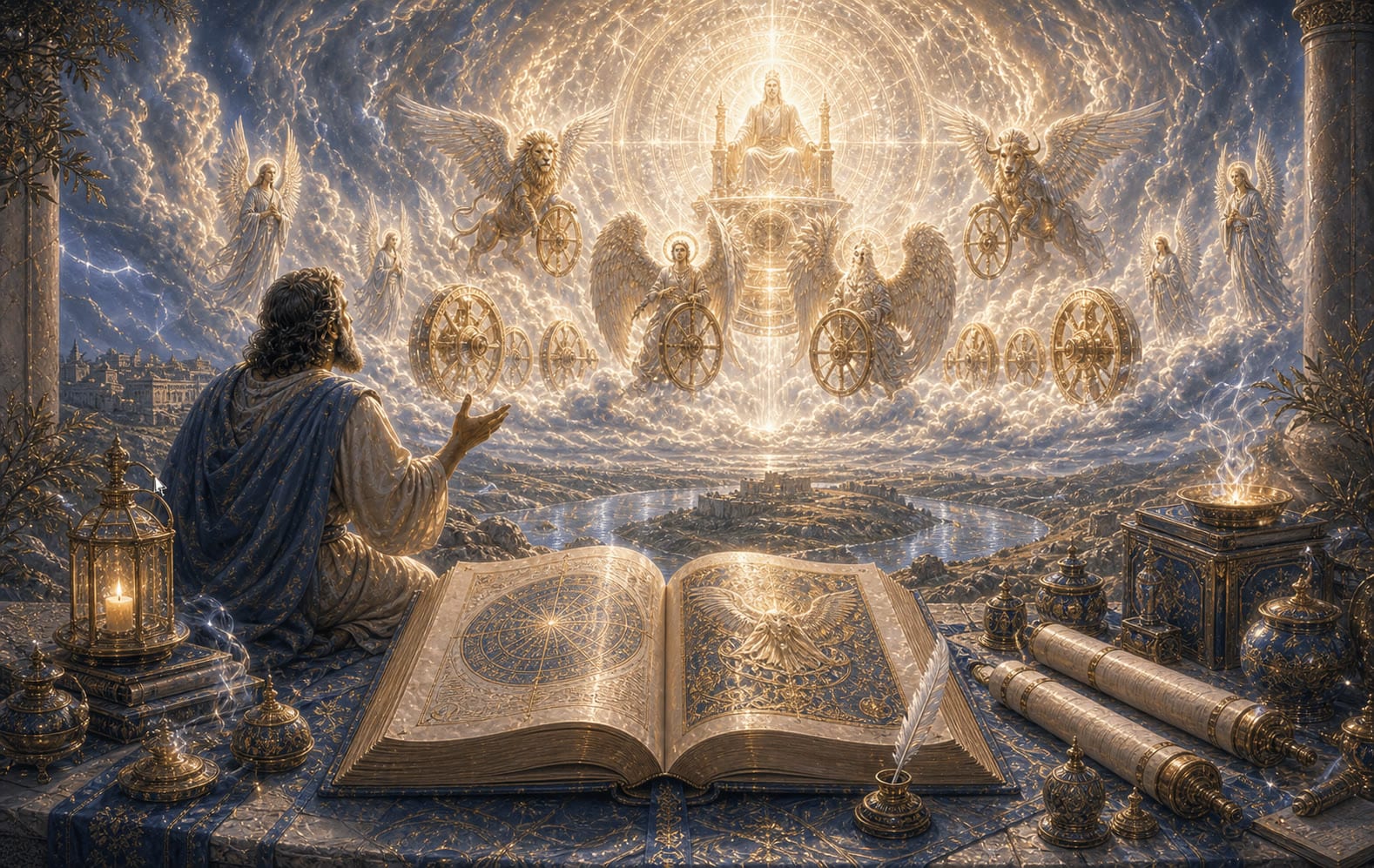
Every heavenly figure in Ezekiel appears inside a vision, and the prophet describes each one by what he sees: creatures, wheels, cherubim, or men. None of them has a name, and the book never gives any of them the title angel.
The visions came to a priest living among the exiles in Babylonia, by the River Chebar, in the fifth year after King Jehoiachin was taken captive (1:1-3). Most of the heavenly figures serve one event the book keeps returning to: the glory of the LORD leaving the Jerusalem temple and, in chapter 43, coming back.
Quick Facts
- Key chapters
- Ezekiel 1, 9, 10, 28, and 40 to 43
- Living creatures
- Four faces (human, lion, ox, eagle) and four wings each (1:5-10)
- Named as cherubim
- Ezekiel 10:15 and 10:20
- Man clothed in linen
- Marks the foreheads of the faithful (9:4) and scatters coals over Jerusalem (10:2)
- The word mal'ak
- Used four times in Ezekiel, each time for a human envoy (17:15; 23:16, 40; 30:9)
- Later name for the vision
- The chariot (merkavah), after 1 Chronicles 28:18 and Sirach 49:8
Which heavenly beings does Ezekiel describe, and are they called angels?
Five kinds of heavenly figure appear across the book's visions, from the first chapter to the plan of the new temple.
| Passage | What Ezekiel sees | What the text calls it |
|---|---|---|
| Ezekiel 1:4-14 | Four creatures of human form, each with four faces and four wings | Living creatures (hayyot) |
| Ezekiel 1:15-21; 10:9-13 | A wheel beside each creature, gleaming like beryl, its rims full of eyes | Wheels (ophanim); in 10:13, "the wheelwork" |
| Ezekiel 9:1-11 | Six men with weapons and a seventh clothed in linen with a writing case | Men |
| Ezekiel 10:1-22 | The same four creatures, seen again at the Jerusalem temple | Cherubim |
| Ezekiel 28:12-16 | A cherub on the holy mountain of God, in a lament over the king of Tyre | Cherub |
| Ezekiel 40:3 to 47:12 | A guide whose appearance shone like bronze, with a linen cord and a measuring reed | A man |
The Hebrew word usually translated angel is mal'ak, a messenger. Ezekiel uses it four times, for the envoys the king of Judah sent to Egypt (17:15), for messengers in the allegory of chapter 23 (23:16, 40), and for messengers who go out in ships (30:9), and the Brown-Driver-Briggs lexicon classes every one of them as a human messenger.
Calling the creatures and the men of the visions angels is therefore a reader's classification. It rests on what they do, carrying God's throne or carrying out his orders, and not on a title the book gives them.
What are the four-faced living creatures of Ezekiel 1?
They are the bearers of God's throne. Ezekiel first sees a storm wind from the north, a great cloud with fire flashing through it, and in the middle of it four creatures that "were of human form" (1:4-5).
Each creature has a human face in front, a lion's face on the right, an ox's face on the left, and an eagle's face (1:10). Each has four wings, two spread to touch the wings of its neighbours and two covering its body, with human hands underneath them (1:8, 11). Their legs are straight, and their feet, shaped like a calf's hoof, "sparkled like burnished bronze" (1:7).
They never turn. Each moves straight ahead, "wherever the spirit would go" (1:12), darting "to and fro, like a flash of lightning" (1:14), and when they fly their wings sound "like the sound of mighty waters, like the thunder of the Almighty" (1:24).
Over their heads is a dome shining like crystal, above the dome "something like a throne," and on the throne "something that seemed like a human form" wrapped in fire and a rainbow-like splendour (1:22-28). Ezekiel calls the whole sight "the appearance of the likeness of the glory of the LORD" (1:28), never simply the LORD. The creatures carry that throne in Babylonia, hundreds of miles from the temple where the ark and its golden cherubim stood.
What is the wheel within a wheel in Ezekiel's vision?
Beside each creature Ezekiel sees a wheel on the ground, gleaming like beryl, "their construction being something like a wheel within a wheel" (1:15-16). He does not explain the construction. He does say what it allows: the wheels move in any of the four directions "without veering" (1:17), matching creatures that never turn.
The rims are "tall and awesome" and "full of eyes all around" (1:18). The wheels have no motion of their own: they rise, move, and stop with the creatures, "for a living spirit was in the wheels" (1:20-21).
Chapter 10 adds two details. The eyes now cover the cherubim as well, their "backs, hands, and wings" (10:12), and Ezekiel hears the wheels called "the wheelwork," galgal in Hebrew (10:13), the same word Daniel 7:9 uses for the burning wheels of God's own throne.
Ophan is the ordinary Hebrew word for a wheel, the same word Exodus 14:25 uses for the wheels of the Egyptian chariots in the sea. The step from wheel to angel came later. 1 Enoch 61:10 lists the ophanim beside the cherubim and seraphim as a rank of heavenly beings, and modern angel books go further and equate them with the Thrones of the Christian nine choirs, a pairing no ancient source makes.
Why does Ezekiel 10 call the living creatures cherubim?
Because Ezekiel sees them again at the temple and recognizes them there. In a second vision, dated to the sixth year (8:1), he is carried to Jerusalem, and when the creatures reappear he writes, "These were the living creatures that I saw by the River Chebar" (10:15), and then, "I knew that they were cherubim" (10:20).
The recognition fits the setting. Cherubim already belonged to the sanctuary as two golden figures on the cover of the ark (Exodus 25:18-22) and two large carved figures in the inner room of Solomon's temple (1 Kings 6:23-28), and Ezekiel was a priest (1:3).
One detail changes between the two visions. Chapter 1 gives each creature the faces of a human, a lion, an ox, and an eagle, while 10:14 lists the faces of a cherub, a human, a lion, and an eagle, and the ox is gone. The Babylonian Talmud noticed the difference: Reish Lakish says Ezekiel pleaded for mercy and had the ox turned into a cherub, asking, "Shall an accuser become a defender?" because an ox would recall the golden calf (Hagigah 13b).
In these chapters the cherubim become the vehicle of the glory's departure, which the book narrates in stages.
How the glory leaves the temple and comes back
Each stage in Ezekiel's temple visions, with the cherubim's part in it.
- Ezekiel 9:3The glory goes up from the cherub on which it rested to the entryway of the temple
The move starts before the city is punished.
- Ezekiel 10:4The glory rises from the cherub again and fills the court with brightness
The cloud now fills the house the glory is about to leave.
- Ezekiel 10:18-19The glory leaves the threshold and stands over the cherubim, who rise and stop at the east gate
The cherubim carry the glory out of the temple.
- Ezekiel 11:22-23The cherubim lift their wings and the glory stops on the mountain east of the city
The glory leaves Jerusalem altogether.
- Ezekiel 43:2-5The glory comes back from the east with a sound "like the sound of mighty waters" and fills the new temple
The return reverses the route of the departure.
Through all these stages the cherubim never speak and receive no command. Their movement is how the book shows the LORD's presence leaving Jerusalem before a survivor reaches the exiles in 33:21 with the news, "The city has fallen."
Who is the man clothed in linen in Ezekiel 9?
He is an unnamed scribe of the vision who marks the faithful before Jerusalem is punished. The text calls him only "a man clothed in linen with a writing case at his side," one of seven figures who come from the upper gate and stand beside the bronze altar (9:2).
The LORD tells him to "go through the city, through Jerusalem, and put a mark on the foreheads of those who sigh and groan over all the abominations that are committed in it" (9:4). The six others follow with weapons and are told to spare no one without the mark, "and begin at my sanctuary" (9:6). The man comes back and reports, "I have done as you commanded me" (9:11).
The mark is the Hebrew letter taw, the last letter of the alphabet, and the Talmud gave the letter its own meaning. In Shabbat 55a God tells Gabriel to write a taw of ink on the foreheads of the righteous and a taw of blood on the foreheads of the wicked. Rav explains the letter as the first of tihyeh, "you shall live," and of tamut, "you shall die," while Reish Lakish calls it the last letter of God's seal, emet, "truth."
In chapter 10 the same man receives a second task. He is sent "within the wheelwork underneath the cherubim" to fill his hands with burning coals and scatter them over the city (10:2), and a cherub reaches into the fire between the cherubim and puts the coals into his hands (10:7). The figure who spared the faithful also carries the fire that falls on Jerusalem.
Linen was the priest's dress: Leviticus 16:4 clothes the high priest in "the holy linen tunic" for the Day of Atonement. Daniel 10:5 later describes another "man clothed in linen" with a belt of gold, and Revelation 7:3 takes up the forehead mark, holding back harm "until we have marked the servants of our God with a seal on their foreheads."
Is the man with the measuring reed in Ezekiel 40 an angel?
Ezekiel never says. In the last vision, dated to the twenty-fifth year of the exile (40:1), the prophet is set on a very high mountain where "a man was there whose appearance shone like bronze, with a linen cord and a measuring reed in his hand" (40:3).
The man walks Ezekiel through a temple that did not yet exist, measuring its walls, gates, courts, and chambers across chapters 40 to 42. In chapter 47 he measures the river that flows from under the temple, leading Ezekiel through water that is ankle-deep, then knee-deep, then up to the waist, and finally "a river that could not be crossed" (47:3-5).
His bronze appearance is the main reason readers call him an angel. Burnished bronze also describes the feet of the living creatures (1:7) and the arms and legs of the heavenly man in Daniel 10:6.
The text still keeps him apart from God. When the glory returns, the man stands beside Ezekiel while "someone" speaks to the prophet "out of the temple" (43:6), so the guide measures and explains, and the words of the LORD come from another voice.
Is the cherub of Ezekiel 28 Satan?
The chapter addresses the king of Tyre, and whether its cherub is that king, a guardian beside him, or Satan turns on one Hebrew phrase and on which tradition a reader follows.
The lament begins, "Mortal, raise a lamentation over the king of Tyre" (28:12). It places him in "Eden, the garden of God" (28:13), covered in precious stones, on "the holy mountain of God," walking "among the stones of fire" (28:14), until the violence of his trade and the pride of his beauty get him thrown out (28:16-17).
The Hebrew of 28:14 makes the king himself a cherub. The King James Version reads, "Thou art the anointed cherub that covereth," and the NRSVUE, "You were a cherub." The Greek Septuagint instead puts the king with a cherub ("thou wast with the cherub") and has "the cherub" bring him out from the stones of fire in 28:16, which is why the 1989 NRSV printed, "With an anointed cherub as guardian I placed you."
On the Greek reading the king is a man who lived beside a guardian cherub and was driven out by it, which echoes the cherubim placed east of Eden in Genesis 3:24. On the Hebrew reading he is the cherub who fell.
Tertullian applied the passage to the devil in the early third century, writing in Against Marcion 2.10 that "in the person of the prince of Tyre it is said in reference to the devil," and many Christian readers have paired it with Isaiah 14:12 ever since. Read inside Ezekiel, the target is a human ruler: the oracle just before the lament quotes the prince of Tyre saying "I am a god" (28:2) and answers him as a mortal.
How did Ezekiel's chariot vision shape later angel traditions?
Ezekiel never uses the word chariot, but later readers gave his vision that name. 1 Chronicles 28:18 already speaks of "the golden chariot of the cherubim" over the ark, and Sirach 49:8 says, "It was Ezekiel who saw the vision of glory, which God showed him above the chariot of the cherubim."
In rabbinic Judaism the first chapter became the ma'aseh merkavah, the account of the chariot, and the Mishnah limited its study: no one may expound it alone "unless he is wise and understands most matters on his own" (Hagigah 2:1). The chapter kept a public place anyway: one opinion recorded in the Talmud makes Ezekiel 1 the prophetic reading for Shavuot (Megillah 31a).
The creatures' Hebrew names also became ranks. Maimonides lists ten ranks of angels in the Mishneh Torah (Foundations of the Torah 2:7), with the holy hayyot first and the ofanim second.
Christian readers turned the four faces into symbols of the four Gospels. Irenaeus matched four living creatures to the Gospels around 180 (Against Heresies 3.11.8), and the scheme that prevailed in the Latin church, explained by Jerome in his commentary on Ezekiel, gives Matthew the man, Mark the lion, Luke the ox, and John the eagle. Revelation 4:7 had already split the faces up, giving each of its four living creatures only one.
The "biblically accurate angel" images that circulate online draw on the same chapters: the eyed rims from 1:18, the eyes over the cherubim's bodies from 10:12, and the four faces from 1:10. As pictures of Ezekiel's creatures they follow the text. As pictures of angels in general they do not, because Genesis 18:2 and Judges 13:16 describe angels whom people took for ordinary men.
Frequently Asked Questions
Are the wheels in Ezekiel angels?
Ezekiel does not call them angels. They are wheels with "a living spirit" in them that move with the creatures (1:20-21); 1 Enoch 61:10 is an early text that counts the ophanim as a rank of heavenly beings.
What do the four faces in Ezekiel mean?
Ezekiel does not explain them. A passage in the Talmud (Hagigah 13b) reads them as rulers of creation: "The king of the beasts is the lion, the king of the domestic animals is the ox, the king of the birds is the eagle, and man is exalted over them." Latin Christian tradition assigned them to the four evangelists.
Are Ezekiel's cherubim the same as Isaiah's seraphim?
They differ in the text. Ezekiel's cherubim have four wings and four faces and never speak, while Isaiah 6 gives the seraphim six wings and has them call out "Holy, holy, holy." Revelation 4:8 combines features of both, giving its living creatures six wings and the same threefold holy.
Does Ezekiel name any angels?
No. No figure in Ezekiel has a personal name; Gabriel and Michael are first named in Daniel. The Talmud (Shabbat 55a) later identifies the man clothed in linen of Ezekiel 9 with Gabriel.
Sources
- (2021). Ezekiel 1; 8:1-4; 9; 10; 11:22-23. Bible Gateway. Link
- (2021). Ezekiel 28:2-16; 33:21; 40:1-4; 43:1-7; 47:3-5. Bible Gateway. Link
- (1611; 1989). Ezekiel 28:14-16. Bible Gateway. Link
- (1851). The Septuagint in English, Ezekiel 28:14-16. eBible.org. Link
- (2021). Exodus 14:25; 25:18-22; Leviticus 16:4; Judges 13:16; 1 Kings 6:23-28; 1 Chronicles 28:18; Sirach 49:8; Daniel 7:9; 10:5-6; Revelation 4:7-8; 7:3. Bible Gateway. Link
- (1906). A Hebrew and English Lexicon of the Old Testament, entry mal'ak (Strong's 4397). Bible Hub. Link
- . Hagigah 13b. Sefaria. Link
- . Shabbat 55a. Sefaria. Link
- . Megillah 31a. Sefaria. Link
- . Hagigah 2:1. Sefaria. Link
- (c. 1180). Mishneh Torah, Foundations of the Torah 2:7. Sefaria. Link
- (1917). The Book of Enoch, 61:10. Wikisource. Link
- (c. 207). Against Marcion, Book 2, chapter 10. Ante-Nicene Fathers, vol. 3, New Advent. Link
- (c. 180). Against Heresies, Book 3, chapter 11, section 8. Ante-Nicene Fathers, vol. 1, New Advent. Link
- (1909). Evangelists (symbols of the four evangelists, citing Jerome on Ezekiel 1). New Advent. Link
- (1997). The Book of Ezekiel, Chapters 1-24. NICOT, Eerdmans
About Our Editorial Process
Every KnowTheAngels guide separates calculation method, tradition context, and personal reflection. We cite where interpretations come from, present more than one view, and never present symbolic reading as prediction.
Read our editorial policy