What Does Angel Number 666 Mean in Numerology Compared With the Bible?
How modern numerology reads care and control in three sixes, why the digits reduce to 9, and how Revelation's Nero and 616 puzzle uses a different method
Angel number 666 has two unrelated interpretive histories. Revelation 13:18 presents it as a number for a person and tells the reader to calculate a name.
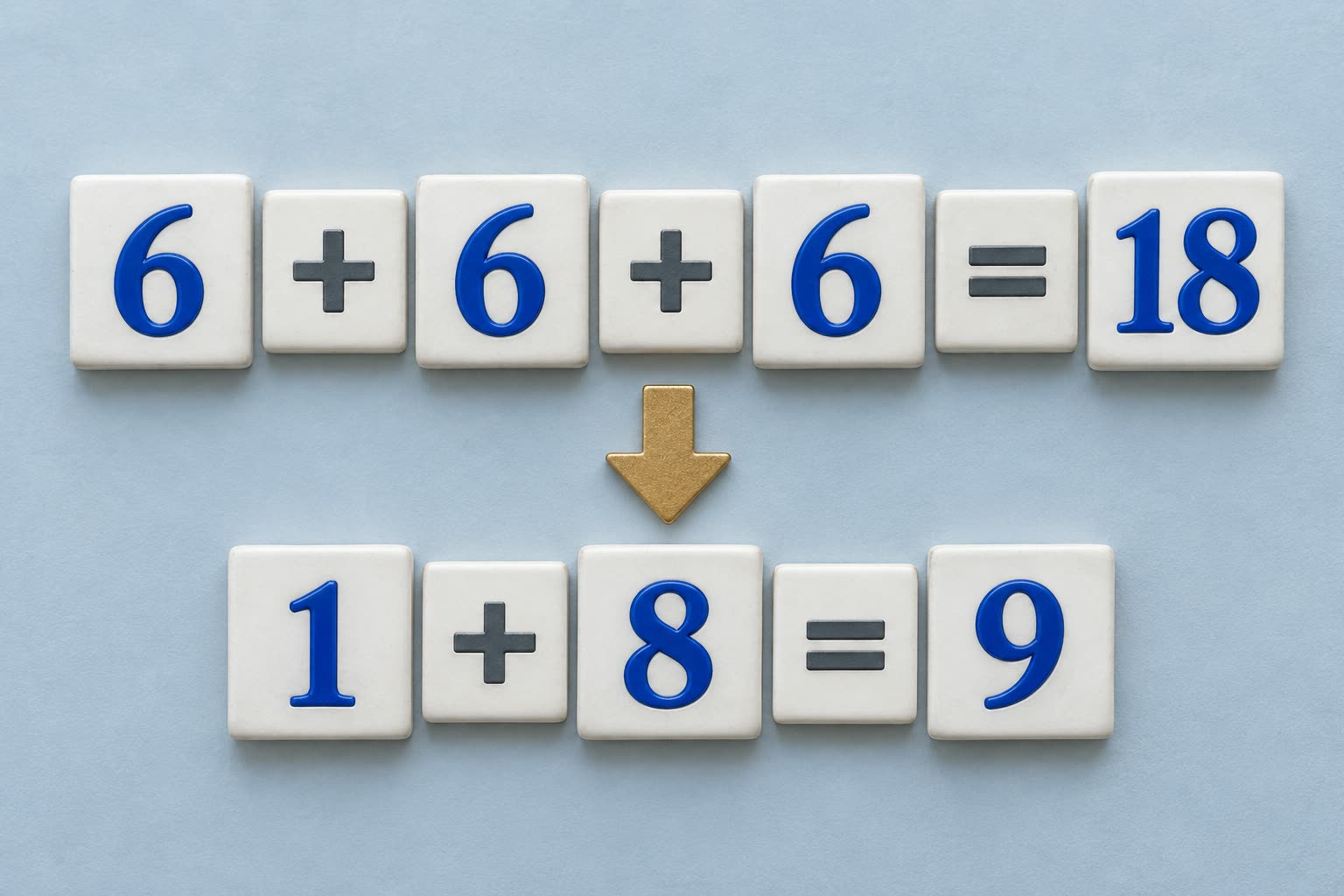
Modern numerology starts elsewhere. It reads 666 as the digit 6 three times, then adds 6 + 6 + 6 = 18 and 1 + 8 = 9.
In Hans Decoz's system, 6 is associated with care, home, fairness and responsibility for other people. His separate reading of 666 focuses on the point where concern starts to control other people's choices or leaves the carer with no room for their own needs.
Revelation requires a different method because Greek and Hebrew letters also served as numerals. A name could therefore be written as a sum, which is why the verse asks its readers to "calculate."
Quick Facts
- Digit sum
- 6 + 6 + 6 = 18, and 1 + 8 = 9
- Root digit
- 6: care, home and responsibility (Decoz)
- Numerology shadow
- Concern that turns into control (Decoz on 666)
- Revelation 13:18
- The number of the beast, "the number for a person"
- Main scholarly reading
- Nero Caesar spelled in Hebrew letters totals 666
- Early variant
- 616, in Papyrus 115 and Codex Ephraemi
- In Chinese slang
- Praise for a smooth, skilful move
What does 666 mean in numerology before the biblical reading?
In Western numerology, 6 is commonly treated as the caretaking number. Decoz calls it the motherhood and fatherhood number and associates it with roles such as teaching, healing, counseling and social work.
Decoz is equally specific about the weak side of 6: involvement can become "intrusive and meddling," while accommodation can leave someone acting as "a doormat." His essay on 666 condenses that problem as "control masquerading as concern."
Other modern interpretations put the same tension in gentler terms. Mindbodygreen connects 666 with overworking and overdoing, then frames balance as including one's own needs rather than treating service to others as endless.
The useful distinction is visible in who still gets to choose. A parent can support an adult child without making the child's decisions, a partner can carry more of the household without controlling every task, and a carer can set a limit without withdrawing care.
| Number | Digit sum | Final digit | How numerology frames it |
|---|---|---|---|
| 6 | 6 | 6 | Care and responsibility in plain form |
| 66 | 6 + 6 = 12 | 3 | Care that has to be talked about and shared |
| 666 | 6 + 6 + 6 = 18 | 9 | Care widened to strangers, or care that controls |
| 6666 | 6 + 6 + 6 + 6 = 24 | 6 | Care that circles back to the household |
Each sum lands on a different final digit, so 66 and 666 are not quieter and louder versions of one reading. Only 6666 returns to 6; 666 reaches 9, which changes the scope of the interpretation.
From three sixes to 18 and then 9: what the reduction changes
Adding the three digits gives 18, and adding 1 and 8 gives 9. In Decoz's system, 9 is the humanitarian number and "understands the connection between all people," so the reduction extends the 6's household care toward strangers, communities and causes.
Decoz also gives 9 a detached side that can become cold or apathetic toward other people's suffering. Read together, the controlling side of 6 and the detached side of 9 describe two different failures: deciding for everyone else, or withdrawing after taking on too much.
A Life Path 9 uses the same root digit for a different calculation based on a birth date. In 666, the 9 explains the internal arithmetic of the sequence; it does not set a lifespan for the interpretation or predict how long a situation will last.
What does Revelation 13:18 actually say?
Revelation 13:16-17 describes a second beast imposing a mark tied to buying and selling. The mark is linked to "the name of the beast or the number for its name," so the number is part of an identification puzzle rather than a free-standing omen.
Verse 18 supplies the method: a reader with understanding is to "calculate the number of the beast," because it is "the number for a person." Letters in Greek and Hebrew also served as numerals, so a person's name could be added up.
The verse gives no instruction about digits on receipts, page numbers or licence plates, and it does not describe 666 as a private message. Its question concerns the identity of the beast within John's vision.
The number also appears elsewhere in the Bible without carrying that role. First Kings 10:14 records 666 talents of gold reaching Solomon in one year, while Ezra 2:13 counts 666 descendants of Adonikam among the returning exiles.
How do Nero Caesar, 666 and the 616 variant fit together?
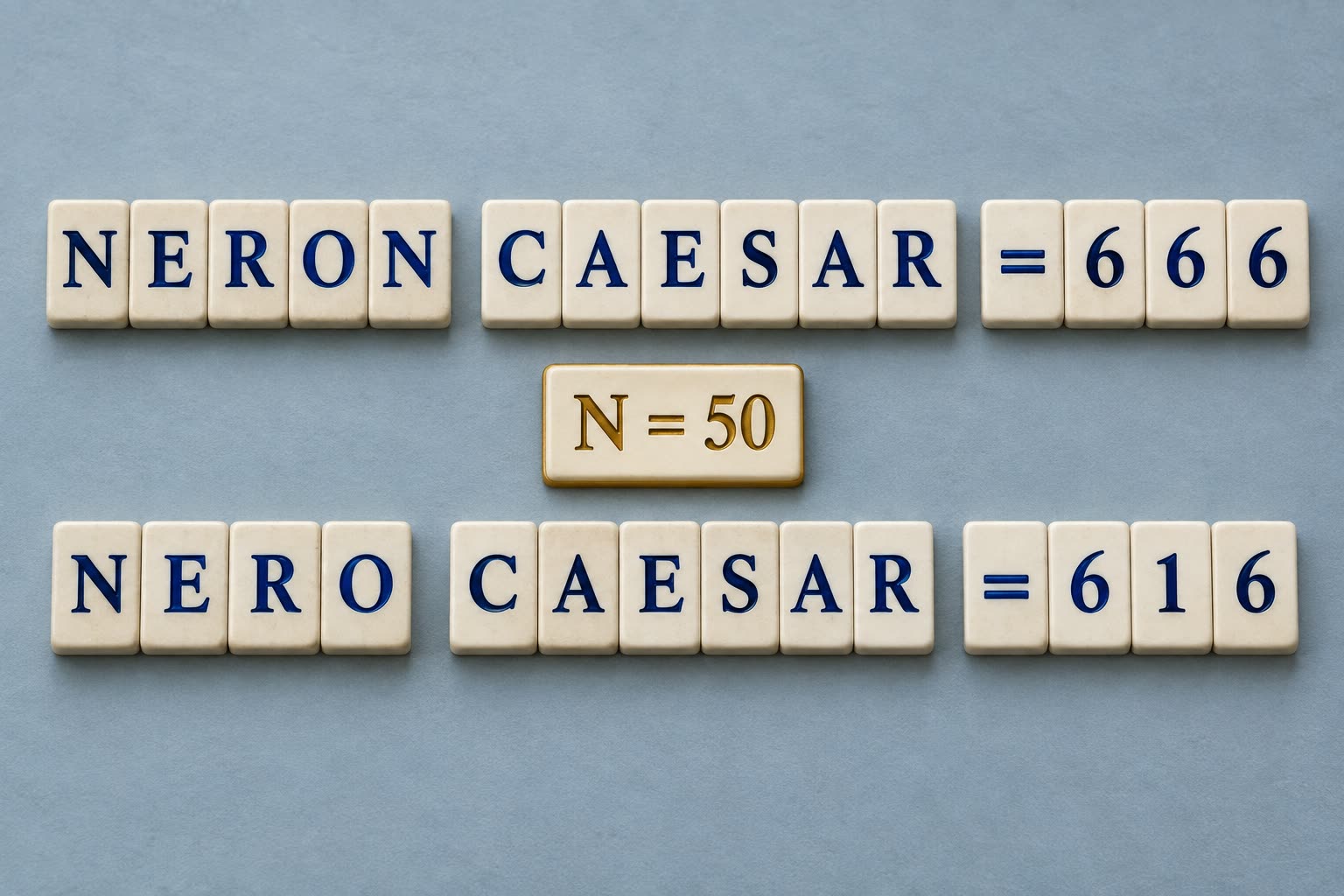
A leading historical solution spells the emperor's title in Hebrew letters as Nrwn Qsr, or "Neron Caesar." The letter values add to exactly 666.
| Hebrew letter | Letter name | Value |
|---|---|---|
| נ | Nun | 50 |
| ר | Resh | 200 |
| ו | Vav | 6 |
| ן | Final nun | 50 |
| ק | Qof | 100 |
| ס | Samekh | 60 |
| ר | Resh | 200 |
| Total | Nrwn Qsr | 666 |
That spelling is attested outside Revelation. In 1963, Delbert Hillers published an Aramaic document from Wadi Murabba'at, dated to "the second year of Emperor Nero," that writes the name in the form required by the calculation.
The 616 variant fits the same candidate. The NRSVUE footnote reports that some ancient authorities read 616, and that number appears in Papyrus 115 and Codex Ephraemi Rescriptus.
The Latin form Nero Caesar lacks the final n of the Greek Neron. Written in Hebrew without that final nun, the name loses 50 and totals 616, which is why the two manuscript readings can point to the same person.
Early readers did not agree on the answer. Irenaeus of Lyon, writing around 180, knew the 616 reading but held that 666 appeared in "the most approved and ancient copies" (Against Heresies 5.30.1).
Irenaeus tested Greek names including Evanthas, Lateinos and Teitan, yet declined to identify the beast. He considered it safer to wait for the prophecy's fulfilment, evidence that the Nero solution was not a settled answer among all early Christian readers.
Richard Bauckham adds a mathematical layer in The Climax of Prophecy (1993). Because 666 is the sum of 1 through 36 and 36 is the sum of 1 through 8, he connects this pattern with Revelation 17:11, where the beast is "an eighth" that "belongs to the seven."
The Nero reading remains an interpretation supported by the spelling, the 616 variant and the first-century setting. Other Christian readings treat the verse as still pointing forward, so the evidence supports a strong historical case without making that case the only possible theological reading.
Why does 666 feel threatening in one context and positive in another?
Neither interpretive system treats an ordinary sighting as bad luck. Revelation uses the number within a vision of hostile power, while modern numerology uses it to examine habits of care.
Fear of the number has still changed public behavior. Route 666 received its number in 1926 because it was the sixth branch of Route 66, but it later acquired the nickname "Devil's Highway" and became a frequent target for sign theft.
New Mexico's governor supported a renumbering, and the road became Route 491 in 2003. The original number came from the highway system; the threatening association was added by the culture around it.
In Mandarin online slang, 666 can carry the opposite tone. RADII traces its use as praise for a smooth or skilful move, especially in gaming communities.
The same digits can therefore read as praise in a Chinese chat and as a threat in an English-language religious context. The contrast shows that the emotional charge comes from a learned interpretive setting, not from the shape of the number itself.
Repeated sightings also have an ordinary cognitive explanation. Linguist Arnold Zwicky called it the frequency illusion: once something becomes noticeable, selective attention finds it more readily and confirmation bias remembers the hits more than the misses.
That does not prove every sighting is meaningless, but it explains why a charged number can suddenly appear to be everywhere. A $6.66 total or 666 in a phone number is easier to remember than a nearby number with no emotional association.
How does the care-control reading apply to love, twin flames and work?
Relationship readings of 666 follow the same line between care and control. Mindbodygreen connects the number with attending to one's own needs, while twin-flame readings often place the emphasis on emotional balance within each person rather than dependence on a partner.
Decoz's description of 6 makes the tension concrete: one partner can become meddling, while the other can become so accommodating that they are easy to take advantage of. The issue is not how much care exists, but whether both people retain choices, limits and responsibility.
- In a couple. The 666 question is who holds the household's decisions, money and calendar, and whether the other partner could take any of it over tomorrow.
- In a family. An adult child still managed like a teenager, or an ageing parent whose choices are made for them, is the meddling pattern Decoz describes.
- After a breakup. Looking for someone new to look after repeats the 6 habit; the 9 in the reduction points toward friends and community before another partner.
- At work. Nursing, teaching, social work and counseling are 6 territory in Decoz's list, and 666 in those jobs is usually read as a question about workload and limits rather than a push to give more.
None of these examples turns 666 into a forecast. The numerology does not predict income, a new relationship or a job change; it supplies language for examining who chooses, who carries the work and whether care flows in both directions.
Why might 666 keep appearing, and what can a two-week log show?
A clock cannot display 6:66, so most sightings come from totals, prices, page numbers and licence plates. A dated log can show which settings produce the pattern and whether sightings cluster around one routine, but it cannot establish that the number caused an event or carried a message.
A two-week care inventory
For repeated 666 sightings that arrive during a stretched season at home or work.
- Log the sighting
- Input
- Each time 666 appears
- Action
- Note where it was and what you were doing or worrying about
- Result
- A record of context instead of one charged moment
- List who you look after
- Input
- Family, partner, work, friends
- Action
- Write each person or duty and what you do for them in a typical week
- Result
- The full scope of your 6 work
- Mark the direction
- Input
- Each item on the list
- Action
- Mark whether care flows both ways, mostly from you, or mostly to you
- Result
- One-sided arrangements become visible
- Find the control point
- Input
- The most one-sided item
- Action
- Ask whether you are doing it for the other person or deciding for them
- Result
- The care-or-control question applied to one real case
- Change one thing
- Input
- That same item
- Action
- Hand back one decision or task, or set one limit, for two weeks
- Result
- A test of whether the arrangement can bend
The log has a modest purpose: it separates the contexts in which 666 appears from the meaning later assigned to it. When the main issue is fear, Revelation's name calculation and the 616 variant provide firmer context than treating the sighting itself as evidence.
Frequently Asked Questions
Is 666 the number of the devil?
Revelation 13:18 calls 666 the number of the beast, a figure the book keeps separate from the dragon it identifies as the devil and Satan (Revelation 12:9; 13:2). Most scholars read the beast's number as Nero Caesar written in Hebrew letters.
Where does 666 appear in the Bible?
Revelation 13:18 is the verse behind the number's reputation. 666 also appears as Solomon's yearly income in talents of gold (1 Kings 10:14; 2 Chronicles 9:13) and as the count of Adonikam's descendants (Ezra 2:13), with no negative meaning.
Why do both 666 and 616 point to Nero Caesar?
Neron Caesar written in Hebrew includes a final nun worth 50 and totals 666. The Latin form Nero Caesar omits that sound; written without the nun, the same name totals 616, matching the early variant in Papyrus 115 and Codex Ephraemi.
Why does 666 reduce through 18 to 9 rather than back to 6?
The first sum is 6 + 6 + 6 = 18, and the second is 1 + 8 = 9. In Decoz's numerology, that 9 widens the 6's household focus toward communities and causes; only 6666 totals 24 and reduces back to 6.
What does 666 mean in Chinese?
In Mandarin, 6 sounds like the word for smooth, so 666 is online praise for something done well. The usage began among gamers and carries none of the Western fear.
Sources
- (2021). Revelation 13:16-18 (New Revised Standard Version Updated Edition), with the 616 footnote. Bible Gateway. Link
- (2021). 1 Kings 10:14; Ezra 2:13; 2 Chronicles 9:13; Revelation 12:9; 13:1-2 (NRSVUE). Bible Gateway. Link
- (2021). Revelation 17:9-11 (NRSVUE). Bible Gateway. Link
- (c. 180). Against Heresies, Book 5, chapter 30. New Advent (Ante-Nicene Fathers translation). Link
- (1963). Revelation 13:18 and a Scroll from Murabba'at. Bulletin of the American Schools of Oriental Research 170, p. 65. Link
- (1993). The Climax of Prophecy: Studies on the Book of Revelation. T&T Clark, pp. 390-394
- (2026). Papyrus 115 (P.Oxy. LXVI 4499). Wikipedia. Link
- (2020). The Meaning of 666 in Numerology. World Numerology. Link
- . Numerology Meaning of number 6. World Numerology. Link
- . Numerology Meaning of number 9. World Numerology. Link
- . 666 Angel Number: The Different Meanings In Numerology. mindbodygreen. Link
- (2019). Watch: In China, 666 Has Nothing to Do With the Devil. RADII. Link
- (2026). U.S. Route 491. Wikipedia. Link
- (2026). Frequency illusion. Wikipedia. Link
About Our Editorial Process
Every KnowTheAngels guide separates calculation method, tradition context, and personal reflection. We cite where interpretations come from, present more than one view, and never present symbolic reading as prediction.
Read our editorial policy