What Does Angel Number 6 Mean for Home and Responsibility?
The care-and-home digit of numerology, the first perfect number of Greek arithmetic, the sixth day of Genesis, and the larger numbers that reduce to 6
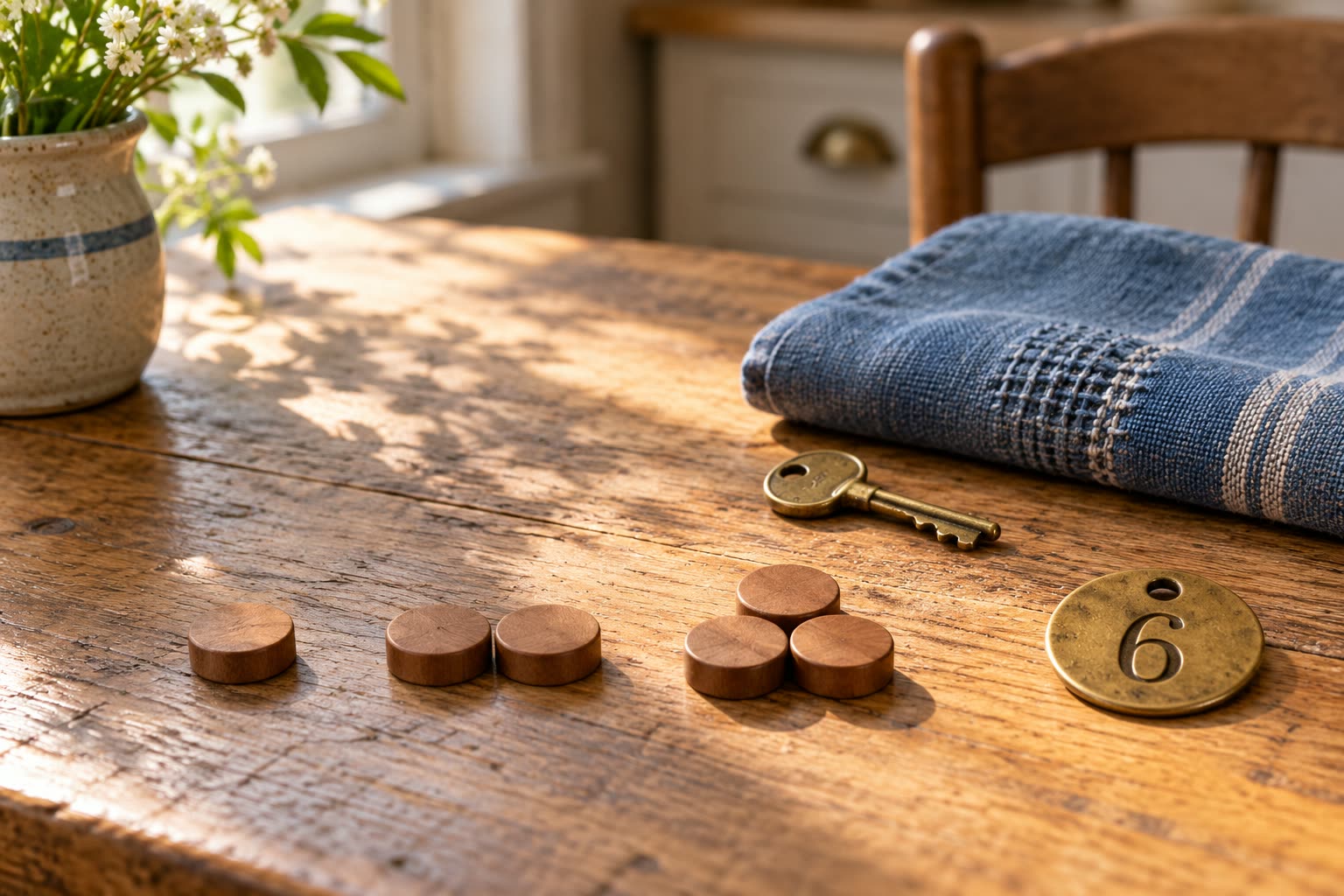
Angel number 6 is the root digit behind the care-and-home readings of every larger number that reduces to it. In Western numerology, Hans Decoz describes the 6 as loving, fair-minded and "highly responsible," the person who shows up and does more than a fair share, and Numerology.com calls it "the embodiment of the heart."
Angel-number writers apply those traits to a number that keeps appearing. Joanne Walmsley's 2011 entry on angel number 6 lists home and family, parenthood, service and responsibility, and she pairs them with a balance between material concerns and spiritual trust.
The number's older reputation comes from arithmetic. Six equals the sum of the numbers that divide it (1, 2 and 3), which made it the first perfect number for Greek mathematicians and gave Jewish and Christian writers a reason to read the six days of creation as a complete work.
Quick Facts
- Numerology theme
- Care, home, fairness and responsibility (Decoz; Numerology.com)
- Shadow side
- Meddling, self-righteousness, or becoming a doormat (Decoz)
- Why 6 is a perfect number
- 1 + 2 + 3 = 6, and 1 × 2 × 3 = 6
- Planet and tarot
- Venus in Cheiro's system; The Lovers, card VI
- 6 in the Bible
- Humans made on the sixth day (Genesis 1:26-31); six days of work (Exodus 20:9)
- Numbers that reduce to 6
- 15, 24, 33, 42, 51, 123, 222, 1212 and 6666
- In Chinese
- Liù sounds like the word for smooth, so 6 counts as lucky
Care, home and fairness: how numerology and Cheiro read the digit 6
Modern Western numerology gives 6 a domestic profile. Decoz nicknames it the motherhood and fatherhood number, puts home, family and friends at the top of its priorities, and credits it with "a keen sense of what is fair and just."
The care he describes is practical: protecting, healing, teaching and settling disputes as much as comforting.
Another system ties 6 to beauty and attraction. Cheiro's Book of Numbers (1926), an early source for what is now called Chaldean numerology, assigns 6 to Venus.
Numerology.com links the number to the Venus-ruled signs Taurus and Libra and to The Lovers, card VI of the tarot's major arcana. These lineages explain why some readings lean toward romance while others lean toward chores and caregiving.
| Source | What 6 stands for | Where the emphasis falls |
|---|---|---|
| Hans Decoz, World Numerology | Love, responsibility, fairness, home | Practical care, and its failure as meddling |
| Numerology.com | Unconditional love, support, healing | Self-sacrifice and passivity as weak points |
| Cheiro, Book of Numbers (1926) | The planet Venus | Charm, beauty and attraction |
| Tarot major arcana | Card VI, The Lovers | Desire and devotion (Numerology.com) |
| Joanne Walmsley, Sacred Scribes (2011) | Home, family, service, responsibility | Material concerns balanced with spiritual trust |
| Chinese number lore | Liù, heard as "smooth"; in Cantonese, close to "fortune" | Luck in business and plans |
The sources agree on care and disagree about its cost. Numerology.com lists "self-sacrificing" among the 6's weaknesses, Decoz warns that a 6 can become "a doormat", and Walmsley pairs the same caring traits with worry about money.
A Life Path 6, calculated once from a birth date, describes that pattern as a lifelong temperament. A repeated 6 is read more narrowly, as a question about the period in which it keeps appearing.
Why is 6 the first perfect number, and why did Philo and Augustine care?
A perfect number equals the sum of its proper divisors. Euclid defined the idea in Book VII of the Elements, and 6 is the smallest case: 1, 2 and 3 divide it and add up to it.
The same three divisors also multiply to 6, so 1 + 2 + 3 and 1 × 2 × 3 both produce the number.
Perfect numbers are rare. Nicomachus of Gerasa, writing around 100 CE, knew only four (6, 28, 496 and 8,128) and noted that each order of magnitude, from units to thousands, held exactly one of them.
Religious writers turned the arithmetic into an argument about creation. Philo of Alexandria, in On the Creation (first century CE), said the world was made in six days because six is the first perfect number, equal to its half (3), its third (2) and its sixth (1).
He also noted that 6 joins the first odd number and the first even number by multiplication.
Augustine repeated the argument in the early fifth century. In The City of God (Book XI, chapter 30) he wrote that the works of creation were recorded as completed in six days because six is a perfect number, and that the number signified the perfection of the work, not a God who needed time.
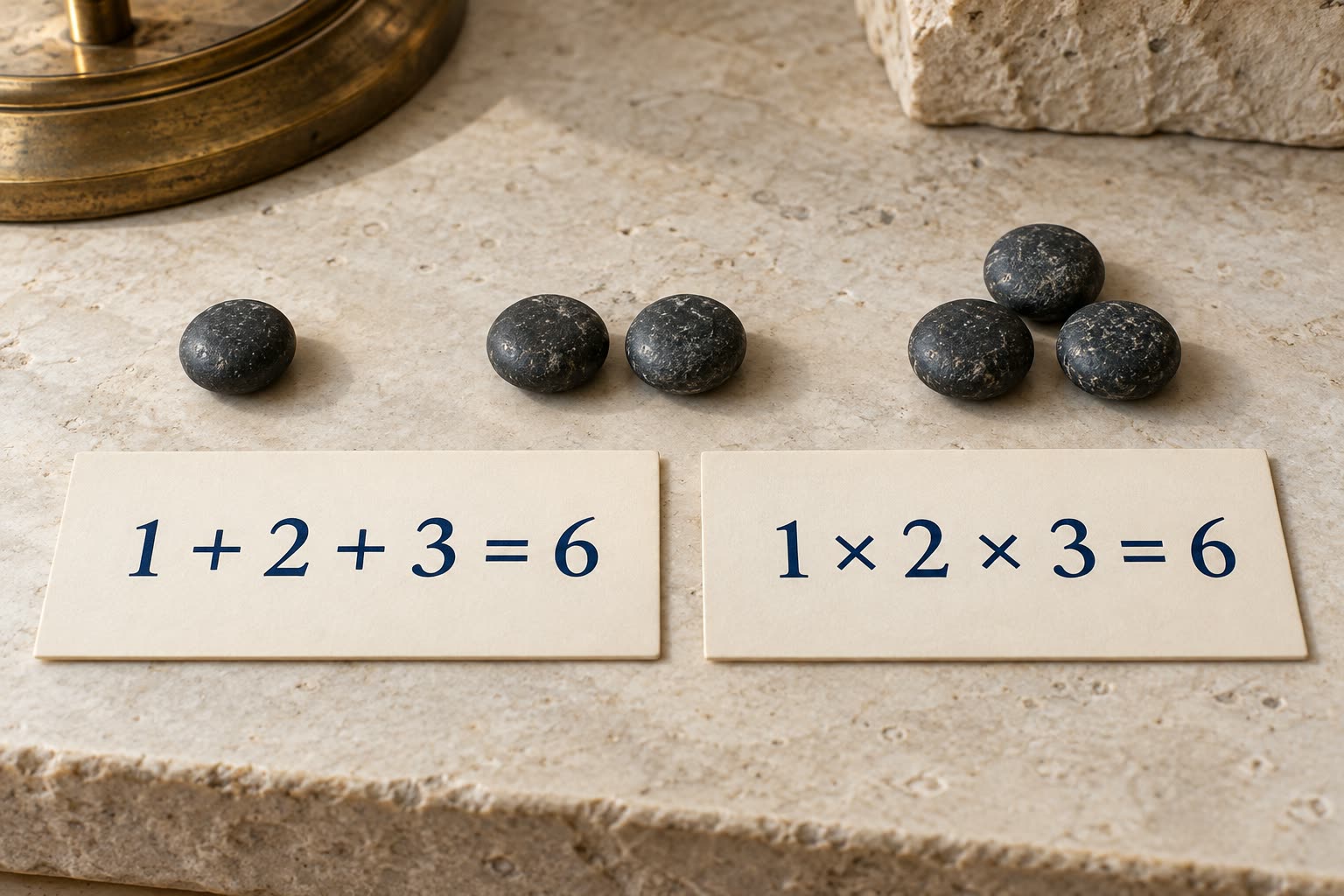
Much of the later talk of 6 as completeness and balance draws on this history, and angel-number writers still start there: Blair Andrews's entry on angel number 6 at Numerologist.com opens with the perfect-number arithmetic. The arithmetic itself makes no claim about a person's home life; the meaning was added by the writers who read it into Genesis.
Biblical sixes are counts; Bullinger supplies the symbolism
No verse assigns 6 a symbolic meaning, but two passages shape how Christian commentators read it. Genesis 1:26-31 places the creation of human beings on the sixth day, and the Sabbath commandment in Exodus 20:9-11 gives six days to labour before a seventh day of rest.
E. W. Bullinger, the Anglican clergyman who wrote Number in Scripture, built his reading of 6 on both passages: six is "the number of man," he wrote, because humans were created on the sixth day and given six days for their work. For Bullinger, 6 falls one short of 7, the number of completion and rest, so it marks human effort and imperfection.
Bullinger's reading pulls against the other two. Numerologists read the same digit as care and harmony, while Philo and Augustine took the sixth day as a sign of perfection.
All three are interpretations laid over Genesis, which states the order of the days without assigning 6 a universal symbolic meaning.
The Bible's best-known six is the triple one. Revelation 13:18 gives 666 as the number of the beast and asks readers to calculate a person's name, which most scholars take to be Nero Caesar; the verse concerns 666 only and says nothing about a single 6.
Which numbers reduce to 6, including master number 33?
Many multi-digit numbers reduce to 6, but a shared root does not make them interchangeable. The table records arithmetic and system handling only; any interpretation of the visible digits needs its own cited source.
| Number | Reduction | Numerology handling |
|---|---|---|
| 15 | 1 + 5 = 6 | A one-step reduction to the single-digit root 6 |
| 24 | 2 + 4 = 6 | A one-step reduction to the single-digit root 6 |
| 33 | 3 + 3 = 6, kept as a master number | Often retained as master number 33 before its root 6 is considered |
| 42 | 4 + 2 = 6 | A one-step reduction to the single-digit root 6 |
| 51 | 5 + 1 = 6 | A one-step reduction to the single-digit root 6 |
| 123 | 1 + 2 + 3 = 6 | Its digits are also the three proper divisors of 6 |
| 222 | 2 + 2 + 2 = 6 | Three repeated 2s total 6 |
| 1212 | 1 + 2 + 1 + 2 = 6 | Alternating 1 and 2 still totals 6 |
| 6666 | 6 + 6 + 6 + 6 = 24, 2 + 4 = 6 | A two-step reduction through 24 |
The arithmetic includes direct reductions and layered cases. The number 123 reaches 6 in one step and happens to use 1, 2 and 3, the three proper divisors that define 6 as perfect.
The sequence 6666 first totals 24 and only then reaches 6, so its visible repetition and final root are separate facts.
Decoz treats 33 as an exception to reduction. He counts 11, 22 and 33 as master numbers that stay intact, and he describes master number 33 as "a double whammy of the creative, free-spirited 3, but dominated by the loving, responsible, caring 6," calling it the Master Teacher and the rarest of the three in a chart.
Runs of the digit itself do not all come back to 6: 66 reduces through 12 to 3, and 666 through 18 to 9. That cycle belongs to the repeated-sixes family as a whole, where each length has its own final digit.
Why is the shadow of 6 hard to name? Help that becomes control or self-erasure
The shadow of 6 is hard to name because each failure looks like a virtue from outside. Decoz describes two opposite versions.
One 6 becomes so involved in loved ones' lives that concern turns "intrusive and meddling", and it can grow "smug" or "annoyingly self-righteous". The other gives way so easily that it becomes a doormat.
Numerology.com names the quieter form as "passive" and "self-sacrificing", a 6 whose own needs never reach the list.
- At home. The meddling form manages an adult child's appointments or a partner's diet; the self-sacrificing form cooks, cleans and remembers every birthday and is never asked what it needs.
- Among friends. The 6 becomes the fixer everyone calls first, and over time the calls stop running in both directions.
- At work. A teacher or nurse stays late every week, and the extra hours go unrecorded because they look like dedication.
Read through Decoz's description, the healthy 6 is the one whose care includes the carer and leaves other people their own decisions. The same traits produce both versions, which is why a person living the shadow usually describes it as simply being responsible.
Venus or the household chores? Angel number 6 in love, twin flames and work
In love readings, the Venus and Lovers associations make 6 a number of attraction and devotion, while Decoz's household 6 makes it a number of shared chores and fairness. Modern angel-number writers combine the two: Andrews reads 6 in a relationship as a question of whether a person gives from fullness or from obligation.
None of the numerology or angel-number sources cited here treats 6 as a sign of a coming partner or a reunion. In twin flame readings the number is applied to the everyday side of a bond: who keeps the home running, and whether one person has disappeared into looking after the other.
For work, Decoz lists teaching, healing, counseling, construction, the legal field and law enforcement as 6 careers. Each involves responsibility for people or property on someone else's behalf.
Walmsley's 2010 entry adds money by asking readers to balance material worries with spiritual trust. Neither source predicts a raise, job offer or cleared debt; both describe how a person handles responsibility.
A one-week care ledger tests why 6 keeps standing out
A single 6 is one of ten digits, so it can recur across the prices, times and phone numbers a person sees in a day. Noticing it more often once it carries meaning has a name: the frequency illusion, coined by the Stanford linguist Arnold Zwicky in 2005, in which selective attention picks out the charged item and memory keeps the hits while dropping the misses.
A week of notes separates that effect from a pattern tied to real circumstances. The steps below use the questions the 6 is traditionally associated with: who is looked after, by whom, and at what cost.
- Record each sighting. Write where the 6 appeared and what you were doing or worrying about at the time.
- List who you look after. Include family, partner, colleagues and friends, with what you do for each in a typical week.
- Mark the direction. Next to each name, note whether care flows both ways or mostly from you.
- Keep money worries separate. Bills and financial stress go on their own line, so a worry about money is not mistaken for a problem of care.
- Change one arrangement. Hand back one task, ask for one kind of help, or step back from one decision that belongs to someone else.

If the log shows no link between the sightings and anything you are carrying, the frequency illusion is the simpler explanation, and the number needs no further reading.
Frequently Asked Questions
Is the luck attached to 6 Chinese or numerological?
In Chinese number lore it is: 六 (liù) sounds like the Mandarin word for smooth, and in Cantonese it sounds close to the words for fortune and happiness, so 6 is considered good for business. Western numerology does not rank digits as lucky or unlucky; it reads 6 as care and responsibility.
What tarot card is number 6?
The Lovers, card VI of the major arcana. Numerology.com pairs it with the Venus-ruled signs Taurus and Libra, which it calls symbols of desire and devotion.
Where does the "number of man" label for 6 come from?
The label comes from E. W. Bullinger's Number in Scripture, not from a verse. He based it on the creation of humans on the sixth day (Genesis 1:26-31) and the six days of work in Exodus 20:9.
Why does 66 not reduce back to 6?
A single 6 is already a root digit, while 66 adds to 12 and then reduces to 3. That arithmetic does not by itself give 66 a meaning; an interpretation of the repeated form needs a source specific to 66.
Does angel number 6 mean love is coming?
None of the numerology or angel-number sources cited on this page treats 6 as a forecast of a new relationship. The Venus association links 6 to attraction, but readings apply it to how care is shared in the relationships a person already has.
Sources
- . Numerology Meaning of number 6. World Numerology. Link
- . Master Numbers 11, 22 and 33. World Numerology. Link
- . Number 6 Meaning in Numerology. Numerology.com. Link
- (1926). Cheiro's Book of Numbers, chapter on the number 6 (Venus). Open Library record. Link
- (2011). Angel Number 6. Sacred Scribes. Link
- (2010). Angel Numbers - Number Sequences - Repeating 6's 6 66 666 6666. Sacred Scribes. Link
- (2026). 6 Angel Number Meaning: The Center of Everything That Matters. Numerologist.com. Link
- (c. 300 BCE). Elements, Book VII, Definition 22 (perfect number). Clark University. Link
- (2026). Perfect number (history: Nicomachus, Philo, Augustine). Wikipedia. Link
- (1st century CE). On the Creation, section III (13-14). Early Jewish Writings. Link
- (c. 417). The City of God, Book XI, chapter 30. Christian Classics Ethereal Library (NPNF1-02). Link
- (2021). Genesis 1:26-31; Exodus 20:9-11 (NRSVUE). Bible Gateway. Link
- (2026). Number of the beast (Nero Caesar interpretation). Wikipedia. Link
- . Number in Scripture: Its Supernatural Design and Spiritual Significance, "Six". Levend Water. Link
- (2026). Numbers in Chinese culture (six). Wikipedia. Link
- (2026). Frequency illusion. Wikipedia. Link
- . Selective attention. APA Dictionary of Psychology. Link
About Our Editorial Process
Every KnowTheAngels guide separates calculation method, tradition context, and personal reflection. We cite where interpretations come from, present more than one view, and never present symbolic reading as prediction.
Read our editorial policy