What Does Angel Number 8 Mean for Authority and Abundance?
The single digit behind every run of eights: Decoz's karmic equalizer, Cheiro's Saturn number, the Chinese word for prosper and the Christian eighth day
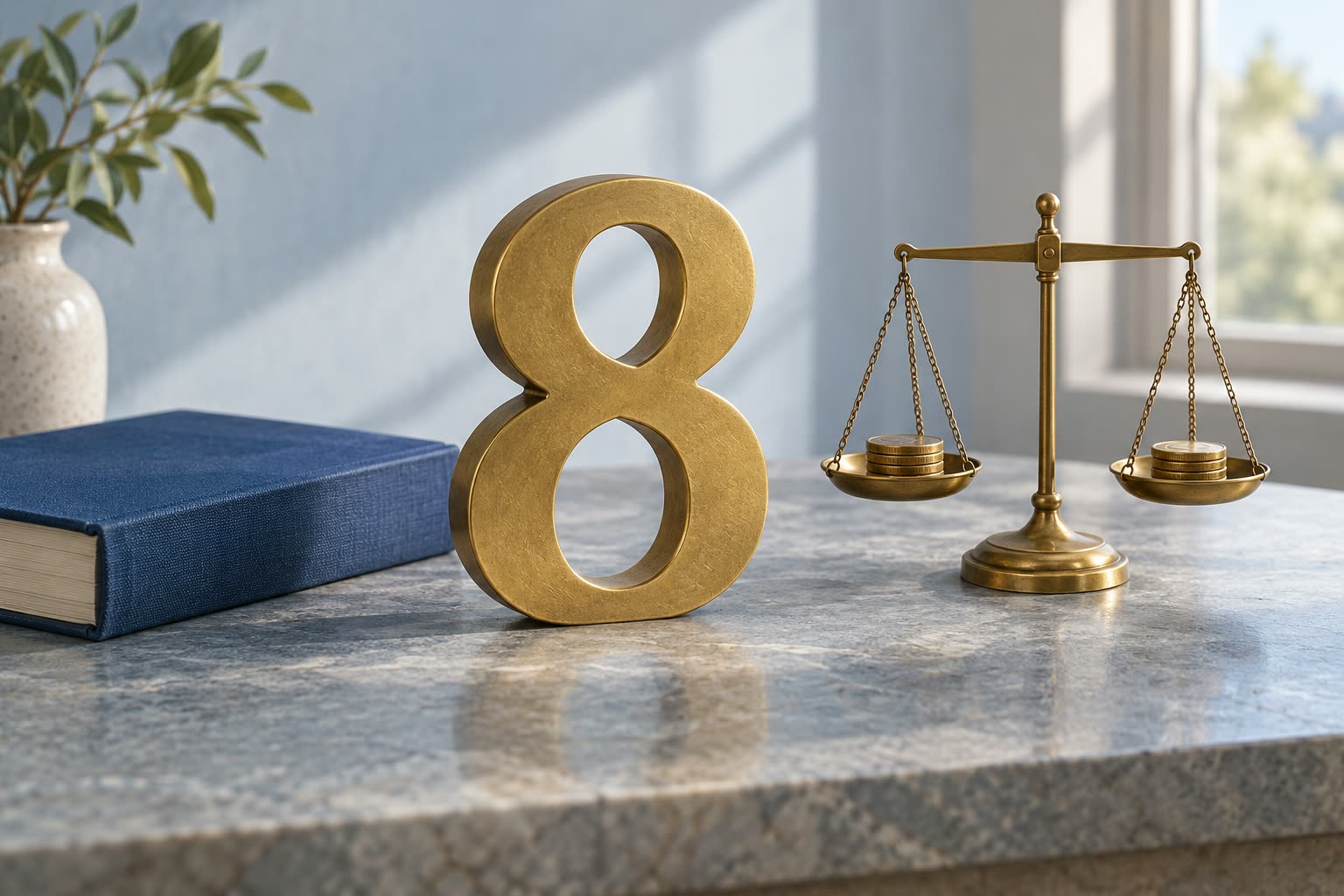
Angel number 8 has the firmest money reputation of any single digit, and the sources behind it agree less than that reputation suggests. Joanne Walmsley, who publishes angel-number meanings on her Sacred Scribes blog, wrote in 2010 that a sighting of 8 means financial and material abundance is on its way, brought about by past work.
The numerologist Hans Decoz calls 8 perhaps the most misunderstood of the single digits because "novices and numerology professionals alike" fix on its "money and power" image.
The older layers pull in other directions. Cheiro's Book of Numbers (1926) gave 8 to Saturn, the planet of fate, and said that from a worldly standpoint it was not a fortunate number to be born under.
The luck of 8 is Chinese: the word for eight, ba, sounds like fa, "to prosper". Early Christian writers counted a different way, treating the day after the seven-day week as the eighth day, the day of resurrection.
Each source gives 8 a different job, and a reading that blends them promises more than any one of them does.
Quick Facts
- Reduction
- None: 8 is already a single digit
- Decoz (World Numerology)
- Balance of material and spiritual; the karmic equalizer
- Cheiro (1926)
- Saturn, fate, "human justice"; 8 = 4 + 4
- Chinese association
- Ba (eight) sounds like fa (to prosper)
- Christian association
- The eighth day of resurrection (Barnabas 15; Justin, Dialogue 138)
- Numbers that reduce to 8
- 17, 26, 35, 44, 53, 62, 71, 80, 89
Eight's money reputation rests on return, not a windfall
The money reading has a documented source. In her 2011 post on angel number 8, Walmsley lists authority, personal power, executive ability, money, finances and manifesting wealth among its vibrations, and she calls 8 "the number of Karma", the law of cause and effect.
Even in that reading the reward is tied to what came before: her abundance arrives for people who "have worked diligently and intelligently" toward their goals.
Decoz starts from the shape. He writes that the form of each digit reflects its main attribute and that for 8 the attribute is balance between the material and spiritual worlds.
He calls 8 the great karmic equalizer, "a force that creates just as efficiently as it destroys", and puts the consequence bluntly: when the 8 comes knocking, "you will reap what you've sown". A balanced 8 in his description treats money as a tool rather than an end and is generous with it; an unbalanced one shows frustration, greed and intolerance.
The Numerology.com entry for 8 makes the same trade in plainer words. Its 8 is the achiever that measures life by the goals it reaches, with a symmetrical shape that stands for balance: "For every blessing it receives, it puts one back out to the universe."
Its list of 8 traits includes both prosperous and materialistic.
| Source | Date | What 8 stands for | What it says about money |
|---|---|---|---|
| Cheiro, Cheiro's Book of Numbers | 1926 | Saturn, fate, two worlds touching | Great success or great failure, rarely in between |
| Joanne Walmsley, Sacred Scribes | 2010, 2011 | Authority, karma, abundance | Abundance on its way as a result of past effort |
| Hans Decoz, World Numerology | Undated web text | Balance, the karmic equalizer | A tool, not an end; you reap what you sowed |
| Numerology.com | Undated web text | The achiever, balance of give and take | Success that gives some of itself back |
Three of the four sources share one structure: 8 connects what a person sends out with what comes back. That is why a balance reading can point at a debt as easily as a gain, and why the same digit can describe a good result or a bad one.
The popular money reading keeps only the gain.
Is 8 a lucky number? Chinese custom and Cheiro disagree
In Chinese culture, 8 is lucky because of a sound. Eight (八, ba) sounds like 發 (fa), "to prosper", and the association is public and commercial.
The Beijing Summer Olympics opened on the evening of 8 August 2008, a date tied to the auspicious 8. In 2003, Sichuan Airlines paid CN¥2.33 million for a telephone number ending in eight eights.
The same custom often treats 4 as unlucky because, especially in Cantonese, it sounds almost like the word for death.
Cheiro's Chaldean system turns this upside down. He wrote that 8 represents two worlds, the material and the spiritual, drawn like two circles just touching, and that it is made of two equal halves, 4 and 4.
He tied it to Saturn, "the Planet of Fate", and described people ruled by 8 as "much misunderstood" and "intensely lonely at heart". He also advised them to live under a name number that avoided 8 altogether.
In his scheme the number 4 is the other fatalistic number, so he and Chinese custom agree that 4 is heavy and disagree completely about 8.
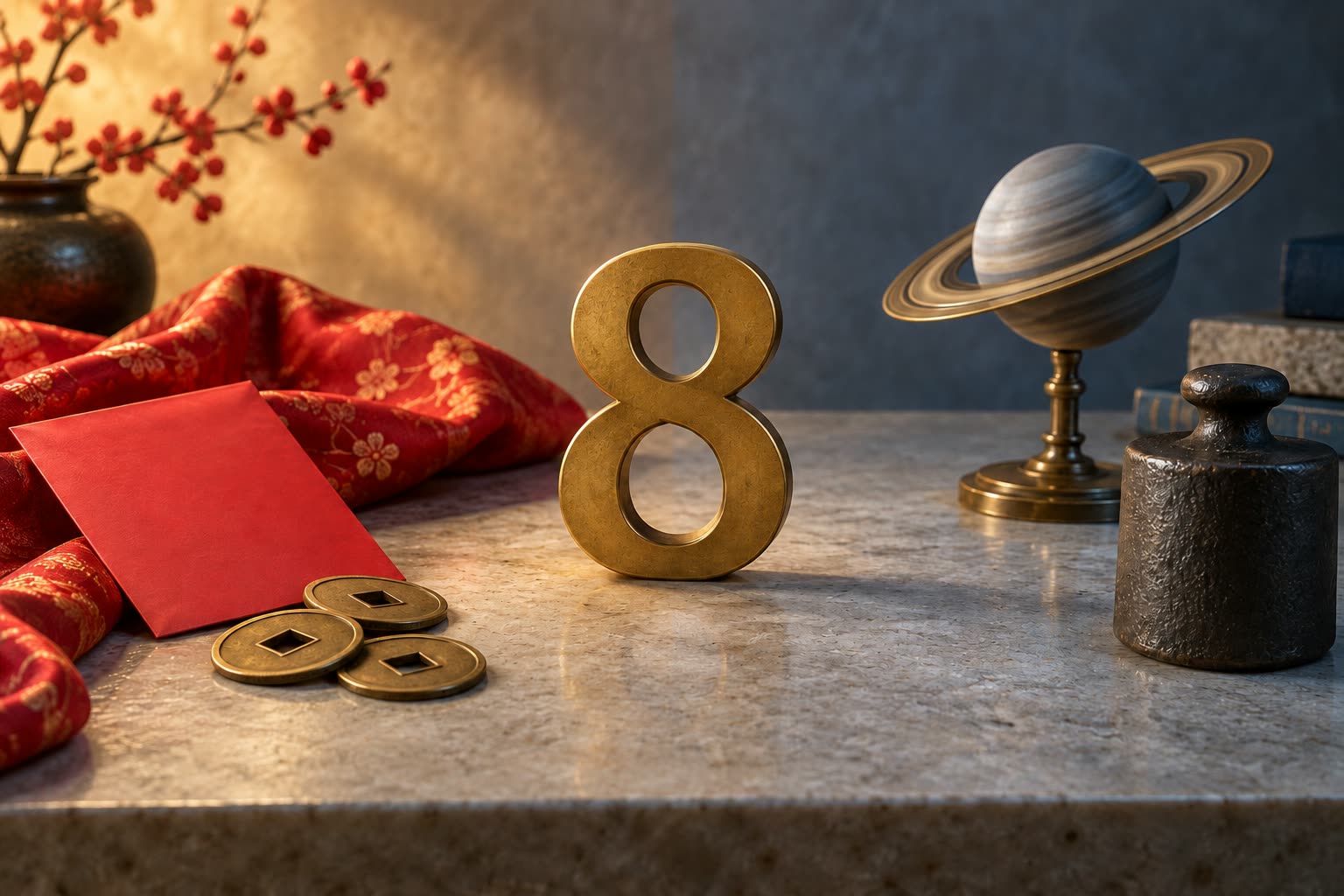
The difference decides what a reader is being told. The Chinese reading is a wish for prosperity attached to a word, with no condition on it.
Cheiro's reading, which comes down through Chaldean numerology, is a warning about extremes: his 8 people rise high or fall hard and "there appears to be no happy medium in their case". Online meanings that call 8 lucky are drawing on the first tradition, even when they borrow the vocabulary of the second.
The infinity sign, or lemniscate, is a later visual analogy for 8
The resemblance is visual, and it came later than the digit. The English mathematician John Wallis introduced the symbol ∞ for infinity in 1655 in De sectionibus conicis, and he did not say where he took it from.
Proposed origins include a Roman form of the numeral for 1,000 or the Greek letter omega. The symbol is also called a lemniscate, after curves of the same shape studied in geometry, and in livestock branding it is the lazy eight.
Modern readers who describe 8 as infinity turned upright are therefore reading a meaning into a likeness. The two older numerological descriptions of the shape say something else: Decoz sees balance in it, and Cheiro sees two worlds meeting at a single point.
Tarot adds a second complication. In the Rider-Waite-Smith deck of 1909, the Strength card is numbered VIII and shows the infinity sign over the head of a woman closing a lion's mouth.
That number is Arthur Edward Waite's choice. In The Pictorial Key to the Tarot, he wrote that Strength "has been interchanged with that of justice, which is usually numbered eight", a swap that followed the astrological order of the Hermetic Order of the Golden Dawn.
In the traditional order, as in the Tarot de Marseille, card VIII is Justice, which sits closer to Cheiro, who called 8 the "symbol of human justice". Which card a reader attaches to 8 depends on the deck, and so does whether the lemniscate belongs in the reading at all.
Biblical eights are counts; the eighth day supplies the meaning
The Bible records eights without explaining them. Genesis 17:12 sets circumcision on the eighth day after birth, while Leviticus 23:36 adds an eighth day of holy assembly to the seven days of the Feast of Tabernacles.
The flood narrative, as 1 Peter 3:20 counts it, saved eight people, and 2 Peter 2:5 calls Noah "the eighth person" in the King James wording. None of these passages says what the number means.
The meaning comes from early Christian readers. The Epistle of Barnabas, usually dated to the early second century, has God speak of "a beginning of the eighth day, that is, a beginning of another world", and explains that Christians keep the eighth day "with joyfulness, the day also on which Jesus rose again from the dead".
The logic is calendrical: Sunday, the first day of the new week, is also the day after the seventh. Justin Martyr, writing around 160, made Noah's household part of the pattern: the eight people in the ark "were a symbol of the eighth day, wherein Christ appeared when He rose from the dead" (Dialogue with Trypho 138).
The idea was later built in stone. An inscription attributed to Ambrose, bishop of Milan from 374 to 397, explains that the city's baptistery had eight walls and an eight-sided font because salvation came through the light of the risen Christ.
The eight-sided plan recurs in later baptisteries. E. W. Bullinger's Number in Scripture (1894) gathered these threads into a rule of thumb, 8 as 7 plus 1, the number of resurrection and regeneration.
This layer has nothing to do with money. A Christian reading of 8 as the new beginning after a completed week is an interpretation of biblical counts, not a meaning the text assigns.
The better-known Christian number of the family is the letter sum of Jesus's Greek name, which belongs to the triple 888 and not to the single digit.
Seventeen through 89 reduce to 8, but repeated eights do not
A single digit has no reduction path of its own, so the arithmetic that matters for 8 is which larger numbers end on it. Every two-digit number whose digits add to 8 reduces to it directly, and 89 gets there in two steps (8 + 9 = 17, then 1 + 7 = 8).
Cheiro used the same rule for birthdays: anyone born on the 8th, 17th or 26th of a month counted as a number 8 person in his system.
| Number | Reduction | Arithmetic note |
|---|---|---|
| 17 | 1 + 7 = 8 | Direct digit sum |
| 26 | 2 + 6 = 8 | Direct digit sum |
| 35 | 3 + 5 = 8 | Direct digit sum |
| 44 | 4 + 4 = 8 | Repeated digits with the same sum |
| 53 | 5 + 3 = 8 | Reverse of 35, with the same sum |
| 62 | 6 + 2 = 8 | Reverse of 26, with the same sum |
| 71 | 7 + 1 = 8 | Reverse of 17, with the same sum |
| 80 | 8 + 0 = 8 | Zero does not change the sum |
| 89 | 8 + 9 = 17, 1 + 7 = 8 | Two-step reduction |
The table shows arithmetic only. A shared root does not make angel number 17 and 26 interchangeable, because the sum alone does not establish a meaning for digit order.
The repeated 4s in angel number 44 require their own source history and sequence evidence before they carry an interpretation beyond the root 8.
Repeated eights do not reduce to 8 at all. Two eights add to 16 and reduce to 7, three add to 24 and reduce to 6, and four add to 32 and reduce to 5; the eights family sets those endings side by side.
A birth date that reduces to 8 is another calculation again, the life path 8, which describes a person rather than a sighting.
Angel number 8 in love: resources and authority raise different questions
None of the numerology sources cited here gives 8 a romantic or twin-flame meaning. What they give it is a theory of exchange, and in a relationship exchange is visible in money, time and decisions.
Decoz's balanced 8 is generous with resources and his unbalanced 8 is greedy and intolerant, so an 8 reading of a couple asks which description matches the way the two people share what they have.
Cheiro adds a portrait of temperament. His 8 people "often appear cold and undemonstrative", though he credits them with warm hearts toward the oppressed.
They hide their feelings and let people think what they please. Applied to a relationship, the description points to feeling that is kept hidden rather than absent.
Twin-flame readings of 8 are a recent online convention with no older numerological source. Some borrow the infinity likeness instead: two loops joined at one point.
Comparing two partners' birth numbers is a different method again, compatibility arithmetic based on life paths, and it does not depend on any sighting.
A money reading can describe existing stakes, not future income
The sources behind 8 stop short of a forecast. The most money-positive of them, Walmsley's 2010 list, still describes abundance "brought about by some positive work and past efforts", and Decoz's version makes the return depend on what was sown.
Cheiro offers no promise at all, only the warning that 8 swings between great success and great failure.
Decoz also explains why 8 attaches so easily to work: more than any other number, he writes, it emphasizes career, business, finances and authority. Read that way, 8 during a promotion, a business launch or a pay negotiation points at money and authority already in play, and at what earlier choices are now returning.
The same reading applies to a debt coming due or a project that failed, which the money slogan leaves out.
Online guides to financial abundance tend to treat 8 as the start of a windfall, and Numerologist.com's own article on 8 calls that one of the worst misreadings in popular numerology. When the question is a change of job, the facts that settle it are pay, workload and the authority the role carries, and no digit supplies those.
Seeing 8 repeatedly on clocks and prices has an arithmetic explanation
Part of the answer is arithmetic. On a 12-hour clock, 126 of the 720 minutes show an 8 somewhere on the display: the whole of eight o'clock, plus :08, :18, :28, :38, :48 and :58 in each of the other eleven hours.
That is about one clock reading in six, and a 24-hour display gives the same share (252 of 1,440 minutes). Prices add more, especially where shops follow the Chinese habit of ending prices in 8 where Western shops would use 9.
Attention supplies the rest. The APA defines selective attention as concentrating on some stimuli while excluding others, and a digit that has just gained a meaning is one the mind starts to pick out.
After reading about 8, the eights that were always on the clock begin to register.

A short record separates the two. A note of the time, the place and the decision in progress for each sighting, kept for two or three weeks, shows whether 8 arrives around money, authority or a debt, or at the rate the clock alone would produce.
The recurring-number sightings that survive that record are the ones the readings above can be tested against.
Frequently Asked Questions
What is the ogdoad, and is it connected to angel number 8?
Ogdoad comes from the Greek ogdoas, "the eightfold", and names a group of eight. In Egyptian religion it was the eight primordial gods worshipped at Hermopolis, four male and female pairs that include Nu and Naunet and Amun and Amunet.
Around 180, Irenaeus described a Gnostic Ogdoad, the first eight Aeons of the Valentinian system, in Against Heresies 1.1. Neither group is a source for the money, karma or balance themes of modern angel-number reading, which come from modern numerology and angel-number writing.
Is angel number 8 the same as life path 8?
No. Life path 8 is calculated from a birth date by reducing the month, day and year, and it describes a person.
Angel number 8 is a digit someone notices repeatedly, and its readings come from what numerology and other traditions say about the digit itself. The two share Decoz's and Cheiro's themes but answer different questions.
Does Cheiro's 8 carry a warning?
In Cheiro's system it partly is: he tied 8 to Saturn and fate and said its people rise very high or fall very low. Decoz's karmic equalizer carries a milder warning, since a force that returns what was sown can return a loss as readily as a gain.
Sources
- (n.d.). Numerology Meaning of the Number 8. World Numerology. Link
- (n.d.). The Numerology Meaning of Single Digit Numbers 1-9. World Numerology. Link
- (n.d.). Number 8 Meaning in Numerology. Numerology.com. Link
- (2011). Angel Number 8. Sacred Scribes. Link
- (2010). Angel Numbers - Number Sequences - Repeating 8's 8 88 888 8888. Sacred Scribes. Link
- (1926). Cheiro's Book of Numbers. Chapter "The Number 8", pp. 58-60. Link
- (n.d.). 8 Angel Number Meaning: The Number That Never Stops Moving. Numerologist.com. Link
- (2026). Chinese numerology. Wikipedia, sections on the numbers 4 and 8. Link
- (2026). 2008 Summer Olympics opening ceremony. Wikipedia. Link
- (2026). Infinity symbol. Wikipedia, history and nomenclature. Link
- (1910). The Pictorial Key to the Tarot. Part II, section 2, card VIII Strength. Link
- (2026). Strength (tarot card). Wikipedia, numbering and Golden Dawn correspondences. Link
- (1611). Genesis 17:12; Leviticus 23:36; 1 Peter 3:20; 2 Peter 2:5. Bible Gateway. Link
- (early 2nd century). Chapter 15. New Advent (Ante-Nicene Fathers translation). Link
- (c. 160). Dialogue with Trypho, Chapter 138. New Advent (Ante-Nicene Fathers translation). Link
- (2002). Conversion and Political Expedience: Imperial Themes in the Early Christian Baptistery. Anales del Instituto de Investigaciones Estéticas; translation of Ambrose's baptistery inscription. Link
- (1894). Number in Scripture. 4th ed., Eyre & Spottiswoode, 1921; chapter "Eight", section "Eight by itself"
- (2018). Selective attention. APA Dictionary of Psychology. Link
- (2026). Ogdoad (Egyptian). Wikipedia. Link
- (c. 180). Against Heresies, Book 1, Chapter 1. New Advent (Ante-Nicene Fathers translation). Link
About Our Editorial Process
Every KnowTheAngels guide separates calculation method, tradition context, and personal reflection. We cite where interpretations come from, present more than one view, and never present symbolic reading as prediction.
Read our editorial policy