Does Hinduism Have Guardian Angels, and What Takes Their Place?
Family deities, chosen deities, village and door guardians, the ancestors, and the Lord within, told apart by how each relationship begins
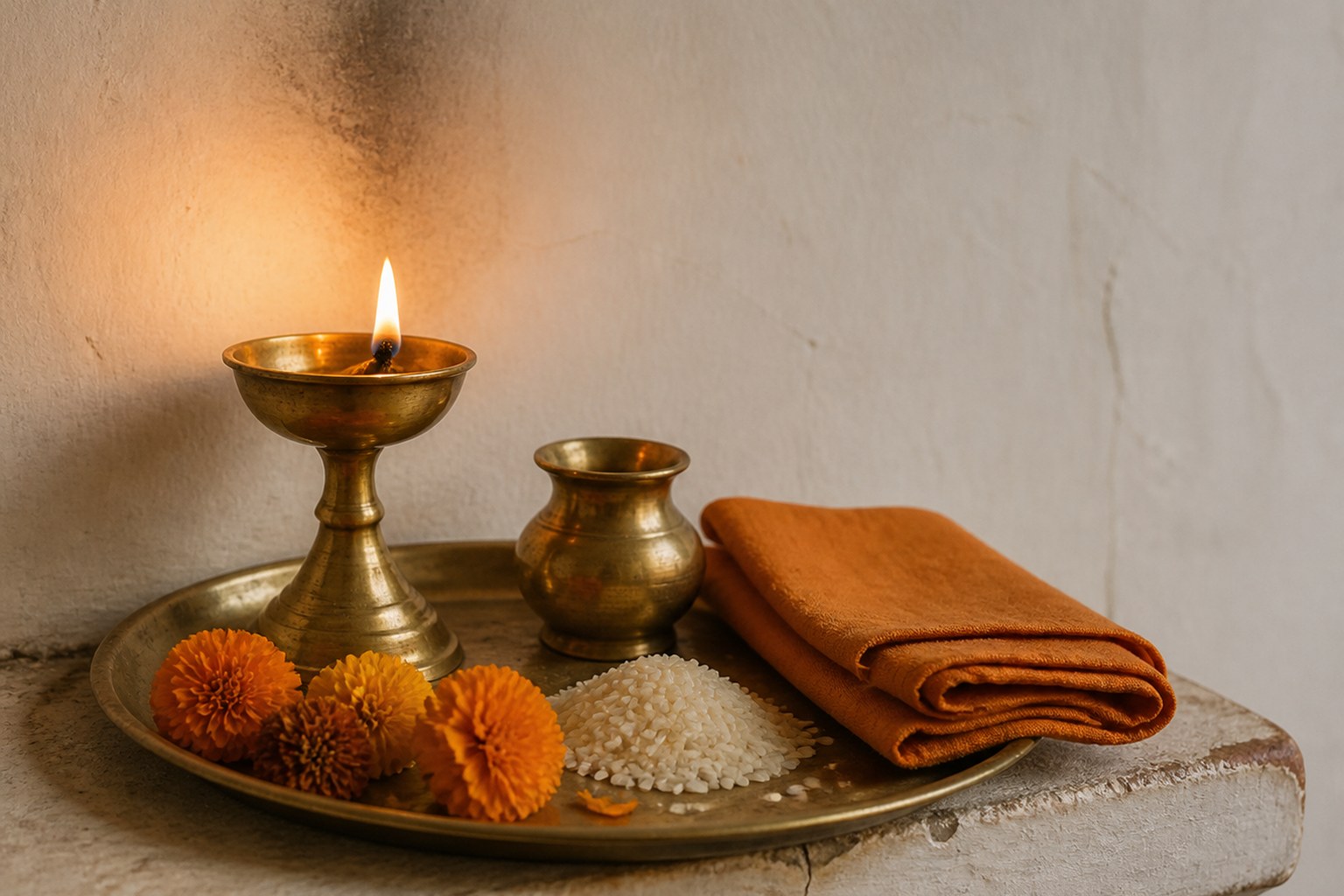
Hinduism has no angel assigned to each person at birth, so in the strict sense it has no guardian angels.
It spreads the work of protection across several relationships instead. A family deity (kuladevata) comes with the lineage, a personal deity (ishta-devata) is chosen or given by a guru, other deities guard a village, a doorway, or a direction, and the ancestors (pitrs) are fed through shraddha rites and asked for help.
Practice changes by region, caste, and sampradaya, the lineage of teaching a family follows, so each claim below names whose practice it describes.
The nearest scriptural picture of a lifelong companion is the pair of birds in Mundaka Upanishad 3.1.1, and the watching bird there is the Lord or the Supreme Self rather than a servant sent from outside.
Quick Facts
- Assigned at birth
- No equivalent in Hindu tradition
- Inherited protector
- Kuladevata (kul devta), shared by one lineage
- Chosen protector
- Ishta-devata, chosen by the devotee or given by a guru
- Place protectors
- Gramadevata, kshetrapala, dvarapalas, the eight dikpalas
- The family dead
- Pitrs, fed through shraddha, strongest during Pitru Paksha
- Protective hymns
- Hanuman Chalisa, Devi Kavacham, Narayana Kavacha
- Closest scriptural image
- Two birds on one tree, Rig Veda 1.164.20 and Mundaka Upanishad 3.1.1
Does Hinduism have guardian angels?
No Hindu figure matches the Catholic description of an angel given to each soul for life. The protection that description promises is split among several relationships, and a practising household usually keeps more than one of them at once.
The Maharashtra State Gazetteer names three deities that hold "a special place" in a person's religious life: the kuladevata or family deity, the gramadevata or village deity, and the ishtadevata or deity of one's choice. It adds that auspicious ceremonies there begin with worship of all three.
Add the ancestors, who are fed and remembered rather than worshipped as gods, and the list covers most of what English speakers mean by a guardian.
Popular answers online usually crown one of these as the Hindu guardian angel, most often the ishta-devata. That shortcut drops the one detail that tells them apart, which is how the relationship began.
Which Hindu protector is being asked about?
Four questions that sort the categories before any comparison with angels.
- Did it come with the family?
- Input
- Family practice
- Action
- Ask whether parents and grandparents already made offerings to this deity before you were born.
- Result
- An inherited deity is a kuladevata
- Did someone choose it?
- Input
- Personal devotion or initiation
- Action
- Ask whether you settled on the deity yourself or a guru gave it with a mantra.
- Result
- A chosen or given deity is an ishta-devata
- Does it guard ground?
- Input
- Location
- Action
- Ask whether the protection covers a village, a field, a temple door, or a direction rather than a named person.
- Result
- Ground points to a gramadevata, kshetrapala, dvarapala, or dikpala
- Was it once a person?
- Input
- Lineage
- Action
- Ask whether the figure is one of your own dead, remembered by name.
- Result
- A family ancestor is one of the pitrs
Region changes the names. A Tamil village may call its protector Mariamman or Ayyanar, while a Maharashtrian family may name Khandoba of Jejuri as the lineage deity.
Are devas the Hindu version of angels?
Deva is the word most often translated as angel, and it is the weakest fit of all. Britannica describes the devas as the gods of Vedic religion, 33 of them in the Rig Veda, a number later Hinduism raised to 330 million to express the countless forms of the divine.
Indra, Agni, and Varuna receive hymns and offerings in their own right. A worshipper addresses them the way one addresses a god, and none of them is described as a messenger posted beside a human being.
Their rank does not last forever either. Bhagavad Gita 9.21 says people who reach heaven through ritual merit "return to the earthly plane" once that merit is used up.
Vishnu Purana 3.1 and 3.2 go further and treat Indra as an office. A different holder takes it in each manvantara, the long cosmic age, and the text names Bali, an asura king, as the Indra of the age to come.
What passes between devas and people is an exchange. In Bhagavad Gita 3.11, sacrifice pleases the gods and the gods support humans in return, with prosperity for both sides.
In the Devi Mahatmya the gods even stand where a human petitioner would. At 4.24 and 4.25, Indra and the other devas ask the Goddess to protect them with her spear and to guard them in the east, west, south, and north.
| Angel in Christian, Jewish, and Islamic teaching | Deva in Hindu texts | |
|---|---|---|
| What it is | A created spirit that serves God | A god of the cosmos, worshipped directly |
| How long it holds its place | Permanently | A heavenly rank that lasts for a cosmic age, or until merit runs out (Vishnu Purana 3.1, Gita 9.21) |
| Relation to people | Sent to guard, guide, or record | Exchanges support with people through sacrifice (Gita 3.11) |
| Who asks whom for protection | A person asks God or the angel | Devas themselves ask the Goddess (Devi Mahatmya 4.24 to 4.25) |
Buddhist cosmology keeps a similar picture of devas as long-lived but impermanent beings, which is why the guardian-angel question gets a comparable answer in both Indian traditions.
Is a kul devta a guardian?
Yes, in the plain sense of a protector, but it guards a lineage rather than one person. The Maharashtra State Gazetteer says the kuladevata "protects the family from all calamities", and that every family descended from a common ancestor shares the same one.
Kula means clan or lineage, so the deity arrives with birth into the family and nobody picks it. In Maharashtra it is often a pair, a male Kulaswami such as Khandoba and a female Kulaswamini such as Ambabai or Bhavani.
A kuladevata usually has an address. Khandoba's seat is Jejuri and Bhavani's is Tuljapur, while at home the family keeps a small brass or silver image or plaque of the deity in its shrine.
On the family's appointed day, relatives who have moved away for work come back to the native place for a shared food offering called kuladharma, the Gazetteer notes.
Losing track of the deity after migration is common. Families ask older relatives, trace the ancestral village, and sometimes find two branches naming different deities, which is settled as a question of family history.
In many patrilineal communities a bride takes up her husband's family deity at marriage. Some women keep making offerings to the deity of the family they were born into as well.
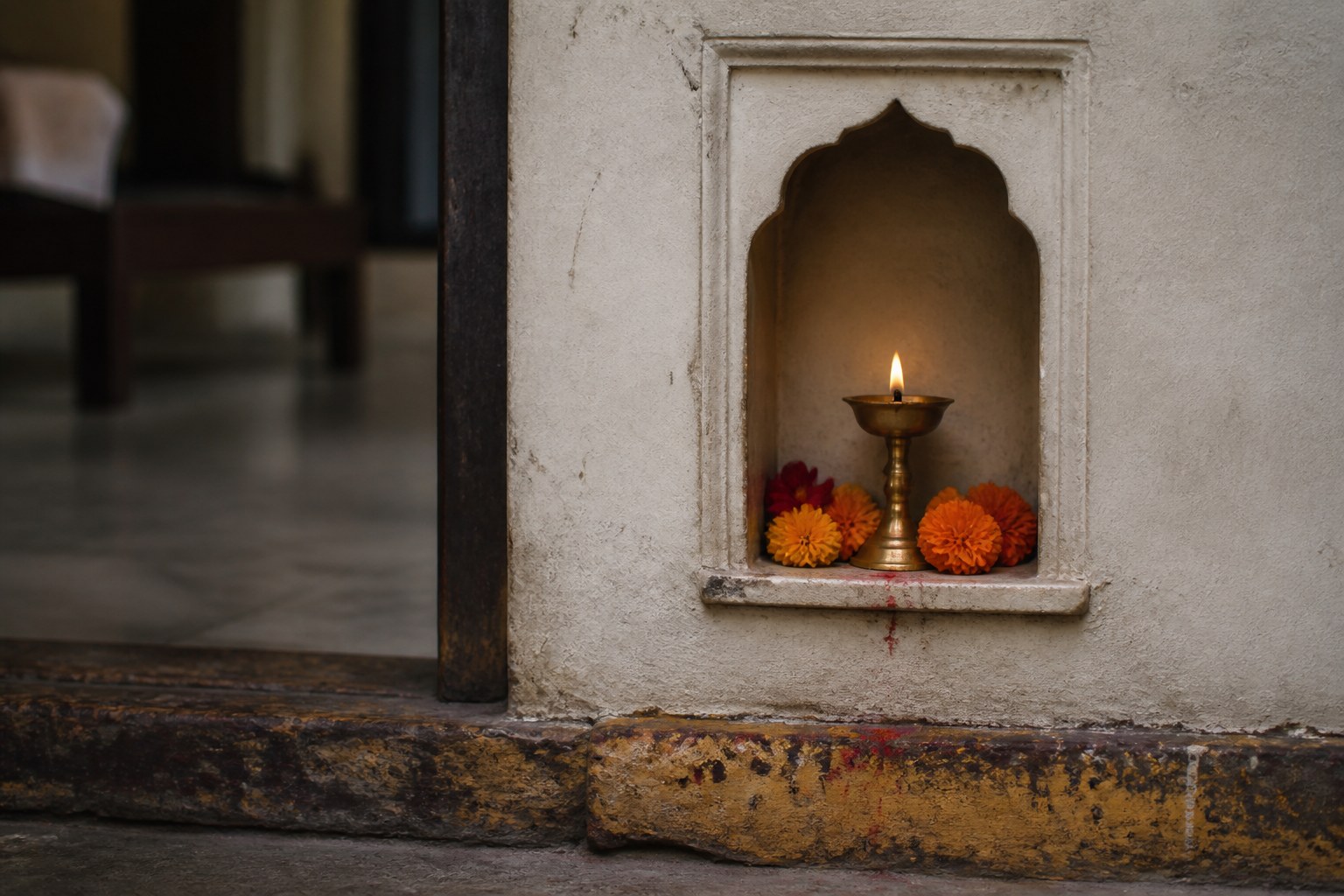
How is an ishta devata chosen, and is it a personal guardian?
An ishta-devata is the one form of the divine a person holds closest. The Concise Oxford Dictionary of World Religions defines it as a deity "chosen by a worshipper, or given to a devotee by a guru".
That definition names two paths. Some people settle on Shiva, Krishna, Durga, or Ganesha by affinity, and in initiation lineages the guru gives the deity together with a personal mantra.
Smarta households that keep the five-deity panchayatana altar, a practice tradition links to Shankara, place the chosen deity in the centre with Shiva, Vishnu, Devi, Surya, or Ganesha arranged around it.
A third path comes from Jyotish, Hindu astrology, where some practitioners read an ishta-devata from the birth chart. That resembles the date-based angel lists in modern angel books, though the dictionary definition above mentions choice and a guru and says nothing about a chart.
Whichever path is taken, the devotee does the approaching. Daily worship, mantra, and offerings keep the relationship going, and no text cited here describes an ishta arriving on its own and staying beside a person unasked.
That makes the ishta the least angel-like of the candidates despite its popularity as the answer. A guardian angel is given without being asked for; an ishta-devata is sought.
Which Hindu guardians protect a place instead of a person?
Several Hindu protectors guard ground, and their care covers whoever stands inside the boundary. The Oxford Dictionary of Hinduism describes the gramadevata as an image set up on a village boundary to ward off evil and disease.
The Maharashtra Gazetteer adds a social detail. The village deity belongs to everyone living there, whatever their caste, and it is often the kuladevata of the family that founded or leads the village, so one family's protector becomes the whole village's.
- Gramadevata: the village deity, frequently a goddess such as Mariamman in Tamil Nadu, honoured for rain and for protection from epidemic disease.
- Kshetrapala: the guardian of a field or temple precinct, often identified with a form of Bhairava, whom village Hinduism worships as a protector of villages and clans.
- Dvarapalas: armed door guardians, usually a pair holding maces, placed on either side of a temple entrance to protect the deity inside.
- Dikpalas: the eight guardians of the directions, including Indra in the east, Yama in the south, Varuna in the west, and Kubera in the north.
- Yakshas: nature spirits once honoured as protectors of a city, district, lake, or well, with Kubera as their king.
Of these, dvarapalas and yakshas look most like angels in temple art. Britannica notes that early yaksha sculptures became the prototypes for the attendants of gods and kings in later Hindu, Buddhist, and Jain art.
Their posts still belong to a door, a shrine, or a stretch of land. A traveller is under a village deity's protection inside its boundary and outside it after leaving, which is the reverse of an angel said to travel with one person.
Which deities do Hindus call on for protection?
In a crisis, Hindus most often call on a major deity directly. Hanuman is the familiar example, and the Hanuman Chalisa, the sixteenth-century Awadhi hymn attributed to Tulsidas, calls him the guard at Rama's door in chaupai 21.
Chaupai 24 of the same hymn says ghosts and evil spirits do not come near when Hanuman's name is recited.
Durga holds the same place in Shakta devotion. Reciting the Devi Mahatmya, often after the Devi Kavacham, is a standard protective practice, and the hymn at 4.24 asks her to shield the worshipper with spear, sword, bell, and bowstring.
Vaishnavas have the Narayana Kavacha of Bhagavata Purana 6.8, taught to Indra before battle. It asks forms of Vishnu to guard the reciter on land through Vamana, in the sky through Trivikrama, and on every side.
Kavacha means armour, and a Catholic reciting the Angel of God prayer is doing something close to what these hymns do. The difference sits in the addressee: a kavacha asks the supreme deity, under many names, to cover each direction and each part of the body.
Ganesha protects in another way. As Vighnaharta, the remover of obstacles, he is worshipped first when an auspicious undertaking begins, a custom the Maharashtra Gazetteer records for every such function in the state.
Do Hindus believe ancestors watch over the living?
Many do, and the idea reaches back to the Rig Veda. Hymn 10.15 invites the Fathers to the sacrificial grass with the request, in Ralph Griffith's translation, "come, help us" and "give us health and strength".
Britannica defines the pitrs as the spirits of dead ancestors. In the Vedas they were treated as immortal like the gods and shared in the sacrifice, though they received different offerings.
Help flows in both directions. The shraddha rite, Britannica explains, is performed for the father, grandfather, and great-grandfather and for the three mothers of those generations, to nourish, protect, and support them on their way toward rebirth.
Taittiriya Samhita 6.3.10.5 frames the duty as a debt. A Brahmin is born owing study to the sages, sacrifice to the gods, and offspring to the ancestors.
Britannica calls shraddha a responsibility "enjoined on all male Hindus", which is why sons traditionally perform it; some families today have daughters perform it as well.
Many households make these offerings together during Pitru Paksha, the fortnight that ends on Mahalaya Amavasya.
So an ancestor can protect, but not in the way an angel does. A pitr is a named member of one family who still depends on the living, and the protection belongs to an exchange that the family keeps up.
Is the watching bird in the Upanishads a guardian?
The closest Hindu image to a lifelong companion is a pair of birds. Rig Veda 1.164.20, in Griffith's translation, begins: "Two Birds with fair wings, knit with bonds of friendship, in the same sheltering tree have found a refuge."
One bird eats the sweet fruit and the other watches without eating. Stanza 21 of the same hymn speaks of "the Universe's mighty Keeper" who "hath entered into me the simple".
Mundaka Upanishad 3.1.1 and Shvetashvatara Upanishad 4.6 repeat the verse and draw the lesson in the line that follows. The eating bird grieves in confusion until it sees the other, the Lord, and knows his greatness, and then its grief passes (Mundaka 3.1.2).
The schools of Vedanta read the pair differently, and the difference decides whether the watcher resembles a companion at all.
Three readings of the two birds
Each school identifies the watching bird differently.
The watcher is your own deepest Self, so there is no second being to be guarded by
The soul belongs to the Lord as a body belongs to its owner: inseparable, yet not the same
The Lord accompanies the soul in every body without ever becoming it
The Vaishnava readings come nearest to a guardian. Brihadaranyaka Upanishad 3.7 calls the one who dwells within every being "the inner controller, the immortal", and Bhagavad Gita 18.61 says the Supreme Lord "dwells in the hearts of all living beings".
Even then the watcher is God rather than a subordinate spirit. The comparison fails at the exact point that makes an angel an angel.
Can a Hindu pray to a guardian angel?
Many Hindus would say yes, and several texts support that openness. Rig Veda 1.164.46 says "To what is One, sages give many a title", and in Bhagavad Gita 7.21 Krishna makes steady the faith of each devotee in whatever form that devotee chooses to worship.
Others would decline. Gita 7.20 to 7.23 says worship of other gods for worldly ends brings results that do not last, and Gaudiya Vaishnava teachers read those verses as a reason to seek protection from Krishna alone.
Christian teaching raises its own question from the other side, because it treats the guardian angel as a created servant of God and not as a deity to be added to a household shrine.
In practice the trouble usually comes from translation rather than from the prayer itself. Calling the kuladevata "my guardian angel" to a Christian friend erases the inheritance, and calling the pitrs "angels" erases what the family owes them.
Naming the Hindu category first and then saying what it does keeps both traditions intact at the cost of one extra sentence.
Frequently Asked Questions
Does Hinduism have guardian angels?
Not in the sense of one being assigned to each person at birth.
Hindu tradition covers protection through a family deity, a chosen deity, guardians of places and directions, and the ancestors.
What is the Hindu equivalent of a guardian angel?
There is no single equivalent, and the answer depends on what you mean by guardian.
For a protector of your family, it is the kuladevata. For a deity you personally turn to, it is the ishta-devata, and for an inner witness, it is the Lord or Self in the two-birds verse of Mundaka Upanishad 3.1.1.
Is my kul devta my guardian?
It is your family's guardian more than yours alone.
The kul devta protects the whole lineage descended from one ancestor, and its worship usually centres on an ancestral temple and a family day of offering.
How do I find my kul devta?
Ask the family before anyone else.
Older relatives, the village the family came from, and the temple where earlier generations made offerings usually settle it. If branches disagree, families treat it as a question of family history.
Can an ishta devata be found from a horoscope?
Some Jyotish astrologers read one from the birth chart.
The standard definition describes an ishta-devata as chosen by the devotee or given by a guru, so a chart reading is one practice among several, not the rule.
Are devas the same as angels?
No.
Devas are gods worshipped in their own right, and texts such as Bhagavad Gita 9.21 and Vishnu Purana 3.1 describe their position as lasting only for a time. Angels in Abrahamic teaching are created servants of God.
Do Hindus believe ancestors protect the living?
Many do.
Rig Veda 10.15 asks the Fathers for help, and shraddha rites feed the ancestors in return, so the protection is part of a two-way obligation.
Sources
- (1896). Hymns 1.164 (stanzas 20 to 22 and 46) and 10.15, translated by Ralph T. H. Griffith. The Hymns of the Rigveda, Wikisource. Link
- (1884). Mundaka III.1.1 to 2, translated by F. Max Muller. Sacred Books of the East, volume 15. Link
- (1884). Shvetashvatara IV.6 to 7 and Brihadaranyaka III.7, translated by F. Max Muller. Sacred Books of the East, volume 15. Link
- . Verses 3.11, 7.20 to 7.23, 9.21, and 18.61. Gita Supersite, IIT Kanpur. Link
- (1840). Book 3, chapters 1 and 2, The Manvantaras, translated by H. H. Wilson. Wisdom Library. Link
- . Chapter 4, Praise by Indra and the Other Gods, verses 24 to 25. The Devi Mahatmya. Link
- . Canto 6, chapter 8, The Narayana-kavaca Shield. Vedabase. Link
- . Hanuman Chalisa, chaupais 21 and 24. Awadhi devotional hymn, sixteenth century
- . 6.3.10.5, the three debts of a Brahmin. Krishna Yajurveda
- . Religion, Land and People, chapter VII, pages 285 to 287. Maharashtra State Gazetteer. Link
- (2000). Istadevata. The Concise Oxford Dictionary of World Religions, via Encyclopedia.com. Link
- (2009). Gramadevata. A Dictionary of Hinduism, Oxford University Press. Link
- . Deva. Encyclopaedia Britannica. Link
- . Pitri. Encyclopaedia Britannica. Link
- . Shraddha. Encyclopaedia Britannica. Link
- . Yaksha. Encyclopaedia Britannica. Link
- . Kubera. Encyclopaedia Britannica. Link
- . Door guardian (dvarapala). Asian Art Museum collection. Link
About Our Editorial Process
Every KnowTheAngels guide separates calculation method, tradition context, and personal reflection. We cite where interpretations come from, present more than one view, and never present symbolic reading as prediction.
Read our editorial policy