How Do Pythagorean and Chaldean Numerology Systems Differ?
A method-focused guide to how major numerology systems differ, what each one is trying to do, and why mixing them changes the result
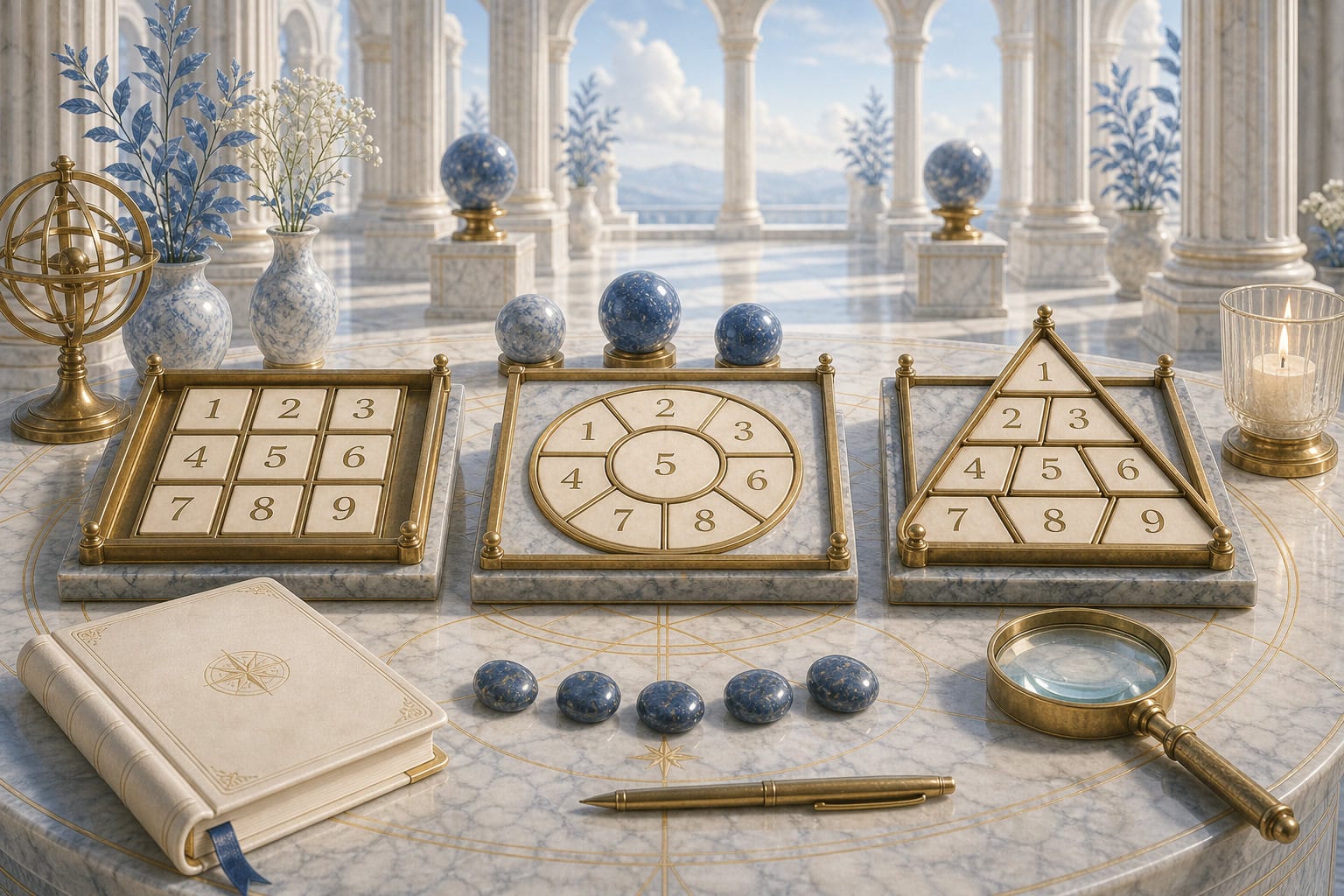
Numerology systems are different rule sets, not different decorative flavors of the same answer. The system determines how numbers are assigned, how they are reduced, and what kind of symbolic emphasis the result is supposed to carry.
That is why two calculators can produce different outputs for the same person without either one necessarily being broken. They may be using different mapping rules, different treatment of master numbers, or different assumptions about which chart roles matter most.
A numerology result without a named system is method without an owner.
Quick Facts
- Most common modern systems
- Pythagorean and Chaldean
- Main difference
- Letter mapping, reduction habits, and interpretive emphasis
- Why it matters
- System choice can change the final chart or its meaning
- Common confusion
- Pages often mix systems while talking like they are universal
- Main caution
- Comparing outputs only helps when the method stays visible
What a numerology system controls before any chart is interpreted
A numerology system controls how numbers enter the reading, how they are reduced, and what kind of symbolic meaning the page is allowed to claim from the result. That makes the system the owner of the chart before any interpretation language begins.
This matters because many readers first meet numerology through a calculator or a profile page such as Life Path 1 without realizing that another system may organize the same inputs differently. The page becomes more honest the moment it says the result belongs to one method rather than to all possible methods.
System choice also changes how confident a reader feels about comparison. If one page is using a Pythagorean chart and another is using a Chaldean mapping, the outputs are not meant to be blended casually.
That basis layer is exactly why the systems page matters. It gives the reader a way to ask not just what number appeared, but which rulebook produced it and what that rulebook thinks the number is for.
In practice that rulebook usually governs at least four things: which alphabet values count, whether compound totals carry their own weight before reduction, which double digits can remain as master numbers, and which chart role deserves the strongest interpretive emphasis.
A page that leaves those questions invisible is giving the reader an answer without the method that produced it.
That is also why systems are a factual guide, not a stylistic sidebar. Pythagorean charts often feel simpler because the mappings are familiar to modern readers, while Chaldean charts may preserve different emphases in the number language itself.
The distinction belongs in the owner section before any profile page tries to sound universal.
| Method choice | What it affects | Why this difference matters to the reader |
|---|---|---|
| Letter mapping | How names become numbers | Different mappings can change the chart |
| Reduction rule | Whether and how totals collapse | Can alter the final output or preserve master numbers |
| Interpretive lens | Which themes get emphasis | Changes how the same number is explained |
The system page is valuable because it restores ownership. It shows readers which rulebook produced the answer they are looking at.
That ownership question is what a reader is really asking. A chart cannot be interpreted responsibly until the system producing it has been named and understood.
What Are the Chaldean Letter Values, and How Do They Differ?
The direct basis answer is that Pythagorean and Chaldean numerology do not begin from the same mapping assumptions.
Pythagorean work usually moves through a repeating 1-to-9 value sequence that modern Western readers now recognize from many life-path and chart tools.
Chaldean numerology uses a different assignment tradition and often keeps stronger attention on sound, compound totals, and older occult associations. That means the system can produce a different guide to the result even when the final headline number looks familiar.
Those differences are not decorative. They change the basis of the chart, the feel of the interpretation, and sometimes the exact output a calculator shows.
A name result or compatibility chart from one system cannot be assumed to match the other just because both pages use the word numerology.
This is also where historical context helps. Pythagorean language often dominates beginner material because it standardized so well in modern handbooks and calculators.
Chaldean language often feels more esoteric because it is carried through a different transmission line and a different symbolic vocabulary.
A compatibility reading is trustworthy only when it names the letter and reduction rules behind its inputs. The method history explains where those rules came from rather than choosing a system for the reader.
A profile such as Life Path 3 must follow the same declared rulebook as the calculation that produced it.
That is where beginner frustration usually comes from. Two calculators may feel like they are disagreeing about the person, when they are actually disagreeing about the rulebook.
A strong systems page turns that frustration into a readable method question before the reader starts deciding which symbolic voice to trust.
| Value | Pythagorean letters | Chaldean letters |
|---|---|---|
| 1 | A, J, S | A, I, J, Q, Y |
| 2 | B, K, T | B, K, R |
| 3 | C, L, U | C, G, L, S |
| 4 | D, M, V | D, M, T |
| 5 | E, N, W | E, H, N, X |
| 6 | F, O, X | U, V, W |
| 7 | G, P, Y | O, Z |
| 8 | H, Q, Z | F, P |
| 9 | I, R | No letter assigned in Cheiro's table |
A systems article does not force one winner. Its job is to make the differences explicit enough that the reader can see why outputs diverge and why the basis of one chart cannot be quietly imported into another.
How Can One Name Produce Different Results in the Two Systems?
The name JAMES shows the mapping difference without changing the spelling. Pythagorean values total 12 and reduce to 3, while the Chaldean values published in Cheiro's table total 14 and reduce to 5.
| Letter | Pythagorean value | Chaldean value |
|---|---|---|
| J | 1 | 1 |
| A | 1 | 1 |
| M | 4 | 4 |
| E | 5 | 5 |
| S | 1 | 3 |
| Total | 12 -> 3 | 14 -> 5 |
The example proves only that the rulebooks produce different arithmetic. It does not establish that either resulting personality interpretation is objectively more accurate.
Where master-number rules and chart roles diverge by system
Master-number handling is one of the clearest places where systems diverge in basis. Some modern pages preserve 11, 22, or 33 in certain calculations.
Others reduce them normally, or preserve some of them while treating the rest as ordinary compound totals.
A life-path tool starts from a birth date. A name calculator starts from letters, so its output changes more visibly when the mapping system changes.
A full-chart reading combines several roles, which makes an unstated rule change harder to detect and more consequential.
That means the calculator result is never stronger than the method explanation beside it.
Some systems foreground life path and the birth-date reading. Others encourage more attention to name-based roles or compound-number texture before reduction.
Those are not small preference shifts. They change what the chart thinks it is measuring and which result deserves priority in the reading.
That divergence also changes how readers should compare outputs across the wider life-path family, the master-number guides, and the more tool-heavy guides. A chart that foregrounds life path will send the reader toward one interpretive owner; a chart that foregrounds name values or compound numbers may send them somewhere else entirely.
This is also where readers should stop mixing outputs casually.
A life path from one system and a name result from another can still be compared, but only if the page is honest that the chart is now crossing methods rather than staying inside one.
- Master numbers can diverge. One system may preserve a total that another reduces.
- Chart roles can shift. Systems may emphasize different parts of the chart more heavily.
- Calculator trust depends on method. A tool that hides its system hides the basis of the result.
- Mixed charts need disclosure. Crossing methods should be named openly, not smuggled into one summary.
That transparency makes system comparison more useful. The reader can finally see whether the difference belongs to the number or to the rulebook, and why a chart needs a named owner before any interpretation can claim authority.
Where readers usually overreach when comparing systems
One overreach is asking which system is the one true method. In practice, the more helpful question is which method the page is using and whether it is applying that method consistently.
Another overreach is shopping for the nicest answer.
If a reader moves between systems until one output feels flattering, the comparison stops being method and becomes confirmation-seeking.
A third overreach is acting as if system differences are minor details. They are the reason a chart looks the way it does, which is why a page like core numerology method should lead into systems before it leads into too many calculator promises.
A fourth overreach is borrowing one system's dramatic language while calculating through another system's rules. That creates a hybrid reading that may still feel resonant, but it no longer has a clean method basis unless the crossover is named openly.
This is where the systems guide becomes practical instead of abstract. It gives the reader a way to slow down, identify the rulebook in play, and decide whether the chart they are reading has stayed method-consistent from input to interpretation.
- No winner theater. The article explains differences before ranking systems.
- No answer shopping. Switching methods to reach a preferred conclusion weakens the reading.
- No hidden crossover. If the chart mixes methods, the article says so.
- No universal claim. Familiar systems are still systems, not neutral reality.
A strong systems page gives the reader more discipline, not more noise. It makes every later result easier to audit.
How to choose a next step after learning the system differences
The cleaner sequence is one calculator and one dedicated article that stay inside the same method long enough to be readable.
A reader who wants life-path clarity can use birth-date reduction and then one profile article.
A reader focused on names can use name-value mapping and then compare the system rules.
The point is not to compare everything at once. It is to let one system become legible enough that the reader can tell whether the interpretation actually follows from the rules and whether the next stop should be a method history, a compatibility reading, or a profile such as life path number 2.
For many readers the cleanest path is to stay inside one calculator category for one full cycle: method page, tool, dedicated article, then a controlled comparison. That sequence teaches far more about the system than jumping immediately into mixed charts and broad compatibility claims.
That application layer matters because the systems guide is supposed to change reader behavior, not just supply background. Once the differences are visible, the reader can choose one rulebook, test one result, and use later comparison pages more responsibly instead of drifting between methods without noticing.
The practical parity standard for this guide is therefore behavioral as much as informational.
By the end of the page, the reader can know which system their current calculator is using, which adjacent tool still belongs to that same category, and which comparison should wait until the method has stayed stable for at least one full reading cycle. That slower sequence is usually where trust returns, because the method stays visible from one page to the next.
That closing discipline is what keeps a systems page from becoming abstract background. It equips the reader to carry one method consistently from calculator to dedicated article, which is the real practical payoff of learning system differences.
Otherwise the comparison remains informational but not usable.
That narrower next step is what makes the systems page useful. It gives the reader a cleaner map before deeper interpretation begins.
Frequently Asked Questions
What are the main numerology systems?
The two most commonly referenced modern systems are Pythagorean and Chaldean, though practitioners may use other hybrids or extensions as well.
Can the same person get different results in different systems?
Yes. Different mappings, reduction rules, or master-number handling can change the chart or the way it is interpreted.
Which system is the real one?
A better question is which system a page is using and whether it applies that method consistently. A result without a named system is incomplete.
Which numerology system is more accurate?
Accuracy is the wrong test, because no system makes a claim that can be measured against an outcome. What can be compared is internal consistency: whether a system applies its own letter mapping, master-number rule, and chart roles the same way every time.
Chaldean writing tends to claim older sourcing, and Pythagorean writing tends to claim simpler arithmetic, but neither claim makes a reading correct. Pick the system you will apply consistently, then read what it produces as reflection.
What should I open after learning the differences?
Usually one calculator and one dedicated article that stay inside the same method long enough to make the result readable.
Sources
- (2026). Numerology. Encyclopaedia Britannica
- (2001). Numerology: Key to Your Inner Self. Avery Publishing
- (1981). Numerology: The Complete Guide. Newcastle Publishing
- (n.d.). Cheiro's Book of Numbers. Digitized edition, Chapter XII, pp. 64-65. Link
About Our Editorial Process
Every KnowTheAngels guide separates calculation method, tradition context, and personal reflection. We cite where interpretations come from, present more than one view, and never present symbolic reading as prediction.
Read our editorial policy