What Does a Full Numerology Calculator Include in Your Chart?
A method-focused guide to what a full numerology calculator is actually doing, which inputs it exposes, and how to keep the output proportional
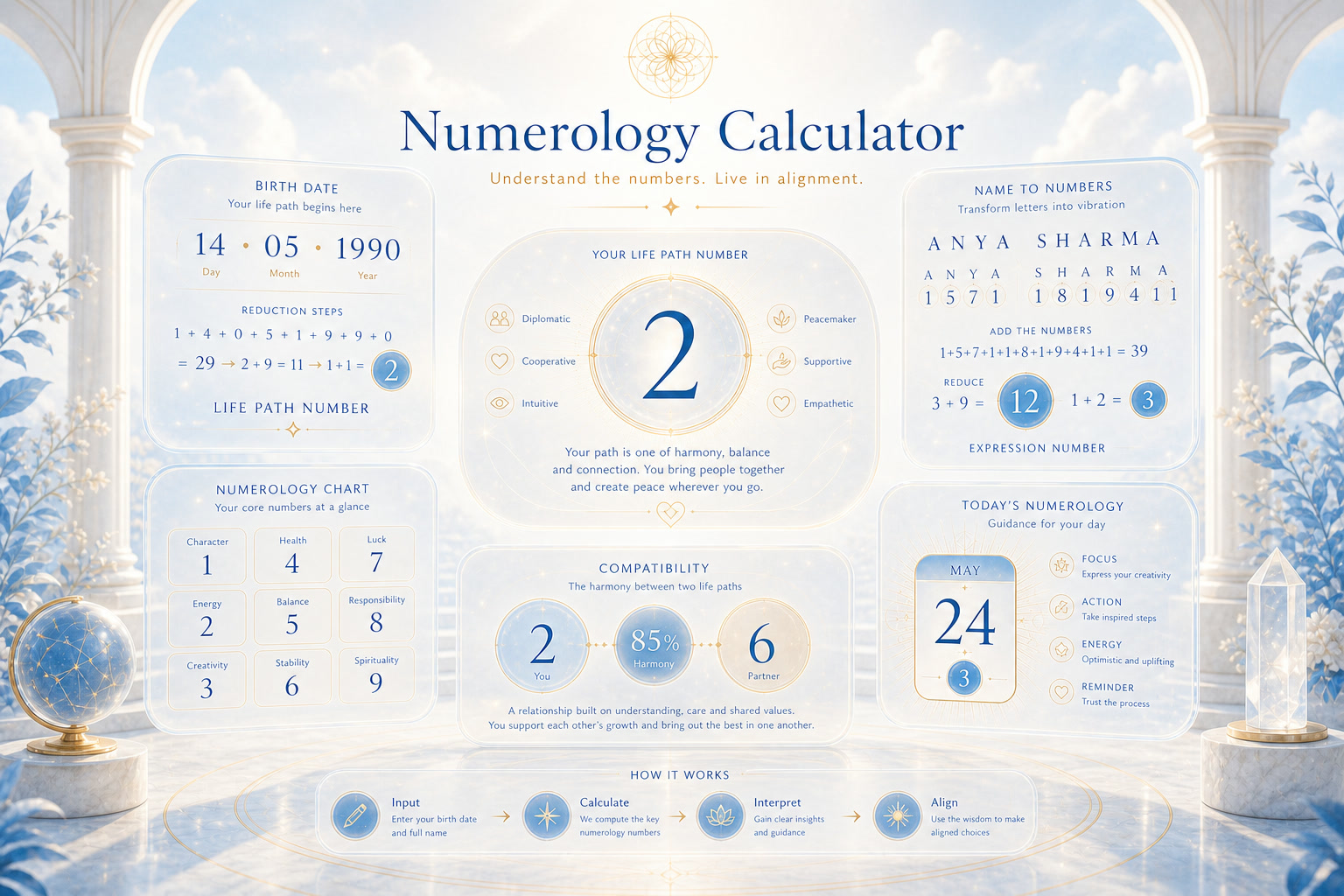
This tool organizes your input for reflection. It does not prove angel contact, predict an outcome, or replace your judgment.
A full numerology calculator is not just a bigger version of a single-number tool. It usually combines multiple inputs, such as birth date and full name, to produce several chart roles that then need to be interpreted separately and in relationship to one another.
That distinction matters because readers often experience the longer output as more authoritative. In reality, the opposite can happen.
The more numbers a page produces, the more important it becomes to show where each number came from, what job it has inside the system, and which parts of the result are still interpretive rather than factual.
A fuller chart is only helpful when the method becomes more visible, not less.
Quick Facts
- Typical inputs
- Birth date, full legal or chosen name, and one named numerology system
- Typical outputs
- Life path plus several chart roles such as expression, soul urge, or personality
- Best use
- Organizing multiple symbolic readings without confusing their jobs
- Big risk
- Mistaking a larger chart for stronger proof
- Main caution
- Different systems and spellings can change the chart
What a full chart adds to a single number
A single tool such as the birth-date calculator answers one question: what broad birth-date pattern is being derived here? A full chart tool adds several number roles, which means it is trying to answer several related questions at once.
That can be useful if the explanation keeps the roles separate. Life path, expression, soul urge, and personality are not duplicate labels.
They are supposed to describe different symbolic functions, and a calculator becomes much stronger when it explains those jobs before it starts blending them into one personality summary.
This is also why the input discipline matters more. A changed spelling, a different transliteration rule, or a different system can alter parts of the chart without changing others.
Readers need to know which result belongs to which assumption.
| Tool type | Main input | Main output |
|---|---|---|
| Life-path tool | Birth date | One core long-range pattern |
| Name tool | Spelling plus system | One name-based symbolic result |
| Full numerology calculator | Birth date plus name inputs | Several chart roles that need separate interpretation |
A bigger result is not the same as a clearer one. Trust comes from seeing which number is doing which interpretive job.
Which inputs a full chart has to show before the output means anything
A full chart calculator shows readers exactly which birth date, spelling, and system are being used. Without that, the chart looks precise while hiding the assumptions that produced it.
That is especially important when the tool blends date-based and name-based numbers. Birth-date logic belongs to one category, which is why a life-path calculation should stay visibly separate from name-value mapping.
If a page never shows readers where one category ends and the other begins, the chart becomes harder to evaluate and easier to over-believe.
Master-number handling matters here too. If the tool preserves 11, 22, or 33 in some chart roles but not others, the explanation has to say so directly.
The same reader may get a different chart from another calculator simply because the system rules were different.
- Show the birth-date input. Readers should be able to retrace the arithmetic behind date-based roles.
- Show the name input. The exact spelling and any transliteration choice should stay visible.
- Name the system. Pythagorean and Chaldean mappings do not produce identical charts.
- Explain preserved numbers. The method names when master numbers stay and when they reduce.
Once those inputs are visible, the output becomes easier to use responsibly. The chart stops sounding like revelation and starts sounding like a symbolic framework the reader can actually inspect.
How to read several chart roles without collapsing them into one personality label
The most common mistake with full calculators is flattening the entire chart into one flattering identity statement. A cleaner reading treats each number as answering a narrower question, then compares the pattern across roles.
For example, a life path may describe a broad developmental arc, while a name-based number highlights outward style or habitual tone. Those are connected, but they are not interchangeable.
A reader with a more initiating life-path profile may still have a softer expression number elsewhere in the chart. A relational life-path pattern may likewise coexist with a more forceful name result, so no single role should become the whole personality label.
This is where article follow-up matters. A full chart tool can send the reader into one core guide at a time rather than pretending the calculator result already contains the finished interpretation.
A practical way to read the chart is to rank the roles by job before you rank them by emotional resonance. One number may be naming the long-range development category, another may be describing expressive style, and another may be clarifying relational habits or outward persona.
That ordering stops the reader from handing total authority to whichever output sounds most flattering first.
| Chart role | Typical job | Common mistake |
|---|---|---|
| Life path | Broad long-range pattern from birth date | Treating it as the whole personality |
| Name-based role | Style, expression, or desire pattern from letters | Forgetting that spelling and system change the result |
| Combined chart summary | Shows where several categories reinforce or contradict | Flattening the whole chart into one slogan |
A full numerology page becomes more trustworthy when it keeps each chart role smaller, clearer, and easier to verify before it starts connecting them.
The point where a full chart is asked for too much
One overreach is assuming that more numbers mean more certainty. In practice, more outputs create more interpretive judgment, which means more places where the guide slows down and explains itself.
Another overreach is mixing systems, spellings, or output labels until the chart sounds impressive. A full chart only helps when the method stays internally consistent from start to finish.
A third overreach is using the chart to replace ordinary judgment. A page that turns every number into proof of vocation, compatibility, or fate is no longer acting like reference material.
It is acting like an authority the method cannot honestly justify.
- No chart inflation. More outputs do not automatically mean a deeper or truer reading.
- No mixed-rule charts. Changing systems midstream weakens the result even if the summary sounds attractive.
- No destiny jump. A full chart still describes symbolic tendencies, not guaranteed outcomes.
- No one-slogan shortcut. Multi-role charts should not be compressed into a single personality headline.
That caution is part of the method, not a disclaimer added at the end. A full calculator stays useful precisely because it resists the temptation to sound final.
Living with a full-chart result
The strongest next move is usually not another calculator. It is one dedicated article for the chart role that felt most central, plus one method page that helps readers review how the chart was produced.
The core numerology method explains how the chart's arithmetic works. A life-path profile then interprets one birth-date role rather than the full chart.
The systems comparison shows where rulebooks diverge. A name calculation answers another question because it starts from letters rather than the birth date.
A relationship reading is the narrower tool when a full chart starts turning into a partnership verdict. The method history answers a different question about what modern practice inherited and added later.
That sequence works best when the reader writes down which role they are following next and why. If the next stop is a life-path profile, the chart should not keep making name-based claims in the background.
If the next stop is a systems page, the reader can pause interpretation until the rulebook becomes clearer. The full calculator becomes far more useful once it teaches that discipline instead of rewarding one dramatic chart dump.
That note-taking step may sound small, but it is what turns a chart from spectacle into method. Once the reader can say which role owns the next question, the full output starts acting like a structured map instead of an oversized personality verdict.
That smaller sequence gives the reader something the chart itself cannot provide: a way to understand one category deeply enough that the wider result stays proportionate.
Frequently Asked Questions
What does a full numerology calculator calculate?
Usually several chart roles from a birth date and one or more name inputs. A good page tells you exactly which roles are being produced and which system is being used.
Is a full chart more accurate than one calculator?
Not automatically. A fuller chart can be more informative, but only when the input, system, and chart roles are shown clearly instead of being blended into one vague reading.
Why can two full calculators disagree?
Different system rules, different spellings, transliteration choices, or master-number handling can all change the chart. A trustworthy calculator names those assumptions openly.
What should I read after the result?
Usually one dedicated article for the main chart role, plus a method page that explains how the full chart was built.
Sources
- (2001). Numerology: Key to Your Inner Self. Avery Publishing
- (1981). Numerology: The Complete Guide. Newcastle Publishing
- (2026). Numerology. Encyclopaedia Britannica
About Our Editorial Process
Every KnowTheAngels guide separates calculation method, tradition context, and personal reflection. We cite where interpretations come from, present more than one view, and never present symbolic reading as prediction.
Read our editorial policy