What Does the Name Michael Mean Across Angel Traditions?
The Hebrew question inside the name, the -el ending it shares with Gabriel and Raphael, its forms from Miguel to Mikhail, and its long run as a boy's name
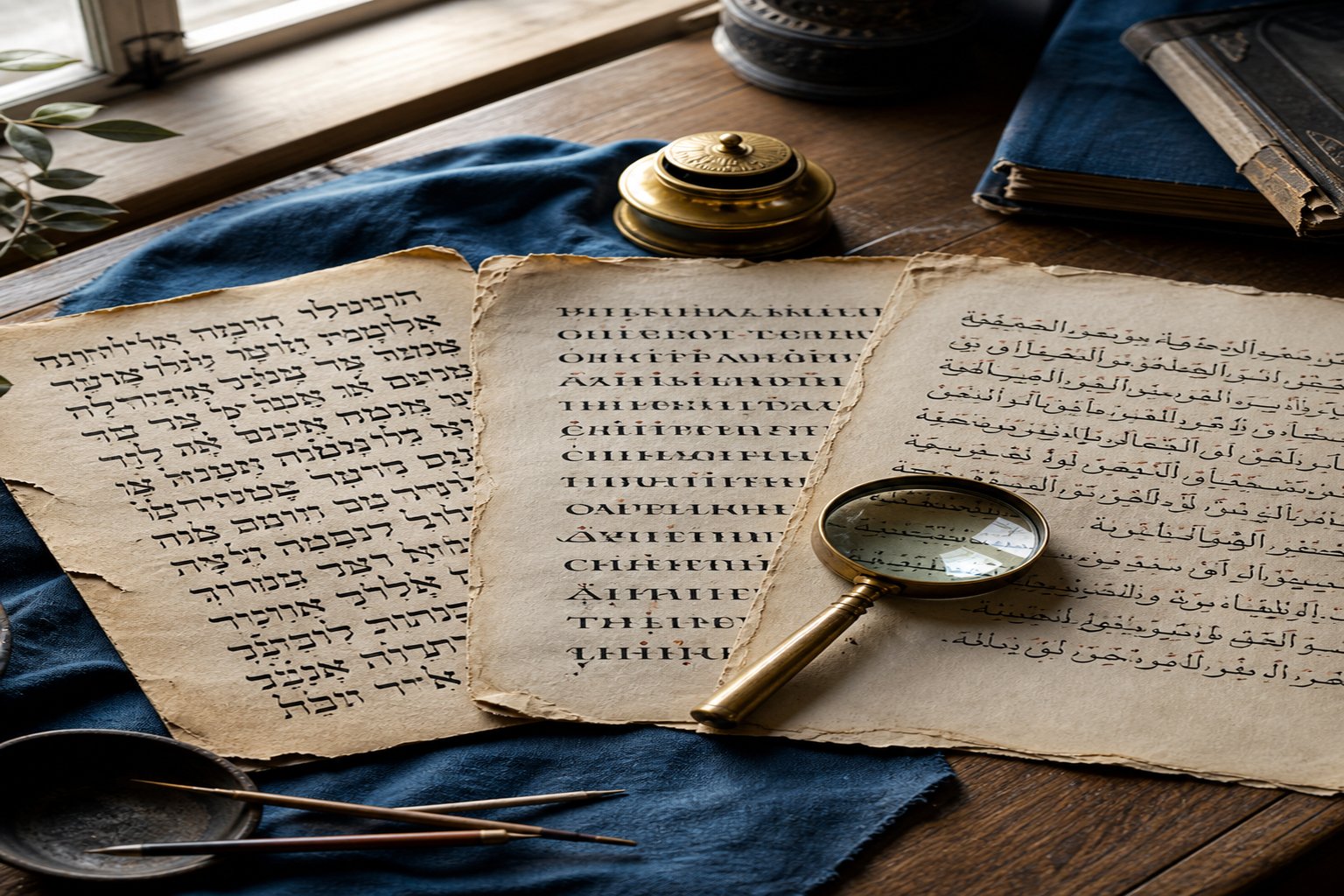
Michael is the English spelling of the Hebrew name Mikha'el, which asks "Who is like God?" and expects the answer that no one is.
Because it is a question, the name works differently from Gabriel or Raphael, which make statements about God. It also has a human history as long as its angelic one: the Hebrew Bible gives it to a spy from the tribe of Asher and to a son of King Jehoshaphat, and it later became one of the most common boys' names in Europe and the United States.
Quick Facts
- Hebrew form
- מִיכָאֵל (Mikha'el), pronounced mee-kha-EL
- Meaning
- "Who is like God?", a question expecting the answer "no one"
- Latin rendering
- Quis ut Deus? (also Quis sicut Deus?)
- Name type
- Theophoric: ends in El, the Hebrew word for God
- Scripture
- Daniel, Jude, Revelation and Qur'an 2:98; Gabriel is also named in all three
- US ranking
- No. 1 boys' name every year from 1954 to 1998 except 1960 (SSA)
Why does Michael mean "Who is like God?" in Hebrew?
Michael is the English form of the Hebrew מִיכָאֵל (Mikha'el), built from three parts: mi ("who"), kha ("like") and El ("God"). Read together, the name asks "Who is like God?", and the answer it expects is that no one is.
Hebrew parts of Mi-kha-El
Question word that turns the whole name into a question
Preposition of comparison, attached to the word that follows
The same divine element that ends Gabriel, Raphael and Uriel
Jewish interpreters heard two verses of scripture in those three parts. According to the Jewish Encyclopedia, the rabbis, in Numbers Rabbah 2:9, took the first Hebrew word of Exodus 15:11, "Who is like you, O Lord, among the gods?", and joined it to the second Hebrew word of Deuteronomy 33:26, "There is none like God." The first supplies mi, the second supplies ka-El, and together they spell Mikha'el: the question of Moses' song at the sea followed by the answer of his final blessing.
Latin writers render the name word for word as Quis ut Deus? (or Quis sicut Deus?). Catholic art sometimes paints the phrase on the shield Michael carries, and the Scapular of St. Michael bears it too. The Catholic Encyclopedia goes a step further and calls the name "the war-cry of the good angels" in the battle in heaven, a devotional reading in which the question becomes a challenge thrown at the rebel angels.
The question mark changes the meaning. Popular glosses such as "one who is like God" turn the name into a claim about its bearer, when the Hebrew denies that anyone, the angel included, is like God.
Is Michael related to Micah, or to Gabriel and Raphael?
The ending -el is El, the ordinary Hebrew word for God, and a name that carries a divine name this way is called theophoric. All four angels who look down from heaven in 1 Enoch 9:1, Michael, Uriel, Raphael and Gabriel, carry it, and so do human names in the Hebrew Bible such as Daniel and Ezekiel.
Inside that family, Michael differs in grammar. Gabriel, Raphael and Uriel are statements about God, while Michael is a question, and its nearest relative is the prophet's name Micah, a shortened form of Micaiah that asks the same question with Yah, short for Yahweh, in place of El.
| Name | Hebrew | Common gloss | Form |
|---|---|---|---|
| Michael | מִיכָאֵל (Mikha'el) | Who is like God? | Question, divine element El |
| Micaiah, shortened to Micah | מִיכָיָהוּ (Mikhayahu) | Who is like Yahweh? | Question, divine element Yah |
| Gabriel | גַּבְרִיאֵל (Gavri'el) | God is my strength | Statement, divine element El |
| Raphael | רְפָאֵל (Refa'el) | God heals | Statement, divine element El |
| Uriel | אוּרִיאֵל (Uri'el) | God is my light | Statement, divine element El |
The shared ending is weaker evidence of kinship than it looks: Michael and Gabriel share only the word for God, while Michael and Micah share the question itself.
Where does the name Michael appear in the Bible and the Qur'an?
Michael is named in the Hebrew Bible, the New Testament and the Qur'an, and Gabriel is named in all three as well. Gabriel appears in Daniel 8:16 and 9:21, in Luke 1:19 and 1:26, and as Jibril in Qur'an 2:97-98, the same passage that names Michael beside him.
In the Hebrew Bible the name belongs to people more often than to the angel. Sethur son of Michael represents the tribe of Asher among the twelve spies (Numbers 13:13), one of King Jehoshaphat's sons is Michael (2 Chronicles 21:2), and Zebadiah son of Michael returns from Babylon with Ezra (Ezra 8:8). The angel appears only in Daniel, as "one of the chief princes" (10:13) and as the prince who stands for Daniel's people (10:21 and 12:1).
Daniel is the only book of the Hebrew Bible that gives angels personal names. The Jewish Encyclopedia reports the teaching of Simeon ben Lakish that the names of the angels came up with the Jews from Babylon (Jerusalem Talmud, Rosh Hashanah 54d; Genesis Rabbah 48:9), and Daniel is set at the Babylonian and Persian courts.
The New Testament uses the name twice, in the Greek spelling Μιχαήλ: Jude 9 speaks of "the archangel Michael," and Revelation 12:7 has "Michael and his angels" fighting the dragon. The Qur'an names him once, at 2:98, which says that whoever is an enemy to God, his angels, his messengers, Gabriel and Michael has God as an enemy. In the Hafs reading, the word there is wa-Mīkāla, from the short form Mīkāl, while the longer Arabic form Mīkāʾīl keeps the glottal stop of the Hebrew Mikha'el.
What is Michael in other languages, from Miguel to Mihai?
Most European languages received the name through Greek and Latin church use, and nearly every form keeps the opening Mi- of the Hebrew question. The ending changes most, from Italian Michele to Romanian Mihai, which drops the -el altogether.
| Language | Form | Note |
|---|---|---|
| Hebrew | Mikha'el (מִיכָאֵל) | Stress on the last syllable: mee-kha-EL |
| Greek | Michaēl (Μιχαήλ); modern Michail, Michalis | The Septuagint and New Testament spelling |
| Latin and English | Michael | The Latin church spelling, kept unchanged in English |
| Arabic | Mīkāl, Mīkāʾīl | Mīkāl is the Hafs reading of Qur'an 2:98 |
| Spanish and Portuguese | Miguel | The -el survives; the k sound softens to g |
| French | Michel | Feminine form Michelle |
| Italian | Michele | Three syllables: mi-KE-le |
| German | Michael | Three syllables, MI-cha-el, with the soft ch of German ich |
| Russian | Mikhail (Михаил) | Stress on the last syllable |
| Polish | Michał | The ł is said like English w |
| Romanian | Mihai | Drops the -el ending |
| Irish | Mícheál | Two syllables: MEE-hawl |
| Swedish and Finnish | Mikael | Danish uses Mikkel |
English is the outlier in sound. It keeps the Greek and Latin spelling but pronounces the name in two syllables, so the three Hebrew parts are no longer audible, while German Mi-cha-el and Hebrew Mi-kha-El still sound all three.
The question also sits inside a common girls' name. Michelle, the French feminine form of Michel, has been common in the English-speaking world since the middle of the 20th century.
How did Michael become the top US boy's name for 44 years?
Devotion to the archangel turned a Hebrew name into a Christian one across Europe. Nine Byzantine emperors were named Michael, among them Michael VIII Palaeologus in the 13th century, and the name was common in Western Europe during the Middle Ages and in England from the 12th century.
In the United States the name rose quickly from the 1930s. Social Security Administration records show Michael as the most common name for boys born every year from 1954 to 1998 except 1960, which makes 44 years in first place.
Frequently Asked Questions
What does the name Michael mean?
Michael comes from Hebrew Mikha'el, "Who is like God?" The question expects the answer "no one," so the name denies that anyone is like God rather than claiming its bearer is.
Is Michael the only angel named in the Bible and the Qur'an?
No. Gabriel is also named in all three scriptures: Daniel 8:16 and 9:21 in the Hebrew Bible, Luke 1:19 and 1:26 in the New Testament, and Qur'an 2:97-98, where Jibril and Michael are named together.
Is Michael a biblical name for people?
Yes. The Hebrew Bible gives the name to several men, including Sethur's father in Numbers 13:13, a son of King Jehoshaphat in 2 Chronicles 21:2 and Zebadiah's father in Ezra 8:8.
How do you say Michael in Hebrew?
Modern Hebrew says Mikha'el as mee-kha-EL, with the kh of Bach and the stress on the last syllable.
What is Michael in Spanish, Russian and Arabic?
Spanish uses Miguel, Russian uses Mikhail (Михаил), and Arabic uses Mīkāʾīl, with the shorter Mīkāl in the Hafs reading of Qur'an 2:98.
Sources
- . Numbers 13:13; 2 Chronicles 21:2; Ezra 8:8. Men named Michael (NRSVUE). Link
- . Daniel 8:16, 9:21, 10:13, 10:21 and 12:1. Gabriel and Michael named in Daniel (NRSVUE). Link
- . Exodus 15:11 and Deuteronomy 33:26. The two verses the rabbis read in the name (NRSVUE). Link
- . Luke 1:19, 1:26; Jude 9; Revelation 12:7. Gabriel and Michael named in the New Testament (NRSVUE). Link
- . Surah al-Baqarah 2:97-98. Quranic Arabic Corpus, word-by-word analysis of 2:98 (wa-Mīkāla). Link
- . Mikaeel. Ontology of Quranic Concepts. Link
- (1917). The Book of Enoch, chapter 9. Wikisource. Link
- (1906). Michael. Rabbinic reading of the name (Num. R. ii. 9) and Simeon b. Lakish on angel names. Link
- (1911). St. Michael the Archangel. New Advent. Link
- . Quis ut Deus?. Citing Ann Ball, Encyclopedia of Catholic Devotions and Practices (2003), p. 520. Link
- . Michael. Meaning, history, pronunciation and forms in other languages. Link
- . Micah. Contracted form of Micaiah, "who is like Yahweh". Link
- . Michelle. French feminine form of Michel. Link
- . Popularity of the name Michael in the United States. Rankings from Social Security Administration data. Link
- . Popular Baby Names. Top names by birth year, 1954-1998. Link
About Our Editorial Process
Every KnowTheAngels guide separates calculation method, tradition context, and personal reflection. We cite where interpretations come from, present more than one view, and never present symbolic reading as prediction.
Read our editorial policy