What Does Raphael Mean in Hebrew, and Where Does the Name Appear?
How rapha and El build the name, which texts actually carry it, and why Rephael, Rafael, and Israfil are not interchangeable

The Hebrew behind Raphael is unusually transparent for an angel name. Two elements, rapha and El, produce a short statement about God rather than a description of a being.
What that statement says is where careful sources part company. Some translate a completed act, God has healed, and others a standing one, God heals.
That small grammatical choice sits underneath almost everything a reader meets next.
This page stays with the name: its formation, the texts that carry it, the spellings it has collected, and the angel it is regularly confused with. Raphael's healing role, symbols, feast day, and devotional use belong to the archangel profile instead.
Quick Facts
- Hebrew form
- רְפָאֵל, from rapha (heal) and El (God)
- Usual translation
- God has healed, often softened to God heals
- Hebrew Bible
- Once, at 1 Chronicles 26:7, for a human Levite
- Angel texts
- Tobit, 1 Enoch, and Aramaic Enoch fragments from Qumran
- Common spellings
- Rafael, Raffaele, Raphaël, Refoel, Rephael
- Frequently merged with
- Israfil, the trumpet angel of Islamic tradition
Does Raphael mean God heals or God has healed?
Raphael joins two Hebrew elements: the verb rapha, to heal or to mend, and El, the old Semitic word for God. Written רְפָאֵל, it works as a complete miniature sentence.
Names of this shape are called theophoric, which means the divine name has been built into them.
The verb sits in the perfect, so the closest English rendering is God has healed. Dictionaries and devotional writing often soften that to God heals, which reads more smoothly but turns a finished act into a continuing one.
The name in parts
Each element contributes something different, and only the whole makes a claim.
The root behind rophe, still the Hebrew word for a physician
What supports the reading God has healed
A statement about God, with no rank or office attached
Nothing in the name identifies a person, an office, or a place in any hierarchy. It reports something about God, which is exactly why the same three consonants could belong to a temple gatekeeper as easily as to an angel.

The healing sense itself is not in dispute, which sets this name apart from harder cases. Uriel still divides translators between light and fire, and Metatron resists derivation altogether.
Why do English Bibles write Rephael for the man and Raphael for the angel?
One Hebrew name, two English spellings, and the split is an editorial decision rather than a linguistic one. Translators write Rephael for the Levite at 1 Chronicles 26:7 and keep Raphael for the angel of Tobit, even though the consonants are identical.
The Chronicles passage lists him as a son of Shemaiah, beside his brothers Othni, Obed, Elzabad, Elihu, and Semachiah. He holds a doorkeeping duty in the temple rota, and the text says nothing else about him.
That single verse is the only occurrence of the name anywhere in the Hebrew Bible.
| Text | Who carries the name | Canon status | Usual English spelling |
|---|---|---|---|
| 1 Chronicles 26:7 | A Levite gatekeeper, son of Shemaiah | Hebrew Bible and every Christian canon | Rephael |
| Tobit 3:17 and 12:15 | An angel sent to Tobit and Sarah | Deuterocanonical: Catholic and Orthodox | Raphael |
| 1 Enoch 10:7 and 20:3 | One of the holy angels over the earth | Canonical only in Ethiopian Orthodox use | Raphael |
| Later Jewish and Christian writing | One of four or seven named angels | Interpretive tradition, not scripture | Raphael or Rafael |
So a reader searching a Protestant Bible for the angel Raphael finds nothing, and concludes the name is unbiblical. The angel is genuinely absent from that canon; the name is not.
Naming the text before naming the tradition settles most arguments about whether Raphael is biblical.
Where does the name Raphael appear in 1 Enoch and at Qumran?
1 Enoch hands Raphael a task that matches his name. In chapter 10 he is told to bind Azazel.
Raphael is then told to heal the earth that the watchers have corrupted.
The assignment and the name agree too neatly for coincidence, which is one reason scholars read these angel lists as constructed rather than inherited.
A second passage, 1 Enoch 20:3, places Raphael among the holy angels and sets him over the spirits of human beings. Read together, the two lines give him both the damaged world and the people living in it.
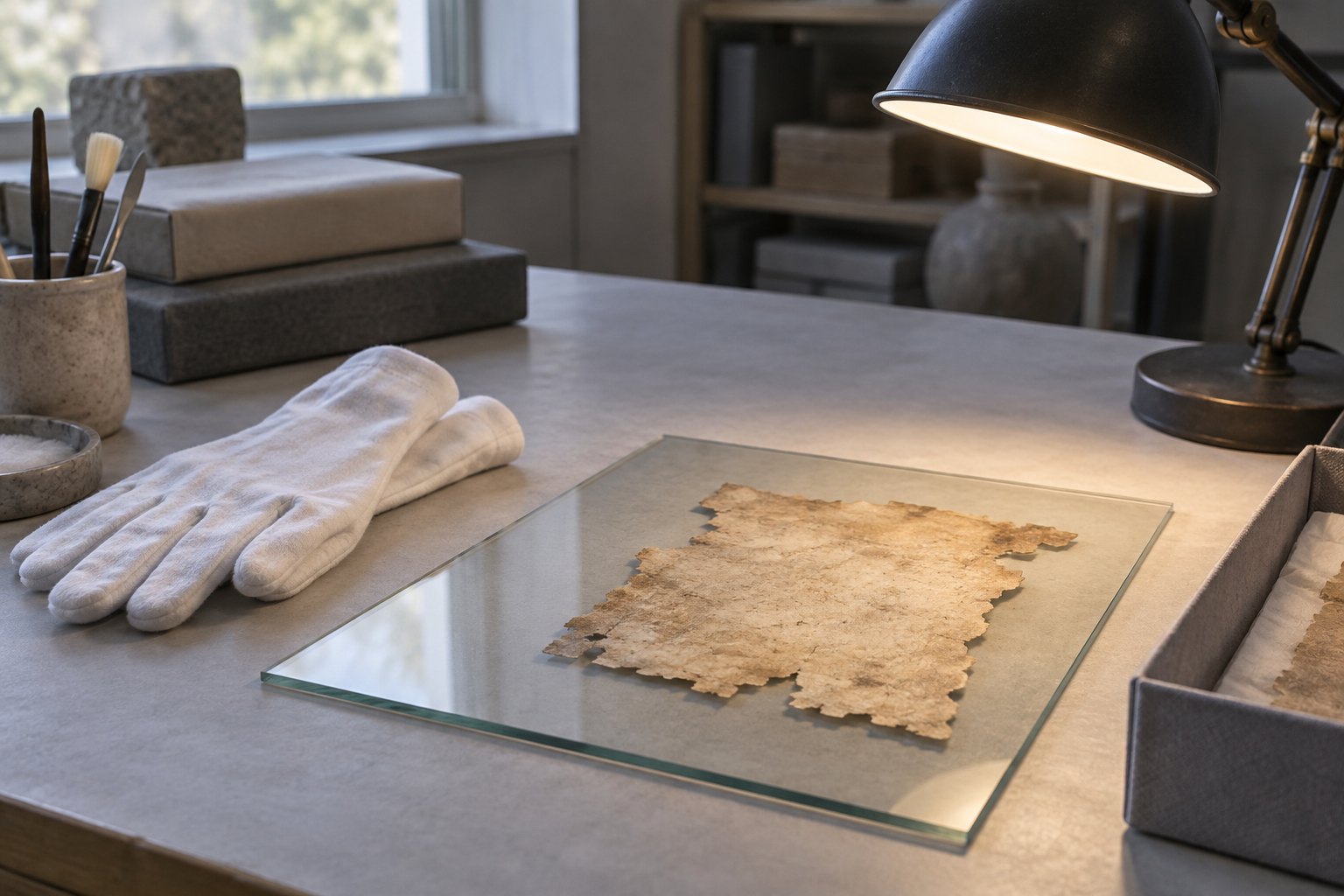
- 1 Enoch 10:4-7: Raphael binds Azazel in the desert and receives the instruction to heal the earth.
- 1 Enoch 20:3: Raphael is named in the list of holy angels, with the spirits of humanity in his charge.
- Qumran Aramaic Enoch fragments: portions of the same watcher traditions survive in copies made before the common era.
None of this makes Raphael canonical for most readers today. It does mean the name was already fixed, and already tied to healing language, centuries before medieval devotion found it.
Why does the angel introduce himself as Azariah instead of Raphael?
For most of the Book of Tobit the angel is travelling under a false name. Asked who he is, he answers that he is Azariah son of Hananiah, a kinsman hired to guide young Tobias to Media.
Both borrowed names are Hebrew sentences of the same type. Azariah means God has helped and Hananiah means God has been gracious, so the alias quietly describes what the angel is doing while concealing who he is.
I am Raphael, one of the seven angels who stand ready and enter before the glory of the Lord.
Tobit 12:15
That phrase raises its own question, because Tobit names only one of the seven. The list itself comes from elsewhere, and 1 Enoch 20 supplies it: Uriel, Raphael, Raguel, Michael, Sariel, Gabriel, and Remiel.
Raphael sits second in that sequence, which is the earliest surviving context for the number Tobit assumes his readers already know.
The reveal arrives only after the travelling, the marriage, and the healing are finished.
He names himself while refusing payment and telling the family to write the account down. The name is handed over as testimony rather than as a formula.

Modern writing that treats Raphael as a name to say aloud for healing sits awkwardly beside a story in which the angel keeps it hidden until the final chapter.
Do Rephaim and Rephaiah share Raphael's root?
Anyone following the root r-p-' through a concordance runs into the Rephaim, the giants and shades of the Hebrew Bible, and assumes a connection. The spelling invites it, and the answer is genuinely unsettled.
Two similar roots are in play. רפא, ending in aleph, carries the healing sense that produced Raphael, while רפה, ending in he, carries sinking, slackening, and growing weak.
The plural repha'im is normally written with the aleph, which points toward healing. Lexicographers still argue for the weakness root, because the word so often describes the powerless dead rather than anyone vigorous.
| Form | Where it appears | Sense usually given |
|---|---|---|
| Rephael | 1 Chronicles 26:7 | God has healed |
| Rephaiah | 1 Chronicles 3:21 and four other lists | The Lord has healed, with a different divine element |
| Rapha | 2 Samuel 21:16, as an ancestor of Philistine warriors | Contested between healer and a giant lineage |
| Repha'im | Genesis 14:5 and Isaiah 26:14 | Giants in some passages, the shades of the dead in others |
Rephaiah is the safe comparison, since it repeats Raphael's structure with the divine element swapped.
Any page that confidently derives giants from healing, or healing from giants, is reporting one side of an open argument as though it had been settled.
How is Raphael pronounced, and why does every language respell it?
English speakers split three ways here, and none of the options is a mistake. RAF-ay-el, RAY-fay-el, and RAF-eye-el all circulate, with the first two dominant in Britain and North America.
Hebrew puts the stress on the final syllable, closer to ref-ah-EL.
| Language | Written form | What changed |
|---|---|---|
| Hebrew | רְפָאֵל (Refa'el) | Stress on the last syllable |
| Greek | Ῥαφαήλ (Rhaphaēl) | The phi that western spelling turned into ph |
| Latin and English | Raphael | Fixed by liturgy and literature |
| Spanish and Portuguese | Rafael | Spelling follows the spoken f |
| Italian | Raffaele, Raffaello | Doubled f, and the form the painter used |
| French | Raphaël | The diaeresis keeps the final syllable separate |
| Ashkenazi Hebrew and Yiddish | Refoel | A different vowel tradition for the same letters |
The variation records transmission rather than disagreement, since a single name passing through Greek, Latin, and half a dozen vernaculars picks up a new spelling at each stop.
The one form worth holding apart is Rephael, and only because English translators reserved it for the gatekeeper.
Does Israfil's trumpet make him the Islamic Raphael?
Popular lists pair them without hesitation, and the pairing is thinner than it looks. Israfil is never named in the Qur'an, and the role later Islamic tradition gives him is not the role Raphael's texts give Raphael.
Israfil's defining task is the trumpet blast that ends the world and raises the dead.
Raphael's defining texts hand him healing, binding, and safe guidance. Nothing in Tobit or 1 Enoch gives him a trumpet, and nothing in the hadith material makes Israfil a healer.
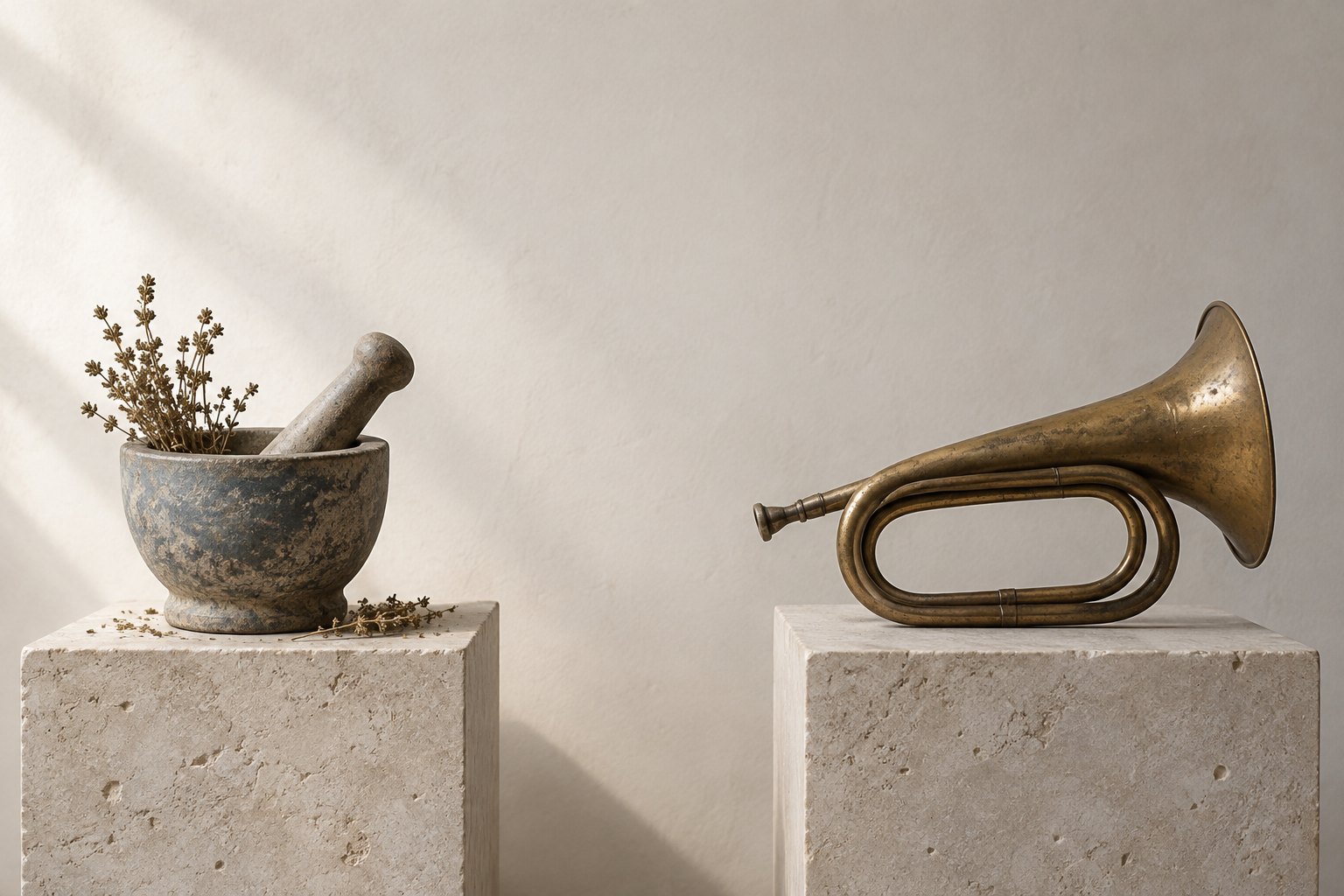
What the Raphael and Israfil comparison can carry
The two figures overlap in structure and contact, not in office.
What the evidence supports
- A matching place in the list
Both stand in a group of four leading angels alongside Michael and Gabriel.
- A matching naming pattern
Islamic tradition uses names ending in -il much as Hebrew uses the -el element.
- Genuine historical contact
Jewish, Christian, and Islamic angelologies borrowed from one another for centuries.
What remains limited
- The offices differ
The trumpet of resurrection and the healing of Tobit's blindness are not one assignment.
- No Qur'anic naming
Israfil is unnamed in the Qur'an, so the equation rests entirely on later material.
- Other candidates exist
Comparative studies also propose Uriel or Seraphiel as closer parallels to Israfil.
Saying which tradition each figure comes from is more useful to a reader than folding them into a single angel with two names.
How do you tell which Raphael a source is talking about?
Most arguments about Raphael dissolve the moment someone opens the citation. The name attracts confident statements, and the texts underneath are short enough to read in an afternoon.
Four questions to ask of any Raphael claim
Each one separates a text from an interpretation built on top of it.
- Which text is being quoted?
Tobit, 1 Enoch, and 1 Chronicles say different things and sit in different canons.
- Which spelling is used?
A source writing Rephael is usually discussing the Levite gatekeeper rather than the angel.
- Which tradition is speaking?
Catholic devotion, Jewish mystical writing, and modern angel literature make separate claims that should not be stacked.
- Is Israfil being folded in?
An Islamic role assigned to Raphael usually signals a blended list rather than a sourced statement.
The name itself makes no promise to anyone reading it. It reports a completed act of God, and every claim about what Raphael does for a person today comes from a tradition that can be named.
A claim with its tradition attached can be checked, compared, and argued with, which is the most a name can honestly offer.
Frequently Asked Questions
What does the name Raphael mean?
In Hebrew it joins rapha, to heal, with El, God, which most sources render as God has healed or God heals. The form is a statement about God rather than a description of the angel who carries it.
Is Raphael in the Bible?
The angel Raphael appears in the Book of Tobit, canonical for Catholic and Orthodox readers and outside the canon for most Protestants.
The Hebrew Bible uses the name once, at 1 Chronicles 26:7, for a Levite gatekeeper usually spelled Rephael in English.
Why is Raphael called Azariah in Tobit?
He travels under that name to keep his identity hidden, and reveals himself only at Tobit 12:15. Azariah means God has helped, so the alias describes his work while concealing who he is.
Are Rafael and Raphael the same name?
Yes. Rafael is the Spanish and Portuguese spelling, Raffaele and Raffaello are Italian, Raphael is French with a diaeresis, and Refoel reflects Ashkenazi pronunciation of the same Hebrew letters.
Is Raphael the same angel as Israfil?
Many popular lists equate them, but Israfil is unnamed in the Qur'an and is known for the trumpet of resurrection rather than for healing. Treat the pairing as a later comparison rather than a shared identity.
Sources
- (ancient). 1 Chronicles 26:7. Hebrew Bible
- (3rd to 2nd century BCE). Tobit 5:13 and 12:15. Septuagint and deuterocanonical tradition
- (3rd to 2nd century BCE). 1 Enoch 10:4-7 and 20:3. Second Temple Jewish literature
- (1906). A Hebrew and English Lexicon of the Old Testament, entries rapha and raphah. Clarendon Press
- (2024). Raphael, archangel. Encyclopaedia Britannica
About Our Editorial Process
Every KnowTheAngels guide separates calculation method, tradition context, and personal reflection. We cite where interpretations come from, present more than one view, and never present symbolic reading as prediction.
Read our editorial policy