Who Are the Angels in the Book of Enoch, and What Do They Do?
Seven named holy angels, four archangels sent against the Watchers, and the angel guides of Enoch's journeys, traced chapter by chapter through 1 Enoch
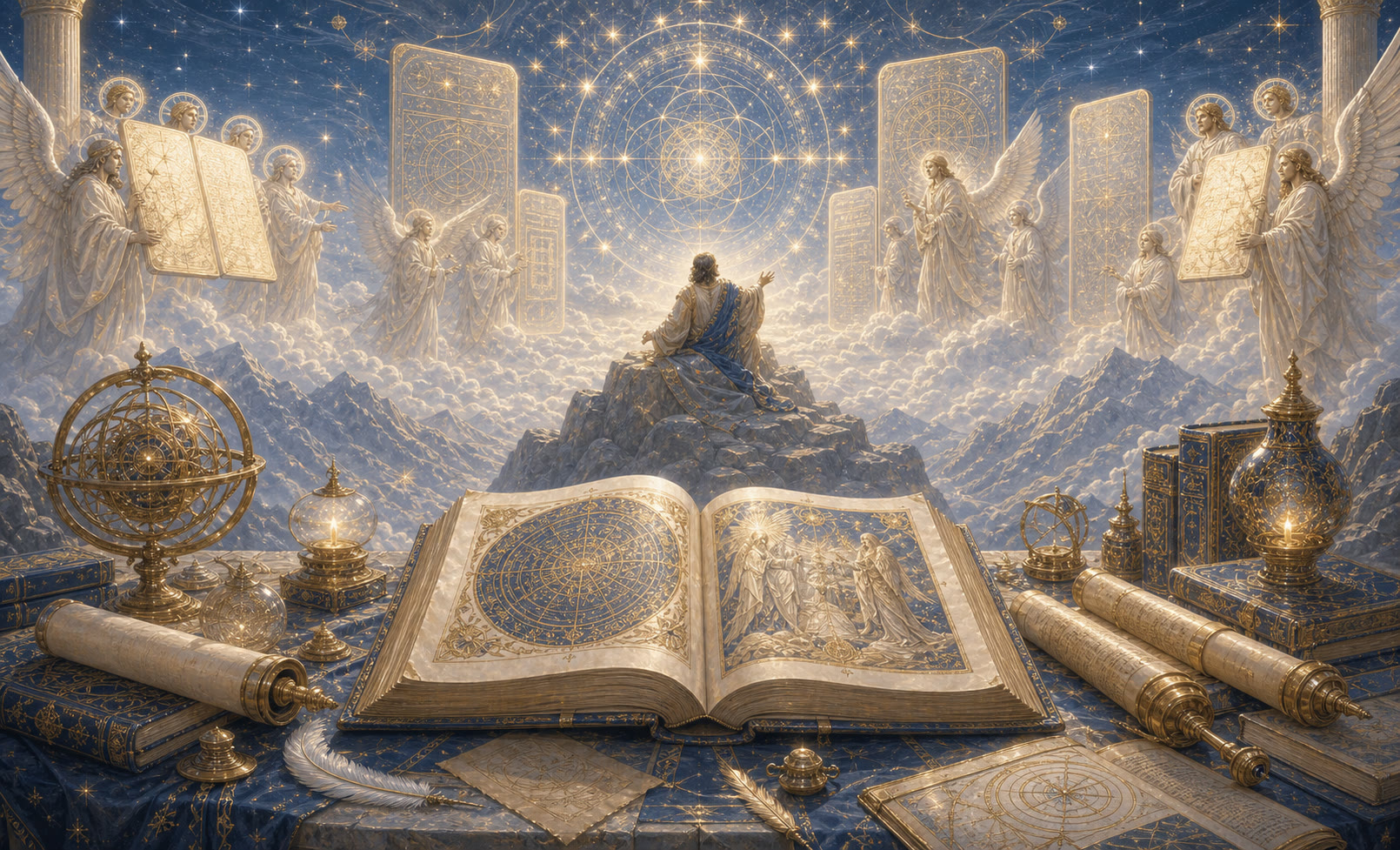
The Book of Enoch, usually called 1 Enoch, has two groups of angels at its center. The Watchers are two hundred angels who come down to earth, marry human women and teach forbidden arts. The holy angels, led by Michael, Raphael, Gabriel and Uriel, bring the Watchers' crimes before God, carry out the sentence and guide Enoch through heaven and the ends of the earth.
The book is a collection of five shorter works, originally composed in Aramaic between about the third century BCE and the turn of the era, and it survives complete only in Ge'ez, the classical language of Ethiopia. Its angel names and roles belong to Second Temple Jewish writing, which later Jewish and Christian readers accepted, borrowed from or set aside depending on their canon.
Quick Facts
- Where the angels are densest
- The Book of the Watchers, 1 Enoch 1 to 36
- Seven holy angels
- Uriel, Raphael, Raguel, Michael, Saraqael, Gabriel, Remiel (1 Enoch 20)
- Four sent against the Watchers
- Michael, Raphael, Gabriel, and Sariel or Uriel (1 Enoch 9 and 10)
- Four angels of the presence
- Michael, Raphael, Gabriel, Phanuel (1 Enoch 40:9)
- Scripture for
- The Ethiopian Orthodox Tewahedo Church
- Quoted in the New Testament
- Jude 14-15 quotes 1 Enoch 1:9
Where do angels appear across the five books of 1 Enoch?
1 Enoch is a collection of five books, and its angels change jobs from one book to the next. Most of the named angels, and the whole Watcher story, sit in the first, the Book of the Watchers (chapters 1 to 36), which Philip Esler dates with the Astronomical Book to the third century BCE.
| Book | Chapters | Angels who appear | What they do there |
|---|---|---|---|
| Book of the Watchers | 1-36 | The Watchers; Michael, Raphael, Gabriel, and Sariel or Uriel; the seven holy angels of chapter 20 | The Watchers descend and are judged; four archangels petition God and carry out the sentence; angel guides explain Enoch's journeys |
| Book of Parables | 37-71 | Michael, Raphael, Gabriel and Phanuel; seraphim, cherubim and ophannim | Four angels of the presence stand around the Lord of Spirits; Michael leads Enoch into the secrets of heaven |
| Astronomical Book | 72-82 | Uriel | Shows Enoch the laws of the sun, moon and stars and a year of 364 days |
| Book of Dreams | 83-90 | Stars that fall from heaven; seven beings "like white men" | The Animal Apocalypse retells the Watchers' fall as stars that become bulls among the cattle (86-87) |
The split explains why statements about "the angels of Enoch" often talk past each other. A writer citing Phanuel is quoting the Parables, the one book of 1 Enoch that George Nickelsburg notes is missing from the Aramaic fragments found at Qumran. A writer citing the Watchers or the list of seven is quoting the older Book of the Watchers.
Who are the seven archangels in 1 Enoch 20?
Chapter 20 is a roster headed "the names of the holy angels who watch," and it gives each angel one area of charge. The Greek text has seven names and closes with "the names of the seven archangels"; the Ethiopic copies stop at six and have no Remiel.
| Angel | Charge in 1 Enoch 20 (Charles) | Other scenes in chapters 1 to 36 |
|---|---|---|
| Uriel | "Over the world and over Tartarus" | Shows Enoch the prison of the fallen angels and stars (19, 21) and the gates of the stars (33) |
| Raphael | "Over the spirits of men" | Binds Asael (10:4) and explains the hollow places of the dead (22) |
| Raguel (Reuel) | "Takes vengeance on the world of the luminaries" | Explains a fire in the west that pursues the luminaries (23:4) |
| Michael | "Set over the best part of mankind and over chaos" | Binds Shemihazah (10:11) and explains the mountain of God's throne (24-25) |
| Saraqael (Sariel) | "Set over the spirits, who sin in the spirit" | In the Aramaic text, one of the four who bring the Watchers' crimes to God (9:1) |
| Gabriel | "Over Paradise and the serpents and the Cherubim" | Sent against the giants (10:9) |
| Remiel | "Whom God set over those who rise" (Greek only) | No other scene in chapters 1 to 36 |
Only two of these names appear in the Hebrew Bible: Gabriel in Daniel 8:16 and 9:21, and Michael in Daniel 10:13 and 12:1. Raphael names himself in Tobit 12:15 as "one of the seven angels who stand ready and enter before the glory of the Lord," a verse in the Catholic and Orthodox Old Testament, but Tobit leaves the other six unnamed, while 1 Enoch 20 gives all seven names and duties.
The charges are narrow. Raguel's is the heavenly lights and Remiel's is the dead who will rise, and modern titles such as Raguel as an angel of justice and harmony come from much later writers.
What do the archangels do about the Watchers in chapters 9 and 10?
The archangels act because of the Watchers. In chapters 6 to 8, two hundred Watchers led by Shemihazah come down on Mount Hermon, take human wives and father giants, while Asael and the other chiefs teach metalwork, weapons, cosmetics, spells and the signs of the sky.
Chapter 9 moves to heaven. Michael, Sariel, Raphael and Gabriel look down from the sanctuary, see "much bloodshed on the earth," and carry the cry of the dead to God, naming Asael and Shemihazah as its cause. The fourth name differs by manuscript: Sariel in the Aramaic fragment from Qumran, Uriel in the Greek and Suryal in the Ethiopic. That is why R. H. Charles's 1917 translation prints Uriel, while Nickelsburg and VanderKam print Sariel.
Chapter 10 answers with four commissions, one for each angel.
| Angel | Verses | Order |
|---|---|---|
| Sariel or Uriel | 10:1-3 | Go to Noah, tell him to hide, and teach him how to survive the coming flood |
| Raphael | 10:4-8 | Bind Asael hand and foot, throw him into darkness in the desert, and heal the earth the Watchers ruined |
| Gabriel | 10:9-10 | Set the giants against each other until they destroy one another |
| Michael | 10:11-15 | Bind Shemihazah and his companions for seventy generations in the valleys of the earth until the day of judgment |
Raphael's order has a close echo in Tobit, where he pursues the demon Asmodeus to Egypt and "at once bound him there hand and foot" (Tobit 8:3). In both books the same angel binds an evil spirit with the same phrase and also brings healing, to the earth in 1 Enoch and to Tobit's eyes in Tobit.
The four archangels do not deliver the verdict themselves. Enoch, whom the Watchers call "scribe of righteousness," carries it: in chapters 12 to 16 the Watchers ask him to petition God for them, he is taken up to God's throne, and he returns with a refusal, "You should intercede for men, and not men for you" (15:2).
The throne room of chapter 14 has a throne whose "wheels" shine like the sun and "ten thousand times ten thousand" attendants standing before God, and scholars have long compared it with the throne scene of Daniel 7:9-10. Chapter 15 then gives the book's account of evil spirits: when the giants die, their spirits stay on the earth, because they were "born from men and from the holy Watchers."
Which angels guide Enoch on his journeys?
From chapter 17 to chapter 36 Enoch travels to the ends of the earth, and at each stop "one of the holy angels who was with me" explains what he sees. Every guide comes from the chapter 20 roster, and the Greek and Ethiopic texts name them as follows.
| Chapters | Guide | What he explains |
|---|---|---|
| 19, 21 | Uriel | Where the angels who mingled with women stand until judgment, and seven stars bound in fire for transgressing the Lord's command |
| 22 | Raphael | Hollow places where the spirits of the dead wait for judgment, and the spirit of Abel still making suit against Cain |
| 23 | Raguel | A fire in the west that pursues all the luminaries of heaven |
| 24-25 | Michael | The highest of seven mountains as the seat of God's throne, and a fragrant tree kept for the righteous |
| 27 | Uriel | An accursed valley for "those who are accursed for ever" |
| 32 | Raphael | The tree of wisdom from which Enoch's first father and mother ate |
| 33 | Uriel | The gates of the stars, whose names and times he writes down for Enoch |
Several explanations match the guide's charge in chapter 20. Uriel, set over Tartarus, shows the prison of the angels; Raguel, who "takes vengeance on the world of the luminaries," explains the fire that pursues them; Michael, set over the best part of mankind, explains the tree kept for the righteous.
Nickelsburg and VanderKam carry the match further and emend two names to follow chapter 20: Sariel for Uriel at 27:2, and Gabriel, who is over Paradise, for Raphael at the tree of wisdom in 32:6. Those readings are editorial reconstructions, since the surviving Greek and Ethiopic copies have Uriel and Raphael.
Who are the four angels of the presence in the Parables?
The Book of Parables (chapters 37 to 71) has its own set of four. In chapter 40 Enoch sees four figures on the four sides of the Lord of Spirits and hears four voices, and the angel of peace who travels with him names them in 40:9.
- Michael, "the merciful and long-suffering," whose voice blesses the Lord of Spirits.
- Raphael, "set over all the diseases and all the wounds of the children of men," whose voice blesses the Elect One and the elect.
- Gabriel, "set over all the powers," whose voice prays for those who dwell on the earth.
- Phanuel, "set over the repentance unto hope of those who inherit eternal life," whose voice fends off the Satans and forbids them to accuse people before God.
Phanuel takes the fourth place that Sariel or Uriel holds in chapter 9, so the Enochic books did not keep one fixed set of four archangels.
Chapter 71 closes the Parables with Enoch taken up again. Michael takes him by the hand and shows him "all the secrets of righteousness," the four come out with the Head of Days, and seraphim, cherubim and ophannim guard the throne as "they who sleep not."
Scholars date the Parables less securely than the rest of 1 Enoch: they are absent from the Qumran fragments, and Harkins, Coblentz Bautch and Endres call their dating obscure. A claim that rests on Phanuel or on chapter 71 therefore rests on a text whose date is still debated.
Is the Book of Enoch in the Bible?
It depends on the church. The Ethiopian Orthodox Tewahedo Church lists Enoch among the 46 books of its Old Testament, beside Jubilees. Jewish Bibles and the Catholic, Eastern Orthodox and Protestant Old Testaments do not include it.
The New Testament knows the book. Jude 14-15 quotes 1 Enoch 1:9, "See, the Lord is coming with ten thousands of his holy ones, to execute judgment on all," and names "Enoch, in the seventh generation from Adam" as its speaker. Jude 6, on angels who "deserted their proper dwelling" and are "kept in eternal chains in deepest darkness," is read by many scholars as the clearest New Testament reference to the Watchers' judgment.
Early Christian writers disagreed about what Jude's quotation proved. Tertullian, in On the Apparel of Women 1.3, defended Enoch as scripture partly because "Enoch possesses a testimony in the Apostle Jude." Augustine, in The City of God 15.23, granted on Jude's word that Enoch "left some divine writings," but kept them out of the canon because "their antiquity brought them under suspicion" and their authorship could not be confirmed.
The popular question of why Enoch was removed from the Bible assumes it was once in most Bibles, and the record points the other way. It stood outside the Hebrew canon Augustine described, its Aramaic original disappeared, and its Greek survived only in part, so the complete book lasted in Ethiopia, where the church read it as scripture and translated it into Ge'ez between the fourth and sixth centuries. Qumran Cave 4 later yielded eleven Aramaic manuscripts of parts of 1 Enoch, covering about a fifth of the Ethiopic text.
Frequently Asked Questions
How many archangels are in the Book of Enoch?
Chapter 20 lists seven in the Greek text and six in the Ethiopic, which lacks Remiel. Chapters 9 and 10 work with four (Michael, Raphael, Gabriel, and Sariel or Uriel), and the Parables name a different four in 40:9, with Phanuel in the fourth place.
Who is Phanuel in 1 Enoch?
Phanuel is the fourth angel of the presence in 1 Enoch 40:9, "set over the repentance unto hope of those who inherit eternal life." His voice fends off the Satans and forbids them to accuse people before the Lord of Spirits (40:7).
Did Enoch become an angel?
Not in 1 Enoch, where he stays a human scribe who is taken up to see heaven and carries God's verdict to the Watchers. The identification with an angel comes later: Targum Pseudo-Jonathan on Genesis 5:24 says Enoch was called "Metatron the Great Saphra" (scribe), and 3 Enoch, a Hebrew work of the Hekhalot literature, tells how he was transformed into Metatron.
Does the New Testament quote the Book of Enoch?
Yes. Jude 14-15 quotes 1 Enoch 1:9 and attributes it to "Enoch, in the seventh generation from Adam." Tertullian treated that quotation as support for the book, while Augustine accepted it as proof that Enoch wrote something and still kept the book outside the canon.
Is 1 Enoch apocrypha or pseudepigrapha?
Scholars usually call it pseudepigrapha, a work written under the name of an ancient figure, since its books date from about the third century BCE onward and the Enoch of Genesis 5:21-24 belongs to the generations before the flood. Many church readers use apocrypha loosely for any book outside their canon, and for the Ethiopian Orthodox Tewahedo Church it is neither, because it is part of the Old Testament.
Sources
- (2012). 1 Enoch: The Hermeneia Translation, 1 Enoch 1:9; 6:1-8:3; 9:1 (note b); 10:1-15; 20:1-8; 22:3-7; 23:4; 24:6; 27:2; 32:6 (note a); 33:3. Fortress Press, sample chapter. Link
- (1917). The Book of Enoch, chapters 9, 10, 14, 15, 20, 22, 24, 27, 32, 40, 71, 86 and 87. SPCK; Wikisource. Link
- (2001). 1 Enoch 1: A Commentary on the Book of 1 Enoch, Chapters 1-36; 81-108. Hermeneia, Fortress Press
- . Dead Sea Scrolls Spotlight: The Book of Enoch. Biblical Archaeology Society Library. Link
- (2018). Taking 1 Enoch Seriously. The Bible and Interpretation, University of Arizona. Link
- (2014). Introduction, pages 1-8 (Jude 6; the throne visions of 1 Enoch 14 and Daniel 7). The Watchers in Jewish and Christian Traditions, Fortress Press. Link
- . The Bible: The Holy Books of the Old Testament. Official church website. Link
- (2021). Jude 6 and 14-15; Tobit 8:3 and 12:15. Bible Gateway. Link
- (c. 200). On the Apparel of Women, book 1, chapter 3. New Advent. Link
- (c. 426). The City of God, book 15, chapter 23. New Advent. Link
- . Targum Jonathan on Genesis 5:24. Sefaria. Link
About Our Editorial Process
Every KnowTheAngels guide separates calculation method, tradition context, and personal reflection. We cite where interpretations come from, present more than one view, and never present symbolic reading as prediction.
Read our editorial policy