Who Is Angel Vretiel, and What Is His Role in 2 Enoch?
The heavenly scribe also called Pravuil or Vrevoil, the books given to Enoch, and why the angel's name changes across Slavonic manuscripts

Angel Vretiel appears in the transmission of 2 Enoch as a heavenly scribe, teacher, and keeper of divine books.
The figure's role is unusually concrete: Vretiel brings writing materials, instructs Enoch, and enables him to record the knowledge disclosed in heaven.
The name is less concrete than the job.
English readers may encounter Pravuil, Vretil, Vretiel, Vrevoil, Vreveil, Vereveil, or other forms depending on the manuscript, recension, transliteration, and translation.
That variation is the central issue, not a minor spelling note.
It shows how an angelic name can change while a narrative function remains recognizable.
The best answer to “who is Vretiel?” therefore begins with the scene in 2 Enoch, then moves to the manuscript problem and only afterward considers later identifications with Uriel, Phanuel, Radueriel, or other recording angels.
Quick Facts
- Primary source
- 2 Enoch, especially the writing scene in chapters 22–23
- Main role
- Heavenly scribe and instructor of Enoch
- Common variants
- Pravuil, Vretil, Vrevoil, Vereveil
- Writing result
- Enoch records 366 books in the longer recension
- Name meaning
- Uncertain because the Slavonic forms diverge
- Identity debate
- Sometimes compared with Uriel or Phanuel
Who is Vretiel in the story of 2 Enoch?
Vretiel is the archangel summoned after Enoch has been transformed and brought before the Lord. The angel is described as exceptionally knowledgeable and associated with writing the deeds of God.
The Lord orders the angel to bring books from the heavenly storehouses, provide a reed or pen for rapid writing, and give Enoch selected books to read. This makes Vretiel a mediator of recorded knowledge rather than the guide for Enoch's entire ascent.

The episode belongs to the wider world of apocryphal angel names. It is not a scene from Genesis, which names Enoch but does not describe this heavenly library or its scribe.
Why is Vretiel also called Pravuil or Vrevoil?
2 Enoch survives in Slavonic manuscript traditions rather than in an agreed ancient-language original. Its longer and shorter recensions preserve differences in wording, sequence, and proper names, so translators must decide how to represent unstable forms.
| Form | Where readers meet it | What it signals |
|---|---|---|
| Pravuil | Older English translation of one manuscript line | A distinct Slavonic reading |
| Vretil or Vretiel | Alternative manuscript and dictionary forms | The same scribal role |
| Vrevoil or Vreveil | Modern transliterations of Slavonic witnesses | Closer attention to manuscript spelling |
| Vereveil | Scholarly English rendering | Another attempt to vocalize the transmitted form |
The variants should not be counted as four independent angels. They occupy the same narrative position, receive the same command, and perform the same instructional task.

This transmission problem resembles other cases where a copied angel name changes across languages. The proper response is to cite the edition and spelling used, not to smooth every form into a confident Hebrew angel-name meaning.
What does the name Vretiel mean?
There is no secure consensus translation for Vretiel. The final letters resemble the divine ending in many names ending in El, but Slavonic transmission makes a confident reconstruction of the full form impossible.
One scholarly proposal treats Pravuil as a corruption of Phanuel and Vretil as a corruption of Uriel. The proposal depends on reconstructing Hebrew letterforms behind the Slavonic readings, which makes it an argument about textual ancestry rather than a dictionary definition.
Four different questions hidden inside “meaning”
The role, spelling, reconstruction, and devotional reading do not answer the same question.
Strongly supported by the scene
Directly observable in transmission
A scholarly hypothesis
A useful summary, not an etymology
For readers, “heavenly scribe in 2 Enoch” is therefore more reliable than a polished English translation. Function supplies the identity that the unstable consonants cannot.
The book storehouse makes Vretiel a working scribe
The objects in the scene create a complete scribal workflow. Books come from storage, a writing implement is prepared, instruction is delivered, and Enoch produces a record for transmission.
The heavenly writing sequence
Each action moves knowledge from the divine storehouse into Enoch's humanly transmissible record.
- Retrieve
- Input
- Books held in heavenly storehouses
- Action
- The angel brings out selected volumes.
- Result
- Knowledge is presented as already ordered
- Equip
- Input
- A reed or pen for rapid writing
- Action
- Vretiel gives Enoch the means to record.
- Result
- Vision becomes a scribal task
- Teach
- Input
- Cosmic and earthly subjects
- Action
- The angel explains what is fitting to learn.
- Result
- Enoch receives a curriculum
- Transmit
- Input
- The completed instruction
- Action
- Enoch writes 366 books.
- Result
- Heavenly knowledge enters a textual chain

The number 366 corresponds suggestively to the full days of a leap-length solar year. In 2 Enoch's broader interest in calendars and cosmic order, that total makes the written corpus feel encyclopedic, though it should not be converted into a surviving catalog of 366 identifiable books.
The scene also explains why Vretiel later appears beside other disputed celestial names. The comparison grows from a shared office, not necessarily from proof that every scribal title names the same being.
What knowledge passes from Vretiel to Enoch?
The instruction ranges across heaven, earth, sea, elements, celestial movements, thunder, the Sun and Moon, stars, seasons, years, days, hours, winds, angels, songs, human life, commandments, and languages. The list joins cosmology, calendrical science, worship, and ethics.

That breadth matters because it prevents the figure from shrinking into a clerk who merely copies names. Vretiel organizes knowledge and prepares Enoch to understand what he records.
The role is close to later wisdom-angel traditions, while angels in 1 Enoch often guide visions, interpret cosmic structures, or announce judgment in different literary settings. Similar subject matter does not make 1 Enoch and 2 Enoch one book.
The curriculum also gives a better modern reading than claims about automatic secret knowledge. The narrative emphasizes disciplined receiving, ordering, and writing, not a shortcut that removes study.
Is Vretiel the same angel as Uriel or Radueriel?
Possibly in a history-of-transmission sense, but not demonstrably in every source. Uriel teaches Enoch about celestial movements in 1 Enoch, while Vretiel instructs and equips Enoch in 2 Enoch, so the figures share an intellectual setting.
The similarity supports the proposal that a damaged or transformed Uriel name lies behind Vretiel. It does not erase the actual Slavonic form preserved by 2 Enoch or prove that every reader of the text understood the angel as Uriel.
| Figure | Primary setting | Connection to Vretiel |
|---|---|---|
| Uriel | Enochic and Ezra traditions | Cosmic instruction and a proposed name reconstruction |
| Phanuel | 1 Enoch and later interpretation | Another proposed reconstruction behind Pravuil |
| Radueriel | Later Jewish mystical texts | Heavenly books, poetry, and scribal authority |
| Metatron | Hekhalot and 3 Enoch traditions | A major heavenly scribe with a different textual history |
The Metatron tradition is especially important as a comparison because Enoch and heavenly record keeping later converge there. That convergence belongs to another corpus and should not be projected backward as the simple explanation of Vretiel.
A source-aware article can hold both facts at once: the figures resemble one another, and their names, texts, and reception histories remain distinguishable.
Do not carry Vretiel from 2 Enoch into 1 Enoch
The titles 1 Enoch and 2 Enoch can make the works sound like consecutive volumes, but they are different compositions with different textual histories. First Enoch survives completely in Ge'ez and contains several component works, while 2 Enoch is preserved primarily through Slavonic witnesses.
In 1 Enoch's angel traditions, named figures such as Uriel interpret cosmic structures, announce judgment, or guide the visionary through particular revelations. The Vretiel episode belongs to 2 Enoch's separate account of transformation, instruction, and writing.
What the two Enoch books do and do not support
The shared figure of Enoch does not make every angelic teacher or textual setting interchangeable.
What the evidence supports
- 1 Enoch preserves its own teaching scenes
Its component books use guided visions and named archangels, including Uriel, in roles that belong to those episodes.
- 2 Enoch preserves a concentrated scribal scene
Its Slavonic recensions place Pravuil, Vretiel, or Vrevoil in the office that instructs Enoch before he writes an encyclopedic set of books.
What remains limited
- A shared protagonist does not prove a shared instructor
The name Vretiel should not be inserted into 1 Enoch merely because both works concern Enoch and heavenly knowledge.
- Parallel themes do not collapse textual history
Different languages, recensions, teaching forms, and named figures must remain visible when the traditions are compared.
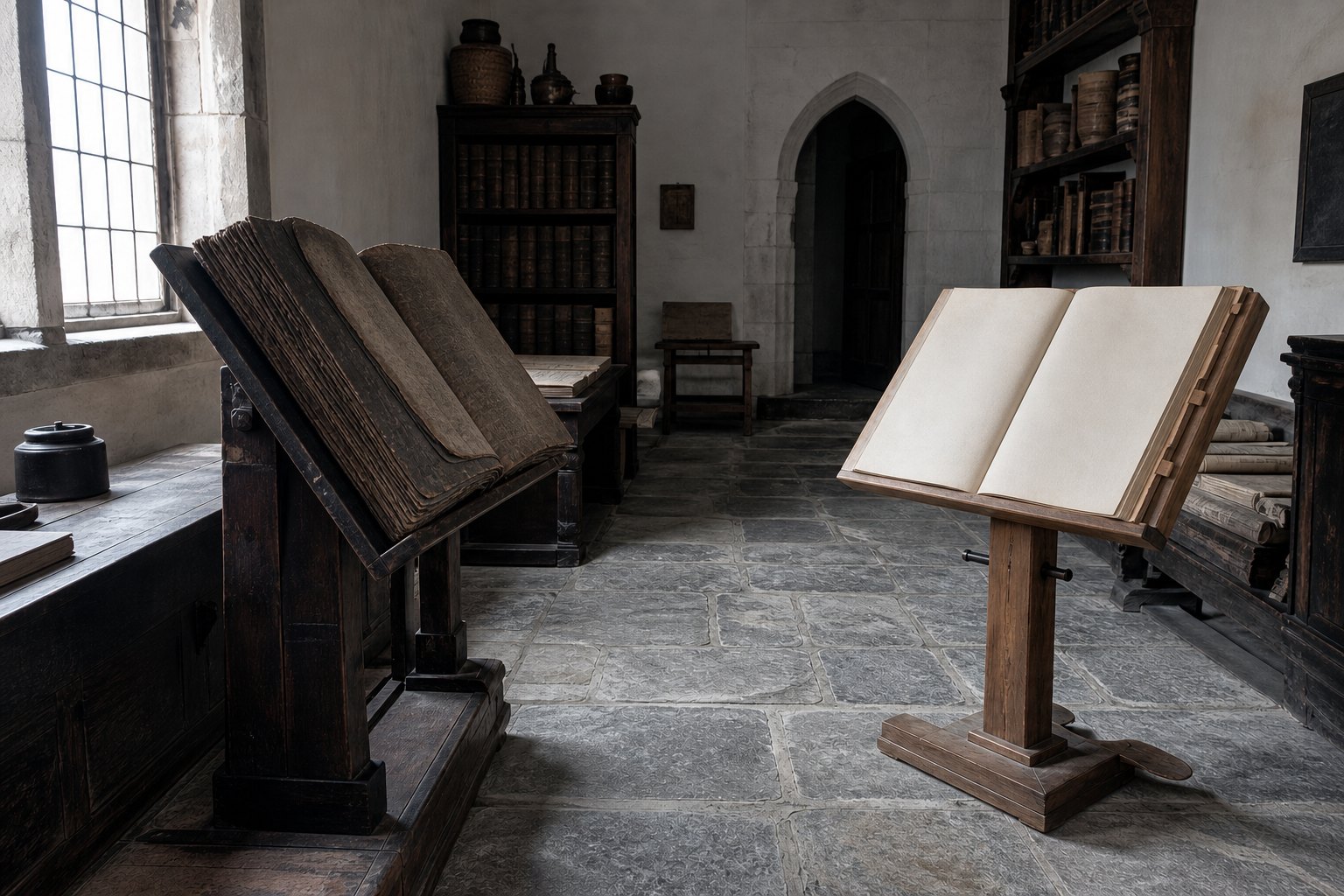
Similar roles can support a historical comparison, while differences in language, date, manuscript survival, and narrative design prevent one book from supplying missing details for the other.
For Vretiel, this means Uriel's better-known identity should not swallow the Slavonic evidence. Readers need to see the actual 2 Enoch name variants before considering a reconstruction behind them.
What can the recording-angel image mean today?
Vretiel can symbolize the responsibility to preserve knowledge accurately. The episode values attention, ordered study, faithful copying, and transmission that does not pretend a private impression is self-authenticating.
That reading differs from claiming that an angel will dictate facts, guarantee memory, or reveal a secret text. Historical study still requires editions, translations, comparison, and clear labels for uncertainty.

- Record the source: Keep the edition, chapter, and spelling with every claim.
- Separate observation from reconstruction: State what the manuscript reads before proposing an older form.
- Preserve variants: Do not delete differences simply to make the tradition look uniform.
- Transmit with limits: Explain what remains uncertain instead of filling gaps with confidence.
The figure's real distinctiveness lies in this chain of custody for knowledge. Vretiel brings, teaches, and equips; Enoch writes; later manuscripts preserve the episode imperfectly; modern readers compare the witnesses.
That complete chain answers both major search questions. Vretiel is the heavenly scribe and instructor in 2 Enoch, while the angel's “meaning” is best expressed through that role because the transmitted name itself remains textually unstable.
Frequently Asked Questions
Who is Angel Vretiel?
Vretiel is the heavenly scribe and instructor in some manuscripts and translations of 2 Enoch. The angel brings books and writing materials so Enoch can record revealed knowledge.
Are Vretiel and Pravuil the same angel?
They are variant names for the figure occupying the same scribal scene in different textual witnesses and translations of 2 Enoch.
What does Vretiel mean?
No secure word-for-word translation is agreed. The narrative role as heavenly scribe is clearer than the etymology of the changing Slavonic forms.
Is Vretiel another name for Uriel?
Some scholars propose that Vretiel is a corrupted or transformed Uriel form. The textual resemblance is plausible, but it remains a reconstruction rather than a universally settled identity.
How many books did Enoch write after Vretiel's instruction?
The longer form of 2 Enoch says that Enoch wrote 366 books after thirty days and nights of instruction.
Sources
- (ancient work preserved in medieval Slavonic manuscripts). 2 Enoch 22–23. Slavonic apocalypse
- (1896). The Book of the Secrets of Enoch. Clarendon Press
- (1983). 2 (Slavonic Apocalypse of) Enoch. The Old Testament Pseudepigrapha, Volume 1
- (2005). The Enoch-Metatron Tradition. Mohr Siebeck
- (1928). 3 Enoch or The Hebrew Book of Enoch. Cambridge University Press
About Our Editorial Process
Every KnowTheAngels guide separates calculation method, tradition context, and personal reflection. We cite where interpretations come from, present more than one view, and never present symbolic reading as prediction.
Read our editorial policy