What Does Angel Number 999 Mean for Endings and Release?
Why 9 + 9 + 9 comes back to 9, where the completion reading started, and the ordinary reasons 999 turns up so often
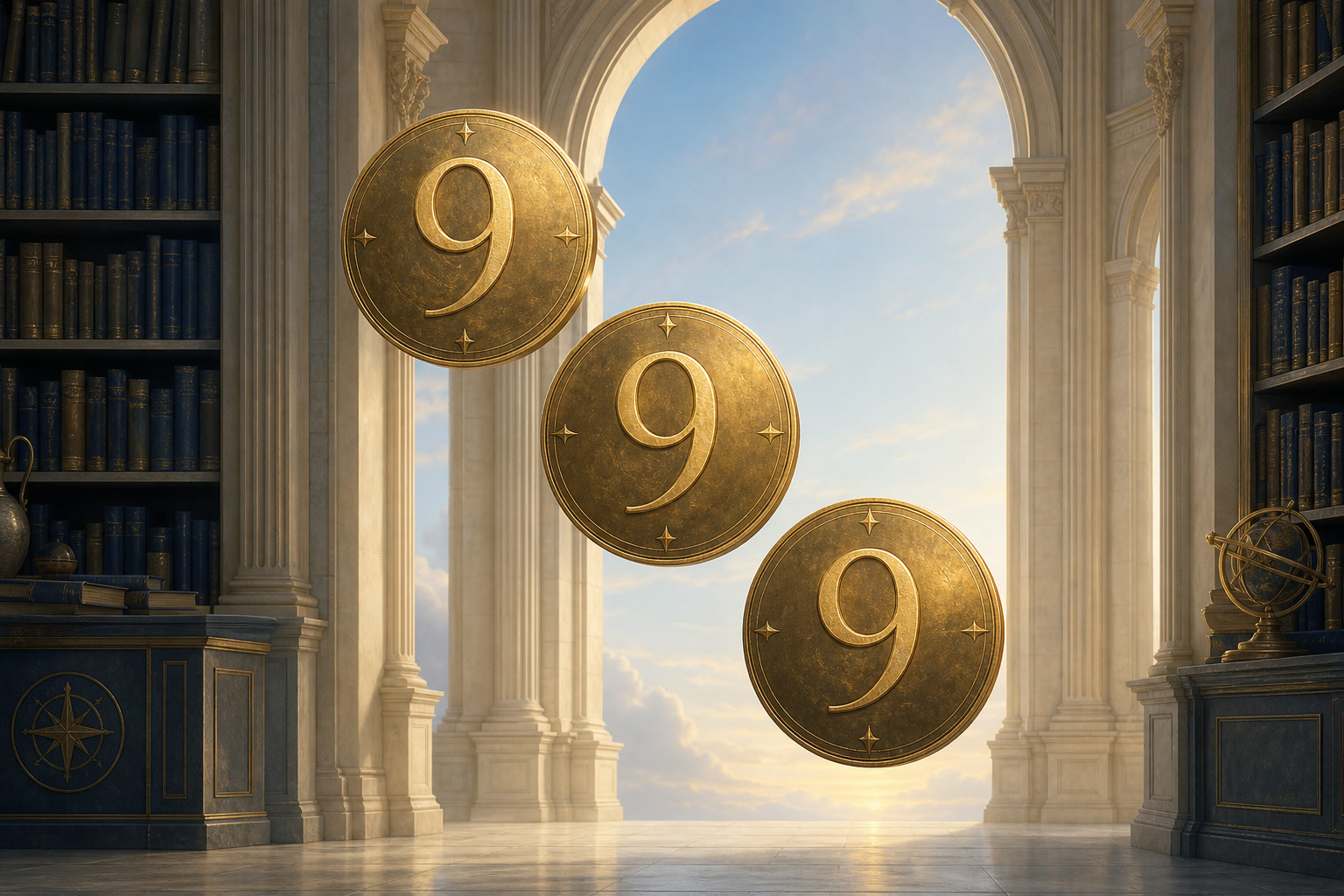
The completion reading of angel number 999 is older than most of the guides that repeat it. It appears in Doreen Virtue's Healing with the Angels (1999), where 999 means completion, the end of a big phase in personal or global life, followed by a message telling lightworkers to get to work because Mother Earth needs them. Current guides keep both halves: an ending, and a push toward service.
Numerology explains why the reading has only one theme. Three nines add to 27, and 27 reduces to 9 again, so 999 is the one triple repdigit that lands on its own digit. Hans Decoz describes 9 as the number of finality and the completion of an era, and in his personal-year cycle a 9 year is followed by a 1 year that opens the next cycle. The number cannot say which part of a life is ending, and the Chinese reading of 9 as endurance shows that the completion meaning belongs to one tradition among several.
Quick Facts
- Digit sum
- 9 + 9 + 9 = 27, then 2 + 7 = 9
- Reduction
- Returns to its own digit, the only triple repdigit that does
- Numerology theme of 9
- Finality, completion of an era, humanitarian concern (Decoz)
- First angel-number entry
- Virtue, 1999: completion, the end of a big phase
- Chinese association
- 9 (jiu) sounds like jiu, long-lasting
- Emergency number
- 999 in the UK since 30 June 1937, and in many other countries
Why is 999 the only triple number that reduces to itself?
Pythagorean reduction adds digits until one remains: 9 + 9 + 9 = 27, then 2 + 7 = 9. Run the same step on every triple repdigit and 999 is the only one that returns to the digit it started with.
| Sequence | Digit sum | Reduces to | Same as its own digit? |
|---|---|---|---|
| 111 | 3 | 3 | No |
| 222 | 6 | 6 | No |
| 333 | 9 | 9 | No |
| 444 | 12 | 3 | No |
| 555 | 15 | 6 | No |
| 666 | 18 | 9 | No |
| 777 | 21 | 3 | No |
| 888 | 24 | 6 | No |
| 999 | 27 | 9 | Yes |
The cause is plain arithmetic. A triple repdigit always adds up to three times its digit. Three times 9 is 27, a multiple of 9, and every multiple of 9 reduces to 9; for the other eight digits, tripling moves the sum to a different root. Decoz points to the same property of 9 in general: add 9 to any number and reduce, and the result "comes back to itself as if nothing was added at all", while any number multiplied by 9 reduces to 9.
The table also shows that 666 and 333 reduce to 9 as well, so ending on 9 is common; what only 999 does is start and finish on the same digit. For interpretation, that leaves 999 without an undertone. 888 reads as 8 finishing on 6, and 666 as 6 finishing on 9: each is a pair of ideas. 999 presents the 9 reading at the surface, at the midpoint 27 and at the root. Numerology offers no second theme through which the ending could be read as something else.
Who tied 999 to completion and lightworkers?
Two writers supply most of the meaning. For the single digit 9, Decoz writes that when 9 appears as a cycle it "often denotes a finality, the completion of an era", and he gives 9 a humanitarian side as well: a number with global concern, drawn to causes that serve people it will never meet. Ending and service are both carried into 999.
Virtue's 1999 entry puts the two together. It opens with completion and the end of a big phase, then turns to lightworkers involved in Earth-healing work and tells them to get to work because Mother Earth needs them now. Current guides mostly lead with the first half, the closing chapter, and treat the service call as secondary.
The position of 9 explains why numerology reads it as closing a sequence. Nine is the last single digit before counting reaches 10, and 10 reduces to 1. In Decoz's personal-year system, the 9 year is a time to finish unfinished business and clear out what is no longer used, and the next year, a 1, starts a new nine-year epicycle.
Do 999 endings point forward?
In numerology they do, by construction. The digit after 9 is the 1 of 10, and the 9 personal year hands over to a 1 year, so an ending read through 9 already implies a new start at 1. The number does not say how long the gap between the two will last or whether the next phase will be better. Neither Decoz's cycle nor Virtue's entry promises improvement.
The practical weight therefore falls on finishing well. Decoz's 9 year is for finishing unfinished business, which in ordinary terms means a conversation had, a project handed over or belongings returned. One way to make an ending deliberate:
- Name what is ending. Write down the specific relationship, role, habit or belief. "My role as the person who manages my mother's expectations" gives something to act on; "my old life" does not.
- List what it gave and what it cost. Three of each: skills gained, people met, time spent, parts of yourself set aside.
- Make one physical closing act. Return a borrowed object, archive the messages, write a letter you do not send, or hand back the keys.
- Leave the space empty for a set time. Wait a few days before filling the gap with a replacement project or relationship, so the next start is chosen and not a reflex.
Some endings are losses, and grief runs on its own timetable; a number sighting does not shorten it. When a loss is heavy or low mood lasts for weeks, a doctor or counsellor can help in ways a number reading cannot.
What does 999 mean in love when a relationship is kept going from habit?
In love readings, 999 asks whether a relationship has reached its end or is going through a hard stretch. Only the first fits the 9 reading. A relationship with an unresolved problem still has work left in it, while one kept going from habit, guilt or fear of being alone has none.
| Situation | What the completion reading looks at | Question to answer |
|---|---|---|
| Single | Attachment to a past partner | Is there room for someone new, or is a former partner still taking it up? |
| New relationship | Habits carried over from the last one | Are you responding to this person or to the last one? |
| Established partnership | Whether the relationship has run its course or hit a problem | Is there a specific problem to work on, or only the habit of staying? |
| After a breakup | Whether the ending has been finished | Have belongings, shared accounts and daily contact actually been closed? |
After a breakup, the 9 reading applies to the practical ending as much as the emotional one. Returning belongings, closing a joint account and stopping the daily check on the other person's profile are the practical side of the completion the 9 reading describes, and they come before any new start.
Does 999 mean I should quit my job?
999 can mark the end of a working chapter, but no numerology source treats it as an instruction to resign. Decoz's 9 finishes business that is already unfinished; it does not create an exit. The clearer test is whether the work the role was taken on for is done: a project delivered, a team trained, a skill learned. If it is, a planned handover fits the 9 reading. If the restlessness comes from tiredness while the work is still half done, the same reading points to finishing first.
Decoz's humanitarian 9 and Virtue's call to lightworkers add a second question for anyone choosing what comes next: whether the next role serves people beyond yourself. That question applies to the choice of a new job, not to the decision to leave the current one.
Does 999 have a biblical or Chinese meaning?
The Bible never uses the number 999. Sites that offer a biblical meaning build it from passages about 9: Jesus cries out at the ninth hour before his death (Mark 15:34), and Paul's list of the fruit of the Spirit in Galatians 5:22-23 names nine qualities in the King James Version. Tripling those into 999 is modern devotional interpretation.
Chinese tradition reads 9 very differently. The word for nine (九, jiu) sounds like 久 (jiu), "long-lasting", which is why 9 is used at weddings, and nine was historically associated with the emperor. Tripled, the Chinese association is endurance, close to the opposite of the Western completion reading. The same three digits therefore mean an ending in angel-number writing and permanence in Chinese usage, and each meaning belongs to its tradition.
Why do I keep seeing 999? The 1937 emergency number and prices ending in 9
In the United Kingdom, Ireland, Hong Kong, Malaysia, Singapore, Bangladesh and a number of other countries, 999 is the emergency telephone number. It was introduced in the London area on 30 June 1937, making it the oldest emergency call number in the world, and it was chosen partly because the 9 on a rotary dial could be found by touch in darkness or smoke.
Prices are the other large source. A 1997 study of advertising found that about 60 percent of prices ended in 9, because shoppers anchor on the left-hand digit and read 9.99 as nearer 9 than 10. Many video games also cap scores at 999. Once the number has been noticed, the frequency illusion that the linguist Arnold Zwicky named in 2005 makes every new instance stand out.
A sighting on an ambulance or a price tag has a plain cause. A recurring number that keeps turning up around one specific decision, noted with its date and context, is the kind of sighting the completion reading was written for.
Frequently Asked Questions
Is 999 a good or bad sign?
None of the traditions above treats it as bad luck. In Virtue's list it marks completion and a call to service, in Decoz's numerology 9 is finality followed by a new cycle, and in Chinese usage 9 sounds like "long-lasting" and is lucky. The ending it describes can still be painful.
What does 999 mean for twin flames?
Twin-flame writers, including mindbodygreen's 999 guide, read it as a sign that the connection serves a larger spiritual mission or that one phase of it is closing. That reading is a modern online convention. Numerology gives 999 no twin-flame calculation, only the 9 theme of finishing what is complete.
Do 9, 99 and 999 all reduce to 9?
All three reduce to 9, so none of them picks up a second theme. The path differs: 9 stands alone, 99 passes through 18 and 999 through 27. Virtue's 1999 entry gives the triple the largest scale: the end of a big phase in personal or global life.
Sources
- (1999). Healing with the Angels. Hay House; number-sequence chapter, entry for 999. Link
- (n.d.). Numerology Meaning of the Number 9. World Numerology. Link
- (n.d.). Personal Year Number 9. World Numerology. Link
- (2026). 999 (number). Wikipedia, mathematics and video-game score limits. Link
- (1611). Mark 15:34. BibleGateway. Link
- (1611). Galatians 5:22-23. BibleGateway. Link
- (2026). Chinese numerology. Wikipedia, section on the number 9. Link
- (2026). 999 (emergency telephone number). Wikipedia. Link
- (2026). Psychological pricing. Wikipedia, citing the 1997 Marketing Bulletin study and Thomas and Morwitz on the left-digit effect. Link
- (2019). Frequency illusion in the OED. Language Log account of Arnold Zwicky's 2005 term. Link
- (n.d.). 999 Angel Number Meaning For Life, Love & More. mindbodygreen, section on twin flames. Link
About Our Editorial Process
Every KnowTheAngels guide separates calculation method, tradition context, and personal reflection. We cite where interpretations come from, present more than one view, and never present symbolic reading as prediction.
Read our editorial policy