What Does Angel Number 99 Mean for Full-Cycle Completion?
Why 9 + 9 = 18 returns to 9, where 99 appears in Islamic and biblical tradition, and how to recognise an ending that is already underway
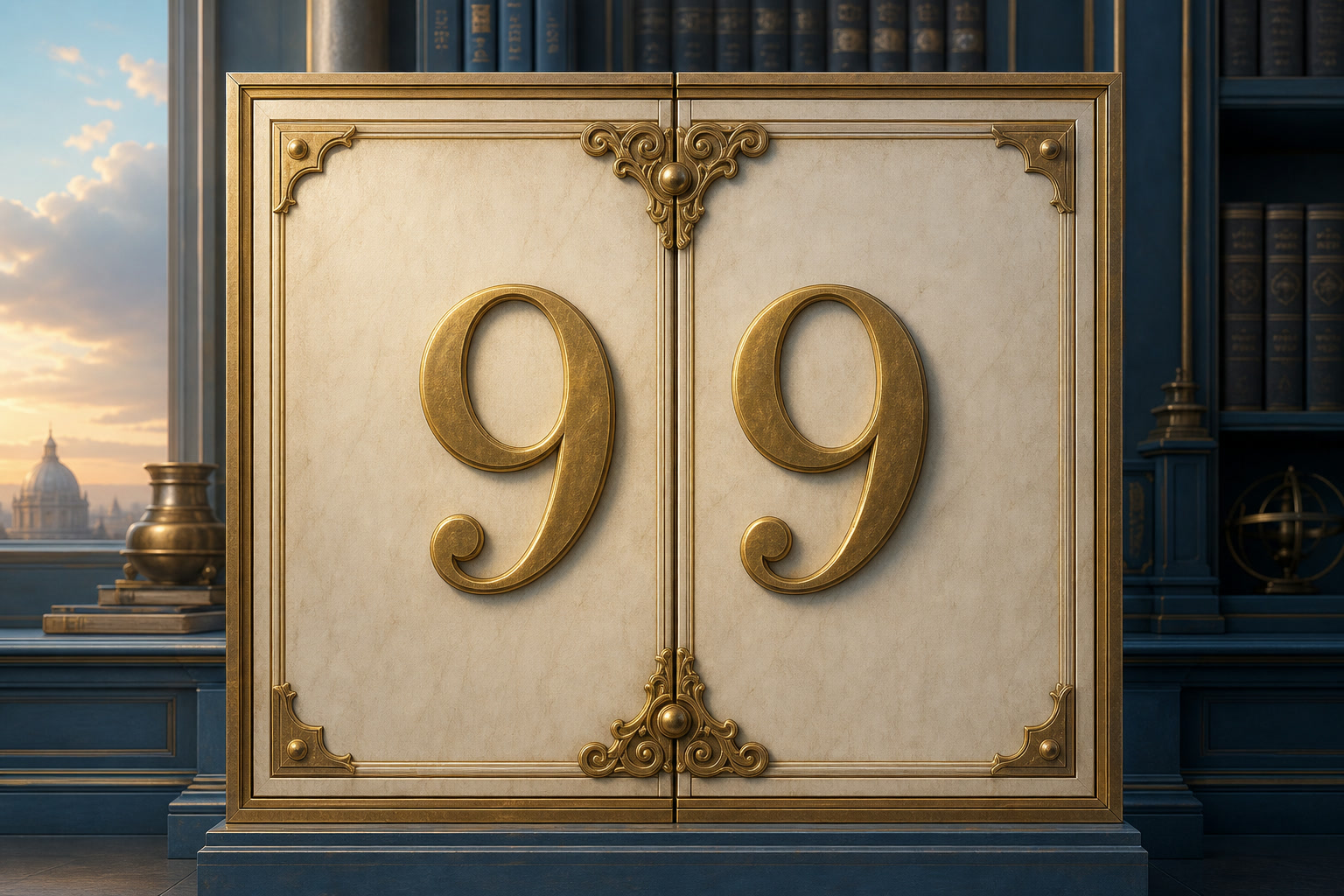
Angel number 99 repeats the last single digit, and its reduction goes nowhere else: 9 + 9 = 18, and 1 + 8 = 9. Every other doubled number from 11 to 88 reduces to a different digit (11 to 2, 55 to 1, 88 to 7), so modern angel-number writers treat 99 as completion that deepens instead of turning into a new theme. Hans Decoz, who describes the 9 as a number of finality and "the completion of an era", classes 99 as a Power number rather than a master number.
The number also has a religious history older than angel-number writing and separate from it. Islamic tradition counts 99 names of God, and in the Bible 99 is the flock left behind for one lost sheep and Abraham's age when God made the covenant of Genesis 17.
Quick Facts
- Reduction
- 9 + 9 = 18, then 1 + 8 = 9
- Among doubled numbers
- The only one from 11 to 99 that reduces to its own digit
- Factors
- 99 = 9 x 11
- Decoz's class
- Power number, not a master number
- Islam
- 99 names of God (Sahih al-Bukhari 7392)
- Bible
- Luke 15:4-7; Genesis 17:1 and 17:24
Full-cycle completion: what angel-number writers mean by 99
In modern angel-number writing, 99 marks the close of a long chapter rather than a small ending. The Joanne Sacred Scribes blog (2011) reads it as a sign that "an important phase or cycle is coming to an end", and Numerologist.com titles its entry "The Finishing of Finishing Itself". Both build on the single 9, which Decoz treats as the finalizing number: in his personal-year cycle, a 9 year always comes before the 1 year that starts the next round.
What doubling adds, in these readings, is scale. A single 9 fits a finished project or a closed conversation, while 99 is usually applied to patterns that have run for years, such as a stage of a long marriage, a career, a caregiving role or a self-image built around one job. The reduction is why writers keep the reading on completion instead of moving it to a new theme, since the arithmetic itself never leaves 9.

Eighteen back to nine: why 99 returns to its own digit
The reduction of 99 takes two steps. Adding the digits gives 18, and adding those gives 9. Set beside the other doubled numbers, the result is unusual:
| Doubled number | Digit sum | Final digit |
|---|---|---|
| 11 | 2 | 2 (kept as master 11 by Decoz) |
| 22 | 4 | 4 (kept as master 22 by Decoz) |
| 33 | 6 | 6 (kept as master 33 by Decoz) |
| 44 | 8 | 8 |
| 55 | 10 | 1 |
| 66 | 12 | 3 |
| 77 | 14 | 5 |
| 88 | 16 | 7 |
| 99 | 18 | 9 |
The reason is a property of 9 that Decoz points out: when 9 is added to any number and the result is reduced, it "always comes back to itself as if nothing was added at all". Ninety-nine is 90 plus 9, and 90 already reduces to 9, so the doubling cannot move the reduction anywhere else. Decoz groups 99 with 44, 55, 66, 77 and 88 as Power numbers, which he describes as "more powerful than other double-digit numbers" but not master numbers, so in his system 99 is still reduced to 9.
The arithmetic is the one part of the 99 reading that is not a matter of interpretation. Whatever else writers say the number means, its sum stays on the digit numerologists assign to endings.
The 99 names of God and the 99-bead prayer string
In Islam, 99 is the number of God's names. A hadith narrated by Abu Hurairah and collected in Sahih al-Bukhari states that God has ninety-nine names, "one hundred minus one", and that whoever believes in their meanings and acts on them will enter Paradise. The hadith gives the count and not the names. The list most often recited comes from a separate narration in al-Tirmidhi's ninth-century collection, which al-Tirmidhi himself called unusual, and scholars including Ibn Hazm and Ibn Hajar al-Asqalani compiled lists that differ from it.
The count shapes daily devotion. Muslim prayer beads, called misbaha, subha or tasbih, are commonly strung with 33 or 99 beads, and a 99-bead string lets a worshipper recite the names, or phrases of praise, through one full round. A reader who meets 99 on a misbaha is meeting a count of divine names that belongs to Islamic practice, which uses no angel-number method.
Ninety-nine in the Bible: the flock left behind and Abraham's covenant
Two passages give 99 a place in the Bible, and in both the number stands one short of a hundred. In the parable of the lost sheep (Luke 15:4-7, with a parallel in Matthew 18:12-13), a shepherd leaves ninety-nine sheep to search for the one that strayed, and Jesus concludes that there is more joy in heaven over one repentant sinner than over "ninety and nine just persons, which need no repentance" (KJV). In Genesis 17, God appears to Abram "when Abram was ninety years old and nine", renames him Abraham and makes the covenant of circumcision, which Abraham carries out at the same age (17:24).
Neither passage treats 99 as symbolic in itself. In the parable, the number sets the scale of what the shepherd leaves behind for the missing one. In Genesis, it marks how late the promise of a son arrives, a year before Isaac is born when Abraham is 100 (Genesis 21:5). The completion reading of angel-number writers does not come from either text.
Why is 99 printed on so many price tags?
Ninety-nine is printed more often than almost any other two-digit number, because shops price goods at 4.99, 9.99 or 99 cents. Retailers use those endings because they change how prices are judged. In five experiments published in the Journal of Consumer Research in 2005, Manoj Thomas and Vicki Morwitz found that buyers judge a price such as $2.99 as noticeably lower than $3.00, but only when the leftmost digit changes. Anyone watching for 99 therefore has a large supply of it on receipts, shelf labels and checkout screens.
Those prices stand out suddenly once 99 feels personal, an effect psychologists call selective attention: concentrating on some stimuli while filtering out others. For a numerological reading, the sightings that carry the most information happen away from prices, and the detail worth recording is which ending was under consideration at the time.
Ninety-nine in love: patterns that have lasted for years
In relationships, the 99 reading concerns a pattern that has lasted years, not a recent argument or a single breakup: a marriage in which the partners have lived as housemates for a long time, a family role such as always being the one who mediates, or a habit of choosing the same kind of partner. The doubled 9 raises whether that pattern has already run its course. For a couple, a finished pattern can end without the relationship ending, and the same quarrel about the same chore for the ninety-ninth time may mean the arrangement, rather than the marriage, needs to close.
| Situation | The long pattern | Sign it may be finished |
|---|---|---|
| Single for many years | An identity built around being unattached | Dating habits continue from routine rather than choice |
| Long marriage | A division of roles set decades earlier | Both partners describe the roles as belonging to an earlier stage of life |
| After a divorce | Grief or anger that organised several years | The story is told the same way each time and has stopped changing |
| Adult children and parents | Parenting habits that outlived the children's dependence | Advice is given and ignored on a regular cycle |
How do you recognise an ending that is already underway?
The 99 reading is most useful for noticing an ending that has already begun, at work or at home, rather than as a prompt to start one. The evidence that a long cycle is finishing tends to be ordinary and cumulative:
- Effort without return. The same work produces less each year, and improvements no longer change the result.
- Repeated lessons. The same problem returns in a new form, and its course is predictable before it starts.
- The past tense. The role, relationship or plan is described as something that used to matter.
- Others have adjusted. Colleagues, friends or family have already rearranged their plans around the change.
At work this might be a role held for a decade, a long project close to handover, or a trade that no longer fits. Reading such an ending as underway leads to a planned close instead of an abrupt one: duties handed over, the people who depend on the arrangement told in advance, and a pause before the next commitment. Ninety-nine does not require a dramatic exit, a sad one, or a replacement already lined up.
Frequently Asked Questions
Is 99 a master number?
No. Decoz reserves master-number status for 11, 22 and 33 and calls 99, like 44 through 88, a Power number: stronger than other two-digit numbers in his system, but still reduced to 9.
What does 99 mean spiritually?
Modern angel-number writers read 99 as the close of a long cycle, sometimes with a call to serve others. In Islam, 99 is the number of God's names; in the Bible it appears in the parable of the lost sheep and as Abraham's age at the covenant of Genesis 17.
What does eighteen back to nine show about 99?
It shows that the doubling never leaves 9. Adding 9 to any number leaves its reduction unchanged, so 99 reduces through 18 to the same digit it started with, unlike 11 to 88.
Why do I keep seeing 99 everywhere?
Mostly because of prices: shops end prices in .99 because buyers read $2.99 as noticeably cheaper than $3.00, so 99 is printed far more often than most two-digit numbers. Once the number feels personal, those prices are simply easier to notice.
How is 99 different from 9?
A single 9 is read as one ending, such as a finished project. Writers apply 99 to patterns that have lasted years, and its reduction back to 9 keeps the reading on completion rather than on a new theme.
Is seeing 99 a bad sign?
Neither Decoz's numerology nor the Islamic and biblical sources treat 99 as a warning. Endings in the modern reading can be planned and peaceful, and in Islam and the Bible the number belongs to divine names, repentance and covenant.
Sources
- (n.d.). Numerology Meaning of number 9. World Numerology. Link
- (n.d.). Master Numbers 11, 22, 33. World Numerology. Link
- (2011). Angel Number 99. Sacred Scribes Angel Numbers. Link
- (n.d.). Angel Number 99: The Finishing of Finishing Itself. Numerologist.com. Link
- (9th century). Sahih al-Bukhari 7392, Book of Tawheed (narrated by Abu Hurairah). Sunnah.com. Link
- (2026). Names of God in Islam. Wikipedia, on the al-Tirmidhi list, variant lists and 33- or 99-bead misbaha. Link
- (1611). Luke 15:4-7; Matthew 18:12-13; Genesis 17:1; Genesis 17:24; Genesis 21:5. Bible Gateway. Link
- (2005). Penny Wise and Pound Foolish: The Left-Digit Effect in Price Cognition. Journal of Consumer Research 32(1): 54-64. Link
- (2018). Selective attention. APA Dictionary of Psychology. Link
About Our Editorial Process
Every KnowTheAngels guide separates calculation method, tradition context, and personal reflection. We cite where interpretations come from, present more than one view, and never present symbolic reading as prediction.
Read our editorial policy