What Does Angel Number 9 Mean for Completion, Service, and Letting Go?
Why a Greek treatise called nine the limit of counting, how every multiple of 9 reduces back to 9, and what angel-number writers, numerologists and the Bible each say about the number
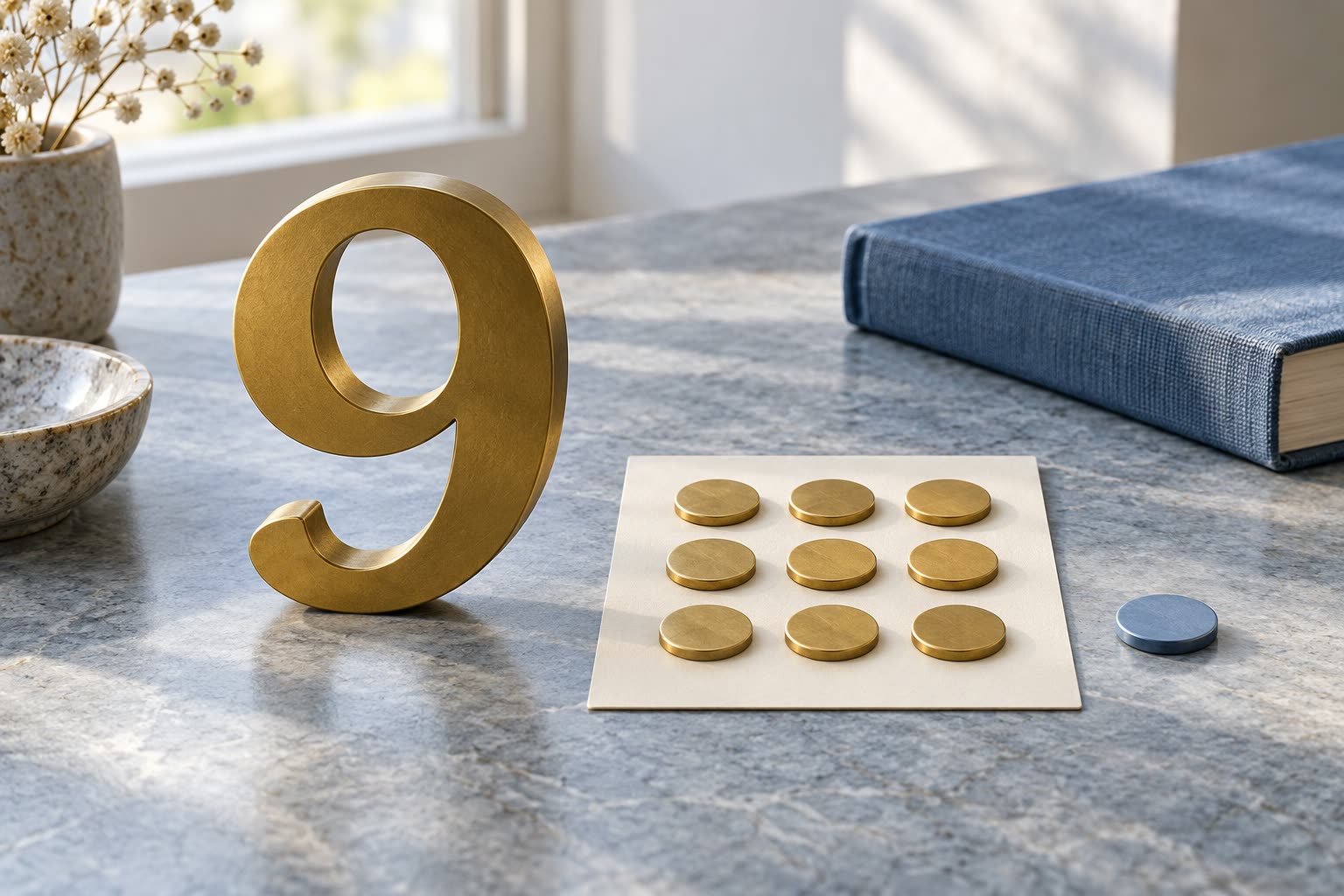
Angel number 9 is read by modern angel-number writers as a sign about service and endings. Joanne Walmsley's Sacred Scribes entry from 2011 says 9 shows that a reader's life path involves "service to humanity", and that it may indicate "it is time to end a phase, situation or relationship that is no longer serving you".
In the numerology of Hans Decoz, 9 is the humanitarian number. When it appears as a cycle, he writes, it "often denotes a finality, the completion of an era."
The completion idea is older than angel-number writing, and one old explanation was arithmetic: past 9, the digits repeat. Other traditions read the same number differently.
Cheiro's numerology made 9 the number of war and force. The Bible uses the ninth hour as a time of prayer without assigning 9 a meaning, while in Japanese one reading of 9 sounds like the word for agony.
A birth date that reduces to 9 raises a different question from a 9 that keeps appearing, and the Life Path 9 guide covers the birth-date calculation.
Quick Facts
- Position
- The last single digit; counting past it repeats 1 to 9
- Arithmetic
- Every multiple of 9 reduces to 9 (9 x 7 = 63, 6 + 3 = 9)
- Greek name
- The ennead, called an "unsurpassable limit" and "that which brings completion"
- Numerology
- Decoz: humanitarian, completion of an era. Cheiro: Mars and physical force
- Bible
- The ninth hour of prayer (Acts 3:1); a nine-part fruit of the Spirit (Galatians 5:22-23)
- Angel-number reading
- Service to humanity and the end of a phase (Walmsley, 2011)
- Master number?
- No. Decoz reserves that status for 11, 22 and 33
Walmsley's 9 joins service to a conditional ending
Joanne Walmsley's entry for angel number 9 joins two messages. The first is vocation: she lists "universal love", "karma", "spiritual enlightenment" and "service to humanity" among the number's attributes, and reads a repeated 9 as a sign that your "life path and soul mission" involve serving others through your own skills.
The second is an ending, phrased conditionally. Nine "may be indicating" that a phase, situation or relationship has stopped serving you, followed by the assurance that something new will enter.
Both messages rest on the place of 9 at the end of the digit sequence. Decoz writes that the 9 "lives in the world and understands the connection between all people", which is the humanitarian half.
For the ending half he uses cycles: when someone is in the ninth period of a cycle, that cycle is in its final stages. His personal year system therefore treats year 9 as the close of a nine-year run calculated from a birth date and a calendar year.
The sighting reading borrows the cycle language without the calculation. Walmsley's entry names no particular phase, so whether the ending concerns a job, a relationship or a habit is left to the reader's circumstances.
A 9 seen during a project's last month fits her reading. The same 9 seen in the first week of a new role gives it nothing to describe.
The Greek ennead closes the first digit cycle
The ancient Greek argument for nine as completion is about counting. The Theology of Arithmetic, a Greek treatise on the numbers one to ten attributed to Iamblichus (circa 245-325 CE), calls the ennead, the Greek word for a group of nine, an "unsurpassable limit."
Its reason is that there is "natural progression up to it, but after it there is repetition." Take one nine away from 10 and the remainder is 1; take nines from 11 or 20 and the remainder is 2.
The treatise records names that Pythagoreans gave the number because of that limit. They called it "Oceanus" and "horizon", the water and the line that circle the edge of the world, and "Prometheus", because it keeps any number from going further.
They also called it "that which brings completion", partly because it "completes nine-month children." Modern readings of 9 as the end of a cycle repeat the conclusion, usually without the counting argument that produced it.
A separate religious tradition reached a similar association by another route. In the Baháʼí Faith, Shoghi Effendi called nine "the sign of perfection", and the letters of the word Bahá add to 9 in the Arabic abjad system of letter values.
The nine-pointed star used as a Baháʼí emblem draws on those associations with perfection and with the name Bahá. It does not derive from the Greek argument about digits.
Casting out nines explains why multiples return to 9
Multiply any positive whole number by 9, add the digits of the result, and keep adding until one digit remains: the answer is 9. For 9 x 7 = 63, 6 + 3 = 9; for 9 x 123 = 1,107, 1 + 1 + 0 + 7 = 9.
The reason is that 10 is one more than 9, so every power of ten leaves a remainder of 1 when divided by 9. A number and the sum of its digits therefore leave the same remainder; a positive multiple of 9 leaves none, which digit reduction writes as 9.
Decoz states the companion rule for addition: add 9 to any number, reduce the result, and "it always comes back to itself as if nothing was added at all" (5 + 9 = 14, and 1 + 4 = 5). In a numerology chart, 9 is therefore the one digit that leaves every other root unchanged.
Cheiro repeated the multiplication rule in 1926 and turned it into symbolism. He called 9 "an emblem of matter that can never be destroyed."
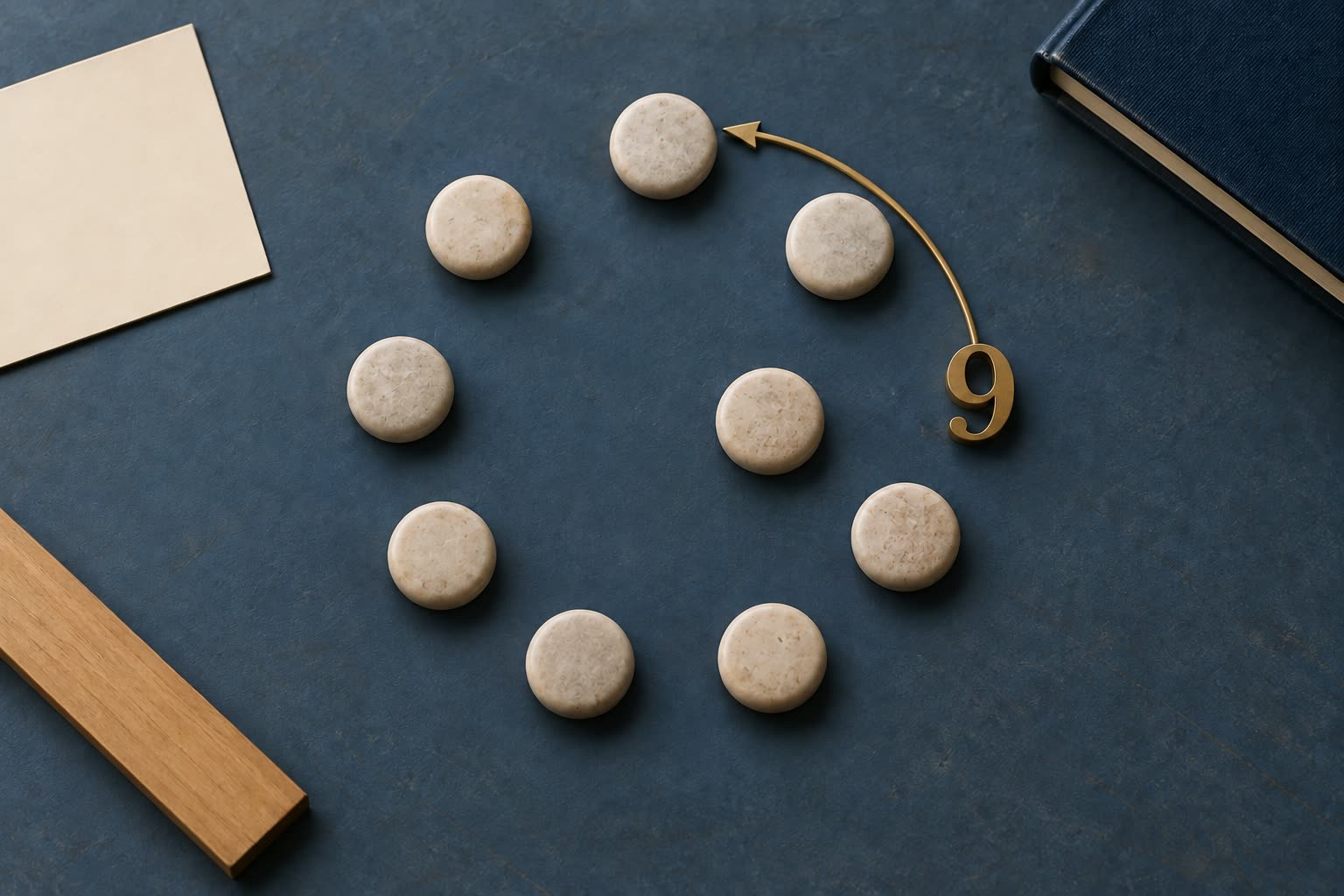
Mathematicians put the same property to practical use long before modern numerology did. Checking a sum by "casting out nines" appears in the Mahāsiddhānta of Aryabhata II, written around 950, the earliest surviving text known to use it that way.
Ibn Sina described it around 1020 as the "Hindu method", and Fibonacci's Liber Abaci of 1202 brought it to European readers. The digit reduction used in numerology takes this old arithmetic property and attaches meanings to the result.
Because the digit sum of every positive multiple of 9 reduces to 9, the two-digit roots in this sequence are 18, 27, 36, 45, 54, 63, 72, 81 and 90. Angel number 18 is the first of them, and its Hebrew reading as chai, the word for life, has nothing to do with the reduction.
Angel number 27 is 3 x 3 x 3 as well as 2 + 7. The same root therefore reaches it through a different structure.
Decoz's humanitarian, Cheiro's fighter and Waite's Hermit are different 9s
Numerologists do not agree on what kind of number 9 is. Decoz describes it as "overwhelmingly loving and empathetic", and the failure he warns about is the opposite of love: a 9 that has become "condescending, arrogant, cold, and apathetic towards the suffering of others."
Cheiro's Book of Numbers (1926), which presents what it calls the Chaldean system of letter values, makes 9 the number of Mars. His "number 9 persons are fighters in all they attempt in life", and the number itself stands for "force, energy, destruction and war" and for iron, the metal of weapons.
Cheiro also explains why his letter table stops at 8: no letter is given the value 9 because, he writes, 9 represents "the 9-lettered name of God." A name can still add up to 9, but no single letter carries it.
The tarot adds a third reading. A. E. Waite's Pictorial Key to the Tarot (1910) gives the Hermit, card IX of the Major Arcana, the meanings prudence and circumspection, and also treason and dissimulation; later writers such as Eden Gray read the Hermit's lantern as "the lamp of truth."
| Source | What 9 stands for | How the 9 goes wrong |
|---|---|---|
| Hans Decoz, World Numerology | Love, empathy, connection between all people; the completion of an era | Condescension, coldness, apathy toward suffering |
| Cheiro, Book of Numbers (1926) | Mars, physical force, courage; people who fight for what they want | Hasty temper, impulsiveness, strife at home |
| A. E. Waite, Pictorial Key to the Tarot (1910) | Card IX, the Hermit: prudence and circumspection | Treason and dissimulation; reversed, concealment and fear |
| Joanne Walmsley, Sacred Scribes (2011) | Service to humanity; the end of a phase that no longer serves you | No failure named |
A reader told that 9 means compassion is hearing Decoz's version. A reader who follows Cheiro would hear courage under conflict, while a tarot reader might hear caution.
The warning common in popular writing, that 9 turns into martyrdom, matches yet another source. Numerology.com lists "sacrificing" as the number's weakness; Decoz's shadow for 9 runs the other way, toward coldness.
Biblical nines are counts; the nine choirs come from Pseudo-Dionysius
The Bible does not assign 9 a meaning, but it uses the ninth hour, mid-afternoon in a day counted from sunrise, as a time of prayer. Peter and John went up to the temple "at the hour of prayer, being the ninth hour" (Acts 3:1), and Mark 15:34 places Jesus's cry from the cross at the ninth hour.
An angel appearance in Acts follows the same pattern. The centurion Cornelius "saw in a vision evidently about the ninth hour of the day an angel of God", who told him his prayers and alms had "come up for a memorial before God" (Acts 10:3-4).
Two of Paul's lists also have nine items. Galatians 5:22-23 names the fruit of the Spirit as love, joy, peace, longsuffering, gentleness, goodness, faith, meekness and temperance, while 1 Corinthians 12:8-10 names nine gifts of the Spirit.
Neither passage comments on the count. The reading of nine as "the number of finality or judgment" comes from E. W. Bullinger's Number in Scripture (1894), which argues that nine, as the square of three, "denotes finality in divine things"; that is a nineteenth-century interpretation layered on the text.
Angel tradition has its own nine in the angelic hierarchy. The Celestial Hierarchy, written around 500 CE under the name of Dionysius the Areopagite, says that scripture "has designated the whole Heavenly Beings as nine" and divides them into three orders of three: Seraphim, Cherubim and Thrones; Dominions, Virtues and Powers; Principalities, Archangels and Angels.
The names are gathered from passages such as Ephesians 1:21 and Colossians 1:16, with the Seraphim of Isaiah and the Cherubim of Ezekiel. The scheme orders angels by their nearness to God; nothing in it treats the number 9 as a sign sent to a person.
Love and work separate a finished phase from ongoing service
In love, the two halves of the 9 reading ask different questions. Walmsley's ending sentence names relationships directly, so on her reading a repeated 9 raises the question of whether a relationship has run its course.
Decoz's description points elsewhere: his 9 fails by going cold, so the issue is whether warmth is being withheld from someone who is still present. A couple in the last stage of a separation and a couple who have grown distant are in different situations, and the number cannot say which one a reader is in.
At work, the service half dominates. Walmsley's call to use "natural skills and talents" in service of others is the basis for readings that point 9 toward teaching, healing and charitable work.
Decoz's cycle reading adds timing: a ninth period is the final stage of a cycle, and the next cycle opens at 1. That is where angel number 1 picks up the sequence.

Neither reading tells anyone to leave. A job with a finished project and an agreed handover date is ending whether or not a 9 appears; a job in the middle of a hard quarter is not, however often the number shows up.
Seeing 9 repeatedly on price tags and clocks often starts with placement
Nine is often a digit that someone chose on purpose. Retail prices end in 9 or .99 so often that the practice has a name, charm pricing, while a 12-hour clock shows 9 as the hour for two hours of every day.
The American Psychological Association defines selective attention as concentrating on some stimuli while ignoring others. Once 9 carries a meaning for someone, the 9s they would have passed over start to register.
None of that rules out a personal reading, but it changes where the evidence starts. A 9 on a price tag was chosen by a retailer.
A 9 that appears while someone is deciding whether something is finished gives the completion reading a specific situation to describe. Three questions separate the remaining work from the symbolism:
- What is ending? Name one commitment, role or relationship, not a whole period of life.
- What is still owed? List the tasks, handovers or conversations that remain before it is finished.
- Who else is involved? An ending that depends on another person's decision is not complete until they have made it.
When the 9 comes as a run, the arithmetic and the readings shift with each extra digit, and the repeating nines guide compares 99, 999 and 9999 side by side.
Frequently Asked Questions
Why can 9 sound lucky in Chinese and unlucky in Japanese?
It depends on the language. In Chinese, 9 (jiu) sounds like the word for "long-lasting", which is why it appears at weddings, and it was historically tied to the emperor.
In Japanese, 9 can be read ku, the same sound as the word for agony, and combs (kushi) are rarely given as presents for that reason.
Why is 9 a root number rather than a master number?
No. Decoz reserves master-number status for 11, 22 and 33.
Nine is a single digit, and in his system 99 is a Power number rather than a master number.
When does release become martyrdom in a modern 9 profile?
Numerology.com describes the weakness of 9 as "sacrificing": caring for others so completely that the 9 neglects itself. On that reading, release turns into martyrdom when giving to others leaves the 9 neglecting its own needs.
Decoz names a different failure, coldness, so the warning belongs to one strand of numerology rather than to the number.
Where does the twin-flame reading of 9 come from?
Neither Walmsley's 2011 entry nor Decoz's description of 9 mentions twin flames. Twin-flame readings of 9 come from later writers who apply the number's completion theme to a relationship idea that developed separately.
Why does 999 have a different modern source from a single 9?
Both reduce to 9: 9 + 9 + 9 = 27, and 2 + 7 = 9. The difference is in the sources.
Doreen Virtue's 1999 entry for 999 reads "the end of a big phase" with a call to lightworkers, while a single 9 carries the broader service and completion reading described above.
Sources
- (2011). Angel Number 9. Sacred Scribes. Link
- (n.d.). Numerology Meaning of number 9. World Numerology. Link
- (n.d.). Master Numbers 11, 22, 33. World Numerology. Link
- (1988). The Theology of Arithmetic, "On the Ennead", pp. 105-107. Phanes Press. Link
- (2026). Baháʼí symbols. Wikipedia. Link
- (2026). Casting out nines. Wikipedia. Link
- (2026). 9 (number). Wikipedia. Link
- (1926). Cheiro's Book of Numbers, Chapter XI, The Number 9, pp. 64-68; alphabet note, pp. 70-71. Herbert Jenkins. Link
- (2026). The Hermit (tarot card). Wikipedia (citing A. E. Waite, The Pictorial Key to the Tarot, 1910, and Eden Gray). Link
- (1999). Healing with the Angels, number sequences (999). Excerpt at SpiritLibrary. Link
- (n.d.). Number 9 Meaning in Numerology. Numerology.com. Link
- (1611). Acts 3:1; Acts 10:1-4; Mark 15:34; Galatians 5:22-23; 1 Corinthians 12:8-10. BibleGateway. Link
- (1894). Number in Scripture, "Nine". Online edition. Link
- (1899). The Celestial Hierarchy, Chapter VI. Tertullian Project transcription. Link
- (1907). Angels. The Catholic Encyclopedia, vol. 1. Link
- (2026). Chinese numerology. Wikipedia. Link
- (2026). Japanese superstitions. Wikipedia. Link
- (2026). Psychological pricing. Wikipedia. Link
- (2018). Selective attention. APA Dictionary of Psychology. Link
About Our Editorial Process
Every KnowTheAngels guide separates calculation method, tradition context, and personal reflection. We cite where interpretations come from, present more than one view, and never present symbolic reading as prediction.
Read our editorial policy