Why Do You Keep Seeing 11:11, and How Is This Mirror Time Interpreted?
Two master 11s, a hidden 22 and a digit total of 4, plus where the 11:11 wish came from and why this minute is so easy to notice
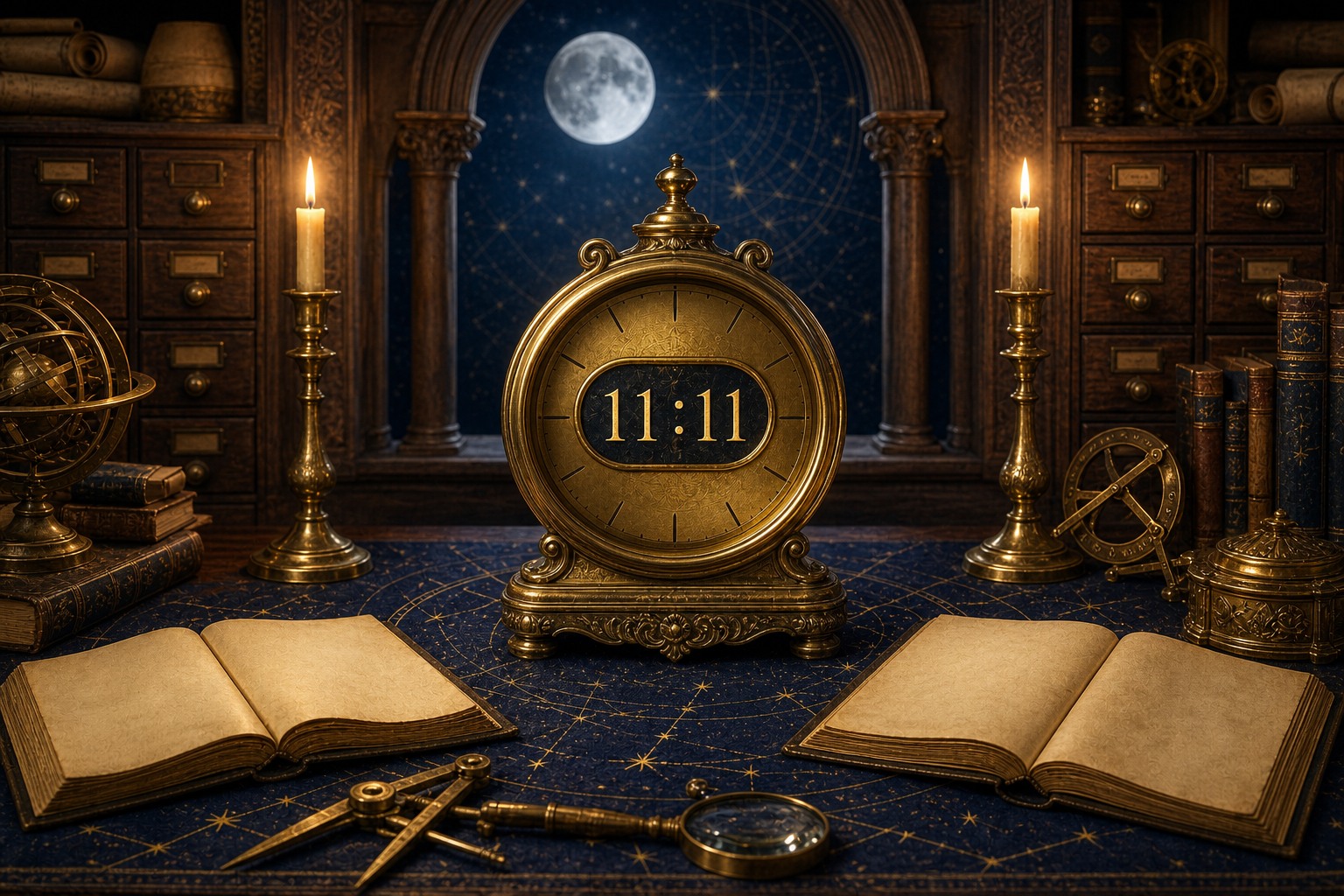
11:11 is the only reading on a 12-hour clock with four identical digits, and it arrives twice a day. Numerologists who keep master numbers read each half as 11, which Hans Decoz describes as having twice the power of a 1 while being dominated by the sensitivity and intuition of the 2. Adding the halves gives 22, a second master number, and adding the four digits gives 4.
The time also carries a custom that no other clock time has on the same scale: making a wish. Its exact origin is unknown, but New Age writers spread it from the late 1980s onward, and it stands apart from both numerology and angel-number teaching.
Quick Facts
- Each half
- Master number 11 (2 if reduced)
- Halves added
- 11 + 11 = 22, the second master number
- Digit total
- 1 + 1 + 1 + 1 = 4
- Four matching digits
- The only such time on a 12-hour clock
- Mirror-hour angel
- Lehahiah (11:00 to 11:20)
- Wish custom
- Popularized by Solara, 11:11: Inside the Doorway (1992)
Why is 11:11 the most noticed time on the clock?
Four matching digits are rare on a clock. A 12-hour display uses three digits from 1:00 to 9:59, so 1:11 and 2:22 repeat only three, and 11:11 is the single time with four. A 24-hour display adds 00:00 and 22:22, but 11:11 is the one of the three that appears on both kinds of clock. That unbroken row of 1s is also why the time is so often folded into readings of angel number 1111, the same digits without the colon.
Where did wishing on 11:11 come from?
Mental Floss traces the habit of wishing at 11:11 in part to Solara Antara Amaa-Ra, who founded the New Age group Star-Borne Unlimited in 1986. Her 1992 book 11:11: Inside the Doorway presented 11:11 as a "wake-up call" and a "pre-encoded trigger placed within our cellular memory banks." The same article names Uri Geller as another voice in the 1990s urging people to wish when the clock showed 11:11.
A wish made at 11:11 therefore belongs to a custom with named promoters and a known period. Numerology is a separate layer with its own rules, and no study has shown that the timing of a wish changes whether it comes true.
Two master numbers in one minute: 11, 22 and 4
Every route through the arithmetic of 11:11 passes a master number. Each half is master number 11, which Decoz keeps unreduced in core chart numbers such as the Life Path and reduces to 2 only in cycle calculations such as the Personal Year. Adding the halves gives 11 + 11 = 22, the number Decoz calls the Master Builder, made of two sensitive 2s but dominated by the pragmatic 4. Adding the digits one at a time, 1 + 1 + 1 + 1, gives 4, which Numerology.com describes as the most stable and grounded of the single digits.
| Layer | Calculation | Result | Reading in Decoz and Numerology.com |
|---|---|---|---|
| Each half | 11 | 11 (or 2 when reduced) | Intuition carried by a doubled 1 |
| Halves added | 11 + 11 | 22 | The Master Builder |
| Four digits | 1 + 1 + 1 + 1 | 4 | Stability and steady effort |
Which layer a reader starts from changes the emphasis. A system that keeps master numbers reads 11:11 as doubled intuition that asks to be built into something, the move from 11 to 22. A system that reduces everything reads a minute of four 1s settling into the number 4, the number of routine and structure. The two finish on the same ground, because 22 itself reduces to 4.
Why do I keep seeing 11:11 every day?
The explanations with evidence behind them concern attention. Once 11:11 has been marked as special, by a friend, a post or the wish custom, the frequency illusion that Arnold Zwicky named in 2005 makes each new sighting memorable while 10:58 and 11:14 pass unrecorded. Confirmation bias, which the psychologist Raymond Nickerson reviewed in 1998, supplies the other half: sightings that fit the story are kept, and the misses are never counted.
On a 12-hour clock the second 11:11 comes late in the evening. A 24-hour display shows that minute as 23:11, so a reader whose phone uses 24-hour time can meet 11:11 only in the morning.
None of this rules out a personal or spiritual reading. For a time this famous, a run of sightings is expected, so the count carries little information; the decision or thought in hand at the moment of noticing is what a reflective reading has to work with.
Lehahiah and the twenty-minute window around 11:11
French mirror-hour lists largely agree on Lehahiah for this minute. Universités Numériques gives Lehahiah the slot from 11:00 to 11:20 and ties him to discipline, perseverance and divine order, and Astroya's table names the same angel with the message that what the reader thinks tends to come true. The slot comes from the twenty-minute rota of 72 Kabbalistic angel names that Lazare Lenain published in 1823. Lehahiah is 34th in that order, and 33 slots of twenty minutes after midnight end exactly at 11:00.
Because the rota divides the whole day evenly, 11:04 and 11:19 fall to Lehahiah just as 11:11 does. On these lists the angel belongs to the twenty-minute window, and the matching digits only make the window easier to notice.
Frequently Asked Questions
Is it lucky to make a wish at 11:11?
Wishing at 11:11 is a modern folk custom, spread by Solara's Star-Borne circle and by Uri Geller in the 1990s. It belongs to that custom rather than to numerology or scripture, and no study has shown that the timing of a wish affects whether it comes true.
Is 11:11 a twin flame sign?
Twin-flame writers often cite it, reading the two matching halves as two souls. That is a modern spiritual interpretation with no numerology rule behind it. The numerology of the time (11, 22 and 4) describes intuition and structure, and says nothing about a particular second person.
How is 11:11 different from angel number 1111?
The digits are the same, and 1111 also reduces to 4. The colon splits the clock time into two master 11s that add to 22, and the wish custom and the mirror-hour angel belong to the time rather than to the four-digit number.
Is 11:11 connected to Armistice Day?
Only by the repeated number. The 1918 armistice took effect at 11 a.m. on November 11, the eleventh hour of the eleventh day of the eleventh month, which is the origin of Armistice Day and Veterans Day. That was an hour on a date, not the minute 11:11.
Which angel is linked to 11:11?
French mirror-hour lists give 11:11 to Lehahiah, 34th in the rota of 72 Kabbalistic angel names that Lazare Lenain published in 1823. The rota gives him the twenty minutes from 11:00 to 11:20, so 11:04 and 11:19 fall to him as well.
Why is 11:11 so common?
A 12-hour clock shows 11:11 twice a day, as often as any other minute. It seems common because it is the only 12-hour time with four identical digits, and once a friend, a post or the wish custom has marked it as special, the frequency illusion and confirmation bias make each sighting memorable while 10:58 passes unrecorded.
Sources
- (n.d.). Master Numbers 11, 22, 33. World Numerology. Link
- (n.d.). Number Meanings 1–9. Numerology.com. Link
- (2026). Why We Wish on 11:11: The Meaning of Angel Number 1111. Mental Floss, March 30, 2026. Link
- (1992). 11:11: Inside the Doorway. Star-Borne Unlimited, Charlottesville, Virginia
- (n.d.). Heure miroir 11h11 : interprétation précise et complète. Universites-numeriques.fr. Link
- (n.d.). Heure miroir : signification complète des 24 heures. Astroya.fr. Link
- (2026). Lazare Lenain. Wikipédia (French), on La Science cabalistique (1823) and its 72 twenty-minute divisions. Link
- (n.d.). Les 72 Anges Gardiens Kabbalistiques : liste complète. Order of the 72 names. Link
- (2019). Frequency illusion in the OED. Language Log account of Arnold Zwicky's 2005 term. Link
- (1998). Confirmation Bias: A Ubiquitous Phenomenon in Many Guises. Review of General Psychology 2(2): 175–220, doi:10.1037/1089-2680.2.2.175. Link
- (2026). Armistice Day. Encyclopaedia Britannica. Link
About Our Editorial Process
Every KnowTheAngels guide separates calculation method, tradition context, and personal reflection. We cite where interpretations come from, present more than one view, and never present symbolic reading as prediction.
Read our editorial policy