What Does Seeing Angel Number 11 Mean, and How Is It Interpreted?
Why eleven became the intuition number of modern numerology, what that status means for a number seen on a clock, and why Bible numerics and Cheiro read the same number as disorder and warning
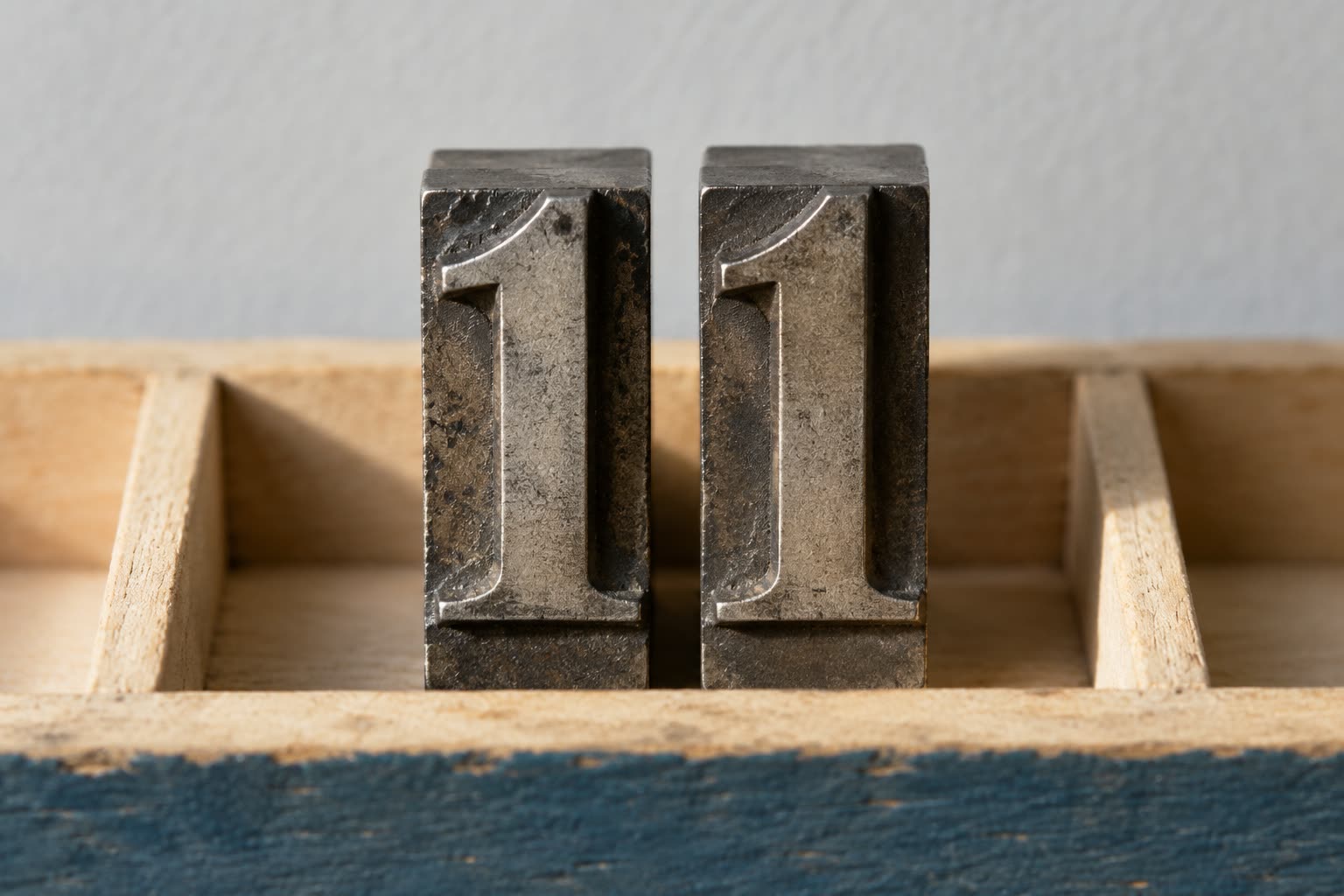
Angel number 11 is two 1s side by side, and it is the first number modern numerology declines to reduce. Most angel-number sites build their reading on that status.
Joanne Walmsley's Sacred Scribes entry of June 2011 calls it "the karmic Master Number 11" and ties it to spiritual awakening, intuition and illumination.
The rule that 11 stays whole goes back to Balliett, who published numerology books between 1905 and 1917. Hans Decoz applies it only to the core numbers of a birth chart.
Older writers pulled the other way: Bullinger read eleven in the Bible as disorder, and Cheiro treated it as a warning.
Quick Facts
- Digits
- Two 1s; 1 + 1 = 2
- Master number
- Yes in chart core numbers; kept whole since Balliett, early 1900s
- Angel-number reading
- Intuition and spiritual awakening (Walmsley, 2011)
- Bible numerics
- Disorder and disintegration (Bullinger, 1894)
- Cheiro
- "An ominous number" of hidden dangers
- On a 12-hour clock
- The hour 11 is on show 120 minutes a day
Why do angel-number writers read 11 as intuition and awakening?
In Decoz's system the digit 1 is "the number of creation" and the drive to act independently.
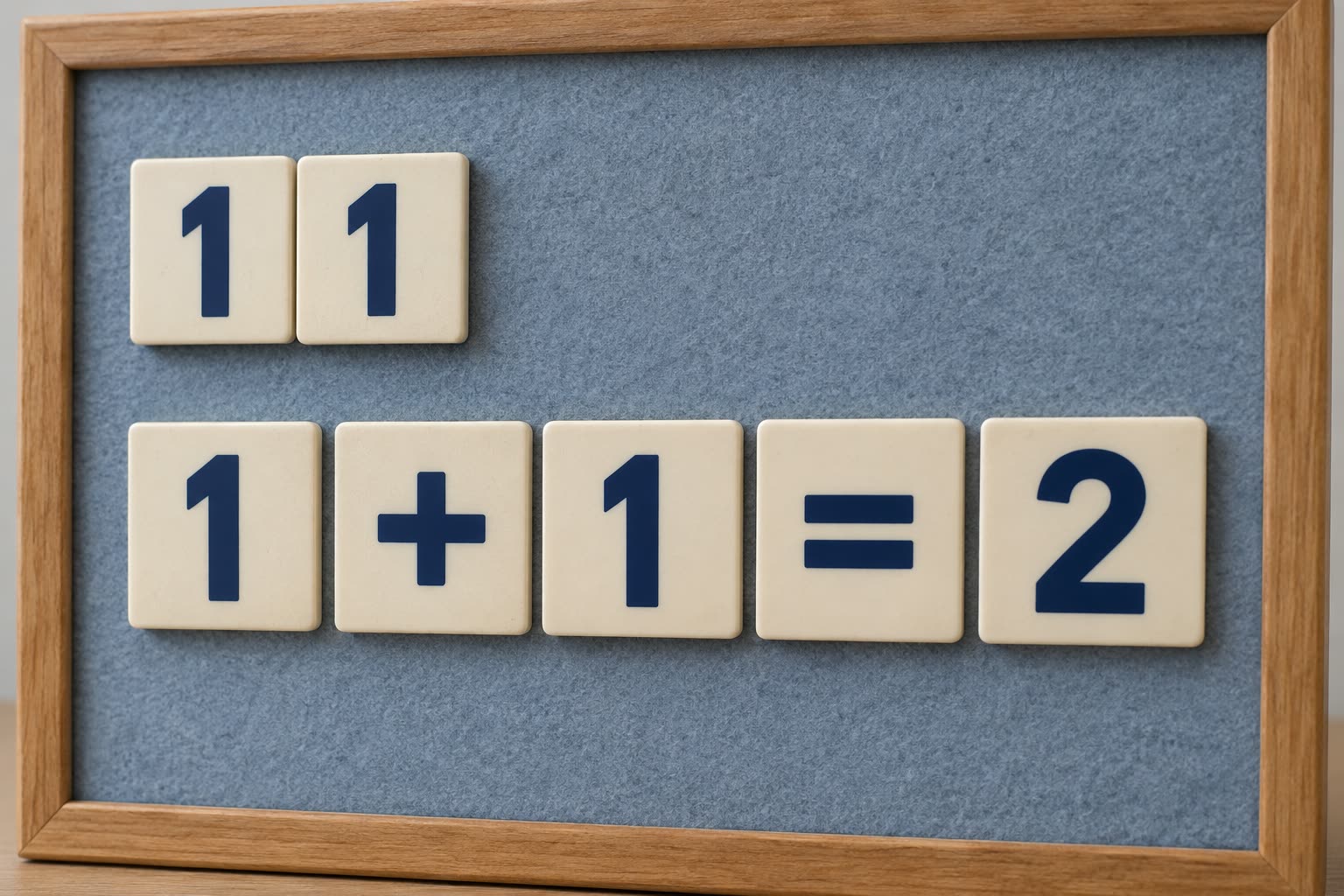
Adding the two 1s gives the digit 2, which he calls the most cooperative single digit. Decoz says 11 has twice the power of 1 but is dominated by the sensitivity and intuition of 2.
His profile calls 11 "the most intuitive of all numbers" and associates it with insight without rational thought. Sensitivity, nervous energy, shyness and impracticality appear as the other side of the same gift.
Walmsley's angel-number entry turns that chart language into a message. She links 11 with awakening, enlightenment, idealism, inspiration and intuition, then directs attention to the reader's own thoughts.
Mindbodygreen carries the master-number status into its luck reading, calling 11 lucky because it is a master number.
The awakening reading adds no evidence of its own about a sighting; it rests on the master-number status. Decoz also gives 11 an "inborn duality" that brings inner conflict alongside insight.
Decoz's chart profile includes strain as well as inspiration, so citing his master-number description as unqualified good fortune leaves part of his account out.
Is an 11 on a clock or a receipt really a master number?
In numerology the word master belongs to a position in a chart, not to the number wherever it appears. Decoz keeps 11 only among core numbers such as the Life Path, Expression and Soul Urge.
He reduces 11 in personal cycles and usually reduces November or the 11th day to 2. The step-by-step birth-date rule belongs to master number 11 as a chart result.
An 11 on a receipt, door or bus is none of those chart positions. An angel-number reading therefore borrows the master description without the calculation that gives it weight.
The digit sum remains 1 + 1 = 2, but Decoz's chart rule does not assign a spiritual message to a sighting. Longer repeating ones also change the sum: 111 gives 3, while 1111 gives 4.
| Context | Treatment | Reason |
|---|---|---|
| Core birth-chart number | Keep 11 | Balliett and Decoz treat 11 as a master number here |
| Personal cycle, November or the 11th day | Usually reduce to 2 | Decoz says these positions do not carry master-number force |
| 11 seen on a clock, receipt or door | No chart rule applies | Angel-number writers borrow the master profile for a sighting |
| Cheiro's compound-number system | Read 11, then note its root 2 | Cheiro uses compound symbols and no master-number category |
The status is a convention of one school. Catherine Yronwode credits Balliett with popularizing the rule that 11 and 22 are not reduced, while Ariel Yvon Taylor later added 33.
Cheiro's compound-number system has no master category and gives 11 the root 2. The table therefore marks a difference between systems, not a universal arithmetic law.
What does 11 mean in the Bible, and where does "the eleventh hour" come from?
E. W. Bullinger built a Bible meaning for 11 in Number in Scripture (1894). Because he assigned divine order to ten and divine government to twelve, he read eleven as one too many or one too few.
Bullinger's disorder reading draws on Jacob's eleven remaining sons, the eleven apostles after Judas and the eleven-day journey in Deuteronomy 1:2.
No verse states Bullinger's meaning, and other passages use eleven as a count. Joseph's eleven stars stand for his brothers in Genesis 37:9.
In Acts 1:26, Matthias joins the eleven apostles to restore the group to twelve. These examples support the idea of an incomplete twelve more closely than they support a fixed spiritual definition.
In Matthew 20:1-16, a vineyard owner hires labourers at dawn and again at the eleventh hour, then pays them the same amount.
The English phrase "at the eleventh hour", meaning at the last moment, comes from this parable. Its late arrival differs from Bullinger's idea of something one short or one over.
Cheiro calls 11 ominous and associates it with hidden dangers, trial and treachery, using the symbols of a clenched hand and a muzzled lion.
Set beside Walmsley's awakening, these readings show that no single meaning of 11 was handed down. Each writer's system produces its own conclusion.
Love, twin flames and work: what an 11 is taken to say
Relationship readings of 11 lean on its total, 2, the digit of partnership. Tanya Carroll Richardson links it both to firmer emotional boundaries and to beginning something together.
Decoz's sensitivity profile can frame a person noticing a changed mood or hesitation before naming it. That is an application of his symbolism, rather than evidence that the hunch is accurate.
The belief in twin flames, one soul split between two bodies, is a separate modern idea that twin-flame writers attach to many numbers. Numerology has no rule that makes 11 a twin-flame number, and Walmsley's 11 entry concerns the reader's own life mission rather than a partner.
At work the sources split in the same way. Walmsley associates 11 with inspiring others, while Decoz calls it "a dreamer" and includes impracticality among its traits.
Together they fit a career change that begins as a hunch but still needs checking against pay, hours and management.
The clock displays 11 for about 142 minutes each day
A 12-hour clock shows the hour 11 twice a day, from 11:00 through 11:59 in the morning and at night. That accounts for 120 minutes.
The minute :11 adds one minute in each of the other 22 hours, so 11 appears for about 142 of the day's 1,440 minutes. Dates add the 11th of every month and November.
The minute 11:11, when both halves read 11, carries a separate wishing custom. That clock-time tradition does not define every sighting of the number 11.
Linguist Arnold Zwicky coined frequency illusion for the experience of a newly noticed phenomenon seeming to appear everywhere.
Someone who has read that 11 is a sign may remember 11:07 and forget 10:52. A short log that includes other clock checks as well as 11s makes this selective memory easier to see.
Frequently Asked Questions
Is 11 a lucky or an unlucky number?
It depends on the system: modern angel-number guides call 11 lucky, while Cheiro calls it ominous and Bullinger associates it with disorder. These symbolic readings do not forecast events.
How do 11, 111 and 1111 use the same digit differently?
11 adds to 2 and may stay whole as a master number in a chart, while 111 adds to 3. The four-digit form adds to 4 and is often encountered as 11:11 on a clock.
Which source gives 11 its spiritual-awakening reading?
Joanne Walmsley's 2011 angel-number entry connects 11 with awakening, intuition and illumination, using its modern master-number profile. Bullinger's older Bible numerics instead reads eleven as one beyond ten and one short of twelve.
What happens if I ignore angel number 11?
The sources used here attach no penalty to ignoring a sighting; Cheiro's warning concerns a name or date number in his system. A hunch noticed at the time can still be examined later against the facts.
Sources
- (n.d.). Master Numbers 11, 22, 33. World Numerology (where master numbers count; November and the 11th day reduced; reduction in personal cycles). Link
- (n.d.). Master Number 11. World Numerology. Link
- (n.d.). Numerology Meaning of Number 1. World Numerology (the 1 as "the number of creation"). Link
- (n.d.). Numerology Meaning of Number 2. World Numerology (the cooperative 2). Link
- (2011). Angel Number 11. Sacred Scribes, June 27, 2011. Link
- (n.d.). Books About Numerology and Number Divination: Annotated Bibliography. Yronwode.org (entries for Mrs. L. Dow Balliett and Ariel Yvon Taylor). Link
- (1894). Number in Scripture: Its Supernatural Design and Spiritual Significance, part II, "Eleven". Eyre & Spottiswoode, London, 1894; online text at levendwater.org. Link
- (1611). Genesis 37:9; Deuteronomy 1:2; Matthew 20:1-16; Acts 1:26. Bible text via bible-api.com (KJV). Link
- (n.d.). eleventh. Online Etymology Dictionary (the phrase "eleventh hour" and Matthew 20). Link
- (1926). Cheiro's Book of Numbers. The Book of Numbers, London, 1926 (date from Yronwode's bibliography); compound number 11 on p. 80 of the Taraporevala reprint scanned on archive.org. Link
- (2023). Angel Number 11: Meanings + What To Do When You See It. mindbodygreen, September 13, 2023 (quoting Tanya Carroll Richardson; FAQ on whether 11 is lucky). Link
- (2019). Frequency illusion in the OED. Language Log, March 19, 2019, on Arnold Zwicky's 2005 term. Link
About Our Editorial Process
Every KnowTheAngels guide separates calculation method, tradition context, and personal reflection. We cite where interpretations come from, present more than one view, and never present symbolic reading as prediction.
Read our editorial policy