What Does a Ladybug Mean, and Why Is It Named for Our Lady?
Where the beetle's Marian name comes from, what the popular farmers' story can and cannot claim, why dozens appear at the window in autumn, and what a single landing can support
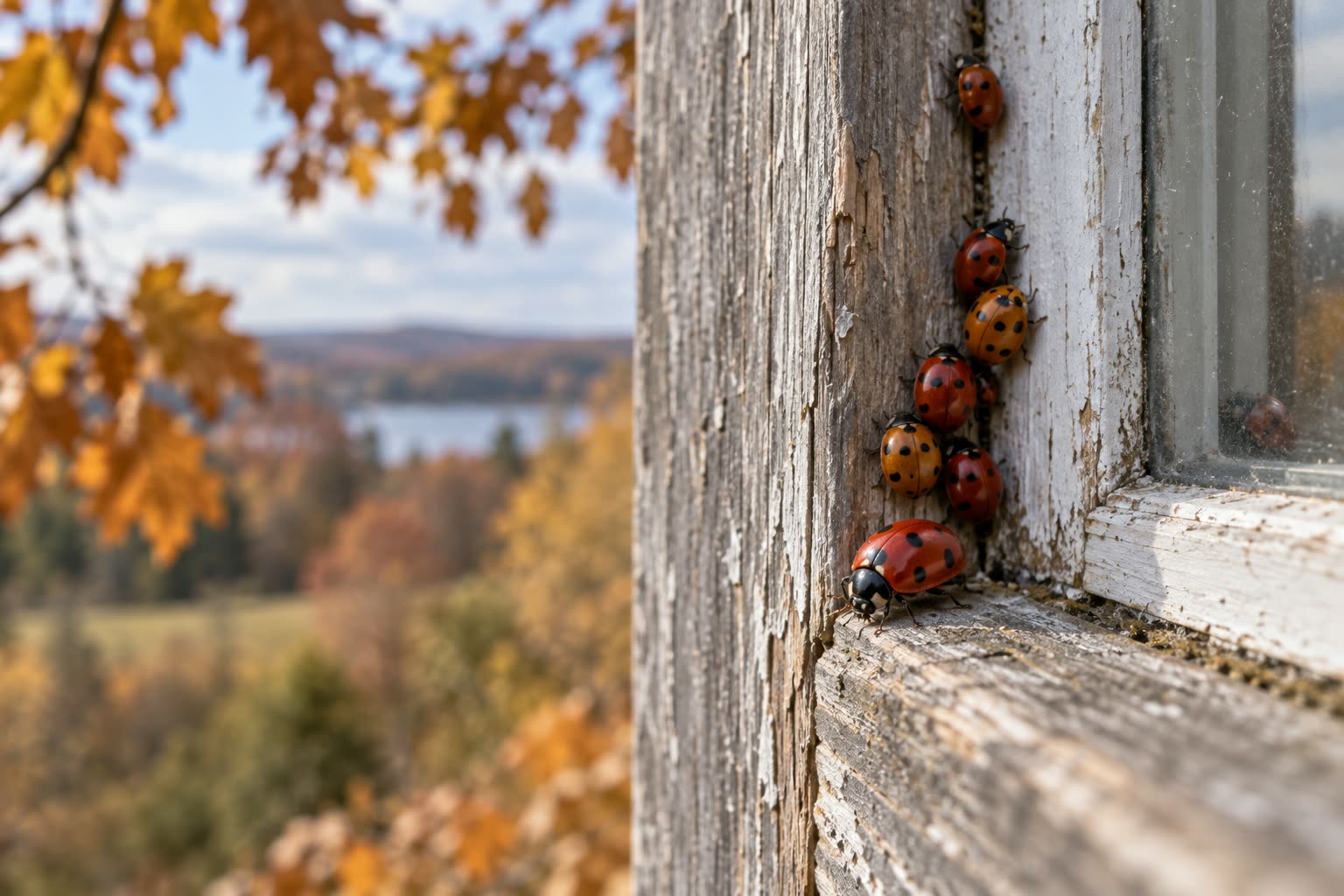
Most people who say ladybird are using a religious name without noticing it. The lady is the Virgin Mary, and German keeps her in plain view as Marienkäfer, Mary's beetle.
That naming is where the beetle's spiritual reputation begins.
It does not begin in an angel tradition or in scripture. It begins in European folk belief, where the beetle was treated as a creature under Mary's protection, and everything modern writing says about ladybirds and good fortune grows out of that.
If ladybirds arrive at a window in numbers, a documented explanation for that behavior is worth considering before attaching a spiritual meaning.
Quick Facts
- Name origin
- Our Lady's bird, for the Virgin Mary
- German name
- Marienkäfer, literally Mary's beetle
- First English record
- Ladybird for the beetle, 1674
- Farmers' story
- A popular retelling; no medieval text has been traced
- Autumn clusters
- Overwintering, most often the harlequin ladybird
- Spot counts
- Point to species and colour form, not age or a message
Why is the ladybird named after the Virgin Mary?
The English name is a worn-down form of Our Lady's bird. Old English applied the word lady to the Virgin, and the Online Etymology Dictionary notes that in many compound names lady- stands for (Our) Lady's.
The beetle sense of ladybird is first recorded in 1674, and English speakers of that century also called it lady-cow.
German makes the dedication explicit, and several other European languages tie the beetle to Mary or to God.
| Language | Name | What it says |
|---|---|---|
| English | Ladybird, ladybug | Our Lady's bird, contracted over time |
| German | Marienkäfer | Mary's beetle, stated outright |
| Spanish | Mariquita | A diminutive of the name María |
| Swedish | Jungfru Marias nyckelpiga | The Virgin Mary's keeper of the keys |
| French | Bête à bon Dieu | The good Lord's creature |
| Dutch | Lieveheersbeestje | The dear Lord's little animal |
The last two rows matter. Not every language gave the beetle to Mary; many gave it to God, which fits Roten's reading that the insect already had a sacred role before Christians attached it to the Virgin.
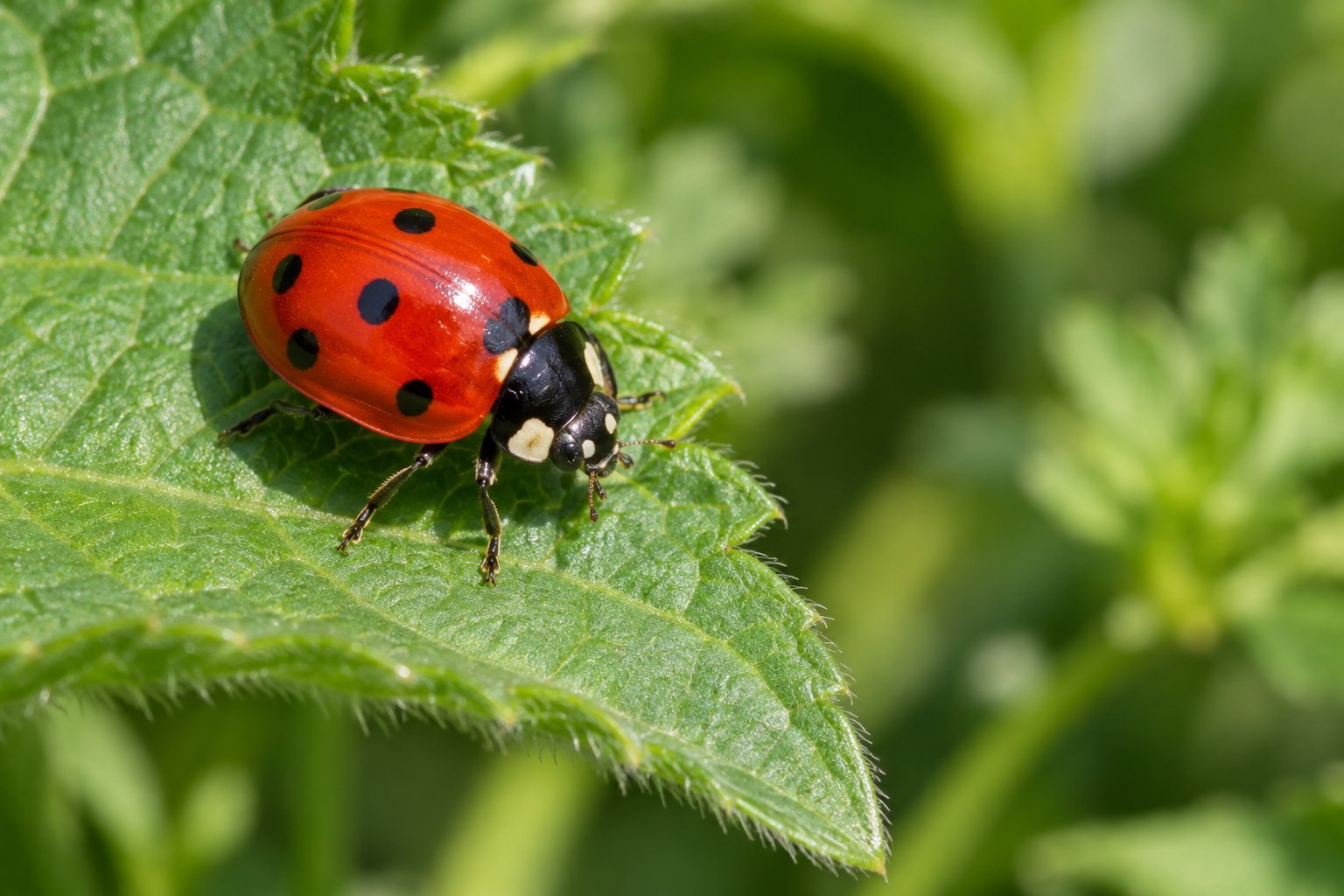
So a reader who finds ladybirds spiritually significant has real history to stand on. The naming is documented and still audible in ordinary speech, even though the famous story about how it happened is not.
What did the medieval story actually claim?
The version that circulates has European farmers losing crops to plant-eating insects, praying to the Virgin for help, and then watching red spotted beetles arrive and eat the pests.
That version is repeated by Catholic writers and etymology sites alike, but none of them points to a medieval chronicle, sermon, or saint's life that tells it. It is best read as a modern explanation of an old name.
Our Sunday Visitor, quoting Roten of the University of Dayton's Marian Library, places the Marian link in the strong devotion to Mary of the 12th and 13th centuries, especially in German-speaking lands.
Roten's own entry argues that the beetle was assimilated to Mary to Christianise it without taking away its older role as a divine messenger.
That biology is why the farmers' story sounds right. A beetle that eats crop pests in large numbers is easy to cast as help sent in answer to prayer.
It also marks what the old material can support. Roten's folk sources treat the beetle as Mary's creature and a messenger between heaven and earth, and none of them makes it an angel or a personal sign about the future.
Why are there suddenly dozens of them on the window in October?
This is the question most people actually arrive with, and it has an answer that has nothing to do with meaning. From September to November, depending on the region, adult ladybirds are looking for somewhere to survive the winter.
In Britain and North America the beetle doing this in numbers is usually the harlequin, also called the multicolored Asian lady beetle. University of Kentucky entomologists report that in Kentucky most flights to buildings happen in October.
How a cluster ends up on your window frame
Each stage is described in university extension guidance and field research.
- Weather
- Input
- A sunny afternoon after a spell of cold nights
- Action
- Adults take flight once temperatures climb back to about the mid-60s Fahrenheit.
- Result
- Sudden arrivals on a few warm days rather than a steady trickle
- Sighting
- Input
- A building that stands out in the landscape
- Action
- They fly to sunlit south and southwest walls and to contrasting features such as dark shutters on a pale wall.
- Result
- Crowds on the warmest, most visible parts of the house
- Scent trail
- Input
- Chemical marks left by beetles already on the surface
- Action
- Newcomers follow the hydrocarbon trails that earlier arrivals lay down as they walk.
- Result
- A few beetles grow into a cluster within days
- Entry
- Input
- Small gaps around frames, vents, and roof edges
- Action
- Beetles squeeze through and settle in wall voids and attics.
- Result
- A dormant group that reappears indoors on warm winter days
Some houses get them every autumn, which can feel pointed. A 2014 laboratory test found that year-old scent marks no longer drew the beetles, so the likelier reason is that the same sunny, contrasting walls stand out again each year.
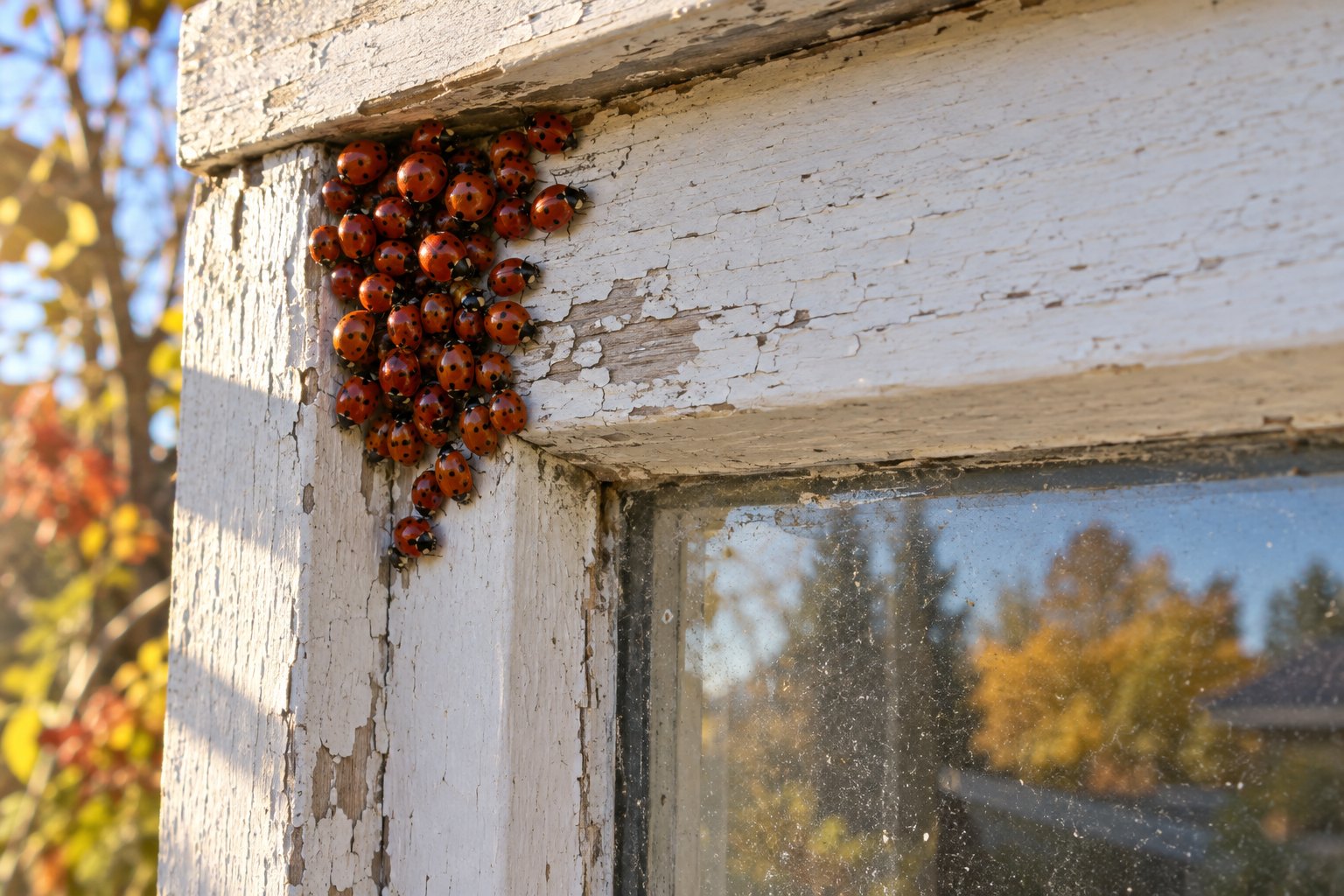
Knowing this does not spoil anything. It separates the two questions cleanly: why the beetles are there is entomology, and what a person makes of noticing them is a different matter.
What should you do about ladybugs in the house?
A cluster indoors is a practical problem before it is a symbolic one. The beetles do not breed indoors, according to University of Kentucky entomologists, and they are not eating anything in your house.
The nuisances are the smell, the marks, and for a few people their health.
A disturbed ladybird releases a yellow fluid from its leg joints, called reflex bleeding, which smells acrid and can stain fabric and paintwork.
Ladybirds can bite. Kentucky's entomologists describe the bite as a pinprick that is seldom serious, and Penn State Extension notes that researchers do not know why the beetles do it.
A heavy infestation can also cause allergy. A 2008 review in Allergy and Asthma Proceedings describes eye and nose symptoms, asthma, hives, and facial swelling, so anyone who wheezes or swells during a ladybird season should tell a doctor about the beetles.
Clearing a cluster without the stains
Extension guidance favours vacuuming over sweeping or crushing.
- Vacuum, do not crush
Penn State Extension suggests a nylon stocking held inside the hose with a rubber band, so the beetles collect in it.
- Empty it promptly
Remove and discard a bag afterwards, or tip the stocking outdoors if you want to release them.
- Release somewhere cold
An unheated shed or porch keeps them dormant; a warm room wakes them when there is nothing to eat.
- Seal in late spring or summer
Kentucky's guidance is to close gaps around frames, vents, and siding before the autumn flights begin.
There is a neat symmetry in that, given the old story. The beetle that earned a religious name by eating crop pests asks for very little in return.
Why has the beetle at your window changed species?
The ladybird arriving in most British and North American houses today is not the one the old names were given to. The swap happened within living memory.
The harlequin, Harmonia axyridis, is native to Asia and was released in many countries to control aphids. In the United States releases began in 1916, and the first wild populations were found in Louisiana in 1988.
Britain never released it on purpose. The Royal Horticultural Society dates its arrival to 2004, and it is now one of the ladybirds people see most.
It eats aphids, and it also eats the eggs and larvae of other ladybirds.
A 2012 study led by Helen Roy found the native two-spot ladybird fell by 44 percent in Britain and 30 percent in Belgium within five years of the harlequin's arrival.
| Seven-spot | Harlequin | |
|---|---|---|
| Status | Native across Europe, introduced in North America | Native to Asia, now widespread elsewhere |
| Appearance | Almost always red with seven spots | Orange or red with none to about 18 spots, or black with red spots |
| Overwintering | Sheltered places outdoors, alone or in small groups | Often inside buildings, in large groups |
| Effect on other ladybirds | Competes for aphids | Also eats their eggs and larvae |
This puts a small tension under the folklore, and it is more interesting than smoothing it away.
The beetle whose family name honours help with crops is now, in its most abundant form, one reason several older species are harder to find than they were twenty years ago.
None of that is the individual insect's doing, but a page that treats every ladybird as the beetle of the old names is describing a countryside that has changed.
Why does the young ladybug look like a different animal?
People meet a ladybird larva and do not recognise it at all. UC Statewide IPM describes it as active, long-legged, and like a tiny alligator, and most are dark with orange or yellow markings.
It is also a serious eater, which is why gardeners are urged to learn it rather than kill it.
Colorado State University Extension puts the larval stage at about 10 to 14 days in typical conditions, while the Royal Entomological Society gives three to four weeks for the seven-spot. The adult then goes on eating, and by that Society's figures it eats far more aphids across its life than the larva does.
The four stages, from egg to beetle
The recognisable beetle is only the last of four stages.
- EggSmall yellow or orange eggs stood on end in clusters
Laid on leaves near aphid colonies, close to the food supply.
- LarvaDark, spiny, and unlike the adult
Eats hundreds of aphids while it grows, molting as it goes.
- PupaRounded, usually dark orange or red, fixed to a leaf by its tail end
Does not feed or crawl, though it may jerk when touched.
- AdultThe familiar domed beetle
Keeps eating aphids for months, and is the only stage the old names describe.
A gardener who does not know the larva can easily mistake it for a pest, which is worth flagging on a page that says the beetle is lucky.
There is a quiet irony there. The stage that shares the work of eating the aphids is the one nobody recognises, and the one that received the name is the one that is easy to love.
Do the spots on a ladybug count for anything?
Two popular claims circulate. One says the number of spots gives the beetle's age, and the other says it gives the number of months until a wish comes true or the number of good things coming.
Colorado State University Extension notes that the amount of spotting is usually a mark of the species. The count is fixed long before any beetle reaches a windowsill.
| Spots | Usual species | What it tells you |
|---|---|---|
| 2 | Two-spot ladybird | A species, which can be red with black spots or black with red spots |
| 7 | Seven-spot ladybird | The common European species most people picture |
| 22 | 22-spot ladybird | A small yellow species that eats mildew, not aphids |
| None to about 18 | Harlequin ladybird | One species that can be orange, red, or black with any of these counts |
The age claim fails on simple arithmetic. Colorado State notes that ladybirds with one generation a year live about a year, yet a seven-spot carries seven spots and a 22-spot carries twenty-two.
The harlequin row settles the message claim. Its spots can run from none to about 18 within one species, so a count cannot carry a message and identify the beetle at the same time.
A tradition can be old and warm and still make a factual claim that does not survive contact with the insect. The spot readings are that kind of claim.
Does the colour of a ladybug change what it means?
Colour readings circulate widely online, and unlike the spot claims they at least track something real. A yellow ladybird and a red one are often different species.
What they do not track is a message. The colour is set by the species and, in the harlequin, by which colour form an individual happens to be.
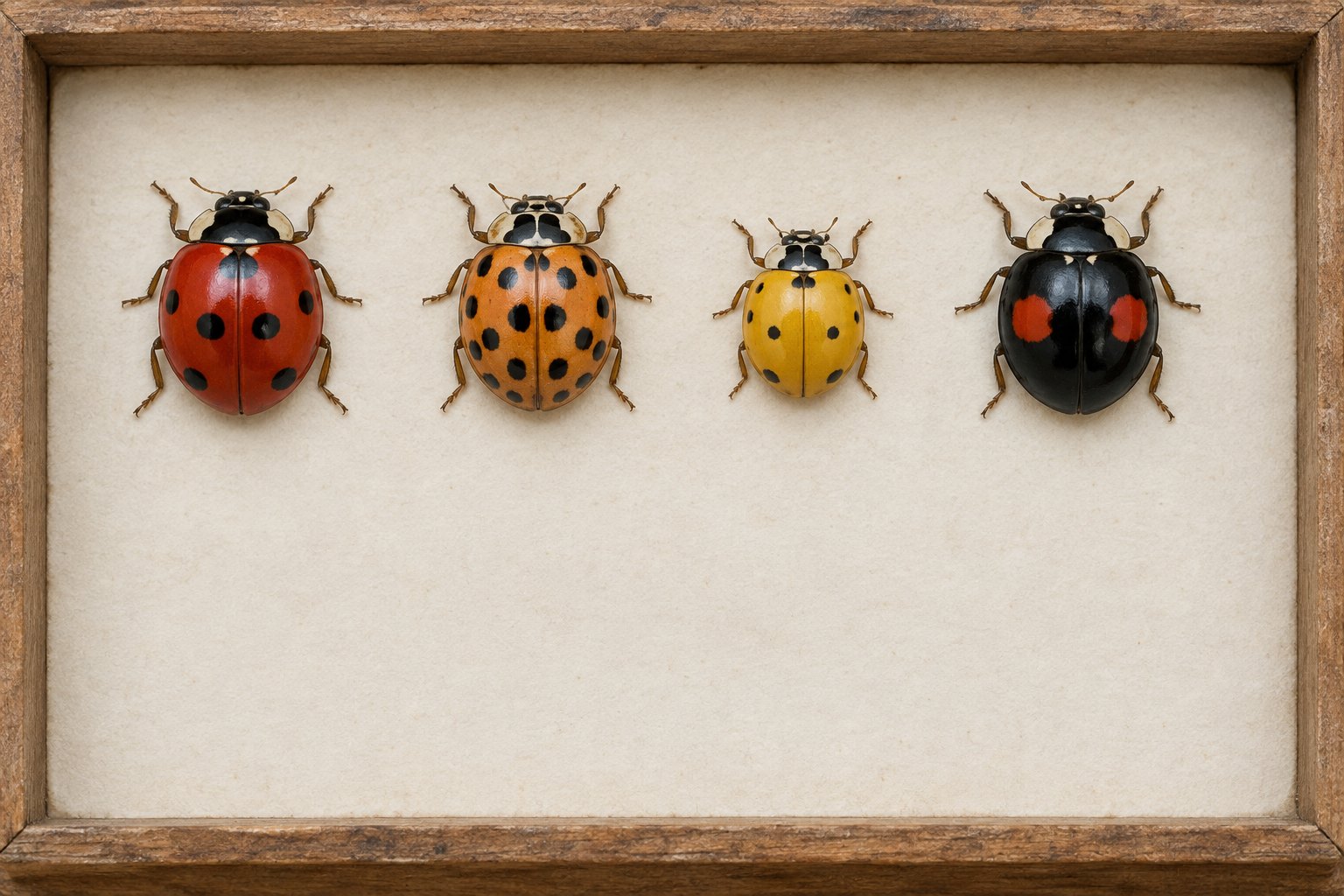
| Colour | What you are probably looking at | Popular reading online |
|---|---|---|
| Bright red | Seven-spot, two-spot, or a red harlequin | Luck, and the Marian association |
| Orange | Commonly a harlequin colour form | Often given as creativity or warmth |
| Yellow | Often a 22-spot, which eats mildew, not aphids | Usually read as cheer or optimism |
| Black with red spots | A dark harlequin or two-spot form, or a pine ladybird | Sometimes read as protection, sometimes as warning |
The yellow row is the interesting one. The Royal Horticultural Society lists the 22-spot as a mildew feeder, so the crop-pest story that gave the family its religious name does not describe it at all.
The colour tells you about the beetle, which is useful to know and a different kind of knowledge from a sign.
Anyone who finds meaning in the encounter can keep it without the colour chart, because the tradition attached itself to the beetle, not to a shade.
What the red shell and black spots were said to stand for
Within the Marian reading the colours and spots were given devotional referents. Some of these have a named source, and one circulates only in modern retellings.
The devotional reading of the beetle
These are interpretations, not properties of the beetle, and each is labelled with where it comes from.
Reported by Roten, who calls the link especially German
The commonest European ladybird happens to carry seven
Repeated in modern retellings; we found no older source
Listed by Roten among the folk meanings, now the dominant one
The first two rows work together. The Seven Sorrows, from Simeon's prophecy to Jesus's burial, and the seven-spot ladybird lined up neatly enough that the reading felt confirmed, which is how a great deal of symbolism gets fixed.
The last row is where most modern usage sits. Luck talk about ladybirds has almost entirely lost its Marian content, which is worth knowing if you are trying to use the older meaning.
What about a dead ladybug, or one indoors in midwinter?
Both are common, both worry people, and both have ordinary explanations worth having before any symbolic reading.
Penn State Extension explains that overwintering beetles in walls and attics come out into living spaces because of indoor warmth. Once awake they find no aphids and little moisture indoors, so many are found dead on sills.
One wandering across a ceiling in January is doing the same thing at an earlier stage.
Reading an out-of-season ladybug
The two columns answer different questions and do not compete.
What the evidence supports
- The timing is explainable
Indoor warmth wakes dormant beetles, which puts them on ceilings in midwinter.
- The death is explainable
A woken beetle has no food and little water indoors and does not survive long.
- Noticing is meaningful to people
Many readers find the encounter significant, and the Marian tradition gives that a long history.
What remains limited
- No omen tradition
The folk beliefs Roten records do not treat a dead ladybird as a message about a person.
- No timing claim
Nothing in those beliefs connects the encounter to events before or after it.
- Killing one
Roten records a belief that killing a ladybird angered Mary for nine days, a rule about conduct rather than a prediction.
If you want the beetle to survive, the useful response is a cool, sheltered spot. That small act fits the older tradition better than reading a warning into a sleepy insect.
One landed on you. What can you honestly take from that?
A ladybird lands on people fairly readily, especially in warm weather and in autumn when the harlequin is searching for shelter. Being outdoors on a sunny afternoon in that season accounts for most encounters.
That does not make the moment worthless.
- As a devotional prompt: within Marian folk tradition the beetle has long been Mary's creature, and treating a sighting as a cue to pray is consistent with that.
- As a seasonal marker: a cluster on the window is a reliable sign of the turn into autumn and a prompt to check gaps around frames next summer.
- As a piece of attention: noticing a small living thing carefully is worth something regardless of what it signifies.
- Not as a forecast: nothing in the tradition or the biology supports reading a landing as information about the future.
That is a proportionate place to leave it. The old names honour a beetle that helped with the harvest, and treating it gently is the part of the tradition anyone can keep.
Frequently Asked Questions
What does a ladybug mean spiritually?
The documented meaning is Marian rather than angelic. The beetle is named for the Virgin Mary in English and German, and folk tradition treated it as Mary's creature and a lucky charm; the modern good-fortune reading grew out of that and has largely lost the Marian content.
What does it mean when a ladybug lands on you?
Folk tradition treats it as a moment of good fortune, and Marian devotion adds a reminder of Mary. Ladybirds also land on people readily on sunny autumn days, when the harlequin ladybird is looking for winter shelter.
Why is it called a ladybug?
The name is a contraction of Our Lady's bird, dedicating the beetle to the Virgin Mary.
The beetle sense of ladybird is first recorded in English in 1674, and German keeps the dedication explicit as Marienkäfer, Mary's beetle.
Do the spots on a ladybug tell its age?
No. Spot number belongs to the species, and most ladybirds live about a year, yet a 22-spot ladybird carries twenty-two spots all its adult life.
Why are ladybugs all over my window?
They are looking for a place to spend the winter, usually from September to November. They fly to sunlit, contrasting parts of buildings on warm afternoons after cold nights, and follow scent trails laid by the beetles already there.
Do ladybugs bite?
They can. University of Kentucky entomologists describe the bite as a pinprick that is seldom serious, though some people become allergic to the beetles during heavy indoor infestations.
Are ladybugs a sign from an angel?
The documented tradition is Marian, not angelic. Folk belief did treat the beetle as a messenger between heaven and earth, but angel-sign readings are a recent addition that borrows that older association.
Sources
- . ladybird (n.). Online Etymology Dictionary. Link
- (2017). 'ladybird': the Virgin Mary's beetle. word histories. Link
- . Ladybugs and Mary. All About Mary, Marian Library, University of Dayton (archived). Link
- . Are ladybugs named after Our Lady?. Our Sunday Visitor. Link
- . Multicolored Asian Lady Beetle. Penn State Extension. Link
- . Asian Lady Beetle Infestation of Structures (ENTFACT-416). University of Kentucky College of Agriculture. Link
- (2014). Lady Beetles, Fact Sheet 5.594. Colorado State University Extension. Link
- . Lady Beetles. University of California Agriculture and Natural Resources. Link
- . Seven-spot ladybird. Insect Week. Link
- . Ladybirds. RHS Advice. Link
- . Harlequin ladybird: identification and impact. RHS Advice. Link
- (2012). Invasive alien predator causes rapid declines of native European ladybirds. Diversity and Distributions 18(7): 717-725. Link
- (2016). The harlequin ladybird, Harmonia axyridis: global perspectives on invasion history and ecology. Biological Invasions 18(4): 997-1044. Link
- (2014). Is conspecific substrate marking a long-term external memory of previously colonized overwintering sites in Harmonia axyridis?. Journal of Applied Entomology 138(5): 338-345. Link
- (2013). Substrate marking by an invasive ladybeetle: seasonal changes in hydrocarbon composition and behavioral responses. PLOS ONE 8(4): e61124. Link
- (2008). Harmonia axyridis ladybug invasion and allergy. Allergy and Asthma Proceedings 29(2): 123-129. Link
About Our Editorial Process
Every KnowTheAngels guide separates calculation method, tradition context, and personal reflection. We cite where interpretations come from, present more than one view, and never present symbolic reading as prediction.
Read our editorial policy