Who Is Archangel Gabriel, the Messenger of Revelation?
Gabriel in Daniel and Luke, in 1 Enoch and the Talmud, as Jibril in the Qur'an and hadith, and in the feasts, prayers and paintings of the churches
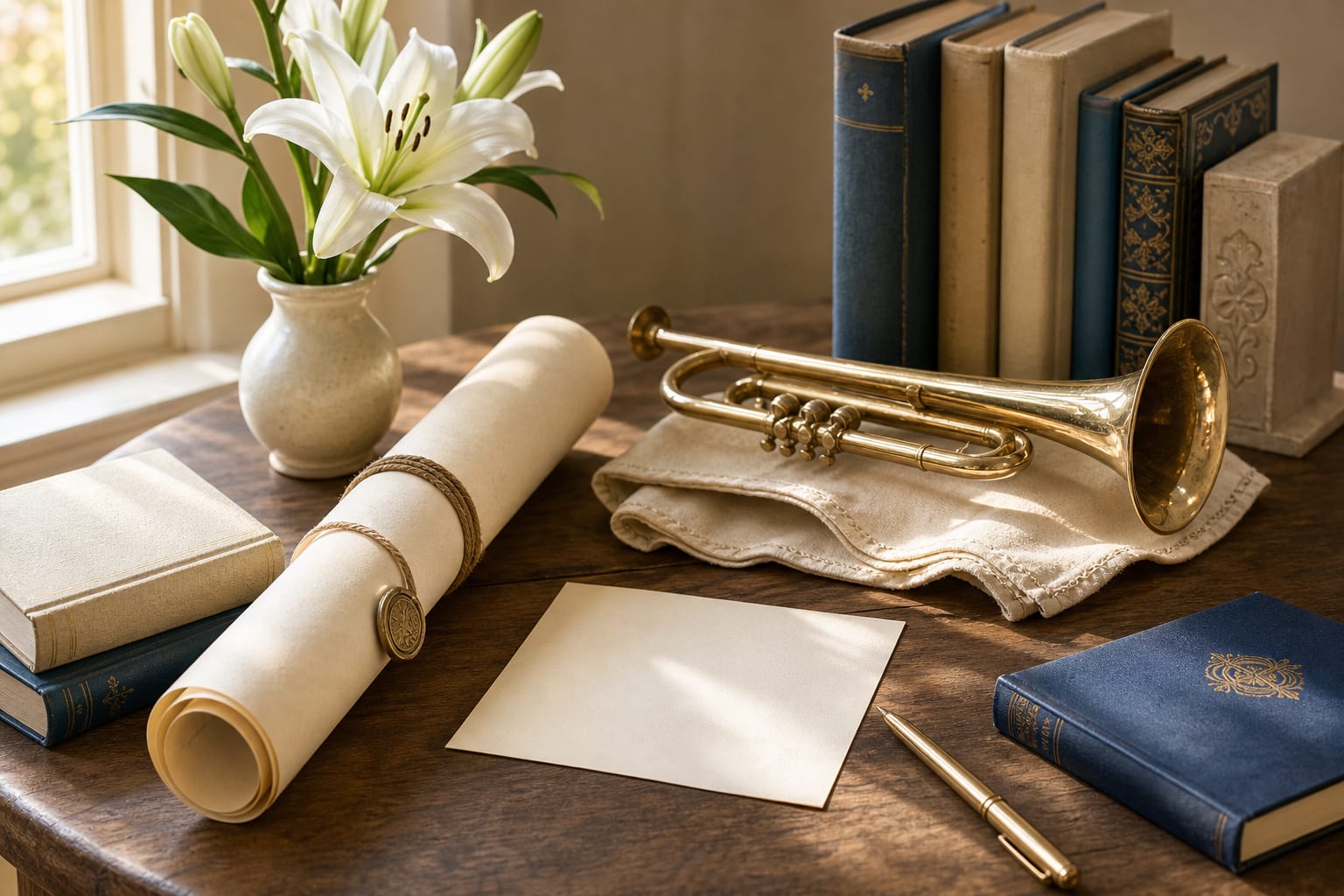
Archangel Gabriel is the angel sent to explain and to announce. In the Book of Daniel he interprets two visions, and in the Gospel of Luke he tells the priest Zechariah that his wife Elizabeth will bear John the Baptist, then tells Mary that she will bear Jesus. The Qur'an names him Jibril and says he brought the revelation down to Muhammad's heart (2:97).
Those four biblical scenes are short. Most of what people now say about Gabriel was added by a later tradition that can be named: the rabbis of the Talmud, the Islamic hadith, the Catholic and Orthodox calendars, and the painters of Italian altarpieces. A Talmudic story, a Qur'anic verse and a Catholic feast each carry authority for a different community, and none of them is in Daniel or Luke.
Quick Facts
- Hebrew name
- Gavri'el, usually translated "God is my strength"
- Named in the Bible
- Daniel 8:16 and 9:21; Luke 1:19 and 1:26
- Called archangel
- Not in the Bible; the title comes from later Jewish and Christian usage
- Name in Islam
- Jibril, named in Qur'an 2:97, 2:98 and 66:4
- Feast days
- September 29 (Catholic); March 26 and July 13 (Orthodox)
- Patronage
- Telecommunications, declared by Pope Pius XII in 1951
Where does Gabriel appear in Daniel and Luke?
Gabriel is named in four passages: two in the Book of Daniel and two in the first chapter of Luke. In each one he speaks, and in three of them the person he speaks to is frightened or perplexed.
| Passage | What Gabriel does | How the hearer responds |
|---|---|---|
| Daniel 8:15-27 | A voice by the Ulai river says, "Gabriel, help this man understand the vision." He explains the ram as the kings of Media and Persia and the goat as the king of Greece. | Daniel falls on his face in fear (8:17), then lies sick for days and still does not understand the vision (8:27). |
| Daniel 9:20-27 | Gabriel arrives "in swift flight at the time of the evening sacrifice" and gives the prophecy of the seventy weeks. | Daniel is still praying and confessing his people's sin when Gabriel reaches him (9:20-21). |
| Luke 1:11-20 | At the altar of incense he tells Zechariah that Elizabeth will bear a son named John, and names himself: "I am Gabriel. I stand in the presence of God." | Zechariah is terrified, asks how he can know this, and is left unable to speak until the birth (1:20). |
| Luke 1:26-38 | "In the sixth month" he is sent to Mary in Nazareth and announces that she will conceive and bear Jesus. | Mary is "much perplexed," asks how this can be, and answers, "let it be with me according to your word" (1:38). |
The two books use him differently. In Daniel he explains a vision the prophet has already seen, and the explanation concerns empires. In Luke he announces events that have not happened yet, and the news concerns two households. Luke also sets the scenes side by side: Zechariah's question earns a punishment, while Mary's question is answered, and Mary's scene, the Annunciation, is the one that Christian feasts and prayers keep returning to.
The Bible gives Gabriel's name in these four scenes and nowhere else, so every other appearance credited to him is a later identification of an unnamed angel.
Is Gabriel called an archangel in Daniel or Luke?
No. Neither Daniel nor Luke calls Gabriel an archangel. The New Testament uses the word twice: once for Michael, "the archangel Michael" who disputes with the devil over the body of Moses (Jude 9), and once for an unnamed archangel whose call sounds at the Lord's return (1 Thessalonians 4:16).
The rank comes from Jewish writings outside the Hebrew Bible. The Book of the Watchers in 1 Enoch lists Gabriel among the holy angels who watch, the one "who is over Paradise and the serpents and the Cherubim" (20:7). The Parables of Enoch name four angels of the Lord of Spirits and give each a charge: Michael, Raphael, Gabriel "who is set over all the powers," and Phanuel (40:9).
Christian churches kept that rank. The Catholic calendar celebrates Michael, Gabriel and Raphael together as archangels, and the Orthodox troparion for his July feast addresses him as "Gabriel, commander of the heavenly hosts." The title rests on that later ranking and on church usage, which is why a Bible concordance will not find the word beside his name.
Why do 1 Enoch and the Talmud make Gabriel an angel of judgment?
Jewish writings after Daniel give Gabriel a harder task than announcing births: he carries out judgment. In 1 Enoch, God sends him against the children of the Watchers with orders to "send them one against the other that they may destroy each other in battle" (10:9). The Babylonian Talmud gives him the same kind of work and an element of his own: Gabriel is the ministering angel of fire.
| Story | Source | Gabriel's task |
|---|---|---|
| The children of the Watchers | 1 Enoch 10:9 | Sent to make them destroy one another |
| Hananiah, Mishael and Azariah in Nebuchadnezzar's furnace | Pesachim 118a | As the angel of fire, offers to cool the furnace from within |
| The three visitors to Abraham (Genesis 18) | Bava Metzia 86b | Goes to overturn Sodom |
| Sennacherib's army at Jerusalem | Sanhedrin 95b | God asks whether his scythe is honed before the Assyrian camp is struck |
| Joseph before Pharaoh | Sotah 36b | Teaches Joseph the seventy languages |
| Speed of travel | Berakhot 4b | Needs two flights where Michael needs one |
Two details in these stories run against Christian expectations. In the Talmud's account of Abraham's visitors, the angel who announces a birth is Michael, who tells Sarah she will bear Isaac, and Gabriel's errand is the destruction of Sodom (Bava Metzia 86b). The Talmud also ranks Gabriel below Michael: when the three visitors walk together, Michael is in the middle with Gabriel on his right (Yoma 37a).
Hugh Pope's 1909 article in the Catholic Encyclopedia names the reversal directly. In Christian tradition, he wrote, "Gabriel is ever the angel of mercy while Michael is rather the angel of judgment," whereas the Jewish sources dwelt on Gabriel's power and treated him as the angel of judgment. A reader who meets Gabriel as a gentle bringer of good news in one source and as the destroyer of Sodom in another is reading two traditions, both of which cite the same angel.
Who is Jibril in Islam?
In Islam, Gabriel is Jibril, the Arabic form of the name, and the angel who brought the Qur'an to Muhammad. The Qur'an names him three times. Surah al-Baqarah says he "revealed this Quran to your heart by Allah's Will" (2:97), and the next verse names him beside Michael among those whose enemies are God's enemies (2:98). Surah at-Tahrim lists Gabriel first among the Prophet's supporters, ahead of the righteous believers and the angels (66:4).
Other verses describe the same angel by title. Surah ash-Shu'ara says the revelation was brought down by "the trustworthy spirit" (26:193), and Surah Maryam has God send His spirit to Mary "as a man, perfectly formed" to announce a son (19:17); translators and commentators identify both with Gabriel.
The hadith supply the scenes. In Sahih al-Bukhari 3, an angel comes to Muhammad in the cave of Hira and commands him to read, and Khadija's cousin Waraqa ibn Nawfal identifies the visitor as the keeper of secrets whom God sent to Moses, understood as Gabriel. In the Hadith of Gabriel (Sahih Muslim 8, narrated by Umar), a stranger in very white clothes asks Muhammad to define islam, iman, ihsan and the Hour. After he leaves, Muhammad tells his companions, "He was Gabriel. He came to you in order to instruct you in matters of religion."
Jibril and the Gabriel of Luke share a name, a messenger's job, and an announcement to Mary. Their defining work differs. In Islam it is carrying the Qur'an to Muhammad, and the son announced in Surah Maryam is a prophet who calls himself "a servant of Allah" (19:30), while Luke's angel says the child "will be called Son of God" (1:35).
Why does Gabriel have feast days in March, July and September?
Catholics celebrate Gabriel on September 29, together with Michael and Raphael. The shared feast dates from the 1969 reform of the Roman calendar. Before it, Gabriel had his own feast, added to the universal calendar in 1921, on March 24, the eve of the Annunciation; communities that follow the older Roman calendar still keep that date. The Orthodox Church honors him twice with a synaxis, on March 26 and July 13.
| Church | Date | What the day marks |
|---|---|---|
| Roman Catholic, since 1969 | September 29 | Michael, Gabriel and Raphael, archangels, celebrated together |
| Roman Catholic, 1921 to 1969 | March 24 | Gabriel alone, on the eve of the Annunciation |
| Eastern Orthodox | March 26 | Synaxis of the Archangel Gabriel, the day after the Annunciation |
| Eastern Orthodox | July 13 | A second Synaxis of the Archangel Gabriel |
| Eastern Orthodox | November 8 | All the angels, with Michael at their head |
Orthodox tradition also gives Gabriel a longer life story than the Bible does. The Orthodox Church in America's account of the March synaxis credits him with announcing Mary's birth to her mother Anna, guarding Mary in the Temple, warning Joseph in his dreams, strengthening Christ in Gethsemane and announcing the Resurrection to the myrrh-bearing women. Matthew 1:20 and Luke 22:43 themselves say only "an angel." The Catholic Encyclopedia is more cautious than the Orthodox account and calls the identifications with Joseph's angel, the shepherds' angel and the angel of Gethsemane a Christian tradition that it is "not unreasonable to suppose."
In a 1951 apostolic brief, Pope Pius XII named Gabriel the heavenly patron of telecommunications, the work of telegraph, telephone and radio operators, a patronage that follows from his role as the bearer of messages.
Where do Gabriel's lily and trumpet come from?
Luke describes nothing in Gabriel's hands. The lily and the trumpet were added by painters and hymn writers long after the Gospel, and each has a traceable source.
The one element taken from scripture is Gabriel's greeting in Luke 1:28, which painters wrote into the picture as text. The lily comes from Italian Annunciation painting. In Simone Martini and Lippo Memmi's Annunciation of 1333, now in the Uffizi, a vase of lilies stands between Gabriel and Mary, and his greeting, AVE GRATIA PLENA DOMINUS TECUM, runs in raised gold across the panel. The Uffizi reads those lilies as "a symbol of the Son of God and the purity of the Virgin Mary." In Leonardo da Vinci's Annunciation, painted around 1472 to 1475, Gabriel kneels and holds the lily out himself.
The trumpet is later and has no biblical anchor. First Thessalonians 4:16 joins "the archangel's call" to "the sound of God's trumpet" without naming the archangel, and Revelation 8:2 gives trumpets to "the seven angels who stand before God" without naming any of them. According to Victoria Emily Jones of Art & Theology, the Armenian church first assigned the last trumpet to Gabriel in the twelfth century, and John Milton did the same in Paradise Lost; the image then passed into African American spirituals.

Can you pray to Gabriel, and why does the Hail Mary quote him?
Catholic and Orthodox Christians do, asking Gabriel to pray for them before God. Jewish and Islamic teaching direct prayer to God alone.
The Catholic Catechism says the Church "celebrates the memory of certain angels more particularly (St. Michael, St. Gabriel, St. Raphael, and the guardian angels)" and invokes the angels' assistance in its liturgy (CCC 335). The Hail Mary begins with Gabriel's words to Mary in Luke 1:28, and the Catechism says so directly: "the greeting of the angel Gabriel opens this prayer" (CCC 2676). A traditional Catholic prayer to Gabriel asks him to "intercede for us at the throne of divine Mercy," so that "as thou didst announce to Mary the mystery of the Incarnation," those praying may share its benefits. The request is for his prayers before God, tied to the job he performed in Luke.
Orthodox hymnody addresses him the same way. The troparion for July 13 reads: "Gabriel, commander of the heavenly hosts, we who are unworthy beseech you, by your prayers encompass us beneath the wings of your immaterial glory."
The Jerusalem Talmud records the opposite instruction, in God's voice: a person in trouble "should cry neither to Michael nor to Gabriel, rather he should cry to Me and I shall answer him immediately" (Berakhot 9:1). Islam holds a similar line. The Qur'an has God say, "Call upon Me, I will respond to you" (40:60), and Muslims honor Jibril through belief in the angels, one of the articles of faith that Gabriel himself asks Muhammad to define in the Hadith of Gabriel.
Why do Gabriel, Michael and Raphael share a feast but not a job?
The three archangels share a Catholic feast day, and the sources that name them together give each different work. 1 Enoch 40:9 calls Michael "the merciful and long-suffering," sets Raphael "over all the diseases and all the wounds of the children of men," and sets Gabriel "over all the powers."
| Figure | Where he is named | His work in those passages |
|---|---|---|
| Gabriel | Daniel 8:16, 9:21; Luke 1:19, 1:26; Qur'an 2:97-98, 66:4 | Explains visions, announces births, brings down revelation |
| Michael | Daniel 10:13, 12:1; Jude 9; Revelation 12:7; Qur'an 2:98 | Protector of Israel, disputes with the devil, leads the war in heaven |
| Raphael | Tobit 12:15, in Catholic and Orthodox Bibles | Guides Tobias on his journey and heals Tobit's blindness |
Gabriel and Raphael describe themselves in almost the same terms. Gabriel tells Zechariah, "I stand in the presence of God" (Luke 1:19), and Raphael tells Tobit he is "one of the seven angels who stand ready and enter before the glory of the Lord" (Tobit 12:15). Michael is introduced by what he does for a people, "the great prince, the protector of your people" (Daniel 12:1).
When a prayer, painting or story leaves the angel unnamed, the task is the best clue to who he is: an explanation or an announcement points to Gabriel, a battle or a defense to Michael, and a healing or an escort for a traveler to Raphael.
Frequently Asked Questions
What does the name Gabriel mean?
Gabriel comes from the Hebrew Gavri'el, usually translated "God is my strength" or "strength of God." The Catholic Encyclopedia gives the Latin Fortitudo Dei, and the Orthodox Church in America renders it "Man of God."
Is Gabriel male or female?
Every text that describes Gabriel's form describes a man. Daniel sees someone "having the appearance of a man" and later speaks of "the man Gabriel" (Daniel 8:15; 9:21), Qur'an 19:17 has the angel appear to Mary as a man, and the Hadith of Gabriel describes a man in white. Catholic teaching calls angels "purely spiritual creatures" (CCC 330), so the male form describes how Gabriel appears, not a body.
Is Gabriel in the Book of Revelation?
Not by name. Revelation names Michael, who leads the war in heaven (12:7), and leaves its other angels unnamed, including the seven angels who receive trumpets (8:2).
What is Archangel Gabriel known for?
Gabriel is known as the messenger angel. In the Bible he explains Daniel's visions (Daniel 8:16; 9:21) and announces the births of John the Baptist and Jesus (Luke 1:19, 26), and in Islam, as Jibril, he brings the Qur'an down to Muhammad (2:97).
What does Judaism say about Gabriel?
The Hebrew Bible names Gabriel only in Daniel, where he explains visions. Later Jewish writings make him an agent of judgment: 1 Enoch sends him against the children of the Watchers (10:9), and the Babylonian Talmud calls him the angel of fire and sends him to overturn Sodom (Pesachim 118a; Bava Metzia 86b). The Jerusalem Talmud teaches that a person in trouble should cry to God rather than to Gabriel (Berakhot 9:1).
What are Archangel Gabriel's symbols?
The lily and the trumpet. The lily comes from Italian Annunciation paintings such as Simone Martini and Lippo Memmi's of 1333, and the trumpet was given to him by Armenian tradition in the twelfth century and later by Milton. Luke describes nothing in Gabriel's hands.
Sources
- . Daniel 8:15-27, 9:20-27, 10:13 and 12:1, New Revised Standard Version Updated Edition. Bible Gateway. Link
- . Luke 1:8-38, New Revised Standard Version Updated Edition. Bible Gateway. Link
- . Matthew 1:20, Luke 22:43, 1 Thessalonians 4:16, Jude 9, Revelation 8:2 and 12:7, Tobit 12:15 (NRSVUE). Bible Gateway. Link
- (1917). The Book of Enoch, chapters 10, 20 and 40. Wikisource. Link
- . Pesachim 118a, Bava Metzia 86b, Sanhedrin 95b, Sotah 36b, Berakhot 4b and Yoma 37a, William Davidson edition. Sefaria. Link
- . Berakhot 9:1, translated by Heinrich W. Guggenheimer. Sefaria. Link
- (1906). Gabriel. Jewish Encyclopedia. Link
- (1906). Angelology. Jewish Encyclopedia. Link
- . Surahs 2:97-98, 19:17-30, 26:193, 40:60 and 66:4, The Clear Quran translation by Mustafa Khattab. Quran.com. Link
- (9th century). Sahih al-Bukhari 3, the beginning of revelation. Sunnah.com. Link
- (9th century). Sahih Muslim 8, the Hadith of Gabriel. Sunnah.com. Link
- (1909). St. Gabriel the Archangel. Catholic Encyclopedia, New Advent. Link
- (1997). Catechism of the Catholic Church, paragraphs 330 and 335. Vatican. Link
- (1997). Catechism of the Catholic Church, paragraph 2676. Vatican. Link
- . Prayer to St. Gabriel, for Intercession. Catholic Online. Link
- (2021). The Feast of the Archangels, Michael, Gabriel and Raphael, Michaelmas for Short. Catholic Culture. Link
- . Synaxis of the Archangel Gabriel (March 26). OCA Lives of the Saints. Link
- . Synaxis of the Archangel Gabriel, Troparion and Kontakion (July 13). OCA. Link
- . Saint Gabriel, Archangel, September 29 (Pius XII's 1951 apostolic brief on telecommunications). Exaudi. Link
- . Simone Martini and Lippo Memmi, Annunciation with St. Margaret and St. Ansanus (1333). Uffizi Galleries. Link
- . Leonardo da Vinci, Annunciation (c. 1472-1475). Uffizi Galleries. Link
- (2021). Advent, Day 25. Art & Theology. Link
About Our Editorial Process
Every KnowTheAngels guide separates calculation method, tradition context, and personal reflection. We cite where interpretations come from, present more than one view, and never present symbolic reading as prediction.
Read our editorial policy