What Are Christian Girl Names Starting With A and Their Meanings?
Compare biblical women, later saint names, and documented medieval name families without treating them as one source category.
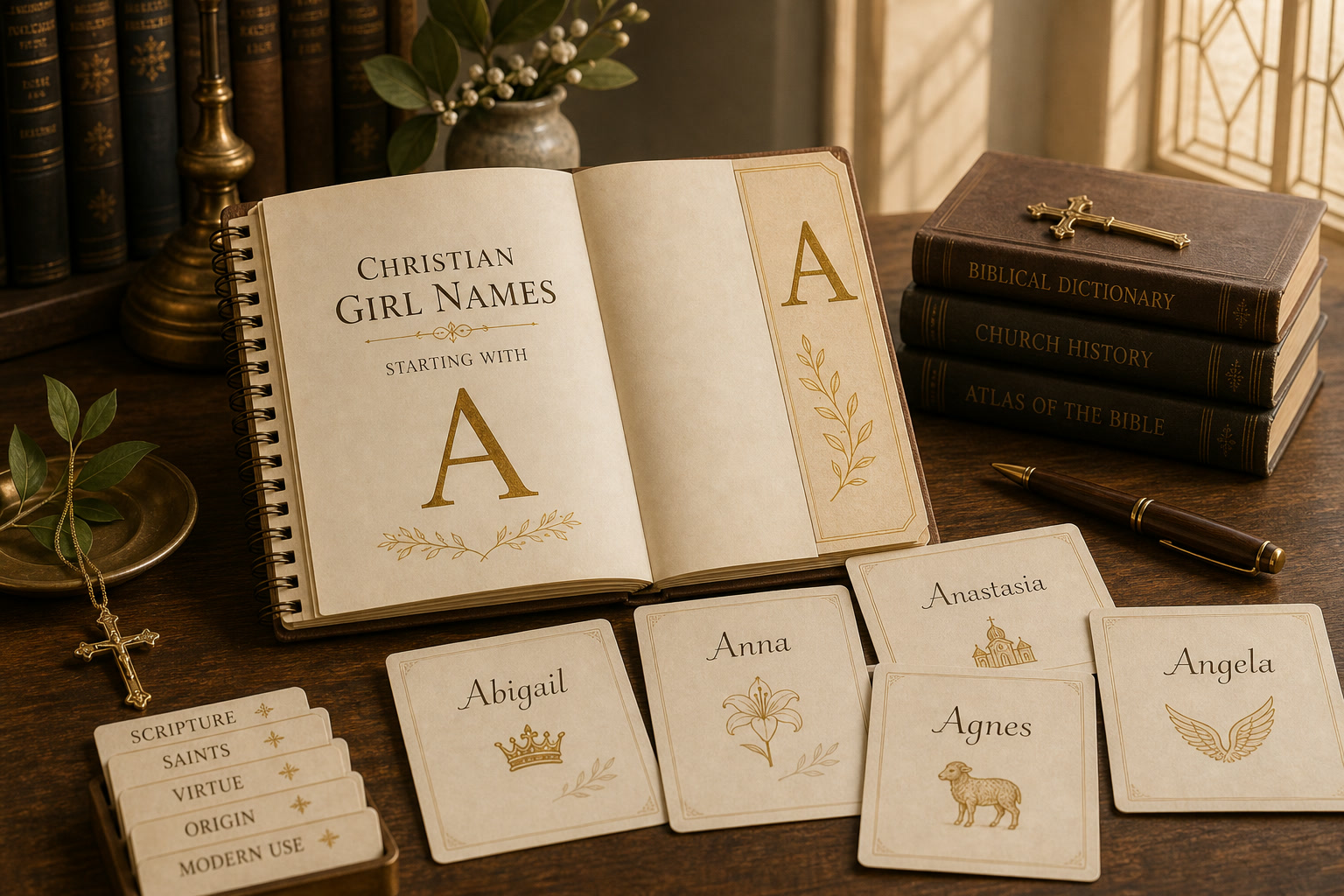
Christian girl names beginning with A include well-known biblical choices such as Abigail and Anna, the one-line New Testament name Apphia, and less familiar Hebrew Bible names including Achsah, Adah, Atarah, Azubah, and Abijah or Abiah. Their passages range from long narratives to short genealogical notices, so the amount we can say about each woman is not equal.
Other A names became important through Christian tradition rather than a biblical bearer. Anne belongs to the Anna name family but the identification of Anne as Mary's mother comes from apocryphal tradition; Anastasia, Agnes, Agatha, Angela, Audrey, Apollonia, and Aurelia have later saint histories.
Adela, Adeline, Amabel, and Alice add a third route through documented medieval language and use. The sections below keep those records separate so a family can choose a name for the connection it actually has.
Quick Facts
- Direct biblical names covered
- Abigail, Anna, Apphia, Achsah, Adah, Atarah, Azubah, and Abijah or Abiah
- New Testament women
- Anna in Luke 2 and Apphia in Philemon 1
- Anna and Anne
- One historical name family, but the Gospel prophetess and the traditional mother of Mary are different figures
- Angel-word family
- Angela, Angelica, and Angelina are human given names, not names assigned to angels in scripture
- Later historical names
- Anastasia, Agnes, Agatha, Audrey, Apollonia, Aurelia, Adela, Adeline, Amabel, and Alice
Eight A names are attached to women in the cited biblical passages
The direct biblical group covered here contains eight choices. Four have enough narrative or greeting context for a short profile, while the others appear in briefer family records.
| Name | Primary passage | What the text establishes | Boundary |
|---|---|---|---|
| Abigail | 1 Samuel 25 | Nabal's wife intervenes between David and Nabal and later becomes David's wife | Read the whole conflict rather than reducing her to a virtue label |
| Anna | Luke 2:36-38 | An elderly prophet of the tribe of Asher speaks about the child Jesus | The passage does not identify her as Mary's mother |
| Apphia | Philemon 1:1-3 | Paul and Timothy address her as 'our sister' beside Philemon, Archippus, and a house church | The greeting does not state her family relationship |
| Achsah | Joshua 15:16-19 | Caleb's daughter asks for springs after her marriage to Othniel | Her story is brief and tied to a land grant |
| Adah | Genesis 4:19-24 | Lamech's wife and the mother of Jabal and Jubal | Other women also bear this name in Genesis |
| Atarah | 1 Chronicles 2:26 | Jerahmeel's wife and the mother of Onam | A single genealogical notice |
| Azubah | 1 Kings 22:41-42 | The mother of King Jehoshaphat and daughter of Shilhi | Do not merge her automatically with another Azubah in 1 Chronicles |
| Abijah or Abiah | 1 Chronicles 2:24 | Named as Hezron's wife in the NRSVUE note | Spelling and syntax vary across English translations |
This is a sourced shortlist, not a claim that no other female A names occur anywhere in every biblical canon or translation.
Abigail acts inside a conflict in 1 Samuel 25
First Samuel 25 introduces Abigail as the wife of Nabal and calls her clever and beautiful, while describing Nabal as surly and mean. After Nabal insults David's messengers, David arms his men and sets out against the household.
A servant warns Abigail. She quickly gathers food, meets David, and asks him not to take vengeance into his own hands; David blesses her good sense and says she has kept him from bloodguilt.
The chapter later reports Nabal's death and Abigail's marriage to David. That ending should not erase the danger, power imbalance, and threatened violence that shape the episode.
The Dictionary of Medieval Names from European Sources derives Abigail from Hebrew and glosses it as 'her father's joy.' It also records that the biblical name became popular among Dutch, English, and French Protestants in the sixteenth century, giving the choice both a scriptural bearer and a documented later naming history.
Anna is the Gospel prophet, while Anne belongs to a wider tradition
Luke 2:36-38 names Anna as a prophet, daughter of Phanuel, and member of the tribe of Asher. The passage describes her long widowhood, worship in the temple, praise of God, and speech about the child to people awaiting Jerusalem's redemption.
Anne and Anna belong to the same historical name family. DMNES traces the family to Hebrew for grace or favor and documents both spellings across medieval European records.
The same dictionary identifies Anne as the name of an apocryphal saint remembered as Mary's mother. The canonical Gospels do not name Mary's mother, so that association is later Christian tradition and should not be folded into Anna's Gospel biography.
- Choose Anna for the named prophet in Luke 2 and a long historical name record.
- Choose Anne for its established spelling and later Christian association while keeping the apocryphal boundary visible.
- Do not present Anna the prophet and Anne the traditional mother of Mary as one woman.
Apphia and Achsah have short but distinct biblical records
Philemon opens with a greeting to Philemon, 'our sister Apphia,' Archippus, and the church in a house. Apphia is therefore a direct New Testament woman's name, but the letter's salutation does not call her Philemon's wife, Archippus's mother, or the owner of the house.
Joshua 15 presents Achsah as Caleb's daughter. After Othniel wins the marriage contest, Achsah presses for a field and asks her father for springs as well; Caleb gives her the upper and lower springs.
Adah, Atarah, Azubah, and Abijah or Abiah need even tighter summaries because their cited appearances are genealogical or regnal notices.
| Name | Recorded relationship | What remains limited |
|---|---|---|
| Adah | Wife of Lamech; mother of Jabal and Jubal in Genesis 4 | The passage gives family and descendant context, not a personality profile |
| Atarah | Wife of Jerahmeel; mother of Onam in 1 Chronicles 2 | One genealogy line supplies nearly all the information |
| Azubah | Mother of Jehoshaphat; daughter of Shilhi in 1 Kings 22 | A different Azubah appears in another genealogy |
| Abijah or Abiah | Presented as Hezron's wife in an NRSVUE note to 1 Chronicles 2:24 | Translations handle the spelling and sentence differently |
Anastasia, Agnes, and Agatha combine language history with saint memory
Anastasia is the feminine form of Anastasius. DMNES records several early saints and notes that the name was often given to children born near Easter, while the Catholic Encyclopedia documents the long veneration of a martyr named Anastasia and the uncertainty surrounding parts of the Roman tradition.
Agnes comes from Greek for pure or chaste. Its medieval spread was strongly aided by devotion to Agnes of Rome, whose early witnesses and later narrative layers are discussed separately in the encyclopedia record.
Agatha comes from the Ancient Greek word for good and is tied to a third-century Sicilian martyr. The historical source confirms ancient veneration but warns that the surviving Acts do not reliably establish the details of her death.
| Name | Documented language note | Christian-history note |
|---|---|---|
| Anastasia | Feminine of Anastasius; associated in medieval use with Easter | Several early saints; individual identities should stay separate |
| Agnes | Greek for pure or chaste | Devotion to Agnes of Rome supported broad medieval use |
| Agatha | Ancient Greek for good | Ancient martyr veneration is documented, while later narrative detail is uncertain |
These meanings describe word history, not a promised character or spiritual outcome for a child.
Angela, Angelica, and Angelina are human names from the angel word family
DMNES derives Angela from Latin angelus, meaning angel or messenger, and records historical forms including Angelica and Angelina. The three are human given names; none is assigned to an angelic being in the cited biblical passages.
For the older vocabulary behind the family, our guide to what angel means in Greek explains how a common word for messenger became a religious title. A shared word root does not imply angel contact, protection, or a supernatural identity.
Angela also has a specific saint association through Angela Merici. The Catholic Encyclopedia identifies her as an educator who founded the Company of Saint Ursula at Brescia in 1535, supplying a later Christian-history route for the name.
- Use Angela for the documented Latin form and its association with Angela Merici.
- Treat Angelica and Angelina as historical members of the same name family.
- Keep all three separate from lists claiming to name angels in scripture.
Audrey, Apollonia, and Aurelia enter through later Christian history
Audrey is the later English form associated with Etheldreda, a seventh-century Anglo-Saxon saint. DMNES derives the older name from Old English elements for noble and strength, and the encyclopedia identifies Etheldreda with Ely and records her death in 679.
Apollonia belongs to an older personal-name family and is documented by DMNES as the name of a third-century virgin martyr. That saint record explains its Christian reception; the name is not taken from a woman in the Bible.
Aurelia is the feminine of Aurelius. DMNES documents Italian records and notes fourth- and eleventh-century saints, but it does not turn Aurelia into a direct scriptural name.
| Name | Documented connection | Source label |
|---|---|---|
| Audrey | English form associated with St. Etheldreda of Ely | Old English name plus saint history |
| Apollonia | Recorded medieval use and a third-century martyr association | Classical name family plus saint history |
| Aurelia | Feminine of Aurelius with medieval Italian records and saint bearers | Latin name family plus saint history |
Adela, Adeline, Amabel, and Alice have documented medieval histories
Adela comes from Old English and Old High German elements meaning noble, and DMNES records several saint and royal bearers. Adeline began as a familiar form of Adela or Adelheid before becoming an independent name.
Amabel comes from Latin amabilis, meaning loving, and appears in medieval English, French, and Italian records. Alice comes from an Old High German name meaning nobility and became exceptionally widespread across medieval Europe.
Alice has Christian historical bearers, but DMNES notes that its popularity did not depend mainly on a classical martyr or saint. That distinction makes it a useful example of a name widely used in Christian societies without being specifically biblical.
- For a direct biblical bearer, start with Abigail, Anna, Apphia, Achsah, Adah, Atarah, Azubah, or Abijah or Abiah.
- For a named saint tradition, compare Anastasia, Agnes, Agatha, Angela, Audrey, Apollonia, or Aurelia.
- For documented medieval language history with a lighter religious claim, compare Adela, Adeline, Amabel, and Alice.
Each route is a valid reason to consider a name as long as the label matches the evidence a family wants to preserve.
Frequently Asked Questions
Which biblical girl names start with A?
The direct biblical women covered here are Abigail, Anna, Apphia, Achsah, Adah, Atarah, Azubah, and Abijah or Abiah, whose records range from full narratives to single genealogy lines.
What does Abigail mean?
DMNES derives Abigail from Hebrew and gives the sense 'her father's joy,' while 1 Samuel 25 supplies the biblical woman's story rather than the lexical gloss.
Are Anna and Anne the same name?
They belong to the same historical name family, but Anna is a prophet in Luke 2 and Anne as Mary's mother belongs to apocryphal Christian tradition.
Is Apphia a biblical name?
Philemon 1:2 addresses Apphia as 'our sister' but does not state her relationship to Philemon or Archippus.
Who was Achsah in the Bible?
Joshua 15 names Achsah as Caleb's daughter and Othniel's wife who asks her father for springs and receives the upper and lower springs.
Is Angela the name of an angel in the Bible?
Angela, Angelica, and Angelina are human given names from the Latin angel or messenger word family, not names assigned to biblical angels in the cited sources.
What do Agnes and Agatha mean?
DMNES derives Agnes from Greek for pure or chaste and Agatha from Ancient Greek for good; both names also gained wide Christian associations through saint veneration.
Are Audrey and Etheldreda connected?
They belong to one English name tradition, documented in records that use Audrey alongside forms of the saint's older name.
Is Alice a biblical or saint name?
Alice is not a woman in the cited biblical passages and, although it has medieval saint bearers, its broad popularity was not driven mainly by one saint cult.
Which A names have later Christian rather than biblical roots?
Look for a saint or medieval-name source rather than a Bible passage: this group includes the Greek-root martyr names, the Angela family, Audrey, Apollonia, Aurelia, and the documented Adela and Alice families.
Sources
- (2021). 1 Samuel 25. New Revised Standard Version Updated Edition via BibleGateway. Link
- (2023). Abigail. Dictionary of Medieval Names from European Sources, Edition 2023, no. 1. Link
- (2021). Luke 2:36-38. New Revised Standard Version Updated Edition via BibleGateway. Link
- (2023). Anne. Dictionary of Medieval Names from European Sources, Edition 2023, no. 1. Link
- (2021). Philemon 1:1-3. New Revised Standard Version Updated Edition via BibleGateway. Link
- (2021). Joshua 15:16-19. New Revised Standard Version Updated Edition via BibleGateway. Link
- (2021). Genesis 4:19-24. New Revised Standard Version Updated Edition via BibleGateway. Link
- (2021). 1 Chronicles 2:24-26. New Revised Standard Version Updated Edition via BibleGateway. Link
- (2021). 1 Kings 22:41-42. New Revised Standard Version Updated Edition via BibleGateway. Link
- (2023). Anastasia. Dictionary of Medieval Names from European Sources, Edition 2023, no. 1. Link
- (1907). St. Anastasia. New Advent. Link
- (2023). Agnes. Dictionary of Medieval Names from European Sources, Edition 2023, no. 1. Link
- (1907). St. Agnes of Rome. New Advent. Link
- (2023). Agatha. Dictionary of Medieval Names from European Sources, Edition 2023, no. 1. Link
- (1907). St. Agatha. New Advent. Link
- (2023). Angela. Dictionary of Medieval Names from European Sources, Edition 2023, no. 1. Link
- (1907). St. Angela Merici. The Catholic Encyclopedia via New Advent. Link
- (2023). Audrey. Dictionary of Medieval Names from European Sources, Edition 2023, no. 1. Link
- (1909). St. Etheldreda. The Catholic Encyclopedia via New Advent. Link
- (2023). Apollonia. Dictionary of Medieval Names from European Sources, Edition 2023, no. 1. Link
- (2023). Aurelia. Dictionary of Medieval Names from European Sources, Edition 2023, no. 1. Link
- (2023). Adela. Dictionary of Medieval Names from European Sources, Edition 2023, no. 1. Link
- (2023). Adeline. Dictionary of Medieval Names from European Sources, Edition 2023, no. 1. Link
- (2023). Amabel. Dictionary of Medieval Names from European Sources, Edition 2023, no. 1. Link
- (2023). Alice. Dictionary of Medieval Names from European Sources, Edition 2023, no. 1. Link
About Our Editorial Process
Every KnowTheAngels guide separates calculation method, tradition context, and personal reflection. We cite where interpretations come from, present more than one view, and never present symbolic reading as prediction.
Read our editorial policy