What Are Christian Girl Names Starting With R and Their Meanings?
Ten names compared through biblical stories, saint traditions, meanings, and spelling choices
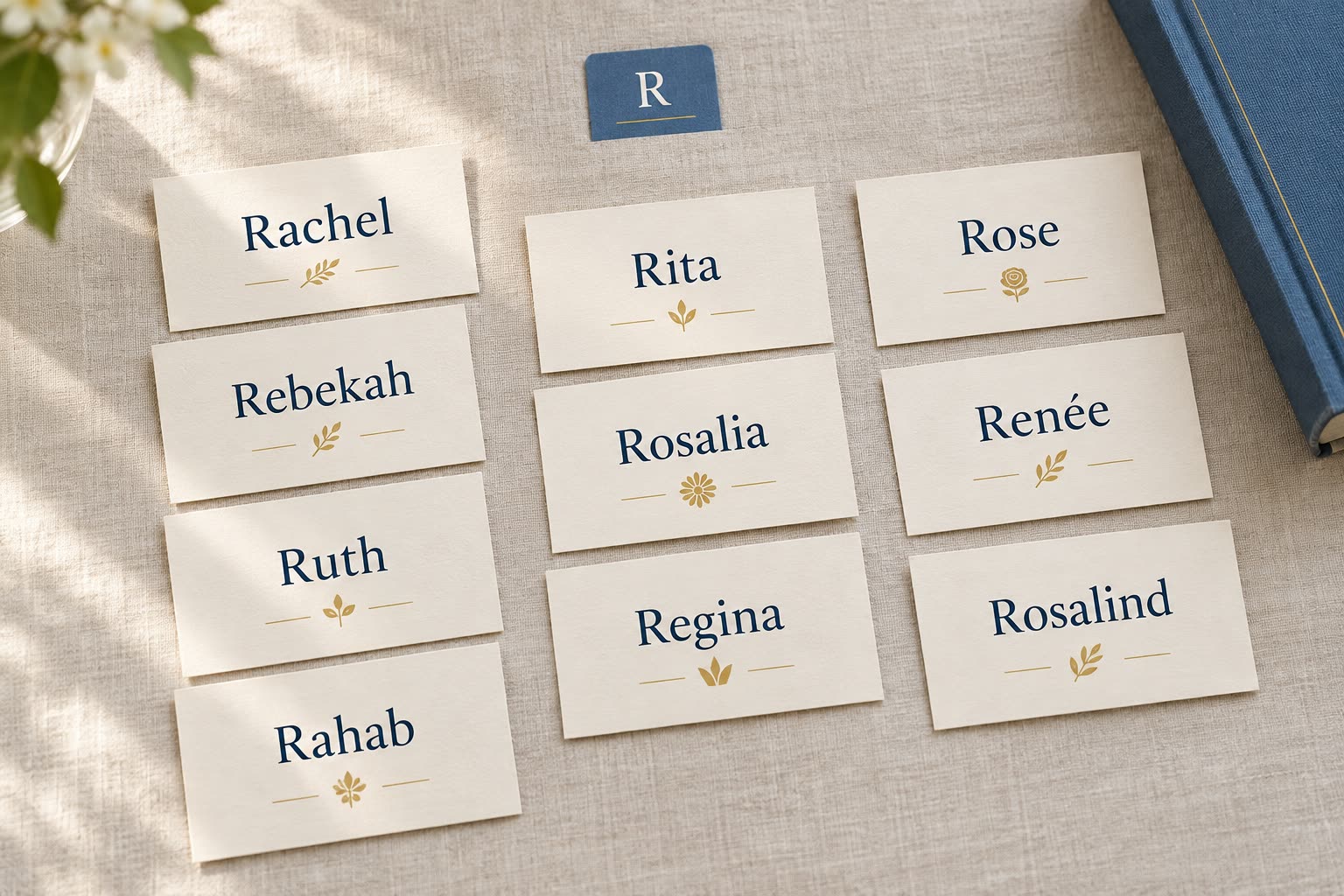
Christian girl names starting with R include Rachel, Rebekah, Ruth, and Rahab from the Bible, alongside Rita, Rosalia, and Regina from saint traditions. Rose, Renée, and Rosalind offer different combinations of language history and religious association.
The connection matters when you choose a name: a biblical woman, a saint, a devotional title, and a name that Christians also use are different kinds of namesake. This shortlist explains ten choices without treating every pleasant meaning as a Christian origin.
Quick Facts
- Biblical women
- Rachel, Rebekah/Rebecca, Ruth, Rahab
- Saint connections
- Rita of Cascia, Rosalia of Palermo, Regina in martyr tradition
- Meaning and devotion
- Rose has Marian symbolism; Renée belongs to the Latin born-again name family
- Etymology limits
- Rebecca and Ruth have proposed, rather than certain, derivations
- Spelling pairs
- Rebecca/Rebekah and Renée/Renee are forms of the same respective names
Which R names are biblical, saint names, or symbolic?
The four biblical choices come from Israel's scriptures, which Christians read as the Old Testament; their Hebrew names and narratives predate Christianity.
| Name | Connection | Meaning or name history | Namesake or limit |
|---|---|---|---|
| Rachel | Biblical woman | Hebrew: ewe | Jacob's wife; mother of Joseph and Benjamin |
| Rebekah / Rebecca | Biblical woman | Probably linked to a Semitic root for joining, tying, or snaring | Isaac's wife; the proposed derivation is uncertain |
| Ruth | Biblical woman | Probably related to a Hebrew word for female friend | Moabite widow in the Book of Ruth |
| Rahab | Biblical woman | Hebrew: spacious | Woman of Jericho remembered in Joshua and the New Testament |
| Rita | Saint tradition | Short form of Margherita and other names ending in -rita | Rita of Cascia, an Augustinian nun |
| Rosalia | Saint tradition | Late Latin, from rosa: rose | Rosalia of Palermo; much of her biography is later tradition |
| Regina | Martyr tradition and Marian devotion | Latin: queen | A personal name as well as a word in Marian titles |
| Rose | Flower association and Marian symbolism | Modern flower association overlays an older personal-name history | Mystical Rose is a title of Mary, not a biblical woman named Rose |
| Renée / Renee | Language history with a Christian association | French feminine of René, from Latin Renatus: born again | The meaning can suggest Christian renewal; no biblical namesake |
| Rosalind | Germanic name with literary and rose associations | Old German elements associated with horse and soft or tender | No specifically Christian origin established |
The meaning column does not describe the child who bears the name. Rachel's association with an ewe, for example, does not make gentleness a promised personality trait, and Rahab's spacious meaning does not summarize her faith.
If your family is seeking a scriptural namesake, the first four entries answer that request directly; a saint or Marian association offers a different kind of connection.
How do Rachel and Rebekah differ in Genesis?
Rachel and Rebekah belong to successive generations. Rebekah marries Isaac and is Jacob's mother; Rachel later marries Jacob, making Rebekah her mother-in-law within the Genesis family.
Rachel comes from Hebrew רָחֵל, conventionally transliterated Raḥel, meaning ewe.
Genesis 29 introduces Rachel tending her father Laban's sheep. Jacob works to marry her, but Laban gives him her older sister Leah first, and the resulting household is marked by unequal affection and conflict.
Jacob’s love explains why a family might associate Rachel with being beloved, but ewe remains the linguistic meaning of her name.
Rachel becomes the mother of Joseph and Benjamin, but Genesis 35 places Benjamin's birth alongside her death. Her story therefore holds love, family rivalry, motherhood, and loss together rather than offering a simple account of a rewarded wish.
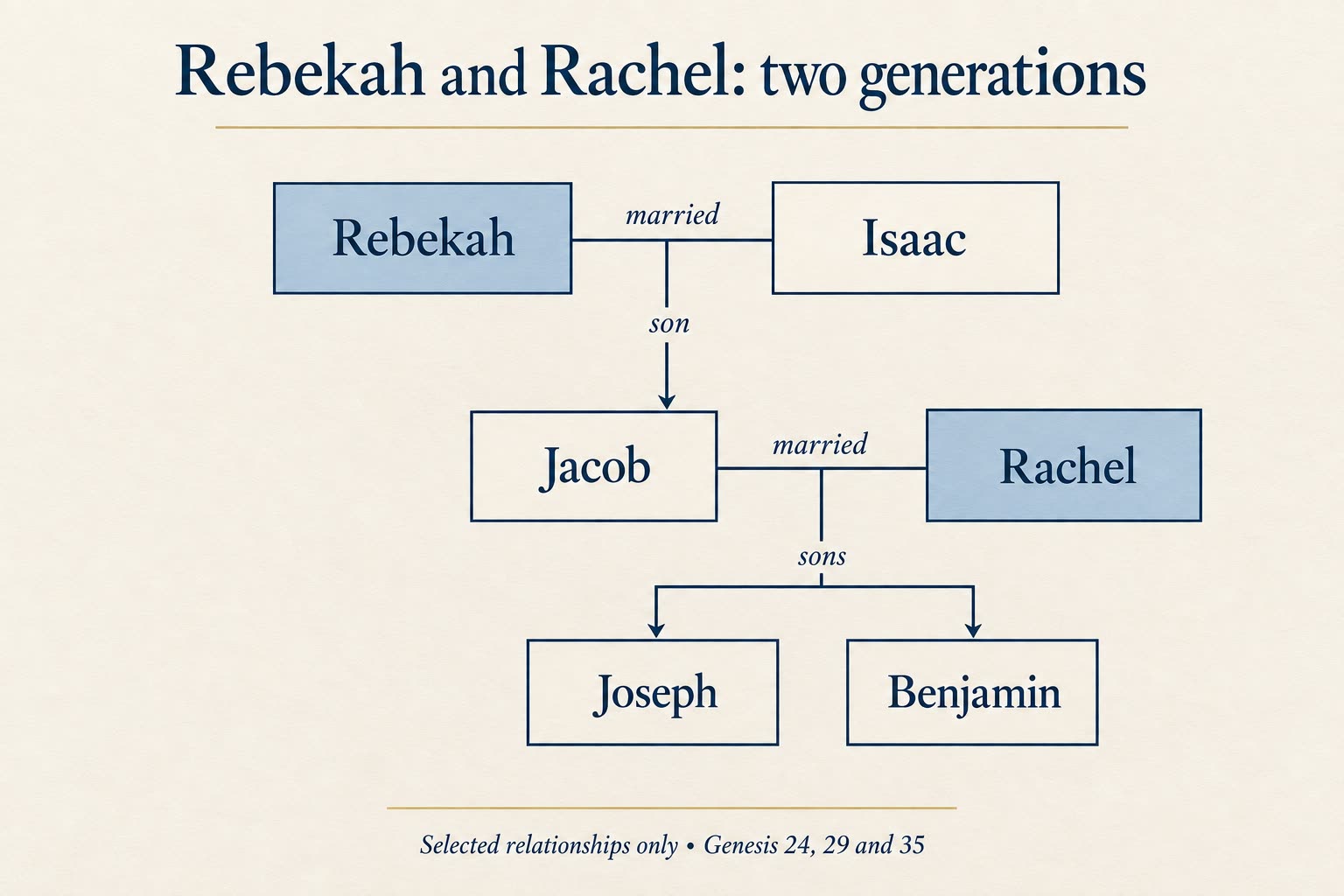
Rebekah's name is also written Rebecca in English. Behind the Name connects its Hebrew form רִבְקָה, Rivqa, probably with a Semitic root involving joining, tying, or snaring, but the derivation is uncertain.
The flattering interpretation “captivating” sometimes attached to Rebecca is not a secure literal translation of its proposed root.
In Genesis 24, Rebekah offers water to Abraham's servant and his camels, and she agrees to leave with the servant when her family asks. Those actions give a concrete basis for remembering her hospitality and initiative.
Genesis 27 adds a harder episode: Rebekah helps Jacob obtain the blessing Isaac intended for Esau. Choosing her as a namesake can honour a central matriarch while still acknowledging a narrative involving deception and family division.
Rachel draws you toward Jacob’s marriages and children, while Rebekah draws you toward Isaac’s household and the struggle between his sons.
What does Ruth's story add to her name's meaning?
Ruth is probably related to a Hebrew word for female friend, according to Behind the Name; the entry presents this as a proposed derivation. Her better-established association with loyalty comes from what she does in the biblical story.
She is a Moabite widow who accompanies her mother-in-law Naomi to Bethlehem. Ruth's commitment crosses the boundaries of homeland and family, so her foreign origin is part of the account rather than a detail that disappears when she becomes an ancestor of David.
The contrast with Orpah also matters: Naomi urges both daughters-in-law to return home, and Orpah does so. Ruth's decision is distinctive without requiring a claim that every different family decision represents disloyalty.
Gleaning makes that commitment materially possible. Ruth 2 describes her collecting grain behind harvesters, while Leviticus 19:9–10 instructs landowners to leave field edges and harvest remnants for poor people and foreigners.
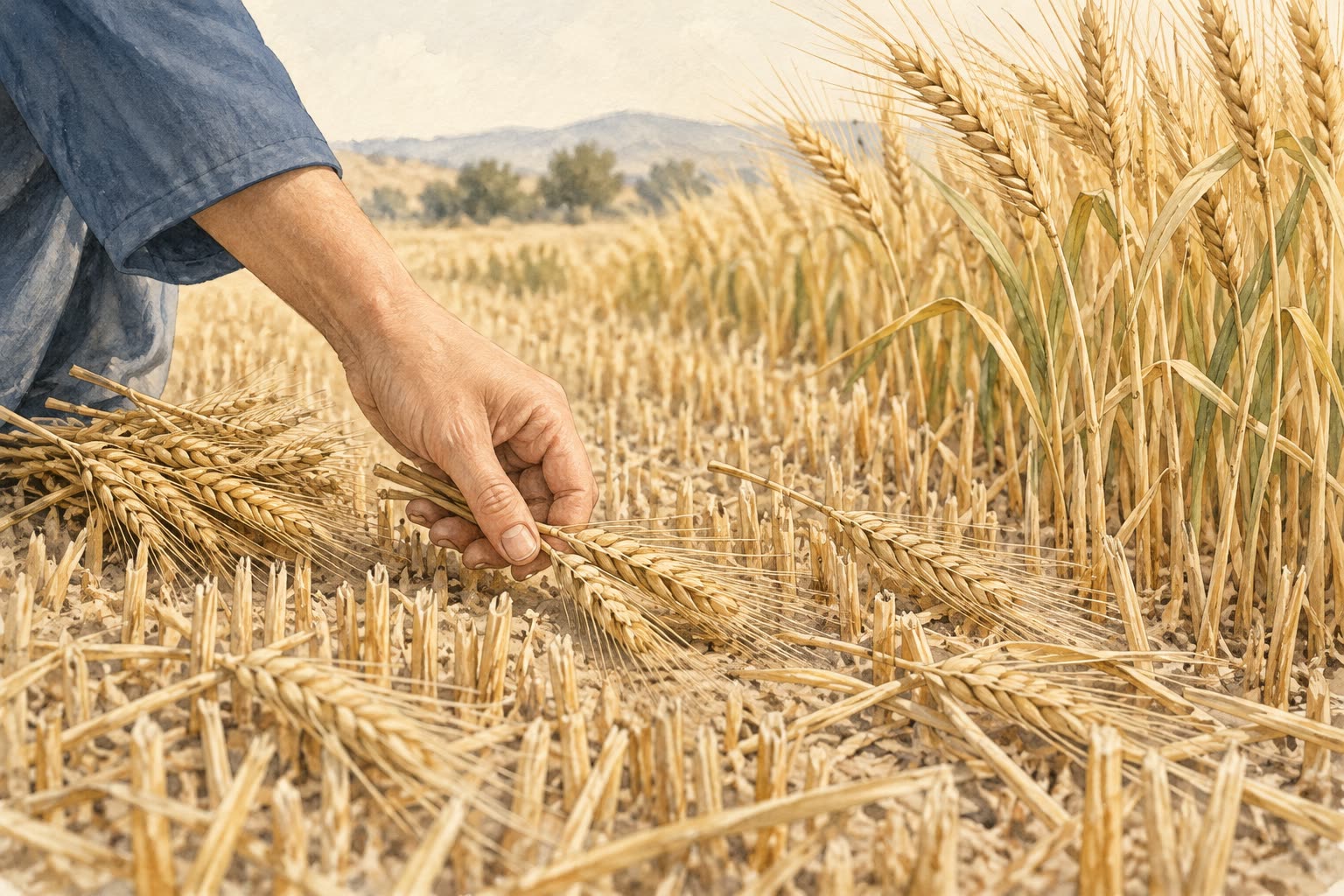
Boaz gives Ruth more than access to scattered grain: he provides protection, water, food, and instructions that extra stalks be left for her. These details show how her work and another person's practical help support the household together.
The later redemption scene concerns land, marriage, and the continuation of a family line. In Ruth 4, a relative with the prior right declines before Boaz takes the role, and the agreement is witnessed at the town gate.
The arrangement gives public and familial dimensions to Ruth and Naomi’s security, and it cannot be reduced to a claim that Boaz was her deceased husband’s brother.
Ruth and Boaz's son Obed becomes Jesse's father and David's grandfather; Matthew 1:5 also names Ruth in Jesus' genealogy. These passages explain her place in Christian memory without changing her Moabite identity or turning the name into a promise about its bearer's future.
Why is Rahab remembered in the New Testament?
Rahab's Christian association rests on her biblical actions and their later reception, rather than on an uncomplicated life story. Her Hebrew name רָחָב is given the meaning spacious in Behind the Name, which is separate from the themes Christians draw from the narrative.
Joshua 2 identifies Rahab as a prostitute living in Jericho and describes her hiding Israelite spies beneath flax on her roof. She asks for protection for her family and negotiates the conditions under which her household will be spared.
The scarlet cord placed in the window belongs to the protection agreement in Joshua 2, rather than to the linguistic meaning of Rahab.
Hebrews 11:31 remembers Rahab for faith, while James 2:25 points to her reception and safe departure of the messengers when discussing faith and action. Matthew 1:5 includes Rahab in its genealogy, adding another New Testament setting in which Christians encounter her name.
These references help explain why someone may value Rahab as a Christian namesake even when the Joshua account is difficult. The name offers a specific story of a woman's consequential choices, not a sanitized account in which her background has been replaced by a more comfortable occupation.
What connects Rita, Rosalia, and Regina to saints?
Rita points to Rita of Cascia, whose religious life belongs to the Augustinian tradition. The name is a short form of Margherita and other names ending in -rita, so a saint association and a linguistic derivation answer different questions.
The Catholic Encyclopedia's 1912 account describes Rita as a wife and mother who later entered an Augustinian convent after widowhood. It also records her canonization in 1900 and her devotional association with seemingly impossible causes.
The title describes believers’ appeals to Rita’s intercession; it is not a literal name meaning or a promise that a child named Rita will receive miracles.
Rita can serve as a full given name while retaining that saint connection, even when the family does not use Margherita.
Rosalia has a different historical setting: devotion in Palermo and Sicily. Linguistically, it is a Late Latin formation from rosa, meaning rose, which makes the flower meaning compatible with a saint connection without making the two identical.
The same encyclopedia records evidence of honour to Rosalia in 1237, but says her written life was compiled much later from local traditions, pictures, and inscriptions. Its discussion even notes uncertainty about whether she belonged to a religious community.
This difference between early devotion and a later detailed biography matters when a naming account describes her as a hermit. The tradition is part of Rosalia's reception, but every episode in it is not equally established by contemporary documentation.
Regina is Latin for queen, and the Dictionary of Medieval Names from European Sources records both medieval uses of the personal name and a French martyr tradition. The entry's 2023 edition supports a historical personal-name connection beyond a modern royal-sounding interpretation.
A separate Catholic association comes through Regina Caeli, the Marian prayer used in the Easter season. In that setting Regina is a title-word referring to Mary; it is not a statement that Mary's biblical personal name was Regina.
A saint namesake and a Marian title are separate connections. A family choosing Regina can value either one, but naming the particular connection gives a clearer explanation than calling the name simply “biblical.”
Are Rose, Renée, and Rosalind Christian names?
Rose can carry a Catholic Marian association through Mystical Rose, a title in the Litany of Loreto. That is a devotional use of a flower image, not an appearance of a woman called Rose in the biblical text.
Behind the Name traces an earlier Norman form of Rose to Germanic elements and notes its early association with Latin rosa and the flower.
For a present-day family, the rose may be the intended meaning regardless of that older derivation. A Marian intention makes the religious association explicit; the flower alone does not establish that every bearer has been named for Mary.
Renée is the French feminine form of René, which comes through Latin Renatus, meaning born again. Renee is also used without the French accent, and the spelling change does not create a different biblical namesake.
The language of rebirth can fit a Christian understanding of renewal, but the name's derivation is a linguistic fact and the family's religious intention is an additional interpretation. It would be inaccurate to identify Renée as a woman in the New Testament on the strength of that meaning.
Its connection is therefore different from Ruth's: Ruth names a person in a scriptural narrative, while Renée can express a meaning a family finds compatible with its faith. Both may be meaningful choices without needing the same kind of evidence.
Rosalind has no established specifically Christian origin in the name source used here. Behind the Name traces it to Old German elements associated with horse and soft or tender, followed by later rose associations and literary use.
That history makes it risky to translate the whole name confidently as “beautiful rose” or give it an invented biblical bearer. A modern association with roses can be real for a family while remaining different from the older linguistic derivation.
A Christian family can still choose Rosalind because of its sound, a relative, or a literary connection. Describing that choice honestly preserves its meaning to the family without turning personal use into a claim about religious origin.
Which R spellings refer to the same name?
Rebecca and Rebekah refer to the same biblical namesake, and Renée and Renee belong to the same respective name family. A spelling preference does not establish a stronger religious connection.
| Forms you may compare | What stays the same | What deserves attention |
|---|---|---|
| Rebecca / Rebekah | Isaac's wife in Genesis | The spelling used in your family or Bible translation; the etymology remains uncertain |
| Rachel / Rachael | The same name family and biblical namesake | Rachael has an extra a; pronunciation depends on language and local use |
| Renée / Renee | Feminine name connected with René and Renatus | The accent belongs to the French spelling; both forms need a clear family pronunciation |
| Rose / Rosalia / Rosalind | A visible or later association with rose imagery | These are distinct names with different histories, not interchangeable spellings |
The last row separates a direct Latin rose derivation, an established flower association, and an older Germanic formation; similar-looking names need not have the same origin.
Pronunciation depends on language as well as spelling. Behind the Name gives English Ruth with the final sound in “both,” while the German pronunciation ends with a t sound, a useful distinction in a multilingual family.
For your own shortlist, the practical question is which connection you want to preserve: a particular person, a devotion, a language, or a family usage. The broader collection of Christian girl names can help compare other initials when that connection matters more than beginning with R.
Sources
- (2021). Matthew 1:5, New Revised Standard Version Updated Edition. BibleGateway. Link
- (1912). Rita of Cascia, Saint. New Advent. Link
- (1912). Rosalia, Saint. New Advent. Link
- (2023). Regina. Dictionary of Medieval Names from European Sources, edition 2023, no. 1. Link
- (n.d.). The Litany of Loreto. Vatican.va. Link
- (2016). Regina Caeli, Easter Monday. The Holy See. Link
- (n.d.). Meaning, origin and history of the name Rose. Behind the Name. Link
- (2024). Meaning, origin and history of the name Renée. Behind the Name. Link
- (2026). Meaning, origin and history of the name Renatus. Behind the Name. Link
- (2026). Meaning, origin and history of the name Rosalind. Behind the Name. Link
- (n.d.). Genesis 24: Rebekah and Isaac. New American Bible, Revised Edition. Link
- (n.d.). Introduction to Ruth. New American Bible, Revised Edition. Link
- (n.d.). Ruth 4: redemption and genealogy. New American Bible, Revised Edition. Link
- (n.d.). Leviticus 19:9–10: harvest provisions. New American Bible, Revised Edition. Link
- (n.d.). Joshua 2: Rahab and the messengers. New American Bible, Revised Edition. Link
- (n.d.). James 2:25: Rahab and action. New American Bible, Revised Edition. Link
- (2021). Genesis 27: Rebekah and the blessing. New Revised Standard Version Updated Edition, BibleGateway. Link
- (2021). Genesis 29: Rachel and Leah. New Revised Standard Version Updated Edition, BibleGateway. Link
- (2021). Genesis 35: Rachel and Benjamin. New Revised Standard Version Updated Edition, BibleGateway. Link
- (2021). Ruth 2: gleaning and Boaz. New Revised Standard Version Updated Edition, BibleGateway. Link
- (2021). Hebrews 11:31: Rahab and faith. New Revised Standard Version Updated Edition, BibleGateway. Link
- (2026). Meaning, origin and history of the name Rachel. Behind the Name. Link
- (n.d.). Meaning, origin and history of the name Rebecca. Behind the Name. Link
- (2026). Meaning, origin and history of the name Ruth (1). Behind the Name. Link
- (2019). Meaning, origin and history of the name Rahab. Behind the Name. Link
- (n.d.). Meaning, origin and history of the name Rita. Behind the Name. Link
- (n.d.). Meaning, origin and history of the name Rosalia. Behind the Name. Link
- (n.d.). Meaning, origin and history of the name René. Behind the Name. Link
- (2021). Ruth 1: Naomi, Ruth, and Orpah. New Revised Standard Version Updated Edition, BibleGateway. Link
About Our Editorial Process
Every KnowTheAngels guide separates calculation method, tradition context, and personal reflection. We cite where interpretations come from, present more than one view, and never present symbolic reading as prediction.
Read our editorial policy