What Are Christian Girl Names Starting With B and Their Meanings?
Compare four women named in the Bible, the place name Bethany, later saint traditions, and documented medieval B-name histories.
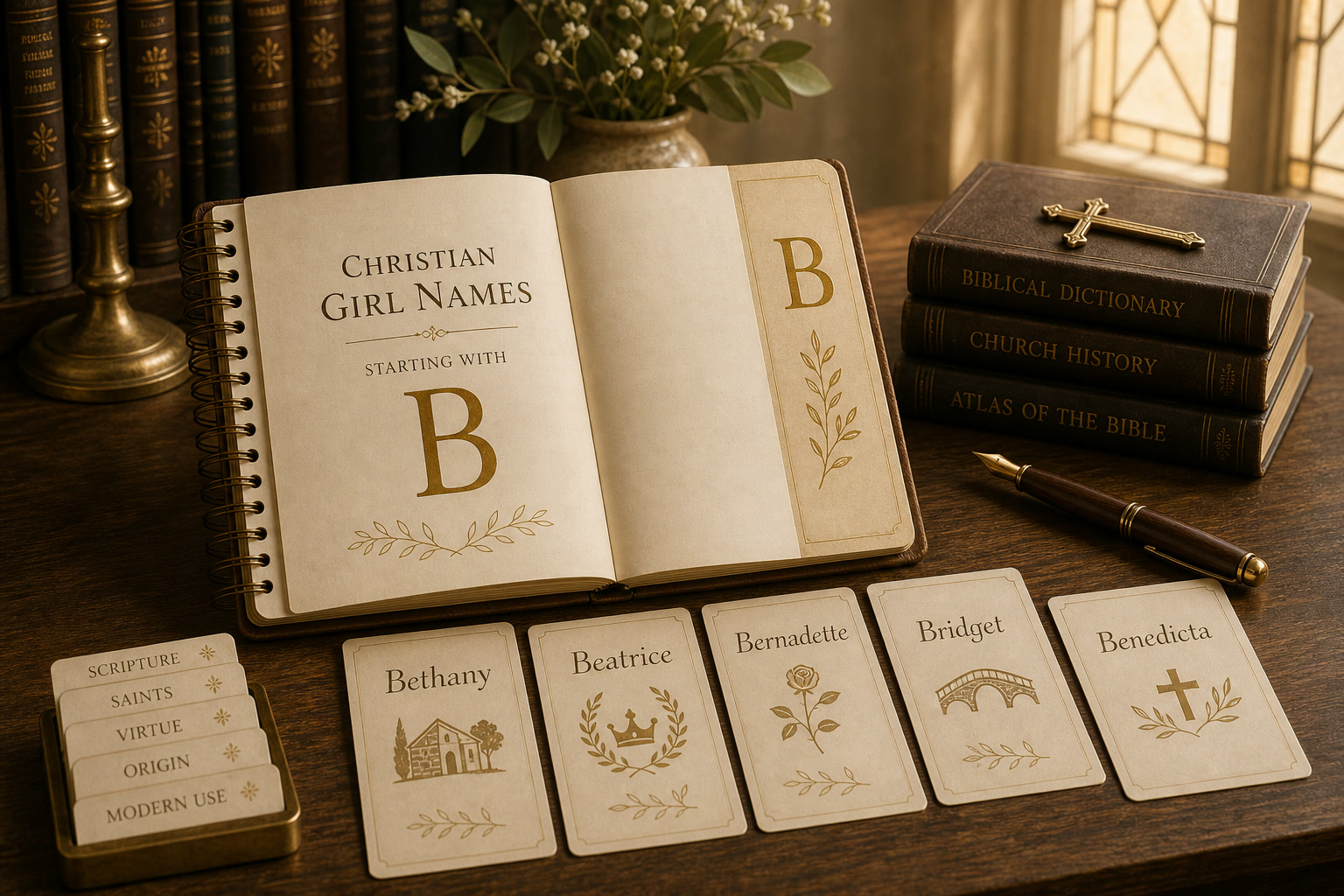
The Christian girl names beginning with B include four clear personal names in the passages covered here: Bathsheba, Bilhah, Bithiah, and Bernice or Berenice. Their records are not interchangeable.
Bathsheba appears across a long and difficult royal narrative, Bilhah's story is bound to household servitude and childbearing, Bithiah receives one genealogy line, and Bernice appears with Agrippa in Acts.
Bethany is also a strong Christian choice, but the Gospel of John names it as the village of Mary, Martha, and Lazarus rather than as a woman. Bernadette, Brigid or Bridget, Barbara, Blandina, and Bibiana entered Christian naming through later history and devotion.
Their surviving records range from well-attested people to traditions whose biographical details are late or uncertain.
Beatrice, Beata, Benedicta, Bertha, Bona, and Blanche offer another route through documented language and medieval use. Keeping those routes separate lets a family choose the connection it actually wants to preserve.
Quick Facts
- Direct biblical women covered
- Bathsheba, Bilhah, Bithiah, and Bernice or Berenice
- Biblical place used as a name
- Bethany, the village linked with Mary, Martha, and Lazarus
- Later Christian histories
- Bernadette, Brigid or Bridget, Barbara, Blandina, and Bibiana
- Latin meaning group
- Beatrice, Beata, Benedicta, and Bona
- Historical language names
- Bertha and Blanche have documented medieval use but are not biblical women
B names at a glance: biblical, place-derived, saint, and historical
The most useful first cut is by the record behind each name. The table does not rank one tradition above another; it shows what kind of claim can be supported for each choice.
| Name | Documented connection | Best label | Important boundary |
|---|---|---|---|
| Bathsheba | Named in 2 Samuel and 1 Kings | Biblical woman | Her story includes David's taking of Uriah's wife and later court politics |
| Bilhah | Named in Genesis 29-30 | Biblical woman | Her status and household setting should not be romanticized |
| Bithiah | Pharaoh's daughter in 1 Chronicles 4:18 | Biblical woman | Only a brief genealogy notice survives |
| Bernice / Berenice | Appears with Agrippa in Acts 25 | New Testament woman | Acts gives little personal information about her |
| Bethany | Village of Mary, Martha, and Lazarus in John 11 | Biblical place name | Not a woman's personal name in the passage |
| Bernadette | Bernadette Soubirous and the Lourdes tradition | Later Catholic saint name | The association is later than the biblical texts |
| Brigid / Bridget | Irish name history and St. Brigid of Kildare | Irish saint-tradition name | Old Irish and saint traditions need their own historical context |
| Barbara | Longstanding veneration from late antiquity onward | Saint-tradition name | The familiar martyr story lacks early historical support |
| Blandina | Martyr of Lyons in 177 | Early Christian martyr name | The record describes violence and enslavement |
| Bibiana | An ancient Roman basilica and later martyr tradition | Saint-tradition name | Her detailed life story is late and historically uncertain |
| Beatrice / Beatrix | Latin name documented across medieval Europe | Language-history name | The meaning is word history, not a promise |
| Beata | Latin name meaning blessed, happy, or fortunate | Language-history name | A documented given name, not a destiny claim |
| Benedicta | Latin feminine name meaning blessed | Language-history name | Distinct from Beata despite related vocabulary |
| Bertha | Germanic name meaning bright, with early saint bearers | Language plus Christian-history name | Not a biblical woman's name |
| Bona | Latin name meaning good, with a medieval saint bearer | Language plus saint-history name | The meaning does not certify a person's character |
| Blanche | Old French name meaning white or pale | Medieval language-history name | Christian-era use does not make it biblical |
This is a researched shortlist, not a claim that every female B name in every biblical canon, translation, or Christian culture appears here.
Bathsheba's story spans David's taking of Uriah's wife and Solomon's succession
Second Samuel 11 first identifies Bathsheba through her marriage to Uriah. David sees her, asks who she is, sends messengers, and takes her while Uriah is away with the army.
After she becomes pregnant, David arranges for Uriah to be placed in the most dangerous fighting and abandoned there.
That sequence matters. Describing Bathsheba only as a beautiful queen or as David's romantic partner removes the king's power, Uriah's death, and the judgment that follows from the name's biblical context.
Bathsheba later acts in the succession dispute in 1 Kings 1. She approaches the aged David, reminds him of the commitment that Solomon would reign, and works with the prophet Nathan as Adonijah tries to secure the throne.
A family may still value Bathsheba as a direct scriptural name. The responsible description is that it belongs to a complex woman whose story stretches from exploitation and loss to influence within the royal court.
Bilhah, Bithiah, and Bernice have very different biblical records
Genesis 29 identifies Bilhah as Laban's maid, given to Rachel when Rachel marries Jacob. In Genesis 30, Rachel gives Bilhah to Jacob as a wife so that Bilhah can bear children on Rachel's behalf; Bilhah gives birth to Dan and Naphtali.
The text supplies a direct name and family record, but it also describes a hierarchy in which others make decisions about her body and children.
Bithiah appears far more briefly. First Chronicles 4:18 calls her Pharaoh's daughter and says that Mered married her.
The verse does not provide a personality, conversion account, or story of Moses, so those details should not be added to this Bithiah from later speculation.
Acts 25 uses the form Bernice in the NRSVUE. She arrives at Caesarea with King Agrippa, attends the hearing with Festus, and appears again in the scene surrounding Paul's defense.
The passage establishes her presence and public setting but does not make her a virtue example.
| Name | Textual setting | What can safely be said |
|---|---|---|
| Bilhah | Genesis household narratives | Rachel's maid; mother of Dan and Naphtali through Jacob |
| Bithiah | Judahite genealogy in 1 Chronicles | Pharaoh's daughter; married to Mered |
| Bernice / Berenice | Paul's hearing before Festus and Agrippa | Present with Agrippa at Caesarea; little biography supplied by Acts |
Bethany is a New Testament village before it is a given name
John 11 introduces Lazarus as a man from Bethany, the village of Mary and her sister Martha. The same chapter places the village near Jerusalem and makes it the setting for Jesus' meeting with the sisters after Lazarus dies.
Bethany therefore has a direct Gospel anchor without being the personal name of a biblical woman. Calling it a biblical place name is more precise than listing it beside Bathsheba or Bithiah as though all three were named female characters.
The place's ancient etymology is disputed, so this guide does not repeat the common but uncertain 'house of figs' or 'house of affliction' gloss as settled fact. The securely documented connection is the village and its Gospel narratives.
For families who prefer a familiar modern sound with a clear New Testament setting, Bethany is the strongest place-derived B option in this shortlist.
Bernadette and Brigid carry later Catholic and Irish histories
Bernadette is closely associated with Bernadette Soubirous, born at Lourdes in 1844. The Sanctuary of Our Lady of Lourdes records her testimony about the 1858 apparitions, her later life with the Sisters of Nevers, her death in 1879, and her canonization in 1933.
These are Catholic devotional and institutional records, not events in scripture.
Brigid is the older Irish form behind English Bridget. DMNES derives it from Old Irish Brigit and a Celtic root meaning high or exalted.
It also warns that the Irish goddess and the sixth-century patron saint were often confused, so the language history should not be collapsed into one biography.
The Catholic Encyclopedia links St. Brigid with Kildare and an important religious community while acknowledging that her biographies are difficult to reconcile. That makes Brigid or Bridget a strong Irish Christian-history choice with a real need for source caution.
- Choose Bernadette for its specific connection to a nineteenth-century Catholic saint and the Lourdes tradition.
- Choose Brigid for the Irish form most directly tied to the saint's name.
- Choose Bridget for the established English form, while retaining the same historical cautions.
Barbara, Blandina, and Bibiana do not have equal historical documentation
Barbara has a long and influential saint tradition, but the Catholic Encyclopedia states that authentic early Christian authorities do not mention her and that her familiar martyr narrative comes from later legendary Acts. The documented fact is widespread veneration from about the seventh century onward, not certainty about the tower, trial, or manner of death.
Blandina has a stronger early record. The account of the martyrs of Lyons places her death in 177 and points to a report from the church of Lyons preserved through Eusebius.
It also identifies her as an enslaved Christian. Her name carries early martyr history, but the violence in that history deserves plain acknowledgment rather than decorative treatment.
Bibiana sits between those cases. An early record says that Pope Simplicius consecrated a basilica containing the martyr's body in the fifth century.
The same encyclopedia entry says that no further historical details of her death survive and that the later family-and-persecution story has no historical claim to belief.
| Name | What is documented | What remains uncertain |
|---|---|---|
| Barbara | Veneration was widespread by the early medieval period | The detailed martyr legend lacks early historical support |
| Blandina | A second-century Lyons martyr record survives through an early church report | Later devotional retellings should not replace that record |
| Bibiana | A fifth-century basilica and burial tradition are recorded | Her detailed biography and death story are later legend |
Beatrice, Beata, and Benedicta share blessing language but not one history
DMNES derives Beatrice from Latin beatrix, 'she who blesses, makes happy, delights,' and documents both Beatrice and Beatrix across medieval Europe. Its record includes saint and royal bearers, but its broad history is larger than one devotional figure.
Beata is a separate Latin feminine name meaning blessed, happy, or fortunate. The dictionary supplies a documented Dutch use in sixteenth-century England; it does not treat Beata as another spelling of Beatrice.
Benedicta is the feminine of the Latin adjective meaning blessed. Its medieval record includes Latin forms in England, France, Hungary, Italy, Spain, and Sweden, together with vernacular forms such as Benoite and Beneta.
| Name | Documented sense | Historical distinction |
|---|---|---|
| Beatrice / Beatrix | One who blesses, makes happy, or delights | A widely documented name with saint and royal bearers |
| Beata | Blessed, happy, or fortunate | A separate feminine adjective used as a name |
| Benedicta | Blessed | The feminine Benedict name family with its own recorded forms |
These meanings describe the words from which the names developed. They do not guarantee a child's temperament, spiritual status, or future.
Bertha, Bona, and Blanche broaden the historical shortlist
Bertha comes from Germanic vocabulary for bright. DMNES records numerous early saint bearers as well as medieval queens and shows forms of the name across several European regions.
Bona comes from Latin for good, kind, right, or useful. Its entry documents a twelfth-century Italian saint, a fifteenth-century duchess of Savoy, and medieval use in France, Italy, central Europe, and Switzerland.
Blanche comes from Old French for white or pale and is extensively documented among medieval European women, including several queens. It belongs in a historical B-name comparison, but neither its color meaning nor its Christian-era use turns it into a biblical name.
- For a woman named in scripture, compare Bathsheba, Bilhah, Bithiah, and Bernice by the amount and character of their actual passages.
- For a Gospel place connection, consider Bethany without recasting the village as a woman.
- For a later saint association, compare Bernadette, Brigid, Barbara, Blandina, and Bibiana with their different evidence limits.
- For documented language history, compare Beatrice, Beata, Benedicta, Bertha, Bona, and Blanche by sound and meaning after checking the record behind each one.
Bella, Belle, Brielle, and Blessing may still suit Christian families, but the sources reviewed for this guide do not establish them as women in the Bible. They should not be promoted to biblical or saint status simply to lengthen the list.
Frequently Asked Questions
Which biblical girl names start with B?
The direct biblical women covered here are Bathsheba, Bilhah, Bithiah, and Bernice or Berenice. Their records range from long royal narratives to a single genealogy line.
Is Bethany a biblical girl's name?
Bethany is biblical as a place: John 11 identifies it as the village of Mary, Martha, and Lazarus. The passage does not use Bethany as a woman's personal name.
Who is Bithiah in the Bible?
The cited genealogy identifies Bithiah as Pharaoh's daughter and Mered's wife. It does not tell a longer story about her.
What does Genesis say about Bilhah?
Genesis identifies Bilhah as Laban's maid given to Rachel; Rachel then gives her to Jacob as a wife, and Bilhah bears Dan and Naphtali.
Is Bernice or Berenice in the New Testament?
Yes. The NRSVUE uses Bernice for the woman who appears with King Agrippa during Paul's hearing before Festus in Acts 25.
Why does Bathsheba need a careful description?
Second Samuel 11 describes David sending for and taking Uriah's wife, then arranging Uriah's death. Bathsheba later has an active role in Solomon's succession, so a beauty-only summary distorts her story.
Are Brigid and Bridget the same name?
Bridget is an established English form of the older Irish Brigid name tradition. The historical record also cautions that stories about the Irish saint and an earlier goddess were sometimes mixed.
How historical is the story of Saint Barbara?
Her veneration is old and well documented, but the Catholic Encyclopedia says the detailed martyr story lacks support in authentic early Christian sources.
Does Benedicta mean blessed?
Yes. DMNES derives Benedicta from the Latin feminine adjective for blessed and documents the name and its related forms in medieval records.
Are Bella, Belle, and Brielle specifically Christian names?
They can be chosen by Christian families, but the sources used here do not make them biblical women's names. A specific family association should be described separately from biblical or saint evidence.
Sources
- (2021). 2 Samuel 11:1-5. New Revised Standard Version Updated Edition via BibleGateway. Link
- (2021). 1 Kings 1:11-31. New Revised Standard Version Updated Edition via BibleGateway. Link
- (2021). Genesis 29:29; 30:1-8. New Revised Standard Version Updated Edition via BibleGateway. Link
- (2021). 1 Chronicles 4:18. New Revised Standard Version Updated Edition via BibleGateway. Link
- (2021). Acts 25:13-23. New Revised Standard Version Updated Edition via BibleGateway. Link
- (2021). John 11:1-18. New Revised Standard Version Updated Edition via BibleGateway. Link
- (2023). Beatrice. Dictionary of Medieval Names from European Sources, Edition 2023, no. 1. Link
- (2023). Beata. Dictionary of Medieval Names from European Sources, Edition 2023, no. 1. Link
- (2023). Benedicta. Dictionary of Medieval Names from European Sources, Edition 2023, no. 1. Link
- (2023). Bridget. Dictionary of Medieval Names from European Sources, Edition 2023, no. 1. Link
- (n.d.). Life of Bernadette Soubirous, Saint Bernadette. Lourdes Sanctuary. Link
- (1907). St. Brigid of Ireland. The Catholic Encyclopedia via New Advent. Link
- (1907). St. Barbara. The Catholic Encyclopedia via New Advent. Link
- (1907). St. Blandina. The Catholic Encyclopedia via New Advent. Link
- (1907). St. Bibiana. The Catholic Encyclopedia via New Advent. Link
- (2023). Bertha. Dictionary of Medieval Names from European Sources, Edition 2023, no. 1. Link
- (2023). Bona. Dictionary of Medieval Names from European Sources, Edition 2023, no. 1. Link
- (2023). Blanche. Dictionary of Medieval Names from European Sources, Edition 2023, no. 1. Link
About Our Editorial Process
Every KnowTheAngels guide separates calculation method, tradition context, and personal reflection. We cite where interpretations come from, present more than one view, and never present symbolic reading as prediction.
Read our editorial policy