What Does Life Path 4 and 8 Compatibility Mean in Numerology?
What a favorable 4-8 numerology reading can say about shared work, and what it cannot decide about money

Hans Decoz and Numerology.com both describe Life Paths 4 and 8 as a favorable pairing in romance and business. Their accounts connect the detail-minded 4 with the goal-oriented or visionary 8, while Numerology.com also raises possible disagreements over risk and stubbornness.
That reading can explain why numerologists like the combination, but it cannot decide who pays for a shared project, who performs the detailed work, or who gets the final say. A successful outcome does not prove that the workload and authority were shared fairly.
For a joint expense, three questions are more useful than an assigned role: who gathers the options, who can change the plan, and whose agreement is needed before money moves? The person who does most of the work may have little control over the budget, whatever their Life Path.
Quick Facts
- Decoz reading
- 4 and 8 are favorable in both Life Path sections of his relationship guide
- Numerology.com reading
- A favorable pairing in its 4-and-8 section, with room for different views of risk
- Life Path 4 theme
- Work, structure and detail in Decoz's numerology
- Life Path 8 theme
- Authority, achievement and material aims in Decoz's numerology
- What the numbers cannot show
- Who does the project work, controls an account or approves a cost
- Useful real-world check
- Who gathers options, can revise a plan and must consent to shared spending
Why is 4-8 usually called a strong match?
The cited practitioners agree that 4 and 8 form a favorable symbolic match.
In Relationship Numerology, Hans Decoz names 8 among the favorable matches for a Life Path 4. Read from the 8 side, he calls 4 a potentially excellent choice because both numbers are described as grounded, methodical, disciplined, and goal-oriented.
Decoz distinguishes their contributions by saying 8 sees the larger picture while no detail escapes 4. He even prefers this combination for work or business in his interpretation.
That is a judgment within his numerology system, not a measured outcome for real partners or teams.
Numerology.com also presents 4 and 8 as excellent romantic or business partners, comparing their work to gears in an engine. Its 4-and-8 section adds a possible point of friction: 8 may appear more willing to take risks, while either number may experience the other as stubborn or stuck.
The descriptions explain why these publishers rate the pairing well, but not whether any particular couple agrees about a budget, makes money together, or will stay together. Agreement between sources is still agreement within a numerology tradition, not independent evidence about a relationship.
This distinction protects the useful part of the reading. A reader can compare the 4 theme of structure with the 8 theme of scale without assuming that the person with 4 must serve the person with 8 or that a profitable project proves compatibility.
Does 4 do the work while 8 decides?
Decoz's detail-and-vision contrast does not establish a job chart. In numerology, those are symbolic descriptions rather than measurements of project skill or authority over shared money.
In a real project, planning, labor, ownership, and approval can belong to different people.
The person who collects estimates may know the details but have no signing authority; the person who pays may not have done any of the research. A third person may own the property or hold a professional responsibility that changes the decision.
| Question | What a source says | What the pair must establish |
|---|---|---|
| Who notices details? | Decoz describes 4 as detail-oriented | Who actually checks prices and terms |
| Who sees the larger aim? | Decoz describes 8 as a visionary | Who proposed and can revise the goal |
| Who approves a cost? | Neither cited pair reading assigns a signer | Who owns the funds and what both agreed |
| Who carries the follow-up? | Neither reading measures administrative labor | Who schedules, checks, records, and resolves problems |
A Life Path 4 may be the higher earner or propose an expensive change; a Life Path 8 may keep careful records. Those possibilities do not contradict the arithmetic, which cannot report how this couple divides authority.
- Detail does not mean service. Knowing the terms of a project does not make someone the other person's assistant.
- Vision does not mean ownership. Proposing a larger goal does not create automatic authority over shared money.
- Contribution does not settle consent. Paying more can matter to the agreement without erasing the other person's stake in a shared decision.
- Competence must remain discussable. A good record of past decisions does not make future objections irrelevant.
Is a 22/4 result the same as Life Path 4?
A plain 4 and a master 22/4 share the final single-digit root, but a method that preserves master numbers keeps their labels distinct. The 22 convention adds its own interpretation, so substituting a plain 4 profile without mentioning the change would hide part of the reading.
Our Life Path calculator uses the sum of all birth-date digits, preserving 11, 22, and 33 when encountered. These fictional dates show the distinction.
| Birth date | Full-digit calculation | Displayed result |
|---|---|---|
| January 1, 2000 | 1 + 1 + 2 + 0 + 0 + 0 = 4 | 4 |
| January 5, 2000 | 1 + 5 + 2 + 0 + 0 + 0 = 8 | 8 |
| February 9, 2009 | 2 + 9 + 2 + 0 + 0 + 9 = 22 | 22, often written 22/4 |
Decoz's Life Path method first reduces the month, day, and year separately and then combines them, retaining master values. That sequence can differ from adding all digits at once, so the method belongs beside a master-number result.
Master 22 does not grant a person extra approval rights or demonstrate superior business skill. Its relevance here is which symbolic profile is being compared, not how much authority someone deserves.
The same distinction applies to an Expression Number derived from a name: an 8 in that chart position is not automatically a Life Path 8. A compatibility reading needs both the number and the chart position to be clear.
A repair quote that needs two decisions
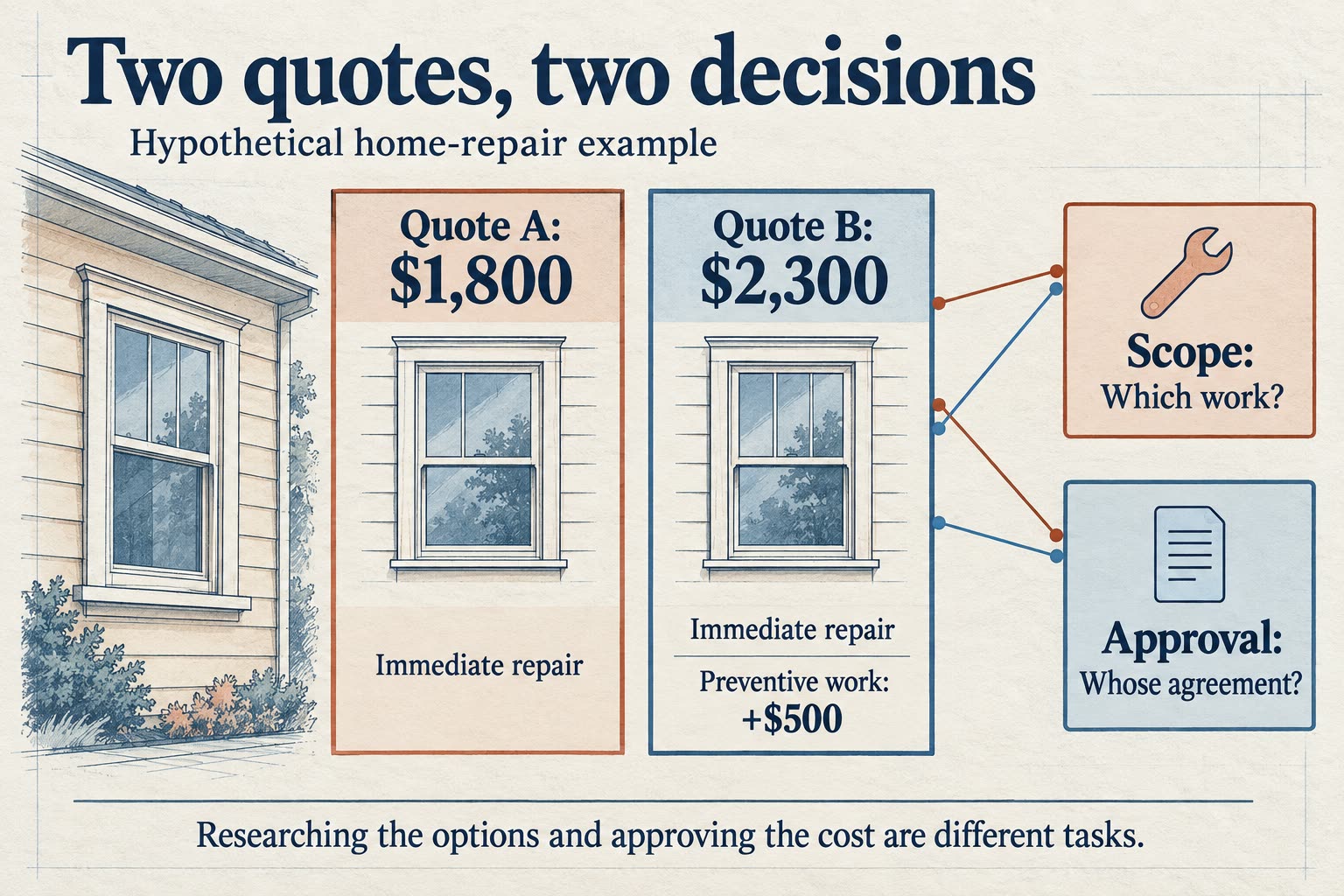
In this hypothetical example, two partners compare $1,800 and $2,300 quotes for a home repair. The higher quote includes additional preventive work, while the lower quote covers only the immediate problem.
One partner gathered both estimates, arranged access, and asked follow-up questions. The other would pay more of the bill because their current income is higher.
Either person could have Life Path 4 or 8.
Choosing the scope and agreeing to spend the money are separate decisions.
The partner who gathered the quotes can explain what the extra $500 buys; the partner covering more of the bill can explain how the expense affects other shared costs. Neither contribution settles both questions alone.
Before either signs, they can check whether both saw the full quotes, whether the extra work is wanted, and whether either can suggest a different scope. Those facts let them discuss the actual choice without treating the supposed 8 as the owner or the supposed 4 as an assistant.
If they choose the lower quote, they still need to record what remains unresolved. If they choose the higher one, they still need to know whether the additional work was understood and accepted.
The decision is incomplete when a signature hides a disagreement rather than resolving it.
Separate the repair into scope, cost, and authority
This keeps one person's research or income from silently deciding every part of the project.
- Compare the scope
- Input
- The $1,800 and $2,300 quotes
- Action
- Mark which work appears in both and what the extra $500 adds
- Result
- The pair can disagree about the actual work instead of arguing about who is cautious or ambitious
- Place the cost
- Input
- Available funds and other shared obligations
- Action
- Show what each quote changes now and later
- Result
- The tradeoff is visible to both people
- Confirm the decision rule
- Input
- Ownership, payment responsibility, and the couple's agreement
- Action
- Identify who can sign and whose consent is required before shared money moves
- Result
- Authority comes from the real arrangement rather than a Life Path label
If the two disagree, the favorable 4-8 rating settles nothing. The repair needs an agreement based on its terms, the available money, and each person's responsibilities, not on which date produced which digit.
What happens when 4 and 8 judge risk differently?
Numerology.com explicitly names risk as a possible source of friction, presenting 8 as more willing to take a chance and 4 as more likely to resist. That is the publisher's symbolic reading.
It does not prove which person in a real pair prefers the expensive quote, a new loan, or a business expansion.
A disagreement about risk becomes clearer when the proposal includes the amount at stake, the possible gain, the possible loss, the time involved, and who carries the consequence if the plan fails. Words such as bold, stubborn, practical, or controlling skip those details and turn a decision into a character judgment.
| Question | Evidence to compare | Claim the numbers cannot prove |
|---|---|---|
| Can the pair afford the loss? | Savings, obligations, insurance, and recovery time | That 4 is always safer |
| Who receives the benefit? | Ownership, income, use, and shared value | That 8's larger goal benefits both equally |
| Who carries the downside? | Debt, extra work, delay, and lost alternatives | That the cautious person is blocking progress |
Risk tolerance is a position on a specific proposal, not a permanent rank between two people. The same person may accept a business risk and reject a home expense because the terms and consequences differ.
Can a working plan still be unfair?
Suppose the repair comes in on budget. One partner still might have arranged appointments, checked invoices and handled surprises while the other approved every change.
That split can be welcome when both people chose it, recognize the work, and can revisit it. If the person carrying the work can never revise the plan, however, the problem is visible in what happens when they ask, not in a Life Path label.
A finished repair, profitable project, or orderly home can hide the same issue.
Results show what was produced. They do not show whether both people had access to information, could object safely, or received credit for the work they performed.
The useful check is specific: who did the work, who could change the cost, who absorbed a mistake, and whether the arrangement can be revised next time. A plan can function well and still distribute voice or labor poorly.
Does business success prove 4-8 relationship compatibility?
No: Decoz and Numerology.com both extend their favorable reading into business, but a business partnership and an intimate relationship ask different questions. A team may divide tasks effectively without sharing a home, caring for relatives, combining finances, or deciding how much personal time each person keeps.
The source descriptions can still help a reader examine one narrow contrast: detailed execution and larger direction. In business, that may concern who checks a contract and who sets a target.
At home, it may concern who compares repair terms and who proposes the renovation. Neither context turns the contrast into a permanent hierarchy.
The 4-5 comparison describes a different tension: maintaining a dependable routine versus keeping options open. A 1-8 comparison emphasizes two strong direction themes, whereas the favorable 4-8 reading rests on shared practicality with different levels of attention.
That favorable expectation is useful to understand as numerology, but it can make an unequal project look reassuring on paper. Comparing who defines the goal, supplies the work, and authorizes changes keeps the practical question visible even when the outcome looks impressive.
Frequently Asked Questions
Are Life Paths 4 and 8 compatible?
In their guides, both Hans Decoz and Numerology.com rate 4-8 favorably as a symbolic pairing; neither predicts a specific couple's outcome.
Does Life Path 8 get the final say about money?
Although Decoz links 8 with authority and material aims, a birth-date label cannot establish account ownership or approval rights.
Does Life Path 4 have to handle all the details?
Decoz calls 4 detail-oriented, but the actual work is whatever the two people agree to and do.
What if the pair succeeds but one person feels overruled?
A good result cannot tell whether both people could change the plan or object to a cost; those answers lie in their actual agreements and decisions.
Sources
- . Relationship Numerology – Discover Compatibility. World Numerology. Link
- . Numerology Meaning of Number 4. World Numerology. Link
- . Numerology Meaning of Number 8. World Numerology. Link
- . Numerology Life Path 4 Compatibility. Numerology.com. Link
- . Life Path Number ? Free Calculator & Complete Guide. World Numerology. Link
About Our Editorial Process
Every KnowTheAngels guide separates calculation method, tradition context, and personal reflection. We cite where interpretations come from, present more than one view, and never present symbolic reading as prediction.
Read our editorial policy