How Do You Calculate Your Life Path Number From Your Birth Date?
Full-date digit-sum calculator with visible reduction steps, a master-number option, and a comparison with the separate-part method
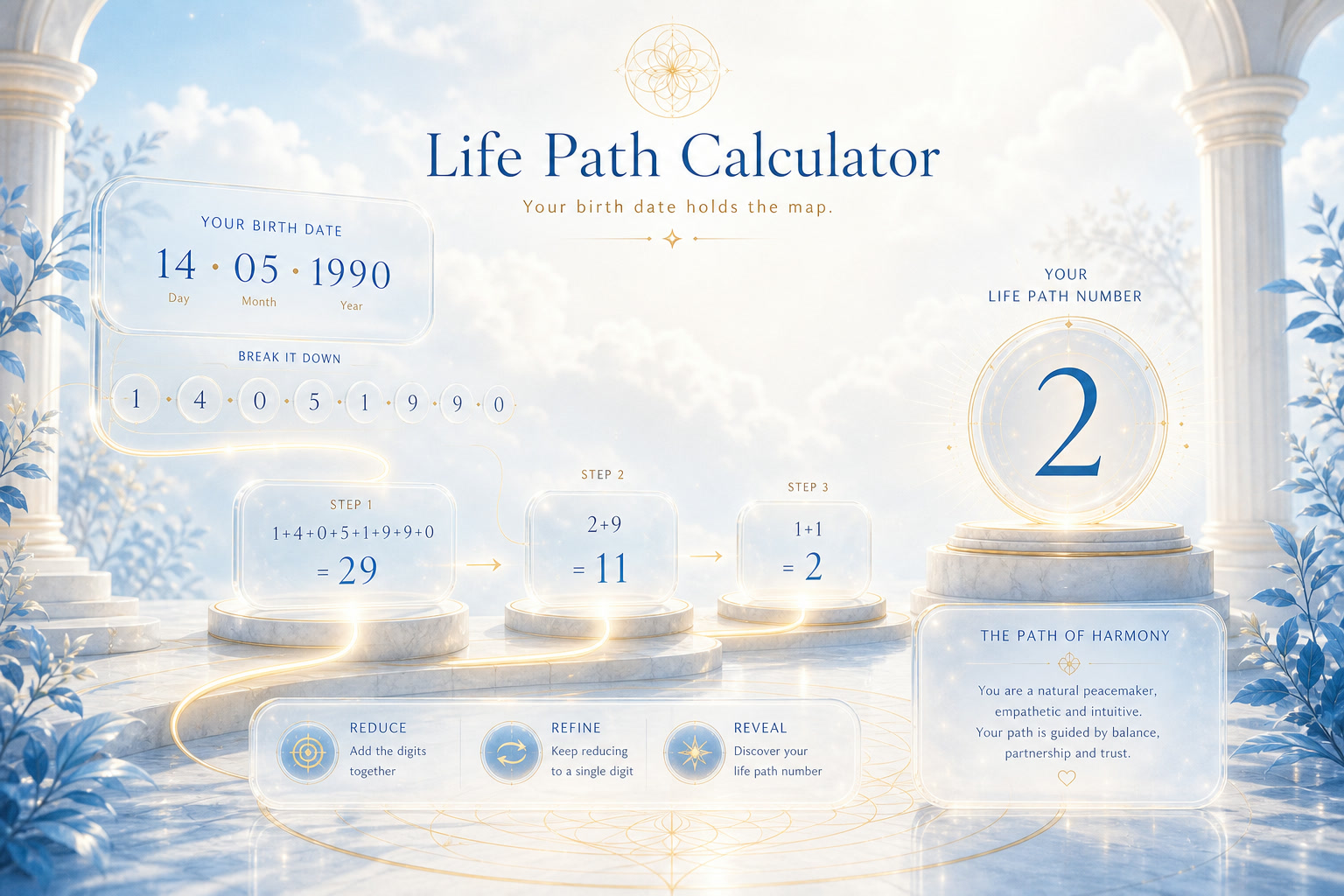
This tool organizes your input for reflection. It does not prove angel contact, predict an outcome, or replace your judgment.
Birth month, day, and year enter the calculator as individual digits, added in one line and reduced by repeated digit sums. For July 18, 1996, the displayed path is 7 + 1 + 8 + 1 + 9 + 9 + 6 = 41, then 4 + 1 = 5.
A separate method, described by Decoz in the World Numerology guide, reduces month, day, and year independently before combining them. The two approaches give different final numbers on about one in seven birth dates, and the difference comes only from master numbers.
The master-number checkbox, checked by default, stops the reduction when the running total reaches 11, 22, or 33. Clearing it continues to a single digit from 1 through 9.
Quick Facts
- Method
- Full-date digit sum: every digit of month, day, and year added in one line
- Input
- Birth month, birth day (1 to 31), and four-digit year (1900 to present)
- Master-number option
- Checked by default; stops reduction at 11, 22, or 33
- Validation
- Rejects incomplete or impossible calendar dates such as February 30
- Method difference
- About 14 percent of birth dates give a different result under the separate-part reduction described by Decoz
What the calculator does with a birth date
The input is a birth month, a birth day from 1 through 31, and a four-digit year from 1900 to the present. The field label reads "Your full birth date" and the helper text says "Choose the calendar date printed on your birth record."
The calculator writes the month, day, and year as individual digits without zero-padding, adds them in one line, and reduces the total by repeated digit sums. If the master-number checkbox is on, reduction stops at 11, 22, or 33.
July 18, 1996
Full-date digit sum with master-number preservation on.
- Write the digits
- Input
- July 18, 1996
- Action
- Month 7, day 18, year 1996 become the sequence 7, 1, 8, 1, 9, 9, 6.
- Result
- Seven individual digits
- Add them
- Input
- 7 + 1 + 8 + 1 + 9 + 9 + 6
- Action
- Sum every digit in one line.
- Result
- 41
- Reduce
- Input
- 41
- Action
- 4 + 1.
- Result
- 5 (Life Path number)
The result panel shows the number, the step line (for example, "7 + 1 + 8 + 1 + 9 + 9 + 6 = 41 -> 4 + 1 = 5"), and one theme line from the site’s list.
Below the theme line, a note reads: "In numerology, the Life Path is one number in a fuller chart. It describes a symbolic theme and does not fix your identity."
Validation rejects an incomplete date or an impossible calendar date such as February 30. An error clears any earlier result, so the displayed number always matches the selected date.
What the master-number checkbox changes
The checkbox labeled "Preserve master numbers" is checked by default. With it on, reduction stops whenever the running total or a later digit sum is 11, 22, or 33.
November 29, 1991 shows the effect. The digit sum is 1 + 1 + 2 + 9 + 1 + 9 + 9 + 1 = 33.
| Setting | Digit path | Result | Badge |
|---|---|---|---|
| Master numbers preserved | 1+1+2+9+1+9+9+1 = 33 | 33 | Master Number |
| Master numbers off | 33 → 3+3 = 6 | 6 | None |
The Master Number badge appears only for 11, 22, and 33. Every other result is a single digit from 1 through 9.
After the result, the tool builds a link labeled "Read about Life Path N" for results 1 through 9. No link button appears for 11, 22, or 33.

Why the result can differ from a book
This calculator adds all the digits in one line. A different approach, described by Decoz in "Life Path Number: Calculator, Meanings and Guide" on World Numerology, reduces month, day, and year separately first.
In that guide, month, day, and year are each "reduced to a single digit or a Master Number (11, 22, or 33)," then the three parts are added and reduced again.
For July 18, 1996, the two methods agree. The full-date digit sum is 7 + 1 + 8 + 1 + 9 + 9 + 6 = 41, then 4 + 1 = 5.
The separate-part approach gives month 7, day 1 + 8 = 9, year 1 + 9 + 9 + 6 = 25, then 2 + 5 = 7. The final step is 7 + 9 + 7 = 23, then 2 + 3 = 5.
For January 6, 1930, the methods diverge. The full-date digit sum is 1 + 6 + 1 + 9 + 3 + 0 = 20, then 2 + 0 = 2.
The separate-part approach gives month 1, day 6, year 1 + 9 + 3 + 0 = 13, then 1 + 3 = 4. The final step is 1 + 6 + 4 = 11, a master number, so the separate-part result is 11.
The tool shows 2 for that date; the separate-part method gives 11.
| Birth date | Full-date digit sum (this tool) | Separate-part reduction (Decoz guide) |
|---|---|---|
| July 18, 1996 | 41 → 5 | 7 + 9 + 7 = 23 → 5 |
| January 6, 1930 | 20 → 2 | 1 + 6 + 4 = 11 |
| November 29, 1991 | 33 | 11 + 11 + 2 = 24 → 6 |
November 29, 1991 shows the reverse pattern. The full-date digit sum reaches 33, a master number, while the separate-part method gives 11 + 11 + 2 = 24, then 2 + 4 = 6.
Across 29,585 valid birth dates from 1930 to 2010 with master numbers preserved, the two methods give different final numbers on 4,160 dates (14.1 percent). The most common divergence pairs are 33 versus 6 (1,422 dates) and 11 versus 2 (1,116 dates).
With master numbers switched off in both methods, the two agree on every date. The difference comes only from master numbers.
The full-date digit sum stops at 11, 22, or 33 whenever the running total reaches one, including at the first addition. The separate-part method preserves a master number only when it appears as the reduced month, day, or year, or as the final sum of those three parts.
The twelve theme lines
After the result number, the tool shows a one-line theme. These are the site’s own descriptions, not sourced from a named publisher.
| Life Path | Theme |
|---|---|
| 1 | Independence, leadership, and new beginnings |
| 2 | Cooperation, diplomacy, and sensitivity |
| 3 | Creativity, expression, and joy |
| 4 | Stability, discipline, and hard work |
| 5 | Freedom, change, and adventure |
| 6 | Responsibility, nurturing, and harmony |
| 7 | Introspection, wisdom, and spiritual seeking |
| 8 | Ambition, authority, and material mastery |
| 9 | Compassion, humanitarianism, and completion |
| 11 | Intuition, spiritual insight, and illumination (Master Number) |
| 22 | Master builder, large-scale vision, and practical idealism (Master Number) |
| 33 | Master teacher, compassion, and spiritual upliftment (Master Number) |
The note below the theme line states that the Life Path is "one number in a fuller chart" and "describes a symbolic theme and does not fix your identity." The tool places this note on every result.
Result links labeled "Read about Life Path N" appear for results 1 through 9 only. A master-number result (11, 22, or 33) has no profile link from the tool.
After the result
Each single-digit result links to its own Life Path profile (Life Path 1 through Life Path 9) and to the numerology method overview.
The birthday-number calculator uses only the day of the month, not the full date. The personal-year calculator adds a year you select, so its result changes with the year entered while the Life Path stays fixed.
Frequently Asked Questions
Does this calculator reduce month, day, and year separately?
No. It adds every digit of the full date in one line, and the separate-part method described by Decoz gives a different result on about one in seven dates when master numbers are preserved.
What does the master-number checkbox do?
With the checkbox on (the default), reduction stops when the running total reaches 11, 22, or 33. With it off, every total continues to a single digit from 1 through 9.
Why is my result different from the one in a book?
The book may use the separate-part method, which reduces month, day, and year independently before combining them. The two methods diverge only when master numbers are preserved.
Can a Life Path number predict events?
No. In numerology, the Life Path number describes a symbolic theme and does not predict events, diagnose personality, or fix identity.
Sources
- . Life Path Number: Calculator, Meanings and Guide. World Numerology. Link
About Our Editorial Process
Every KnowTheAngels guide separates calculation method, tradition context, and personal reflection. We cite where interpretations come from, present more than one view, and never present symbolic reading as prediction.
Read our editorial policy