What Does Angel Number 10 Mean for Cycles and New Beginnings?
Why counting past 9 sends 10 back to 1, what the zero does and does not add, and how the Pythagoreans, the Bible and the tarot's Wheel of Fortune treat ten
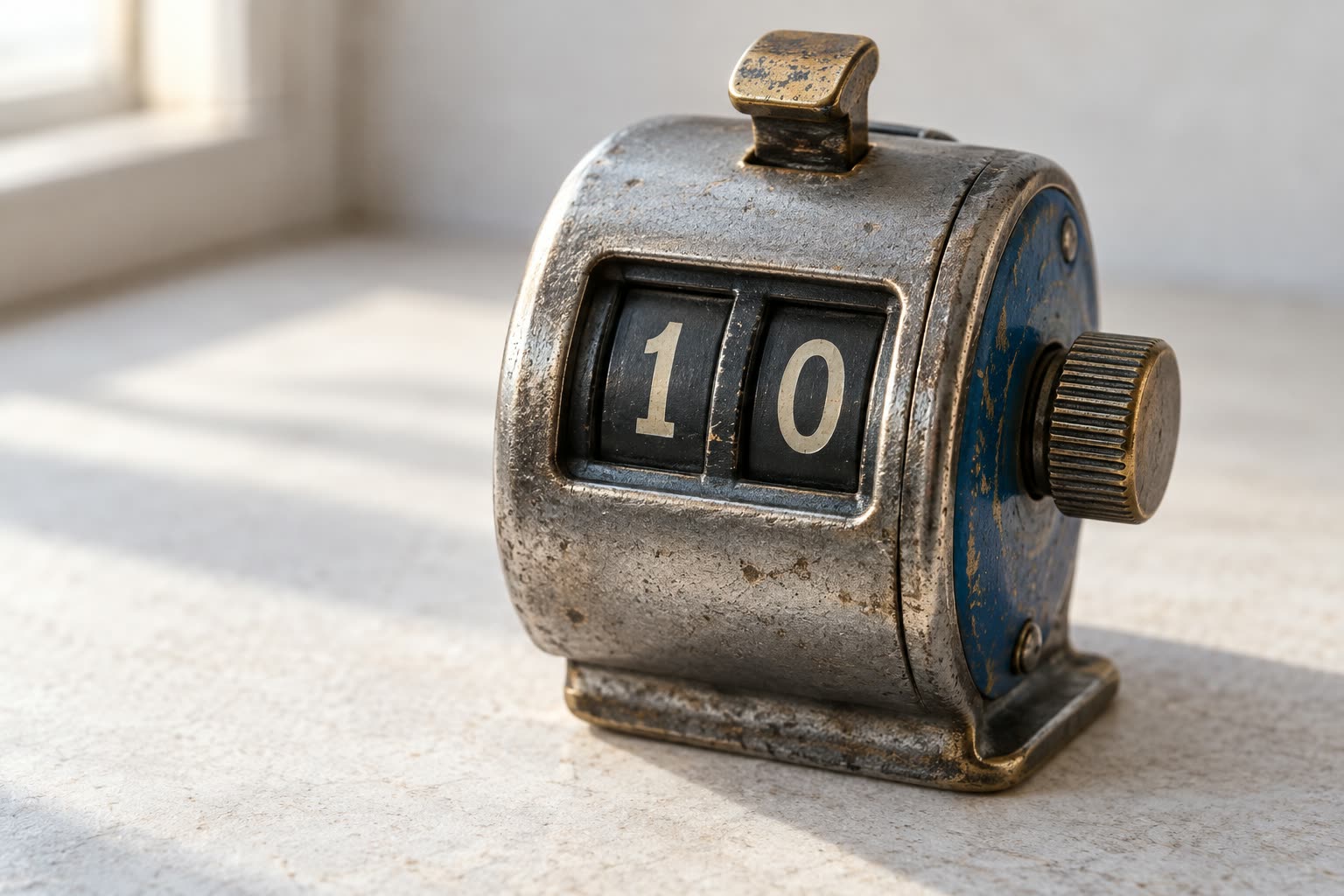
Ten is the first number that cannot be written with a single digit. The figures 1 to 9 run out, a 1 moves into the tens column and a 0 fills the units.
Numerology's reduction, 1 + 0 = 1, takes the number back to the digit it started from. Modern angel-number writers read that as a new beginning made after a cycle has run its course; Blair Andrews at Numerologist.com describes 10 as the return to the starting position, "same place, completely different person."
The older readings of ten come from separate systems and disagree about the 0. The Pythagoreans had no zero and built their ten from 1 + 2 + 3 + 4.
Cheiro dismissed the zero as not a number. Joanne Walmsley's Sacred Scribes entries, which many angel-number sites repeat, say it amplifies the 1 beside it.
Quick Facts
- Reduction
- 1 + 0 = 1
- Place in the count
- The first number after the nine single digits; the 0 marks an empty units column
- Pythagorean view
- "Perfect", comprising "the whole nature of numbers" (Aristotle, Metaphysics 986a)
- Bible
- The ten commandments (Exodus 34:28); the tithe, a tenth (Leviticus 27:32)
- Tarot and Cheiro
- Card X, the Wheel of Fortune; Cheiro's symbol for 10
- Master number?
- No; Hans Decoz's master numbers are 11, 22 and 33
Why does 10 close the 1 to 9 cycle and start again at 1?
Fibonacci's Liber Abaci (1202) explains that nine figures together with the sign 0 can write any number. Ten uses that system's first two-place combination.
Counting past nine does not produce a new figure. It produces the first digit again, one column to the left.
Adding the digits gives 1 + 0 = 1, and Cheiro's Book of Numbers says that beyond 9, ordinary numbers repeat the first nine.
Cheiro therefore calls 10 "a repetition of the number 1." Nineteen adds to 10 and then to 1 again, which is why angel number 19 is also read as a restart.
What separates 10 from a plain 1 is the route taken to reach it. A 1 is a first step with nothing behind it, while 10 reaches the same digit only after every figure from 1 to 9 has been used.
Walmsley points toward new directions, while Andrews stresses the sequence: "You do not get to 10 by skipping steps."
The cycle depends on decimal notation. Counting in base twelve would place the first two-digit boundary at twelve instead.
Ten fingers may help explain the widespread use of base ten, but the notation alone cannot show that a life stage ends at the number 10.
What does the zero beside the one add?
In arithmetic, the 0 in 10 records that the units column is empty; the value sits in the 1. The written zero is also younger than most of the symbolism attached to ten.
Greek numerals wrote ten as iota and Hebrew used yod, so neither the Pythagoreans nor the biblical writers saw a 1 beside a 0. Brahmagupta set out rules for zero in 628 CE, and the sign reached Western Europe with Fibonacci.

Cheiro treated zero as nothing, which is why his 10 simply repeats 1.
Walmsley describes 0 as an amplifier of the number beside it. Andrews instead interprets it as open space for a new round.
| Source | What zero contributes | Resulting reading |
|---|---|---|
| Cheiro | Nothing; zero is not a number | 10 repeats 1 after a completed count |
| Joanne Walmsley | Amplifies the adjacent digit | 10 strengthens the initiative associated with 1 |
| Blair Andrews | Open room after one cycle | 10 begins again with prior experience |
A claim that 10 is more powerful than 1 depends on an amplifying-zero rule such as Walmsley's; it cannot follow from the digit sum alone.
Why did the Pythagoreans call ten perfect?
Aristotle reports in Metaphysics 986a that the Pythagoreans thought ten perfect and inclusive of the whole nature of numbers. Their esteem for ten predates the written zero.
Their tetractys stacks ten points in rows of one, two, three and four, making 1 + 2 + 3 + 4 = 10 visible.
Aristotle says the Pythagoreans also required the bodies moving through the heavens to number ten.
Since only nine could be seen, they proposed an unobserved tenth, the "counter-earth." For them, ten was a total the world had to match.
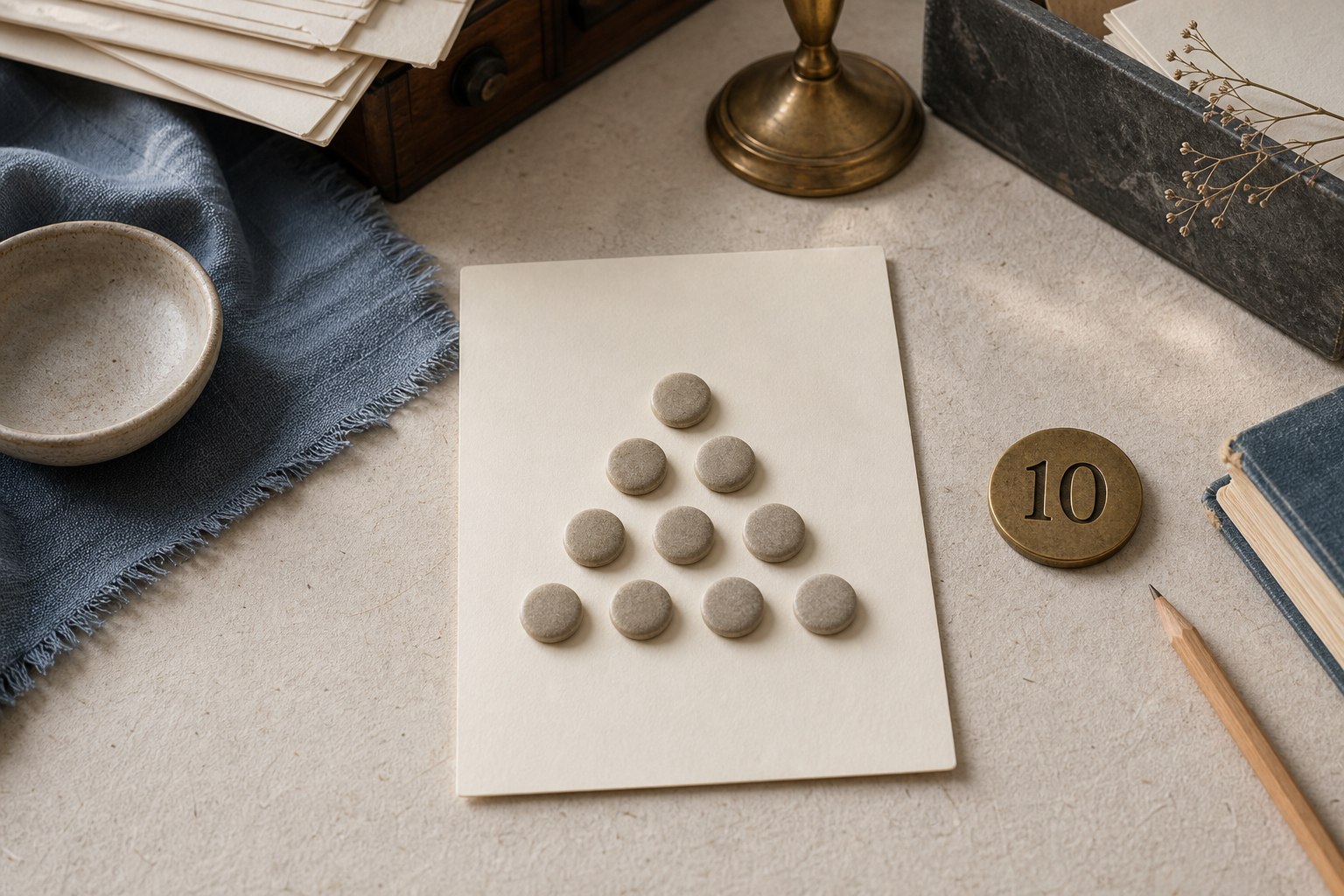
A similar fixed count appears in Jewish mysticism. Sefer Yetzirah, an early Hebrew text on creation through ten sefirot and twenty-two letters, says: "Ten and not nine, ten and not eleven" (1:4).
In both systems ten is complete because nothing is missing. Modern angel-number readings make a different claim: 10 matters because it starts the count again.
Ten commandments, the tithe and ten righteous: what does 10 mean in the Bible?
The Bible uses ten for a count that has to be whole. The law given at Sinai is "the ten commandments" (Exodus 34:28; Deuteronomy 4:13), in Hebrew the "ten words."
Jacob vows to give God a tenth (Genesis 28:22), and Leviticus 27:32 marks every tenth animal from the herd or flock as holy.
Several narratives also turn on ten. Abraham's bargaining over Sodom stops at ten righteous people (Genesis 18:32), while the parable in Matthew 25:1 has ten bridesmaids.
Exodus 7 to 12 narrates ten plagues on Egypt. In Luke, only one of ten healed lepers returns to give thanks, and Jesus asks where the other nine are (Luke 17:17).
E. W. Bullinger's Number in Scripture (1894) drew these examples into a rule, calling ten "the perfection of Divine order." That is a nineteenth-century scheme rather than a statement made by the biblical texts.
The passages concern law, offerings and counts of people; none presents ten as a private message. The reading of 10 as a personal restart comes from numerology.
Is angel number 10 linked to the Wheel of Fortune?
Card X of the tarot's major arcana is the Wheel of Fortune. Cheiro says his compound-number symbols survive in tarot and explicitly links 10 with that wheel.
He associates 10 with honour, faith, self-confidence and rise and fall. His favorable reading concerns plans being carried out, rather than every turn of the wheel bringing a gain.
A. E. Waite's explanation of the 1910 deck drawn by Pamela Colman Smith describes the wheel as perpetual motion and the flux of human life. The sphinx at its top represents equilibrium within that movement.
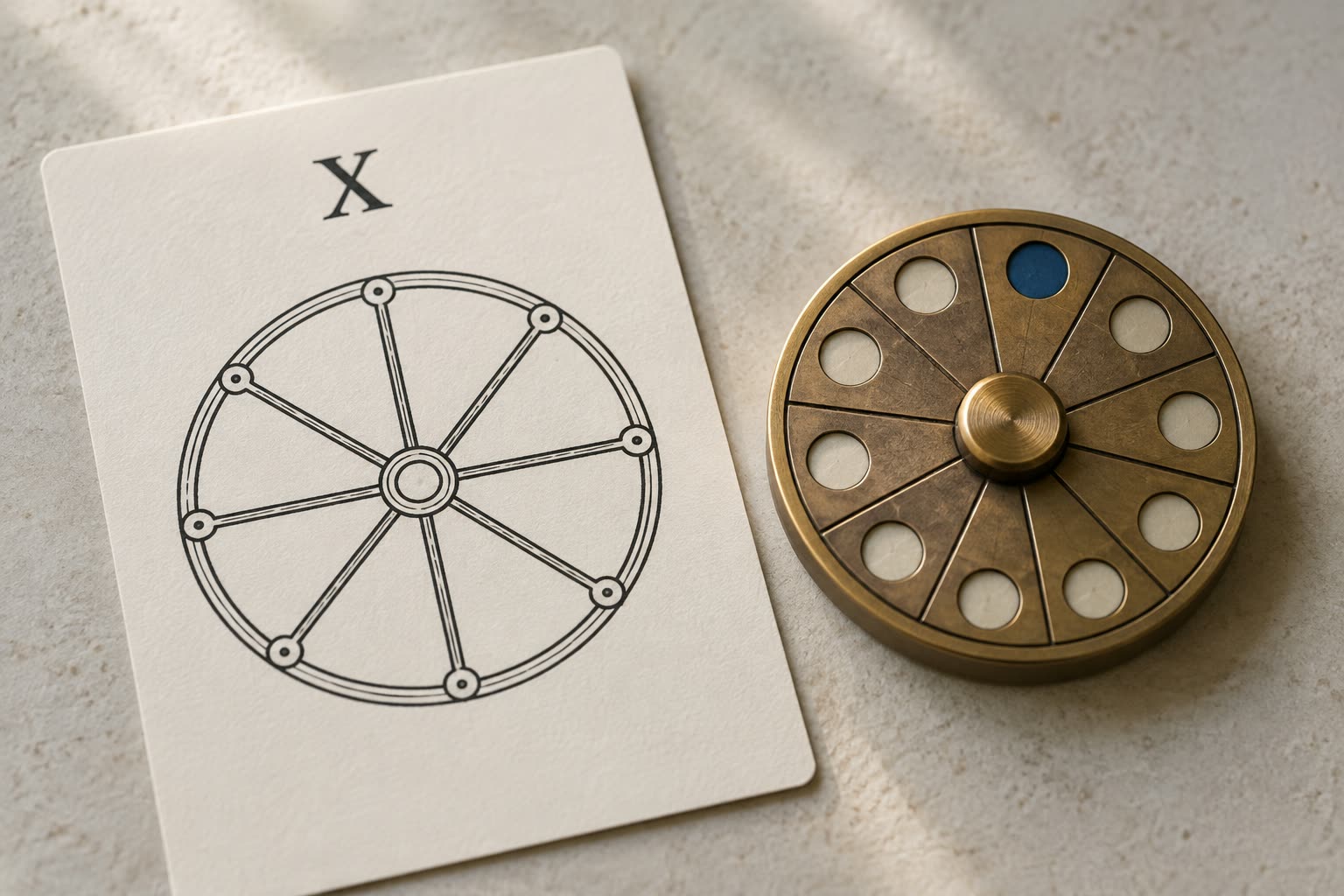
The wheel helps answer whether 10 marks an ending. A wheel that completes a turn keeps moving, and the rise and fall in Cheiro's entry comes round again.
The wheel's recurring movement explains why Cheiro can include both rise and fall in a number he calls fortunate.
Does 10 end a chapter or the whole thing? Love, twin flames and work
Modern angel-number writers distinguish 9's completion from 10's restart: ten is the next step after the single-digit count has finished.
Ten is the step after that ending. The same person begins the next round with what the last one taught.
In relationships, modern writers apply 10 to a second start. It fits a couple rebuilding after a long separation, or someone dating after a divorce with clearer boundaries.
The 1 carries the new start, while the finished cycle supplies prior experience. The number describes that carry-over; it cannot say whether a relationship will last.
Anahana links 10 with self-discovery in a twin-flame relationship, extending the restart reading to a particular kind of partnership.
Those claims come from modern twin-flame teaching. The 1 and 0 provide no second person, date or evidence of a reunion.
At work, 10 fits a return made with more experience: re-entering a field after retraining, reopening a business, or taking a first leadership post after years on a team. Cheiro adds reputation, writing that under 10 a person's name may become known for good or evil.
In a career change, the checkable part is the carry-over. Which skills, contacts and lessons from the finished round will the new role actually use?
A restart reading fits only when something actually carries over: experience, a continuing relationship or reusable work. A final breakup or business closure cannot be turned into a promised return by seeing 10.
Base ten puts 10 on prices, rankings and clocks
Decimal counting places ten on round prices, discounts and top-ten lists. Watch advertisements also commonly set the hands to ten past ten.
Selective attention can make those placements stand out after a reader learns a meaning for 10. Remembering a rounded price while overlooking the other prices beside it does not show that tens became more frequent.
Frequently Asked Questions
Does numerology ever keep 10 unreduced?
The sources used here reduce 10 to 1; Hans Decoz reserves master-number status for 11, 22 and 33. Compound-number writers may still discuss 10 before reducing it, as Cheiro does with the Wheel of Fortune.
Why does Cheiro call 10 fortunate without promising luck?
Cheiro says plans under 10 are likely to be carried out, but his Wheel of Fortune also includes rise and fall. His symbolic reading therefore does not predict a favorable event for every person who sees 10.
How is angel number 10 different from 1?
Both reduce to 1. A single 1 is read as a first step, while 10 is the same step taken after the digits 1 to 9 have been used up, so it is read as a new start made with a finished cycle behind it.
Sources
- (2026). 0 (Fibonacci's Liber Abaci, 1202; Brahmagupta's rules for zero). Wikipedia. Link
- (2026). Decimal (counting on ten fingers). Wikipedia. Link
- (2026). Greek numerals (iota = 10). Wikipedia. Link
- (2026). Yodh (numerical value 10). Wikipedia. Link
- (c. 1926). Cheiro's Book of Numbers. Herbert Jenkins, London; the zero and 10 on p. 12, compound number 10 on p. 80 of the scanned edition. Link
- (2011). Angel Number 10. Sacred Scribes Angel Numbers. Link
- (2023). Angel Number 10: The New Start That Carries the Old (updated May 12, 2025). Numerologist.com. Link
- . Metaphysics, Book I, part 5 (986a). Internet Classics Archive, MIT. Link
- (n.d.). Sefer Yetzirah 1:4. Sefaria. Link
- (2026). Sefer Yetzirah (ten sefirot and twenty-two letters). Wikipedia. Link
- (n.d.). Exodus 34:28; Deuteronomy 4:13; Genesis 28:22; Leviticus 27:32; Genesis 18:32; Matthew 25:1; Luke 17:12-17 (KJV). Bible Gateway. Link
- (2026). Ten Commandments (Hebrew aseret ha-devarim, 'ten words'). Wikipedia. Link
- (1894). Number in Scripture: Its Supernatural Design and Spiritual Significance, Part II, "Ten". Levend Water (online text). Link
- (1910). The Pictorial Key to the Tarot, Part II, section 2, "Ten. Wheel of Fortune". William Rider & Son; Wikisource. Link
- (2024). 10 Angel Number Spiritual Meaning, Love & Twin Flame, Money (updated September 25, 2024). Anahana. Link
- (n.d.). Master Numbers 11, 22, 33. World Numerology. Link
- (n.d.). Selective attention. APA Dictionary of Psychology. Link
About Our Editorial Process
Every KnowTheAngels guide separates calculation method, tradition context, and personal reflection. We cite where interpretations come from, present more than one view, and never present symbolic reading as prediction.
Read our editorial policy