How Do You Keep an Angel Number Journal With a Worked Example?
Record the sighting, its ordinary source, and your circumstances before deciding what a repeated number means to you

An angel number journal records the numbers you notice, where they appeared, and what was happening before you interpret them. Its purpose is to preserve a usable account of the sighting, including details that might challenge your first impression.
The method below is an optional editorial practice for readers interested in contemporary number symbolism. It does not require a daily sighting, a special notebook, or a belief that every repeated digit has a message.
Quick Facts
- Format
- A notebook or private digital note with dated entries
- First entry
- Exact display, time, source, context, and how you noticed it
- Meaning field
- A separate, dated interpretation added after observation
- Review
- About ten minutes weekly as a starting suggestion
- Stop signal
- Checking interrupts sleep, work, relationships, or ordinary choices
How do you start an angel number journal?
Use one notebook or a private digital note, then give every sighting the same short set of fields.
A phone note is convenient when you are away from home; paper may suit someone who wants to put the record physically out of reach afterward.
Choose a recording rule before the first entry: note numbers that catch your attention during ordinary activity, without arranging extra encounters. You can write after reaching a safe stopping point rather than interrupting driving, work, or a conversation.
The fields below preserve both the displayed number and the conditions that made it noticeable. Copy the labels as a reusable template and leave a field marked unknown when you do not remember it.
| Field | What to record | Why it matters |
|---|---|---|
| Exact display | Digits in order, including a colon, decimal, currency sign, or leading zero | Distinguishes 2:22, $2.22, and 222 before any symbolic grouping |
| Date and time | When you noticed it and, if different, when you wrote the note | Separates a fresh observation from a later recollection |
| Object and place | Receipt total, phone clock, address, ticket, or other source and setting | Shows whether several entries came from one recurring object |
| Activity and concern | What you were doing and what was already on your mind | Preserves context without assigning the number a purpose |
| Feeling | A plain description such as worried, amused, tired, or neutral | Separates your response from what the display itself showed |
| Exposure and checking | Recent number reading, repeated purchases, usual schedules, or deliberate checking | Helps explain why this sequence was available or noticeable |
| Later interpretation | Date of review, optional association, source used, and remaining uncertainty | Keeps meaning and later edits out of the observation record |
The template is a recording aid, not a demand to collect more information. If you cannot remember the time, writing "afternoon, approximate" is more useful than inventing a precise timestamp.
One line per field is usually enough.
Keep personal addresses, account details, and other people's names out of screenshots you intend to share.
What does a completed angel number journal entry look like?
Record the visible display before opening a meaning search.
The following invented receipt example shows how one entry can hold an observation and a later reflection without making either pretend to be the other.
Observation, September 7: "At about 2:40 p.m., I noticed $2.22 on my grocery receipt while checking the change outside the shop."
"I had bought the same snack and drink as yesterday and was thinking about spending too much on small purchases. I felt uneasy, and I had read about repeated twos the previous evening."
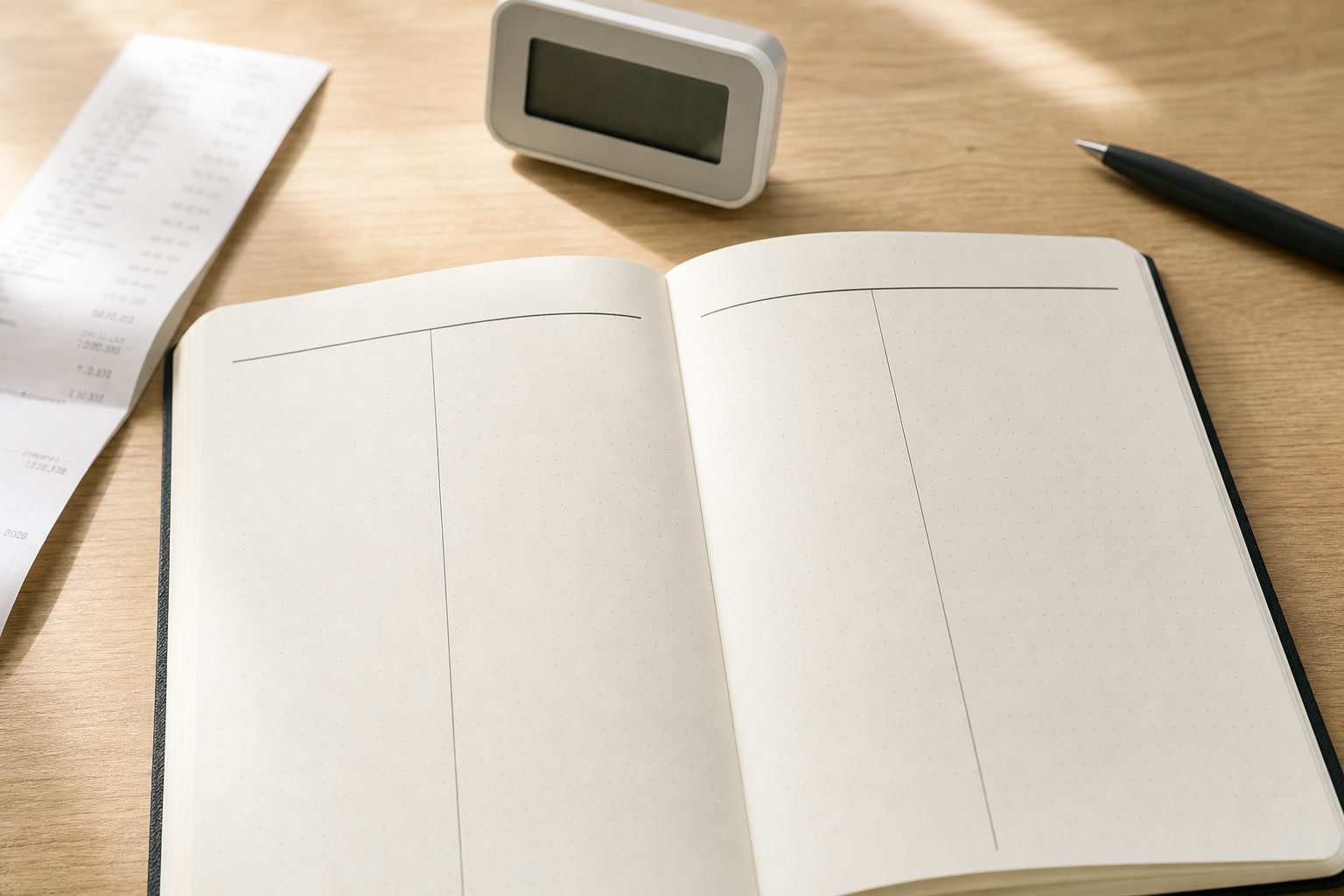
A receipt photograph would support the amount, while the separate context note preserves what the photograph cannot show. The price remains $2.22 in the record even if you later associate its digits with 222.
Later reflection, September 13: "The twos reminded me to examine my purchases, but the repeated total came from buying the same items. I will add the week's snack receipts before deciding whether to change that habit."
That review names an ordinary source, a personal association, and an action that can be checked against spending records. It does not turn the amount into a prediction that money will arrive or a verdict that the purchase was wrong.
If a meaning occurred immediately, preserve it with a time label: "First association at the shop: money worry." A separate label makes clear that the association accompanied the sighting and was not written later during review.
The receipt entry answers where the amount appeared and how it was recorded. A later 222 interpretation addresses symbolic associations without supplying a missing date or changing the receipt into an exact three-digit display.
For an uncertain memory, write "I think the receipt ended in .22; receipt not available" and leave it out of exact-match counts. If you later find the receipt, add a dated correction instead of replacing the first note.
Why do you notice more repeated numbers after tracking them?
A longer log can result from looking more often, encountering more displays, or noticing a number that previously passed without comment.
Those possibilities differ, so the exposure field belongs beside every count.
The American Psychological Association defines selective attention as concentrating on some environmental information while leaving other information outside that focus. Applied to a number journal, a recently researched sequence may attract attention among many prices or timestamps.

Linguist Arnold Zwicky's Stanford abstract describes the frequency illusion: after noticing a phenomenon, a person can believe it occurs unusually often. He connects that impression with selective attention and confirmation bias in observations of language; applying the distinction to number sightings is an explanatory comparison, not a study of angel journals.
The APA describes confirmation bias as favoring evidence that fits an existing expectation while overlooking contrary evidence. In this setting, writing down the two striking clock checks while forgetting the uneventful checks would leave a misleading account of how often the number appeared.
Consider someone who begins glancing at a phone repeatedly near 11:11. The display really does show 11:11, but the checking routine has increased the opportunity to catch it; there is no need to doubt the sighting to question the conclusion drawn from it.
Other repetitions come from the environment: a bus retains its service number, an office retains its address, and the same purchases can produce the same total. Seeing the same address on a letter and on a map supplies two displays of one underlying fact.
You do not need to count every clock glance to keep an honest journal. A note such as "checked deliberately several times" is enough to prevent that entry from being mistaken for an unplanned encounter.
An ordinary explanation can coexist with personal reflection, but it changes the question you can answer.
After accounting for the price, you might still ask why this particular amount caught your attention while you were worried about spending.
What can a cluster of repeated sightings actually show?
A cluster is a descriptive group of entries, not a threshold at which an angel message becomes established. Start by grouping exact displays and then ask whether the entries represent different events or repeat views of the same object.
Three photographs of one receipt document one purchase. Three receipts for the same order document separate purchases with a shared reason for producing the same amount.
Keep 222, 22, and 202 separate in the first comparison. If you later group 2:22 with $2.22 as a symbolic twos theme, label that as your chosen grouping rather than an exact match.

A cluster across unrelated settings deserves a description that preserves those differences: "two clock sightings and one ticket number this week." It does not justify silently replacing the record with "222 appeared everywhere."
The count also lacks a comparison base if you do not know how many numbers were encountered.
Five memorable repeats among an unknown number of clocks, prices, and screens cannot establish how statistically unusual the experience was.
A personal notebook is rarely designed to estimate probability. Do not assign odds by treating every receipt total, address, and clock time as equally likely or independent.
Record a quiet week as "no entries this week," if you are reviewing anyway. That statement describes the notebook accurately; it does not establish that the number never appeared anywhere you looked.
Preserve the original entries when you compare different displays through a named numerology method. Reduction or symbolism adds a separate interpretive operation, so a later reader needs to see which resemblance you chose to examine.
How should you review your number journal each week?
Set aside roughly ten minutes once a week as a starting suggestion, then read the entries before searching for interpretations.
Weekly review provides a manageable interval for comparison; it is not a spiritually significant schedule or a tested treatment.
Review the record in four passes
Use the notes already written; do not seek new sightings to finish the review.
- Check the observations
- Input
- This week's original entries
- Action
- Group exact displays and mark uncertain memories or repeated views of one object.
- Result
- You know what was actually recorded and which entries cannot support an exact count.
- Compare exposure
- Input
- Objects, routines, and checking notes
- Action
- Ask whether the same purchase, schedule, address, or deliberate search explains several entries.
- Result
- A shared ordinary source remains visible beside the recurrence.
- Examine the context
- Input
- Activities, concerns, and feelings
- Action
- Look for a recurring concern and for entries that do not fit it.
- Result
- You can distinguish a possible personal theme from a story imposed on every sighting.
- Date the conclusion
- Input
- The comparison and any meaning source you consulted
- Action
- Write one limited observation or question, including what remains unknown.
- Result
- The review ends with an account you can revise when circumstances change.
Useful review questions include: Did my surroundings change, or did I start checking more? Did the same concern appear before the number was noticed, and which entry challenges my preferred explanation?
In the receipt example, the weekly result might be "three $2.22 purchases, all from the same shop." Adding the receipts answers a spending question; searching for a stronger spiritual meaning does not improve that calculation.
If an interpretation seems relevant, record the author or named method and the date you read it. This lets a later review distinguish your earlier association from wording you encountered afterward.
When a week contains unrelated entries, "no clear connection" is a complete conclusion.
You do not need to produce a theme, a question, or an action from every set of notes.
Finish when the comparisons are recorded or the planned time ends. Leave unresolved entries intact for a later review rather than searching repeatedly until one explanation feels satisfying.
Can a number journal make decisions or prove communication?
An angel number journal cannot establish an outside speaker or supply the evidence needed for a high-stakes decision. A detailed record improves the description of an event; it does not identify who, if anyone, intended a message.
For a financial choice, use the actual price, account balance, obligations, and independent advice appropriate to the risk. The financial abundance interpretation can provide symbolic language, but it cannot show whether a purchase is affordable.
A health concern needs clinical assessment, and a legal question needs relevant records and qualified advice. Do not postpone care, change treatment, or commit money because a sequence appeared repeatedly.
Another person's feelings and consent come from their words and conduct.
Silence, refusal, or a relationship boundary cannot become an invitation because a love interpretation seems meaningful.
If words arise after a sighting, label them as a separate impression rather than part of the external display. Those inner phrases or imagined replies can be preserved through communication journaling without crediting the number with a sentence it never showed.
When should you put the number journal away?
Pause when recording begins to organize your day around finding digits: checking clocks repeatedly, changing errands to revisit an address, or postponing a normal choice until a preferred number appears. These are reasons to reconsider the practice even if the notebook is accurate.
Other practical stop signals include lost sleep, missed work, repeated meaning searches, or feeling afraid that an unrecorded sighting will cause harm. There is no obligation to complete a streak or make up missed entries.
Close the record and stop the extra searches and number notifications that keep bringing you back to it. A pause has no required length, and you do not need another number to authorize returning to ordinary activities.

The National Institute of Mental Health distinguishes ordinary habits from uncontrollable repetitive thoughts or actions that cause distress or disrupt daily life. Its OCD guidance supports seeking assessment when checking becomes difficult to control; noticing repeated numbers by itself does not diagnose OCD.
If stopping feels unmanageable, or distress persists, tell a qualified health professional what you are doing and how it affects sleep, concentration, and responsibilities. Bring a few representative entries if useful, without creating a new obligation to document every thought.
You may discontinue the journal entirely.
Keeping the existing pages or archiving the note is enough; there is no final pattern you need to find before you stop.
Frequently Asked Questions
Do I need a special angel number journal?
No. A notebook or private digital note is enough, provided you can keep the original observation separate from later interpretation.
Should I write down every number I see?
No. Record incidental sightings that already caught your attention; trying to capture every number would change the activity into continuous checking.
Is a missed day a problem?
A missed day needs no replacement entry. If the gap matters during review, label it as a day you did not record rather than guessing what you might have seen.
Can I combine clock times and prices?
You can compare their digits during reflection, but preserve their original formats. A time of 2:22 and a price of $2.22 are different observations even when you choose to examine a shared twos theme.
How long should I keep an entry before looking up the meaning?
There is no required waiting period. Complete the observation first, then add any lookup with its source and date so it cannot be mistaken for what you noticed originally.
Sources
- (2018). Selective attention. APA Dictionary of Psychology. Link
- (2018). Confirmation bias. APA Dictionary of Psychology. Link
- (2006). Why are we so illuded? Section 3: Frequency Illusion. Stanford University, September 2006 abstract. Link
- . Obsessive-Compulsive Disorder: When Unwanted Thoughts or Repetitive Behaviors Take Over. NIMH. Link
About Our Editorial Process
Every KnowTheAngels guide separates calculation method, tradition context, and personal reflection. We cite where interpretations come from, present more than one view, and never present symbolic reading as prediction.
Read our editorial policy