What Does Angel Number 12 Mean in Numerology and Cultural Symbolism?
How 1 and 2 add up to 3, why months, zodiac signs and clock hours come in twelves, the twelves of the Bible, and why Cheiro and the tarot tie 12 to sacrifice
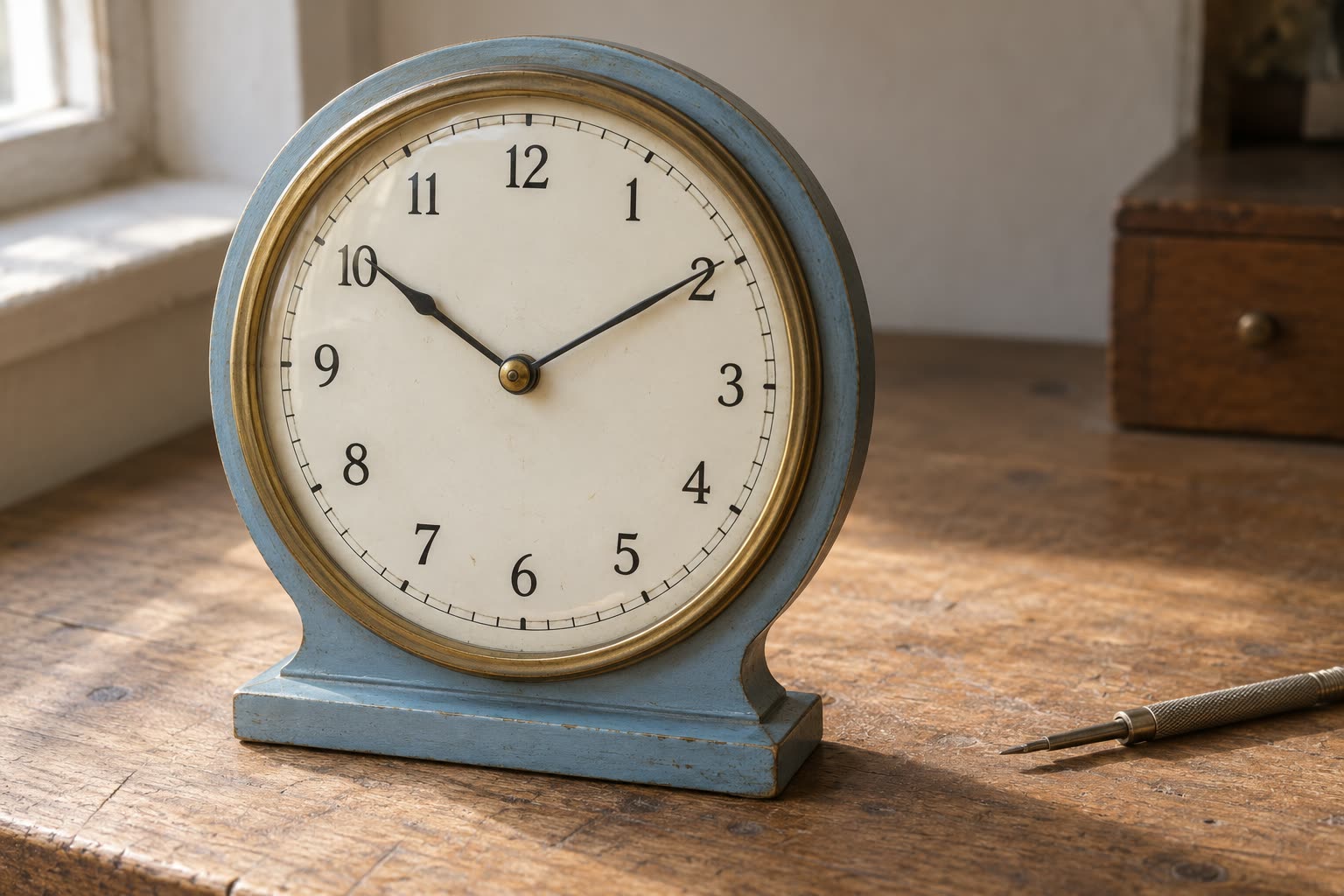
Twelve carries two sharply different readings. Modern angel-number writers associate it with constructive change, while Cheiro's Book of Numbers gives the compound 12 "suffering and anxiety of mind".
Joanne Walmsley's 2011 entry focuses on changing old habits and improving home life. Blair Andrews calls twelve "civilization's organizing number."
That organizing reputation has an ordinary history. Twelve lunar months come close to filling a solar year, and astronomers, clock-makers and traders built on that count and on how easily twelve divides.
Quick Facts
- Reduction
- 1 + 2 = 3
- Divisors
- 1, 2, 3, 4, 6 and 12, more than any smaller number has
- Calendar
- Twelve lunar months make a lunar year of about 354 days
- Bible
- Twelve tribes (Genesis 49:28), twelve apostles (Matthew 10:2), twelve angels at the gates (Revelation 21:12)
- Cheiro's compound 12
- "The Sacrifice" or "the Victim"; tarot card XII, the Hanged Man
- Reversal
- 21, which also reduces to 3
What is 12 made of: 1 + 2, or 3 x 4?
The 1 represents initiative. It precedes the partnership associated with 2 before the digits are added.
Their sum is 3, which Numerology.com calls "a communicator through and through." In this reading, 12 describes an idea started by one person that becomes a shared project once someone else joins.
Walmsley adds a domestic emphasis: changing old habits and improving home, garden and family arrangements. That turn toward the household belongs to her interpretation; the arithmetic does not require it.
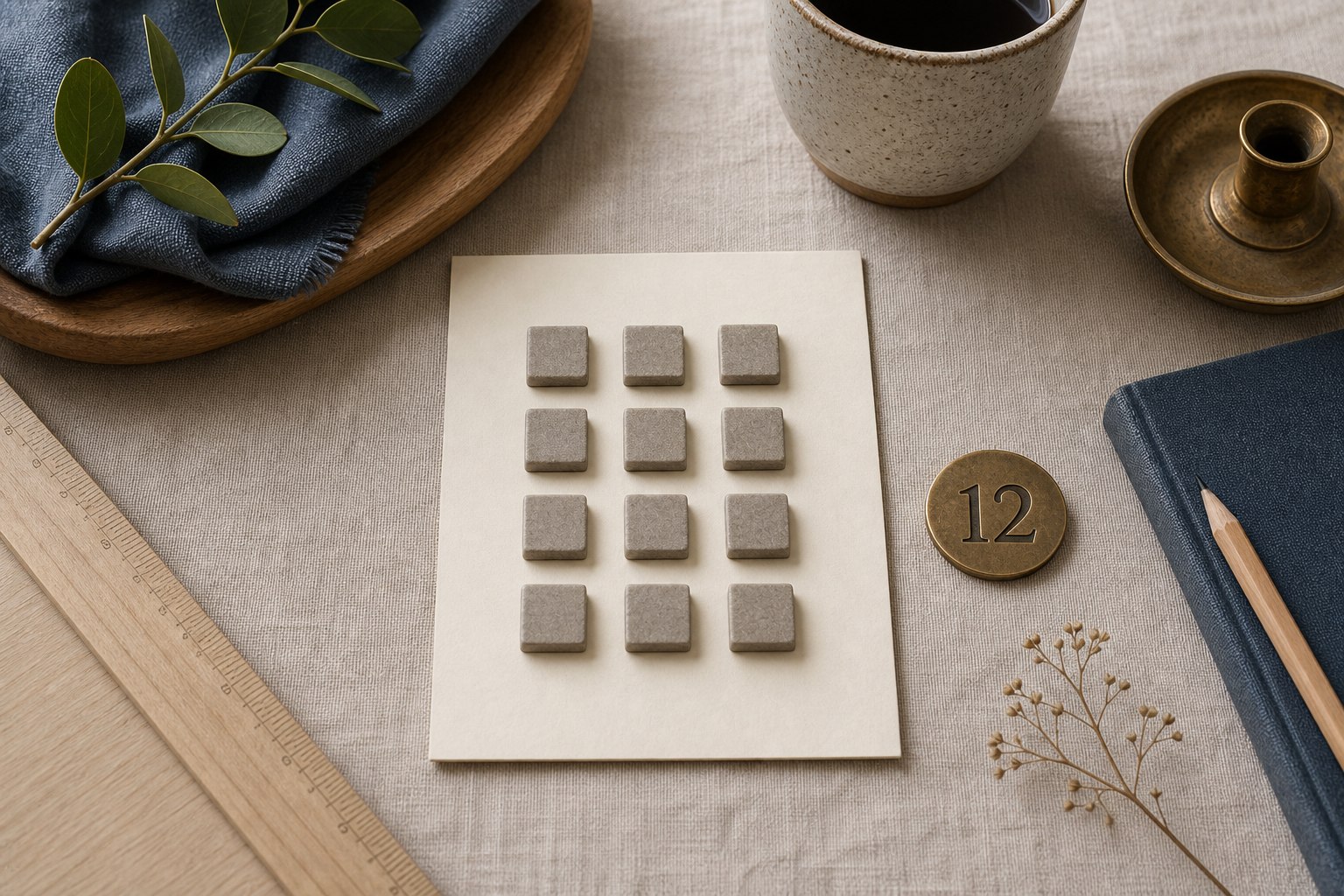
Arithmetic offers another way to break 12 down: 3 x 4 or 2 x 6. Its six divisors, 1, 2, 3, 4, 6 and 12, are more than any smaller number has.
Some modern writers treat 3 x 4 as expression held inside structure. That factor symbolism is an extension by individual authors; the usual numerological calculation remains the digit sum to 3.
Why is 12 used for so many systems?
A lunar month averages 29 days, 12 hours and 44 minutes, so twelve make about 354 days.
That falls about eleven days short of a solar year, which is why lunisolar calendars sometimes add a month. Twelve nevertheless became a familiar division of the year.
Around the end of the fifth century BC, Babylonian astronomers divided the ecliptic, the sun's yearly path, into twelve equal signs of 30 degrees. These corresponded to twelve schematic months of 30 days.
The twelve zodiac signs therefore project a calendar division onto the sky. Their fixed count does not show that twelve separate meanings were discovered in nature.
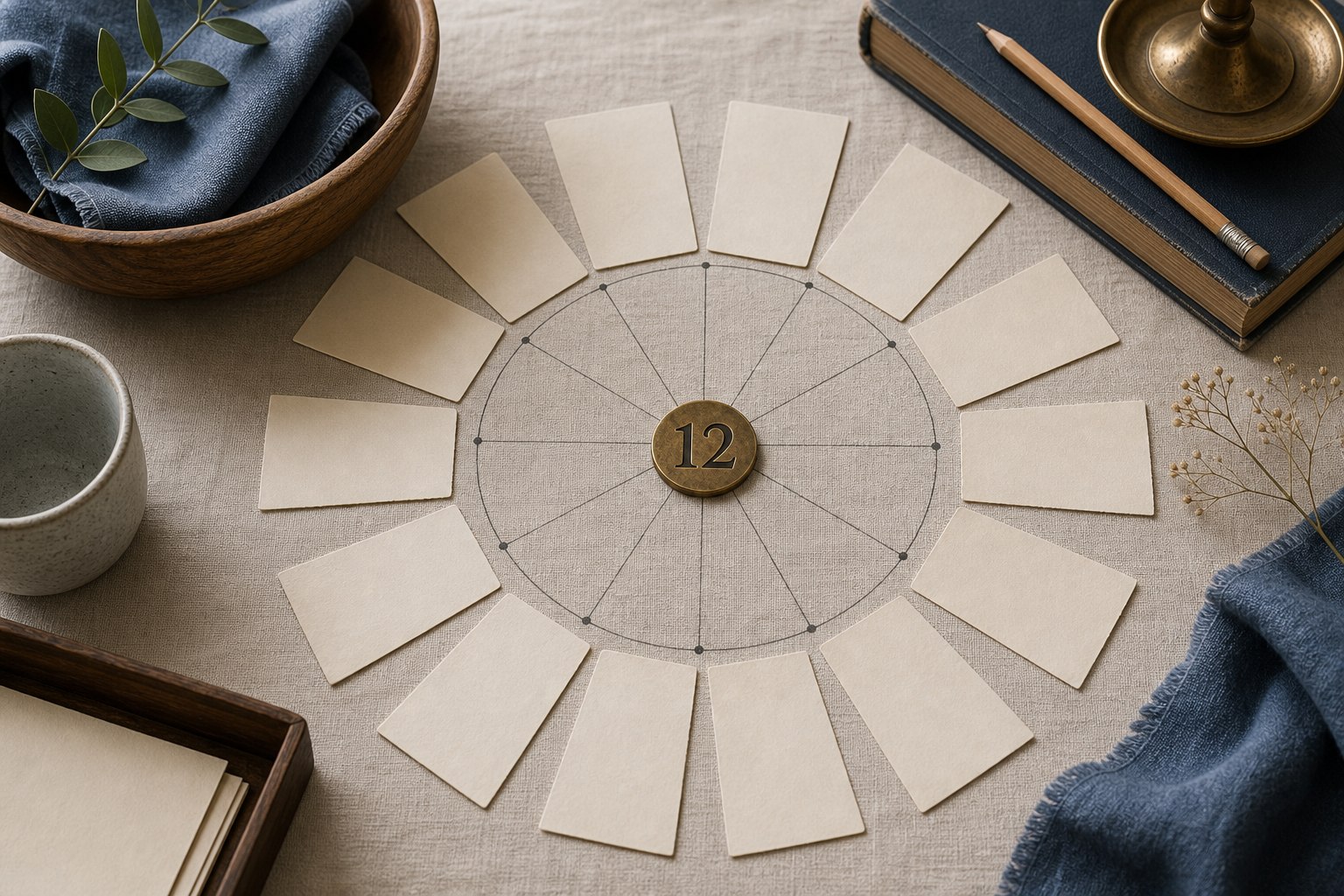
Egyptian timekeeping also used divisions of twelve for day and night. That convention lies behind the familiar twelve-hour dial, on which noon and midnight both read 12.
Divisibility kept twelve useful in trade. A dozen splits into halves, thirds, quarters and sixths without fractions, and the British shilling was worth twelve pence until decimalization in 1971.
Twelve is also the smallest abundant number: its proper divisors, 1 + 2 + 3 + 4 + 6, add to 16. This is an arithmetic property, separate from spiritual claims about abundance.
Calendars, zodiac signs and clock divisions give the modern order reading its historical setting. Their use of twelve explains the association without establishing a message in an individual sighting.
Twelve tribes, twelve apostles and twelve angels at the gates: 12 in the Bible
The Bible uses twelve to name a whole people. Jacob's sons become the twelve tribes of Israel (Genesis 49:28), represented by twelve engraved stones on the priest's breastplate (Exodus 28:21).
Jesus calls the twelve apostles named in Matthew 10:2. After Judas is gone, Matthias joins the eleven remaining apostles in Acts 1:26, restoring the group to twelve.
Revelation joins the two groups in the new Jerusalem. Twelve angels stand at gates named for Israel's tribes, while twelve foundations bear the apostles' names (Revelation 21:12-14).
The woman in Revelation 12:1 wears a crown of twelve stars. The tree of life yields twelve kinds of fruit, one crop each month (22:2), returning the number to a calendar setting.
E. W. Bullinger sums up these uses as "governmental perfection" in Number in Scripture (1894). That label belongs to his interpretation.
The passages organize tribes, followers and a city. None presents twelve as a private message to someone who encounters the number.
Is 12 a lucky number? Cheiro's "Sacrifice" and the Hanged Man
Cheiro's compound-number system gives 12 a difficult reading. He calls it "the Sacrifice" or "the Victim" and associates it with suffering and being used for another person's plans.
Cheiro applied the reading to Ramsay MacDonald because his first name totalled 12 in Cheiro's letter values. This illustrates the author's method; it does not establish that a name total predicts a political career.
Cheiro linked his compound symbols to tarot, where card XII is the Hanged Man, suspended upside down by one foot. A. E. Waite read Pamela Colman Smith's figure differently in the 1910 deck.
Waite describes living wood and a face expressing entrancement rather than suffering. He rejects the label of martyrdom, so even writers who use the same card disagree about the sacrifice it depicts.
Andrews treats the Hanged Man as a voluntary inversion that leads to creative work. Cheiro's sacrifice and the modern constructive reading consequently belong to different systems.
An unlucky label states which symbolic system an author uses. It does not establish that an unfavorable event will follow a sighting of 12.
Does reversing 12 to 21 change the reading?
Reversing the digits keeps the sum and changes the order. In 12, initiative comes before partnership; in 21, partnership comes before an individual statement.
The first reading fits a plan one person starts and opens to others; the second fits a view formed by listening that someone finally says aloud.
Cheiro separates the pair more sharply: his 12 is the Sacrifice, while 21 is the Crown of the Magi and a symbol of advancement. Compound numerology retains the whole number, so equal digit sums do not guarantee equal readings.
| Form | Digit sum | What changes |
|---|---|---|
| 12 | 1 + 2 = 3 | Initiative precedes partnership; Cheiro retains the Sacrifice symbol |
| 21 | 2 + 1 = 3 | Digit order reverses; Cheiro uses the Crown of the Magi |
| 1212 | 1 + 2 + 1 + 2 = 6 | The pair repeats, producing a different total |
| 12:12 | Each half gives 3; together they give 6 | The clock format adds two visible halves and a time setting |
Repeating the pair gives 1212, whose four digits add to 6 rather than 3. On a clock, 12:12 is read half by half, with each 12 reducing to 3 before the whole is added.
Making room for a partner: 12 in love and twin-flame readings
In relationship readings, the 1-then-2 order makes 12 about one person's plans making room for another. It fits a first joint lease, merged work calendars or a partner meeting the family.
Walmsley's home emphasis places the final 3 in what the pair makes together, such as a household routine or shared project.
Cheiro's sacrifice symbolism raises a different question about shared arrangements. When the same partner always gives up their plans, the apparent cooperation conceals an unequal cost.
Anahana's twin-flame entry claims that 12 indicates a harmonious reunion. That promise belongs to modern twin-flame teaching.
The digits can support a symbolic sequence of a start followed by partnership. They contain no information about who will meet or when a reunion will occur.
Clocks and calendars expose readers to 12 every day
Twelve is built into timekeeping: it appears at the top of a conventional twelve-hour dial and marks noon and midnight. It also counts eggs by the dozen and months in a year.
Seeing 12 on the same clock each day repeats exposure to a fixed display; the dial's design accounts for that recurrence.
Frequently Asked Questions
Which traditions give 12 its spiritual meanings?
Modern angel-number writers connect 1, then 2, adding to 3 with a start that becomes shared and creative; biblical passages use twelve for groups such as tribes and apostles. Cheiro's compound system instead associates 12 with sacrifice.
Is angel number 12 the same as 1212?
1212 repeats the 1-2 pair twice, adding to 6, while 12 adds to 3. The order is shared, but the total and length differ.
Why is 12 considered a complete number?
Twelve divides a year into months, the zodiac into signs and a conventional clock into hours, while splitting evenly into halves, thirds, quarters and sixths. The twelve tribes and twelve apostles add a religious sense of a complete group.
Sources
- (n.d.). Number 3 Meaning in Numerology. Numerology.com. Link
- (2011). Angel Number 12. Sacred Scribes Angel Numbers. Link
- (2023). Angel Number 12: The Number That Built Civilization (updated May 9, 2026). Numerologist.com. Link
- (c. 1926). Cheiro's Book of Numbers. Herbert Jenkins, London; compound numbers 12 and 21 on pp. 80-82, the MacDonald example in the chapter on names, scanned edition. Link
- (2026). 12 (number) (divisors, smallest abundant number, months and hours). Wikipedia. Link
- (2026). Lunar month (synodic month; lunar year of twelve months). Wikipedia. Link
- (2026). Zodiac (Babylonian division into twelve signs, 409-398 BC). Wikipedia. Link
- (2026). 12-hour clock (historical day and night divisions). Wikipedia. Link
- (2026). Decimal Day (twelve pence to the shilling before 1971). Wikipedia. Link
- (n.d.). Genesis 49:28; Exodus 28:21; Matthew 10:1-2; Acts 1:26; Revelation 12:1; 21:12-14; 22:2 (KJV). Bible Gateway. Link
- (1894). Number in Scripture: Its Supernatural Design and Spiritual Significance, Part II, "Twelve". Levend Water (online text). Link
- (1910). The Pictorial Key to the Tarot, Part II, section 2, "Twelve. The Hanged Man". William Rider & Son; Wikisource. Link
- (2024). 12 Angel Number Meaning: Spiritual Insights on Twin Flame & Love (updated September 25, 2024). Anahana. Link
About Our Editorial Process
Every KnowTheAngels guide separates calculation method, tradition context, and personal reflection. We cite where interpretations come from, present more than one view, and never present symbolic reading as prediction.
Read our editorial policy