Angel Number 21: Root 3, The World and the Meaning of Arrival
The shared root of 21 and 12, two accounts of attainment, and the difference between a number sighting and an age milestone

Twenty-one acquires different meanings depending on the source: digit reduction gives 3, Cheiro retains the compound 21, and The World occupies position XXI in Waite's Tarot account. Each interpretation answers a different question about the same written number.
The older association with coming of age adds cultural context, but it cannot identify a present legal entitlement or confirm angel contact.
Quick Facts
- Root shared with 12
- 2 + 1 = 1 + 2 = 3
- Retained compound
- Cheiro: Universe / Crown of the Magi, compound 21, page 82
- Tarot position XXI
- The World in Waite's 1910 account
- Master-number status
- 21 is outside the modern 11, 22, 33 convention
- Whole mirror time
- 21:21 sums to 6; each 21 half sums to 3
21's root 3, reversed 12 and master-number status
Digit reduction gives 21 a root of 3: 2 + 1 = 3.
Numerology.com associates 3 with communication, creativity and expression, which supplies a named symbolic reading rather than a forecast of what will happen next.
Reversing 21 to 12 leaves that sum unchanged, because 1 + 2 also equals 3. The calculation contains no instruction to listen before speaking, and swapping the digits does not establish a different sequence of life events.
| Number or input | Calculation | What the method establishes |
|---|---|---|
| 21 | 2 + 1 = 3 | Root 3; compound systems can still interpret 21 separately |
| 12 | 1 + 2 = 3 | The same root, despite the reversed written order |
| Life Path 3 | Calculated from a birth date | A chart result, not a result obtained by seeing 21 |
A compound-number reading retains 21 as its subject instead of replacing it with 3. That is why Cheiro can give 21 a particular symbol even when another number has the same digit sum.
Under the modern convention described by Numerology.com, the master numbers are 11, 22 and 33; 21 is not a master number.
Is 21 lucky? Cheiro's promise and The World XXI
In A. E. Waite's 1910 Pictorial Key to the Tarot, XXI is The World, which he describes as the completion of the Major Trumps' message. His account concerns a card's place in a symbolic sequence, not the arrival of a message whenever 21 appears.
Waite describes a figure dancing within an elliptical garland, holding a wand in each hand.
The four creatures at the corners recall imagery from Ezekiel and the Apocalypse, giving the composition more specific content than a general claim that 21 means success.
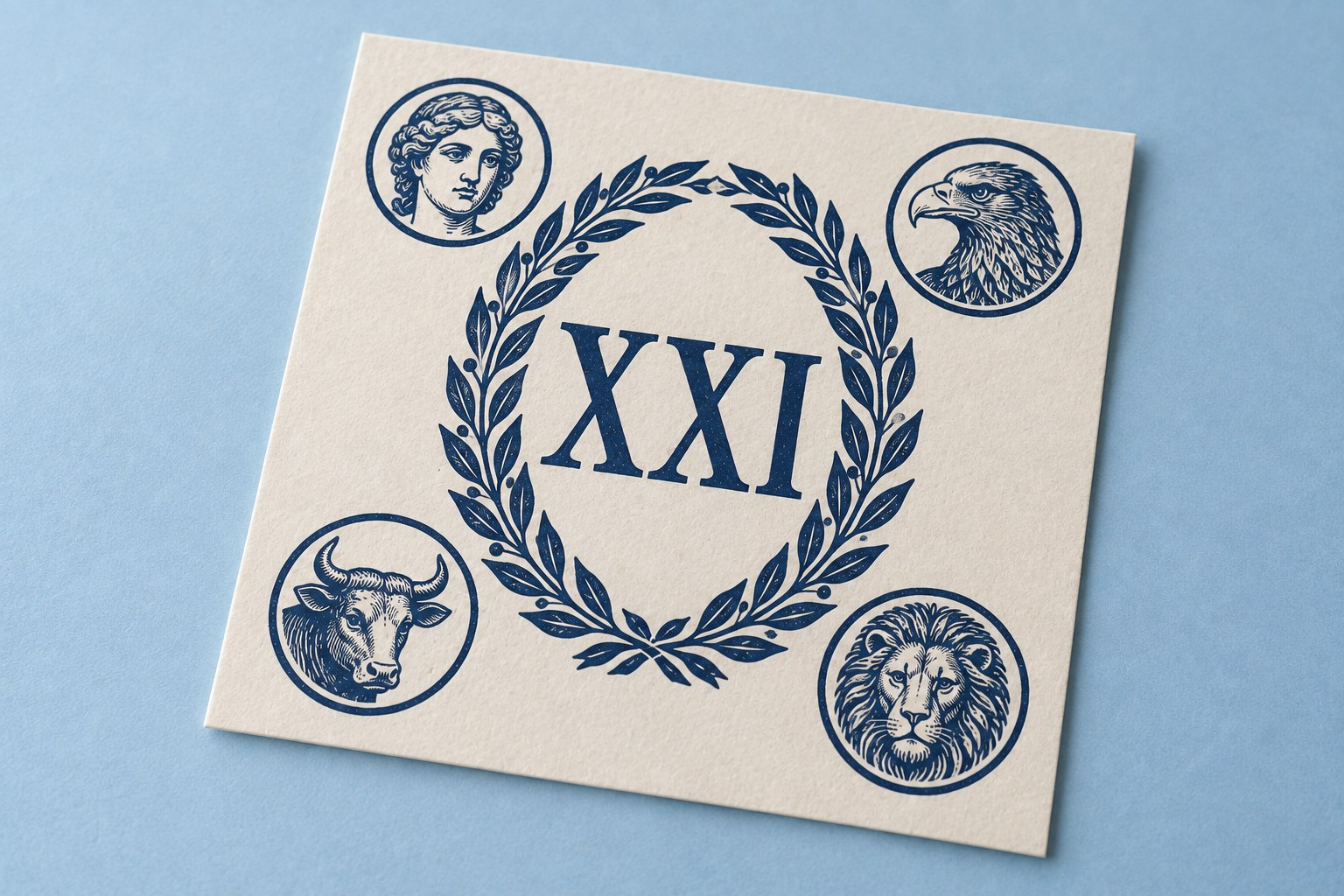
The final numbered position explains why completion is a plausible Tarot association for 21. A closed project or a finished course can provide an analogy for that image, but the image cannot establish that a particular project is already finished.
Cheiro's Book of Numbers gives compound 21 the titles The Universe and the Crown of the Magi. On page 82, he connects it with advancement, honors and eventual success after a long struggle or initiation.
Waite emphasizes a completed symbolic whole; Cheiro adds a story of recognition following difficulty.
Those accounts differ in emphasis, and the shared crown language alone does not demonstrate that one author borrowed the interpretation from the other.
Calling 21 lucky accurately describes Cheiro's favorable interpretation. It does not establish a higher chance of winning, receiving an offer or avoiding a loss after seeing the number.
Why does 21 still suggest coming of age?
The association between 21 and adulthood has a legal and cultural history distinct from numerology. In England and Wales, the Family Law Reform Act 1969 reduced the historical age of majority from 21 to 18, as summarized in the cited encyclopedia entry.
That earlier threshold helps explain why a twenty-first birthday can retain ceremonial importance after a rule changes. The birthday marks twenty-one elapsed years; it is not evidence that the digits have caused a new level of spiritual maturity.
An age threshold also answers a different question from an angel-number interpretation. A label containing 21 or 21+ refers to the activity or rule behind that label, while 21 on a receipt may simply identify a price or transaction.
The historical association does not establish present voting, drinking, contractual or other eligibility in any jurisdiction.
Those categories can follow different rules, so a cultural milestone cannot supply the legal answer.
What does Bullinger's 3 x 7 interpretation mean in the Bible?
E. W. Bullinger's Number in Scripture interprets 21 through its factors, 3 x 7. He associates 3 with divine completion and 7 with spiritual perfection, combining them in a commentary on biblical numbers rather than a digit-sum calculation.
In the section titled Twenty-one, Bullinger reports twenty-one references in 1 and 2 Kings to Jeroboam making Israel sin. His chosen example concerns wrongdoing, which prevents his factor interpretation from serving as a simple claim that every occurrence of 21 predicts a favorable event.
The important distinction is the author's interpretation and the passage's statement. A count of references can support a claim about how Bullinger reads the text, but it does not turn the number into an angel's instruction to the reader.
Multiplication also preserves information that addition discards: 3 x 7 = 21, while 2 + 1 = 3.
The two results are mathematically compatible, yet the symbolic associations attached to them belong to different methods.
21 in love and career: what would count as completion?
In a love reading built around The World, completion can describe an achieved milestone, such as two partners actually agreeing on a shared arrangement. The relevant evidence is the agreement itself; a 21 sighting cannot establish the other person's consent.
Numerology.com's root-3 association brings communication into this reading, but a conversation and its result remain separate events. A clear statement of affection may open a question that still needs an answer rather than closing it.
Twin flame interpretations add another belief framework. Neither Waite's card description nor Cheiro's compound entry establishes that an absent partner will return, so their completion imagery supplies no reunion date.
For career questions, Cheiro's account of recognition after struggle fits the difference between sustained preparation and recognition actually received. A completed qualification is an achieved milestone; an unanswered application is still an application, however often 21 appears.
A finished piece of creative work also differs from an offer to pay for it. The root-3 association can describe expression, while a commission or employment decision depends on the people evaluating the work.
Why do 21:00 and 21:21 invite different readings?
A 24-hour display shows 21:00 at nine in the evening.
A routine that puts the clock in view around that hour can make 21 a familiar sight without establishing an unusual external event.
The full display 21:21 contains four digits, not just the number 21. Each half reduces to 3, but all four digits sum to 6: 2 + 1 + 2 + 1 = 6.
Those are two explicitly different calculations, so repeating 21 does not merely preserve its root unchanged. A reading of one half and a reading of the whole time need to state which digits they use.
Michael Shermer's 2008 discussion of patternicity describes the tendency to find meaningful patterns in noise. It offers an ordinary account of why a newly significant number may stand out, without deciding the cause of any individual's experiences.
Sources
- (n.d.). Number 3 Meaning in Numerology. Numerology.com. Link
- (n.d.). The Master Numbers of Numerology. Numerology.com. Link
- (1910). The Pictorial Key to the Tarot. William Rider & Son, 1910; Part II, XXI, The World. Link
- (c. 1926). Cheiro's Book of Numbers. Herbert Jenkins, London, 1926; compound 21, page 82 of the cited scan. Link
- (1921). Number in Scripture: Its Supernatural Design and Spiritual Significance. Eyre & Spottiswoode, first published 1894; Part II, Twenty-one. Link
- (2026). Family Law Reform Act 1969. Wikipedia, on the age of majority in England and Wales. Link
- (2008). Patternicity: Finding Meaningful Patterns in Meaningless Noise. Scientific American. Link
About Our Editorial Process
Every KnowTheAngels guide separates calculation method, tradition context, and personal reflection. We cite where interpretations come from, present more than one view, and never present symbolic reading as prediction.
Read our editorial policy