What Does Angel Number 14 Mean for Initiative and Change?
The 1 + 4 = 5 calculation, Decoz's chart-specific karmic debt, Temperance, and the separate fourteens in scripture
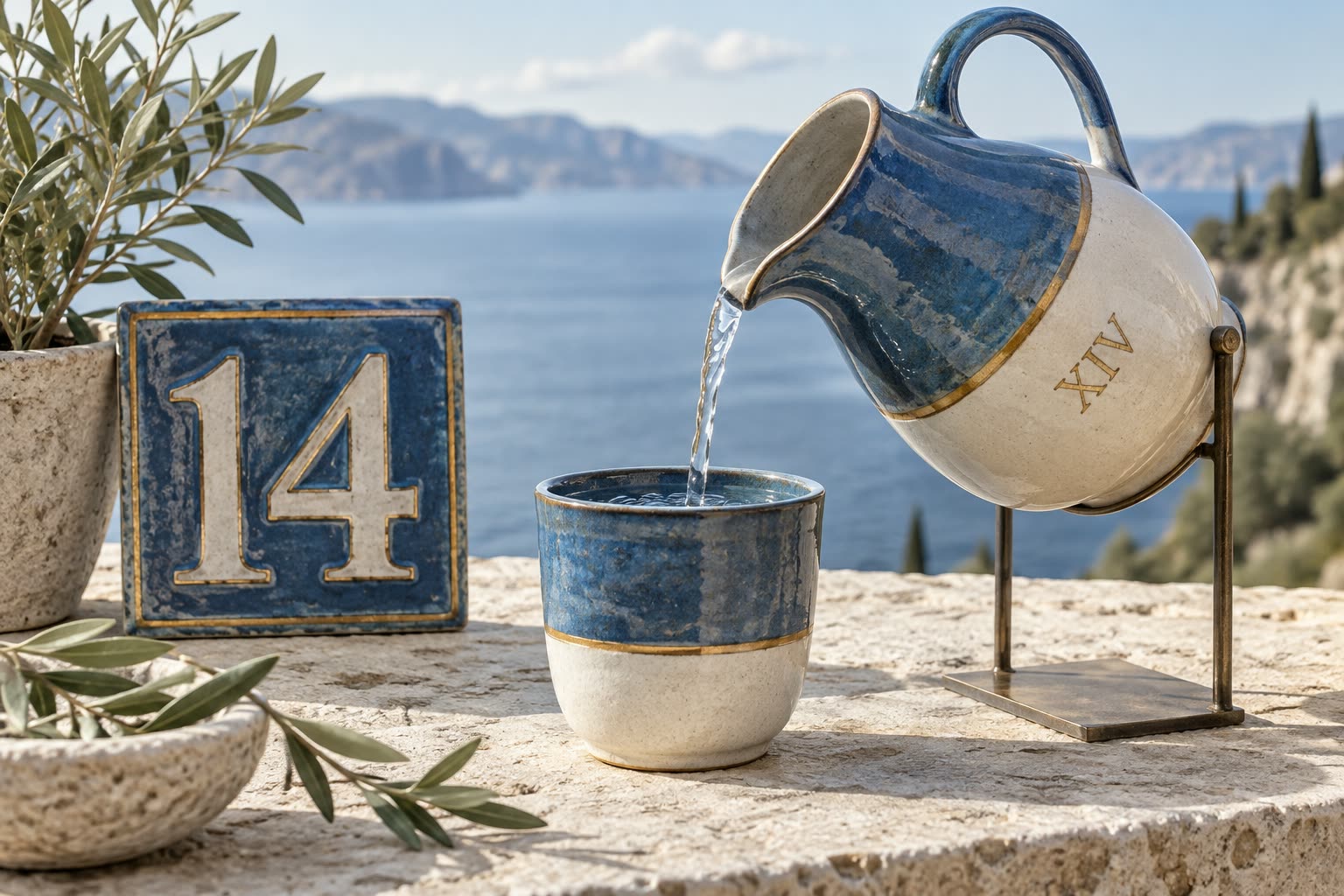
Blair Andrews interprets angel number 14 as freedom earned through discipline. Hans Decoz uses the same compound number more narrowly, as a karmic debt label in specified birth-chart positions.
The calculation 1 + 4 = 5 explains its root, but it does not prove that a change is coming. Tarot's Temperance, Cheiro's warnings and biblical uses of fourteen belong to different sources, each with a different reason for using the number.
Quick Facts
- Reduction
- 1 + 4 = 5
- Karmic debt
- Decoz's chart-specific 14/5; associated with moderation and commitment
- Tarot
- Card XIV, Temperance
- Cheiro's compound 14
- Movement and combination, with risk from other people's actions
- Bible
- Three sets of fourteen generations (Matthew 1:17); Passover on the fourteenth day (Exodus 12:6)
- Reversal
- 41, which also reduces to 5
How does 14 reduce to 5, and what does that explain?
The additive calculation is 1 + 4 = 5.
Hans Decoz associates 5 with freedom, movement and variety. Contemporary compound-number readings also retain the visible 1 and 4 rather than discussing only their sum.
| Element | Attributed association | What it establishes |
|---|---|---|
| 1 | Initiative and independence, Numerology.com | A symbolic vocabulary, not an event |
| 4 | Method and dependable work, Numerology.com | A symbolic vocabulary, not a deadline |
| 1 + 4 = 5 | Decoz's freedom-loving 5 | An exact sum with an interpreted profile |
Andrews combines those ideas into his phrase earned freedom: an initiative becomes sustainable through repeated effort. That is an author's account of 14, rather than a result that can be derived from addition.
For example, someone taking an evening class may gain more choice in their work while also accepting a regular timetable. The example illustrates the contrast between freedom and routine; it does not show that a person who notices 14 needs a new job.
A different story for 14 and 41 therefore needs a compound-number author's interpretation, rather than a chronology supplied by their common root.
A compound-number writer can give the two written numbers different stories, but that distinction needs the writer's interpretation. The common root alone provides no chronology.
When does Decoz's karmic debt 14 label apply?
Decoz lists 13, 14, 16 and 19 as karmic debt numbers when they occur in specified core chart positions. His overview names Life Path, Expression, Heart's Desire, Personality and Birth Day, so the input matters as much as the numeral.
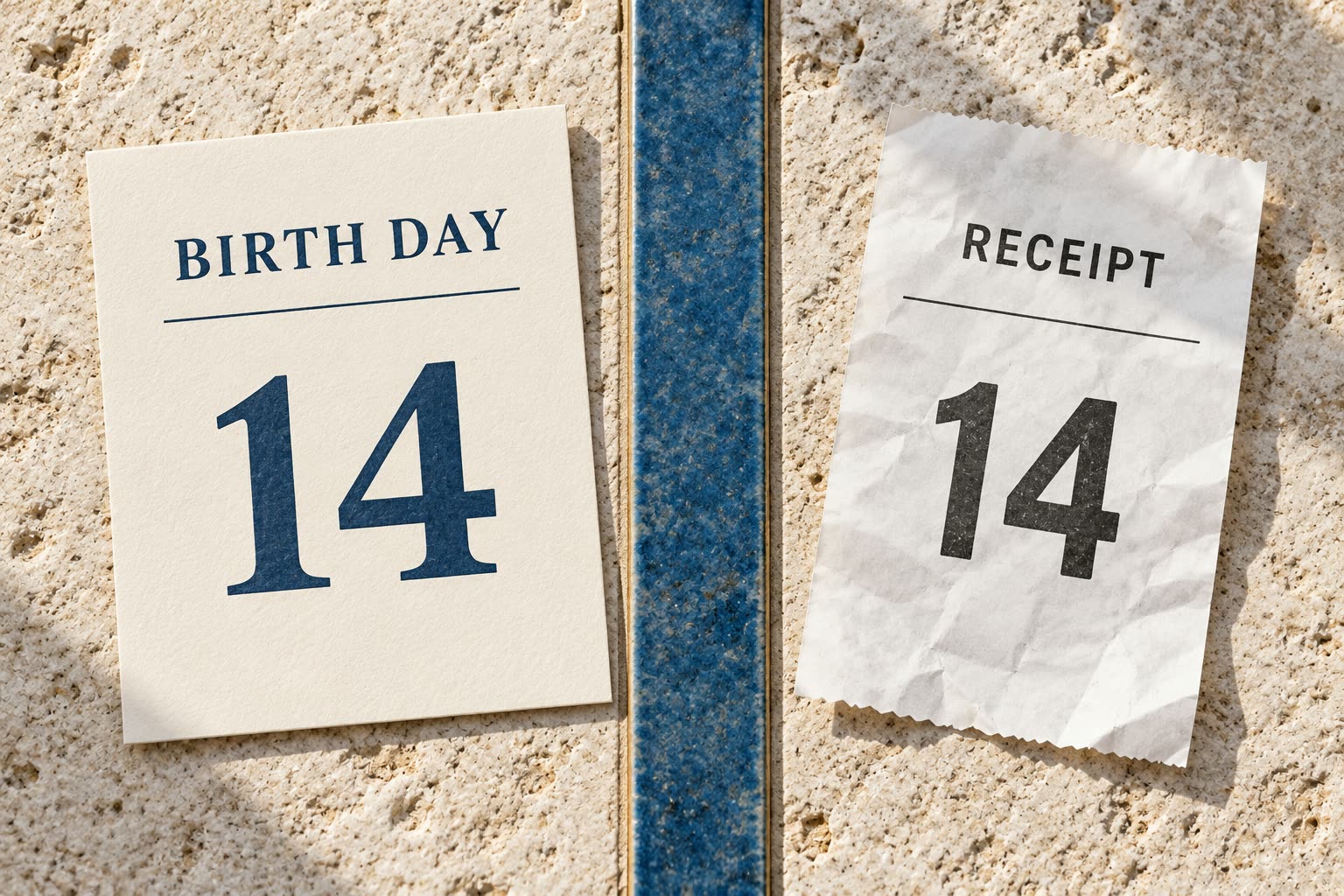
A person born on the fourteenth has a Birth Day number of 14, reduced to 5. A receipt showing 14 uses no birth information and is not that chart calculation.
In Decoz's reincarnation-based account, this debt concerns misuse of freedom in a previous life. He associates it with overindulgence and restlessness; those are claims within his belief system, not evidence of someone's past life or a diagnosis of their present behavior.
Decoz's response is moderation and commitment.
His detailed entry warns against major changes made only to escape routine or responsibility, which gives the reading a narrower focus than a general promise of change.
An imagined example is the difference between leaving a project because its purpose has changed and abandoning each project once repetitive work begins. The same action can have different reasons, and the chart label cannot establish which reason applies.
Decoz's overview describes karmic debt as an opportunity for growth rather than punishment.
Seeing 14 repeatedly does not supply the chart position his method requires.
Anahana extends the karmic language to a noticed angel number and discusses unhelpful habits. That extension belongs to its contemporary interpretation; it does not turn a sighting into a core chart number.
What do Temperance and Cheiro contribute to the meaning of 14?
Temperance is the fourteenth numbered card of tarot's major arcana. In The Pictorial Key to the Tarot, A. E. Waite describes a winged figure pouring between chalices, with one foot on earth and the other on water.
The depicted action makes combination and proportion visible. Waite describes the figure as harmonizing psychic and material natures, whereas Andrews applies its measured pouring to his modern reading of 14.
Cheiro's compound-number entry uses a less reassuring combination of ideas: movement, combinations of people and things, and danger from natural forces. Its shared theme with Temperance is combination, not an identical judgment about what combination brings.
Calling 14 universally harmonious erases Cheiro's warnings as well as the separate reasons Waite and Andrews discuss measured combination.
Fourteen generations and a Passover date: the biblical uses of 14
Matthew 1:17 arranges Jesus's genealogy into three sets of fourteen generations: Abraham to David, David to the Babylonian exile, and the exile to Christ. The repeated count is part of how the Gospel presents the ancestry.
An established interpretation connects fourteen with David's Hebrew name, whose letters d-v-d have values 4 + 6 + 4. This explains a possible purpose for Matthew's arrangement; the verse itself does not state that gematria explanation.
The three stated groups produce 42 by multiplication, but that schematic total is not a claim that Matthew lists every intervening ancestor. The wider genealogy question belongs to the text's arrangement and selected names.
Exodus 12:6 uses fourteen differently: the Passover lamb is kept until the fourteenth day of the month and slaughtered in the evening. Here the number identifies a calendar date within the narrative of Israel's departure from Egypt.
SunSigns and Anahana connect 14 with deliverance. Exodus supplies a dated deliverance setting, but neither that date nor Matthew's genealogy establishes a universal message of salvation for someone noticing fourteen.
How is 14 interpreted in love and twin-flame readings?
Andrews places 14 beside the stage when a relationship needs compromise, conversation and patient attention. SunSigns instead describes a tendency to move between relationships while seeking an ideal match.
Both writers discuss restlessness, but a number cannot determine whether a particular relationship needs continuity or change. The concrete question in their interpretation is how novelty relates to commitments already made.
For example, one partner may want to travel while the other expects shared evenings at home. An agreed arrangement answers a real disagreement; the appearance of 14 reveals neither partner's wishes nor consent.
Decoz's warning about escaping routine can be compared with that situation, provided its chart-specific origin remains visible. It would be a further inference to classify a partner as irresponsible because they want a change.
Anahana's twin-flame interpretation emphasizes independence, communication and overcoming difficulties together. The 1 + 4 calculation gives no evidence of a destined partner, a separation schedule or a reunion.
Career and money: why the sources disagree about 14
Cheiro calls 14 fortunate for money dealings and changes in business, yet also associates it with risk from other people's actions. Decoz's profile emphasizes a profession or lifestyle that gives creativity limits and form.
| Source | Claim about 14 | What the number cannot establish |
|---|---|---|
| Cheiro, compound 14 | Money and business changes, with risk from others | Whether a particular proposal is reliable |
| Decoz, karmic 14 | Commitment within a defined profession or lifestyle | Which job fits an individual |
| Andrews, modern angel-number reading | Freedom developed through sustained effort | When effort will produce income |
These claims do not combine into a rule that a person should speculate cautiously. Cheiro's prediction belongs to his number system, while an actual venture has terms, participants and results that the numeral does not describe.
A hypothetical job change may offer more autonomy but also require training and fixed working hours. That illustrates Andrews's freedom-through-effort theme without making 14 a reason to resign or accept an offer.
Cheiro locates much of the risk in other people's actions, so his entry cannot be reduced to a favorable money omen.
Why does 14 recur on clocks, bills and calendar dates?
Fourteen has ordinary routes into daily life: 14 on a 24-hour clock denotes 2 p.m., a fortnight lasts fourteen days, and February 14 is Valentine's Day. These conventions create repeated exposure without requiring a private message.
The complete time 14:14 includes another pair of digits, so it is a different observed pattern from an isolated 14. A fortnightly bill also repeats because of its schedule, not because a new interpretation has been generated each time.
A number journal can preserve where a sighting occurred and what was happening then. Such a record describes selected observations; without the other numbers encountered in the same settings, it cannot show that fourteen appeared unusually often.
Personal reflection may still draw on an attributed meaning, such as Andrews's relationship between effort and freedom. That chosen reflection remains separate from the cause or frequency of the sightings.
Frequently Asked Questions
Does a birthday on the 14th count as karmic debt 14?
In Decoz's method, Birth Day is a core position and a birth on the fourteenth carries 14/5. That classification belongs to his reincarnation-based numerology; it is not established by seeing 14 elsewhere.
Is 14 a bad number?
Decoz discusses a challenge involving freedom and commitment, while Cheiro includes both favorable money claims and warnings. Neither interpretation establishes that an incidental 14 causes misfortune.
How does 14 differ from its reversal, 41?
Both reduce to 5, because addition gives the same total in either order. A different compound reading depends on an author's interpretation, not proof that events happen in reverse order.
Sources
- (2023). Angel Number 14: The Alchemy of Getting Things Built (updated April 30, 2026). Numerologist.com. Link
- (n.d.). Angel Number 14 Meaning: Symbol of Constant Changes. SunSigns.Org. Link
- (n.d.). Numerology Meaning of Number 5. World Numerology. Link
- (n.d.). The Number 1 in Numerology. Numerology.com. Link
- (n.d.). The Number 4 in Numerology. Numerology.com. Link
- (n.d.). Karmic Debt Numbers (core numbers where karmic debt applies). World Numerology. Link
- (n.d.). Karmic Debt Number 14. World Numerology. Link
- (2026). 14 Angel Number Spiritual Meaning, Love & Twin Flame Significance (updated April 8, 2026). Anahana. Link
- (1910). The Pictorial Key to the Tarot, Part II, section 2, "Fourteen. Temperance". William Rider & Son; Wikisource. Link
- (c. 1926). Cheiro's Book of Numbers. Herbert Jenkins, London; compound number 14 on p. 80 of the scanned edition. Link
- (n.d.). Matthew 1:17; Exodus 12:6 (KJV). Bible Gateway. Link
- (2026). Genealogy of Jesus (Matthew's three sets of fourteen; gematria of David). Wikipedia. Link
- (n.d.). fortnight. Online Etymology Dictionary. Link
About Our Editorial Process
Every KnowTheAngels guide separates calculation method, tradition context, and personal reflection. We cite where interpretations come from, present more than one view, and never present symbolic reading as prediction.
Read our editorial policy