How Do Angel Numbers 777 and 888 Differ in Meaning?
Luck from the slot-machine reel against luck from a Mandarin sound-alike, totals of 21 and 24, Virtue's 1999 entries, and Lamech's age against the letters of Jesus's name
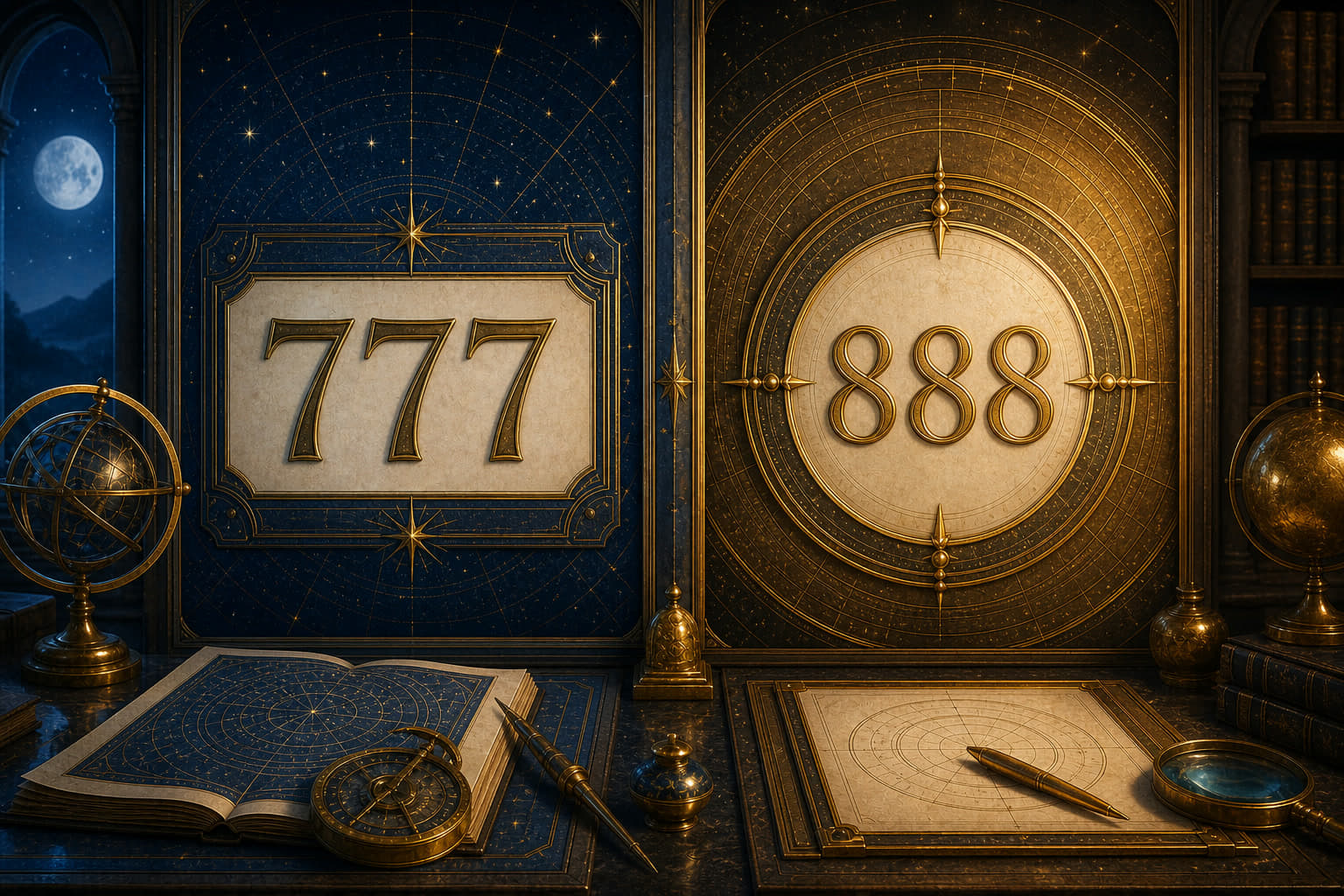
Angel numbers 777 and 888 are usually set apart as spiritual against material: 777 for inner wisdom, 888 for abundance. Numerology supports a version of that split. Hans Decoz describes the 7 as "the seeker, the thinker, the analyst", a number that enjoys long periods of solitude, and the 8 as a balance between the material and spiritual worlds through which "you will reap what you've sown".
The totals and the history add distinctions the usual split leaves out. Three 7s add to 21 and reduce to 3, a number of speaking and sharing, and three 8s add to 24 and reduce to 6, a number of care for other people. The first angel-number list to include them, Doreen Virtue's Healing with the Angels (1999), made 777 the number of applause and gave 888 a warning that a phase was ending, with no mention of money.
Quick Facts
- Main difference
- 777: private study heading toward speech; 888: resources heading toward the household
- Digit totals
- 777 totals 21 and reduces to 3; 888 totals 24 and reduces to 6
- Root digits (Decoz)
- 7: the seeker and analyst; 8: the karmic equalizer
- Source of each number's luck
- 777: the slot-machine jackpot; 888: Mandarin ba (eight) sounds like fa (to prosper)
- Virtue's 1999 entries
- 777: "your wish is coming true"; 888: a phase is about to end
- In the Bible
- 777 is Lamech's age (Genesis 5:31); 888 does not appear
- On a clock
- Neither: 7:77 and 8:88 are not valid times
Does 777 stand for depth and 888 for authority?
Depth and authority fit the digits when depth means solitary study. Decoz's 7 prefers inner exploration to outside stimulation and, pushed too far, turns cynical and emotionally detached. His 8 is a number of authority and material consequence that "creates just as efficiently as it destroys". A 777 reading concerns what a person has studied or worked out alone. An 888 reading concerns money, authority and the results of earlier choices.
| Feature | 777 | 888 |
|---|---|---|
| Digit (Decoz) | 7: seeker, thinker, analyst; can turn detached | 8: material and spiritual balance; reaps what was sown |
| Digit total and root | 21, then 3: expression | 24, then 6: care of home and community |
| Virtue's 1999 entry | Applause: "your wish is coming true" | A phase is ending; the crops are ripe |
| Luck association | Three sevens as the slot-machine jackpot | 8 sounds like "prosper" in Mandarin |
| Bible | Lamech lived 777 years (Genesis 5:31) | Not in the text; the Greek letters of Jesus's name add to 888 |
| Four-digit form | 7777 adds to 28 and reduces to 1 | 8888 adds to 32 and reduces to 5 |
Is 777 or 888 luckier?
Each number's luck comes from outside numerology, and from a different place. The 777 jackpot is a casino convention: stylised lucky sevens are among the classic slot-machine symbols, next to the fruit, bells and bars of the early reels, and three in a row is the line a player hopes to see. Seven is also a winning number at the dice table, where a 7 on the come-out roll wins a pass-line bet in craps. The luck of 888 is linguistic: in Mandarin, eight (ba) sounds like fa, "to prosper", so three eights read as triple fortune.
The two kinds of luck work differently. A slot machine pays on three sevens because of how it is built and set, whatever the player's circumstances, and the Chinese preference for 8 is a wish attached to a sound, visible in prices, phone numbers and dates. Numerology's only luck for either number sits in the 3 at the root of 777, where Decoz describes a "tendency to be 'lucky,' or rather, to be in the right place at the right time", a matter of social timing and not of odds.
The first angel-number list ranked the pair the other way from today's guides. Virtue's 1999 entry for 777 reads: "The angels applaud you, congratulations, you're on a roll! Keep up the good work and know your wish is coming true." Her 888 says that "a phase of your life is about to end" and gives forewarning so the reader can prepare, then adds: "The crops are ripe. Don't wait to pick and enjoy them." In that list 777 carried the good news, and 888 carried a harvest with an ending attached.

Why do the sevens end on speech and the eights on the household?
Pythagorean reduction adds the digits until one remains: 7 + 7 + 7 = 21 and 2 + 1 = 3; 8 + 8 + 8 = 24 and 2 + 4 = 6. The middle totals have readings of their own, angel number 21 for the sevens. The eights pass through angel number 24, and a single-digit reading of either number stops at its root.
The roots carry each number out of its own habit. Decoz's 3 has a "passionate need to express feelings, ideas, and vision", so the solitary study of the sevens ends on speaking, writing or teaching what was found. His 6 is "the glue that keeps a family and community together", so the power and resources of the eights end on the people who depend on them. Read through their totals, 777 asks whether private understanding has been shared, and 888 asks whom money or authority serves.
The comparison of 444 and 555 ends on the same two roots, 3 and 6, reached from steady fours and restless fives instead of solitary sevens and powerful eights, so the root alone does not identify the number.
Do money questions belong to 777 or 888?
In numerology, money belongs with the 8. Decoz writes that the 8 "sees money as a tool not an end-result", and he notes that novices and professional numerologists alike tend to focus on the "money and power" image of the number. The 7 carries no material forecast; its profile is study, analysis and time alone, so a 777 sighting says nothing about income, a raise or a win.
Even for 888, the tradition describes return and responsibility more than new money. The 8 returns what was sown, which can be a debt as easily as a gain, and the 6 at the end of the reduction points the question at dependants and household. A pay rise, an inheritance or a decision about a business fits an 888 reading because it raises the question of whom the money reaches. The months of research before such a decision, working out whether a business idea holds up, fit the 777 side.
The popular promise that 888 brings financial abundance draws on the Chinese prosperity wish more than on Decoz or Virtue. A budget, a debt schedule and a pension contribution remain what decides the outcome.
What do the Bible and early Christian writers say about 777 and 888?
Neither sequence is given a meaning in scripture, but each has a documented link to Christian texts. Genesis 5:31 gives the age of Lamech, the father of Noah: "all the days of Lamech were seven hundred seventy-seven years". The text makes nothing further of the figure, and the Bible's weight falls on seven itself, from the seventh day of rest in Genesis 2:2-3 to the seven seals, trumpets and bowls of Revelation.
888 does not appear in the Bible. Its Christian link comes from isopsephy, the Greek practice of adding the number values of a word's letters: Ἰησοῦς (Iesous), the Greek form of Jesus, totals 10 + 8 + 200 + 70 + 400 + 200 = 888. Book 1 of the Sibylline Oracles, a collection of Greek prophetic verse with Jewish and Christian layers, uses the sum, and Irenaeus, writing around 180, rejected the Gnostic teacher Marcus's theology built on it. Christian numerology that sets 888 against 666, the number of the beast in Revelation 13:18, draws a later contrast, since Revelation writes only the 666.
Do 777 and 888 seen together make one sign?
Neither number can appear on a clock, because 7:77 and 8:88 are not valid times, so sightings come from printed and typed numbers. 777 is on slot-machine artwork, lottery tickets and prices such as $7.77; 888 is sought out for addresses and phone numbers in Chinese-speaking communities, where such numbers can command a premium. The frequency illusion, Arnold Zwicky's 2005 name for noticing a thing everywhere once it matters, keeps each sighting in memory while the 776s and 889s pass unnoticed.
Pages that present the pair as a single sign, one of them calling it "the ultimate sign of manifestation", have no source in Virtue's list, which treats each sequence separately, or in numerology, which reads each number through its own total. If both numbers keep appearing around one piece of work, the arithmetic gives each its own question: whether the study behind the work has been shared (the sevens ending on 3), and whom its results serve (the eights ending on 6).
Frequently Asked Questions
What do 777 and 888 mean in love?
Decoz notes that a 7 can seem aloof, so 777 in a relationship concerns what one partner has worked out alone and not said. 888 follows the 8-to-6 path, so it concerns who controls shared money and decisions and whether that control serves the household. Neither number reports what a partner feels.
Is 888 more powerful than 777?
No source ranks them by strength. Numerology gives 7 and 8 different traits, and Virtue's 1999 list presented 777 as the more positive of the two, calling it "an extremely positive sign".
Is 777 a holy number and 888 the number of Jesus?
Seven has a strong pattern in scripture, and 888 is the letter-sum of Jesus's Greek name, but the Bible gives neither 777 nor 888 a meaning. Irenaeus objected to building theology on the name-sum as early as the second century.
Sources
- (n.d.). Numerology Meaning of the Number 7. World Numerology. Link
- (n.d.). Numerology Meaning of the Number 8. World Numerology. Link
- (n.d.). Numerology Meaning of the Number 3. World Numerology. Link
- (n.d.). Numerology Meaning of the Number 6. World Numerology. Link
- (1999). Healing with the Angels: How the Angels Can Assist You in Every Area of Your Life. Hay House, ISBN 978-1-56170-640-2. Link
- (2008). Number Sequences From The Angels. Spirit Library, posted August 18, 2008, excerpt from Healing with the Angels. Link
- (2026). Slot machine. Wikipedia, history section (Liberty Bell, fruit symbols, sevens). Link
- (2026). Craps. Wikipedia, on the come-out roll. Link
- (2026). Chinese numerology. Wikipedia, section on the number 8. Link
- (2026). 888 (number). Wikipedia, Christian numerology and Chinese culture. Link
- (2021). Genesis 5:28-31 (New Revised Standard Version Updated Edition). Bible Gateway. Link
- (2021). Genesis 2:1-3; Revelation 5:1; 8:2; 13:18; 15:7 (NRSVUE). Bible Gateway. Link
- (1899). The Sibylline Oracles, Book 1. Lines 381-387, the number of the name. Link
- (c. 180). Against Heresies, Book 1, Chapter 15. New Advent (Ante-Nicene Fathers translation). Link
- (n.d.). Meaning of 777 and 888: Spiritual Luck vs. Money. buddhabodhis.com (example of a combined reading). Link
- (2019). Frequency illusion in the OED. Language Log, on Arnold Zwicky's 2005 term. Link
About Our Editorial Process
Every KnowTheAngels guide separates calculation method, tradition context, and personal reflection. We cite where interpretations come from, present more than one view, and never present symbolic reading as prediction.
Read our editorial policy