How Many Angels Appear in Revelation, and Who Are They?
From the angels of the seven churches to Michael, Abaddon, the trumpet and bowl angels, and the angel who twice refuses John's worship
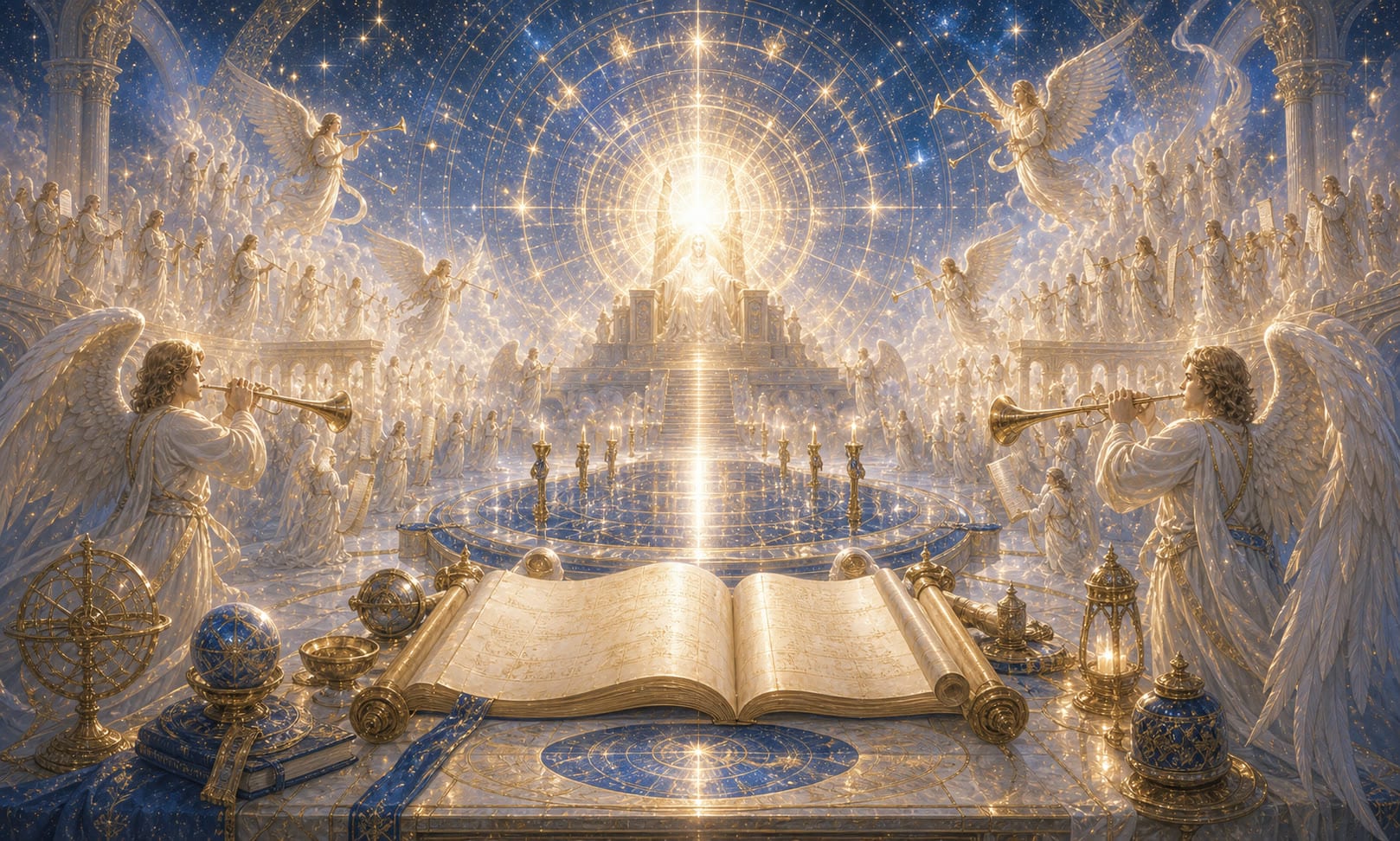
The Book of Revelation uses the Greek word angelos, angel, 67 times, more than any other book of the New Testament. Its angels range from the single guide who shows John the vision to "myriads of myriads" singing around the throne (5:11).
Only two angels in the book have names: Michael, who fights the dragon in chapter 12, and the angel of the bottomless pit, called Abaddon in Hebrew and Apollyon in Greek (9:11).
Two identities are still argued over: whether the angels of the seven churches were heavenly beings or church leaders, and whether the mighty angel of chapter 10 is Christ. Quotations follow the New Revised Standard Version Updated Edition.
Quick Facts
- Uses of the word angel
- 67 in Revelation, out of about 175 in the New Testament
- Named angels
- Michael (12:7) and Abaddon or Apollyon (9:11)
- Numbered groups
- 7 church angels, 4 wind angels, 7 trumpet angels, 4 Euphrates angels, 7 bowl angels, 12 gate angels
- Largest crowd
- "Myriads of myriads and thousands of thousands" (5:11)
- Worship refused
- Revelation 19:10 and 22:8-9
- Date
- Usually placed near the end of Domitian's reign, about 95 CE, following Irenaeus
How often does Revelation mention angels, and can they be counted?
No verse gives a total, and one verse rules a total out. In 5:11 John hears angels around the throne who "numbered myriads of myriads and thousands of thousands."
What can be counted is the word. The Greek angelos appears 67 times in Revelation, against roughly 175 uses in the whole New Testament, so more than a third of the New Testament's angel language sits in this one book.
One angel is a matter of manuscripts. In 8:13 the King James Version has "an angel flying through the midst of heaven," following later Greek copies, while the NRSVUE and most modern translations read "an eagle," the reading of Codex Sinaiticus and Codex Alexandrinus.
| Passage | Who appears | What they do |
|---|---|---|
| 1:1 and 22:16 | The angel Jesus sends to John | Carries the revelation itself and frames the whole book |
| 1:20 to 3:22 | The seven angels of the churches | Receive one letter each, addressed to seven cities in Roman Asia |
| 5:2, 10:1, 18:21 | Three angels called mighty | Ask who can open the scroll, bring the little scroll, and throw a millstone into the sea |
| 5:11 and 7:11 | Countless angels around the throne | Sing and fall on their faces in worship |
| 7:1-3 | Four angels at the corners of the earth, and one from the sunrise | Hold back the winds until God's servants are sealed |
| 8:2 to 11:15 | The seven angels who stand before God | Blow the seven trumpets |
| 8:3-5 | An angel with a golden censer | Offers incense with the prayers of the saints, then throws fire on the earth |
| 9:11 | The angel of the bottomless pit | Rules the locusts as king; named Abaddon and Apollyon |
| 9:14-15 | Four angels bound at the Euphrates | Are released at the sixth trumpet |
| 12:7-9 | Michael and his angels | Defeat the dragon and his angels |
| 14:6-11 | Three angels flying in midheaven | Proclaim an eternal gospel, the fall of Babylon, and a warning against worshiping the beast |
| 14:15-19 | Angels from the temple and the altar | Call for the harvest and gather the vintage of the earth |
| 15:1 to 16:21 | Seven angels with seven bowls | Pour out the last plagues |
| 16:5 | The angel of the waters | Declares God's judgment just |
| 17:1 and 21:9 | One of the bowl angels | Shows John Babylon, then the bride, the new Jerusalem |
| 19:17 | An angel standing in the sun | Calls the birds to the great supper of God |
| 20:1-3 | An angel with a key and a great chain | Binds the dragon for a thousand years |
| 21:12-17 | Twelve angels at the gates, and a measuring angel | Stand at the city gates; measure the city with a golden rod |
Nearly every angel in Revelation is unnamed and identified by one task, often by the object in its hand. A trumpet, a bowl, a sickle, a key, a chain and a measuring rod each belong to a different angel.
Numbers do the organising. The groups of seven match the book's other sevens (seals, trumpets, bowls), and in Jewish symbolism seven marks completeness, from the seven days of Genesis 1 onward.
Seven stars, seven churches: were their angels bishops or guardians?
Revelation 1:20 decodes one symbol for the reader: the seven stars in the risen Christ's right hand "are the angels of the seven churches." Each letter in chapters 2 and 3 then opens the same way, beginning at 2:1 with "To the angel of the church in Ephesus write."
The puzzle is that the letters scold the angel for what the congregation has done. Ephesus hears, "you have abandoned the love you had at first" (2:4), and Sardis, "you have a name of being alive, but you are dead" (3:1).
| Reading | Who has held it | Main reason | Main difficulty |
|---|---|---|---|
| Heavenly guardian angels of each church | Origen (Homilies on Luke 13); Henry Alford in the 19th century | Everywhere else in Revelation, angelos means a heavenly being | A heavenly angel is told to repent of lost love |
| Bishops or leading pastors | Epiphanius (Panarion 25); Augustine; many later Catholic and Protestant readers | Only a human leader could fall and need to repent (2:5) | No other New Testament text calls a church leader an angel |
| Human couriers who carried the letters | Some modern commentators | The ordinary sense of angelos, messenger, fits a letter carrier | The stars are held in Christ's hand, a heavenly image |
| A personification of each church's character | Some modern commentators | Explains why angel and church share one verdict | Letters that name real people, such as the prophet called Jezebel in Thyatira (2:20), fit an abstraction poorly |
Augustine's argument is the one most often repeated. As the 1907 Catholic Encyclopedia summarises it, the letters speak of these angels falling from their first charity, "which is not true of the angels."
Ian Paul, an Anglican New Testament scholar, defends a heavenly reading from another direction. In Daniel, angelic princes stand for whole nations in the heavenly court (Daniel 10:13 and 12:1), so a church could have a heavenly counterpart that shares its fate.
Whichever view a reader takes, the praise and warnings were first addressed to seven real congregations in Ephesus, Smyrna, Pergamum, Thyatira, Sardis, Philadelphia and Laodicea. The dispute is about who receives the letters, and the answer does not change what each letter says.
Lion, ox, human face, eagle: are the living creatures angels?
Revelation never calls them angels. John names them zoa, living creatures: four beings around the throne, "full of eyes in front and back," one like a lion, one like an ox, one with a human face and one like a flying eagle, each with six wings (4:6-8).
The text also keeps them apart from the angels. In 5:11 the angels surround "the throne and the living creatures and the elders," and 7:11 lists the same three groups again.
Their features come from two older visions. The four faces and the many eyes echo the cherubim of Ezekiel 1 and 10.
The six wings and the unceasing song, "Holy, holy, holy, the Lord God the Almighty," echo the seraphim of Isaiah 6:2-3. Most commentators therefore treat the creatures as throne beings of the cherub and seraph kind, a separate order from the angels who carry messages.
They also act in the story. Each of the first four seals opens when one of the creatures calls a rider forward (6:1-7), and in 15:7 one of them hands the seven golden bowls to the seven angels.
The seven who stand before God and blow the trumpets
Revelation 8:2 introduces the trumpet angels as "the seven angels who stand before God," with a definite article, as if readers already knew them.
Jewish writings older than Revelation did know a group of seven. In the Book of Tobit, the companion who guided young Tobias finally reveals himself as "one of the seven angels who stand ready and enter before the glory of the Lord" (Tobit 12:15).
Raphael, who gives his name in that same verse, appears again in a list of seven holy angels. That list is chapter 20 of 1 Enoch, a Jewish work widely read in John's time.
Many commentators identify the trumpet angels with this traditional seven, sometimes called the seven archangels. The link rests on the shared phrase, because Revelation never names them.
Before any trumpet sounds, "another angel" with a golden censer offers incense "with the prayers of all the saints" and then throws fire from the altar onto the earth (8:3-5). Many readers connect this to the martyrs' cry for justice in 6:9-10, so the trumpets arrive as a response to prayer.
Seven trumpets against seven bowls, plague by plague
The two sets run in parallel, and the difference is scale. Most trumpets strike a third of their target, while the bowls strike the whole of it.
| Order | Trumpet (chapters 8 to 11) | Bowl (chapter 16) |
|---|---|---|
| First | Hail and fire burn a third of the earth and trees (8:7) | A painful sore on those who bear the beast's brand (16:2) |
| Second | A burning mountain turns a third of the sea to blood (8:8-9) | The sea becomes like a corpse's blood and everything in it dies (16:3) |
| Third | The star Wormwood makes a third of the waters bitter (8:10-11) | Rivers and springs become blood (16:4) |
| Fourth | A third of the sun, moon and stars is darkened (8:12) | The sun scorches people with fire (16:8-9) |
| Fifth | The pit opens and locusts torment people for five months (9:1-11) | Darkness falls on the beast's throne and kingdom (16:10-11) |
| Sixth | Four angels bound at the Euphrates are released (9:13-15) | The Euphrates dries up for the kings from the east (16:12) |
| Seventh | Loud voices announce the kingdom of God (11:15) | A voice says "It is done!" and a great earthquake follows (16:17-18) |
The targets line up in the same order: earth, sea, fresh water, sky, the abyss or the beast's kingdom, the Euphrates, then a final announcement. Several plagues also repeat the plagues of Egypt in Exodus 7 to 10, including water turned to blood, sores, hail and darkness.
Readers disagree about how the two sets fit together in time. Some place the bowls after the trumpets on a single timeline; others follow Victorinus of Pettau, the earliest known Latin commentator on Revelation (third century), who read the sevens as retelling the same period with rising force.
Twice the text records that the survivors "did not repent" (9:20-21 and 16:9-11). The book presents the angels' plagues as warnings that went unheeded, as well as punishments.
Some angels in these chapters are set over parts of nature. Between the third and fourth bowls "the angel of the waters" speaks (16:5), 14:18 names an angel "who has authority over fire," and in 7:1 four angels hold back the winds.
Abaddon, or Apollyon, king of the locusts from the pit
Abaddon is the king of the locust army released at the fifth trumpet: "They have as king over them the angel of the bottomless pit; his name in Hebrew is Abaddon, and in Greek he is called Apollyon" (9:11).
Both names mean destruction or destroyer. In the Hebrew Bible abaddon is a place, a name for the world of the dead alongside Sheol, in Job 26:6, 28:22 and 31:12, Proverbs 15:11 and 27:20, and Psalm 88:11.
Revelation turns that place into a ruler. Rabbinic tradition kept the older sense, and the Babylonian Talmud lists Abaddon among the names of Gehenna (Eruvin 19a).
What Revelation 9:11 settles, and what it leaves open
The verse is one sentence long, which is why readers fill the gaps so differently.
What the evidence supports
- A commander
He is called king over the locusts, so the plague is led, not random.
- A link to the pit
He is the angel of the same shaft opened in 9:1-2.
- A pointed Greek name
Apollyon sounds like Apollo, and since Hugo Grotius in the 17th century many readers have heard a jab at that god.
What remains limited
- Not clearly Satan
Revelation names the devil in 12:9 and 20:2 and never connects him with Abaddon.
- Not clearly God's enemy
In 20:1 an angel holding the key of the pit binds the dragon, and some readers identify the two.
- Not clearly the fallen star
The star fallen from heaven opens the pit in 9:1, but the text never calls him its king.
David Aune, in the Word Biblical Commentary, suggests the Apollo allusion may point at Nero, who presented himself as Apollo; other readers think of Domitian. On either reading, John places an emperor's claim to divine favour under the king of a destructive plague.
The mighty angel of chapter 10 and the little scroll John eats
Between the sixth and seventh trumpets a mighty angel comes down "wrapped in a cloud, with a rainbow over his head; his face was like the sun and his legs like pillars of fire" (10:1). He plants his right foot on the sea and his left on the land, holding "a little scroll open in his hand."
Some of those features belong elsewhere to Christ, whose face in 1:16 shines "like the sun," and to God's throne, circled by a rainbow in 4:3. G. K. Beale, in his major commentary, argues that the figure may be more than an angel, perhaps the angel of the Lord known from the Hebrew Bible.
Most commentators read him as a created angel. Revelation never calls Christ an angel, the title "mighty angel" also marks plain angels in 5:2 and 18:21, and in 10:6 he swears by the God "who lives forever and ever."
A few readers connect him with Gabriel, whose name comes from a Hebrew root for strength. They also note that an angel in Daniel 12:7 raises his hand to heaven and swears in almost the same way, but Revelation 10 gives no name.
John is told to take the scroll and eat it; it is "sweet as honey" in his mouth and bitter in his stomach (10:9-10), repeating the scene of Ezekiel eating a scroll in Ezekiel 2:8 to 3:3. The next line explains the meal: "You must prophesy again about many peoples and nations and languages and kings" (10:11).
Richard Bauckham argues that the little scroll is the same scroll the Lamb unsealed in chapter 5, now handed to John so that its contents become his prophecy from chapter 11 on.
The chapter also holds the only words John is forbidden to record. When the seven thunders speak, a voice says, "Seal up what the seven thunders have said, and do not write it down" (10:4), so no reader can claim to know what they said from the text.
Michael's war in heaven and the fall of the dragon
Revelation 12:7-9 is the one battle in the book led by a named angel: "war broke out in heaven; Michael and his angels fought against the dragon." The dragon's side loses, and "there was no longer any place for them in heaven."
The loser is identified plainly as "that ancient serpent, who is called the devil and Satan, the deceiver of the whole world," and he is thrown down to the earth with his angels (12:9).
Michael arrives with a history. In the book of Daniel he is "the great prince" who protects Israel (Daniel 12:1) and helps an angelic messenger against the prince of Persia (Daniel 10:13), and Jude 9 calls him "the archangel."
It is Revelation that gives Michael his lasting image as the leader of heaven's army against Satan, standing over a dragon in Christian art. The sword or spear he holds in those paintings is the artists' addition, because Revelation gives him no weapon.
When the battle happens is disputed. A long popular tradition, shaped by the Lucifer passage of Isaiah 14:12 and by Milton's Paradise Lost, places it before creation as the first fall of Satan.
The chapter's own order points to a different moment. The war follows the birth and ascent of the child "who is to rule all the nations" (12:5), and the hymn that explains it credits the victory to "the blood of the Lamb" (12:10-11), so many modern commentators read the expulsion as a picture of what Christ's death and exaltation achieved.
The "third of the stars of heaven" swept down by the dragon's tail (12:4) is often read as the angels who fell with him. The verse does not say so, and the image comes from Daniel 8:10, where a horn throws some of the stars to the ground.
Why does the angel refuse John's worship?
John falls at an angel's feet twice, and both times he is stopped.
In 19:10 the angel calls himself "a fellow servant with you and your brothers and sisters who hold the testimony of Jesus" and ends with the command to worship God.
In 22:8-9 John kneels before "the angel who showed them to me" and hears almost the same words again, this time naming "the prophets" and "those who keep the words of this book" as the angel's fellow servants.
Richard Bauckham argues that the repetition is deliberate. In his reading the whole book turns on the difference between true worship and idolatry, and these scenes apply it to heaven itself: do not worship the beast, and do not worship even God's angels.
The title the angel claims matters as much as the refusal. "Fellow servant" puts the angel on John's side of the line, while God and the Lamb receive the worship of every creature in chapters 4 and 5.
The warning had a setting. Colossians 2:18 already cautions against "worship of angels," and Loren Stuckenbruck's study of angel veneration argues that honouring angels was a live question in Jewish and Christian circles of the period.
Catholic and Orthodox Christians still honour angels in the liturgy: the Catechism of the Catholic Church (335) notes feasts for Michael, Gabriel, Raphael and the guardian angels. They read these verses as forbidding the worship owed to God, while many Protestant readers draw the line more tightly and avoid addressing angels at all.
Preterist, historicist, futurist, idealist: four ways to read the angels
The four classic approaches disagree about when Revelation's visions take place, and that decides what its trumpets and bowls are taken to mean. Steve Gregg's Revelation: Four Views sets them side by side.
| Approach | Core claim | Associated names | How it reads the angels |
|---|---|---|---|
| Preterist | Most visions concern the first century: Rome, its emperors and the churches of Asia | Luis de Alcazar (1614); much modern historical-critical scholarship, which reads the visions first against first-century Rome | The trumpet and bowl angels announce judgment on the Roman order John's first readers lived under |
| Historicist | The visions trace church history from the apostles to the end | Joachim of Fiore; many Reformation commentators; Seventh-day Adventist teaching | Angels are matched to movements; Adventists read the three angels of 14:6-12 as describing their own mission |
| Futurist | From chapter 4 on, the visions describe events still ahead | Francisco Ribera (1590); dispensationalists such as J. N. Darby and John Walvoord | The trumpets and bowls are read as future judgments, many taken literally |
| Idealist | The visions picture the lasting conflict between God and evil in every age | Tyconius and Augustine (City of God, book 20); William Milligan | Angels show God's rule over all of history, without fixed dates |
Many recent commentators mix elements. G. K. Beale describes his own position as a modified idealism, reading most visions as covering the whole period between Christ's first and second coming.
None of the four approaches needs a date to identify the angels. Whether the church angels were bishops, and why the angel refuses worship, are argued from the text itself, and the church-angel debate goes back to Origen and Epiphanius, more than a thousand years before the futurist and preterist schools of Ribera and Alcazar.
Frequently Asked Questions
Is Gabriel mentioned in the Book of Revelation?
No. The only angels Revelation names are Michael (12:7) and Abaddon, or Apollyon (9:11).
Linking the mighty angel of chapter 10 with Gabriel is a guess some readers make from the word mighty, and the text does not support it directly.
Is Jesus an angel in Revelation?
Revelation keeps them apart.
Jesus sends "his angel" to John (1:1 and 22:16) and receives worship with God in chapter 5, while an angel refuses worship twice (19:10 and 22:8-9). The debate about the mighty angel of chapter 10 is the main exception readers discuss.
Are the twenty-four elders angels?
Readers are divided. David Aune reads them as an angelic council around the throne, while many others see them as representatives of God's people, twelve for the tribes of Israel and twelve for the apostles, whose names appear together on the new Jerusalem in 21:12-14.
Who are the seven spirits before the throne?
Most Christian readers take the seven spirits of 1:4, 4:5 and 5:6 as the Holy Spirit in full, drawing on Isaiah 11:2. A minority read them as the seven chief angels, pointing to 8:2 and Tobit 12:15.
Who are the four angels bound at the Euphrates?
They are released at the sixth trumpet, having been "held ready for the hour, the day, the month, and the year" (9:14-15). Revelation gives them no names, and it is disputed whether they are the same four angels who hold back the winds in 7:1.
Does the book give a date for the events the angels announce?
No.
Its angels announce judgment and the kingdom of God without a calendar date, and in 10:4 John is told to seal up what the seven thunders said. Readings that set dates come from later interpreters.
Sources
- (about 95 CE). Revelation 1:1 to 22:21, New Revised Standard Version Updated Edition. Bible Gateway. Link
- (about 3rd to 2nd century BCE). Tobit 12:15, New Revised Standard Version Updated Edition. Bible Gateway. Link
- (about 180). Against Heresies 3.11.8 (the four creatures and the four Gospels) and 5.30.3 (the vision dated to the end of Domitian's reign). New Advent. Link
- (about 426). The City of God, book 20. New Advent. Link
- (1907). Angels of the Churches. The Catholic Encyclopedia, vol. 1. Link
- (1906). Abaddon. Jewish Encyclopedia. Link
- . Eruvin 19a, the names of Gehenna. Sefaria. Link
- (1997). Paragraph 335, the angels in the liturgy. Holy See. Link
- (1993). The Climax of Prophecy: Studies on the Book of Revelation, chapter 4 (The Worship of Jesus) and chapter 9 (The Conversion of the Nations). T&T Clark
- (1999). The Book of Revelation, introduction and comment on Revelation 10:1. New International Greek Testament Commentary, Eerdmans
- (1997 to 1998). Revelation 1-5 and Revelation 6-16, comments on Revelation 4:4 and 9:11. Word Biblical Commentary 52A and 52B
- (2014). Revelation, introduction, History of Interpretation. Anchor Yale Bible 38A, Yale University Press
- (2013). Revelation: Four Views, revised edition, introduction. Thomas Nelson
- (1995). Angel Veneration and Christology, chapter on Revelation 19:10 and 22:8-9. WUNT 2/70, Mohr Siebeck
- . What are the angels doing in the Book of Revelation?. Psephizo. Link
About Our Editorial Process
Every KnowTheAngels guide separates calculation method, tradition context, and personal reflection. We cite where interpretations come from, present more than one view, and never present symbolic reading as prediction.
Read our editorial policy