What Does Angel Number 85 Mean for Change, Responsibility, and Stability?
The 8-5-13-4 reduction and the karmic-debt question, two modern readings that disagree about change, Caleb's request at eighty-five, and the difference from 58

Angel number 85 puts a change (5) after something already achieved or held (8), and its digits reduce through 13 to 4. Numerology.com calls the 5 "a master of change" and says the 4 "lends a great amount of stability", so modern numerology reads 85 as a move made from an established position that ends in a new, settled arrangement.
The two named readings of 85 disagree about which way the change runs. Joanne Walmsley (2011) says old "restraints and constraints will be shed" to make way for opportunities and promotions, and that the reader's "financial flow is increasing". Blair Andrews (2023) reads 85 as a discipline that once freed a person and "has quietly become the thing keeping you in place". The first promises gains from change; the second asks what should be given up.
Quick Facts
- Reduction
- 8 + 5 = 13, then 1 + 3 = 4
- The 13 step
- A karmic debt number for Decoz, weighed in birth charts
- Walmsley (2011)
- Restraints shed; promotions; finances improving
- Andrews (2023)
- A freeing discipline now confines (the Death card for 13)
- Bible
- Caleb at 85 (Joshua 14:10); 85 priests killed at Nob (1 Samuel 22:18)
- Reversal
- 58 changes first and gains power afterwards
Is 85 karmic? The 13 inside 8 + 5 and the 4 it reduces to
The calculation runs 8 + 5 = 13, then 1 + 3 = 4, and Walmsley prints it the same way: 85 "relates to number 4 (8+5=13, 1+3=4)". The 13 cannot be kept as a final value, because only 11, 22 and 33 are treated as master numbers.
The 13 step gives 85 its heavier associations. Hans Decoz lists 13 among four karmic debt numbers, with 14, 16 and 19, but gives them their weight when they occur among a person's core numbers: the Life Path, Expression, Heart's Desire, Personality and Birth Day. A total on a receipt is not part of anyone's chart, so calling a sighting of 85 karmic carries Decoz's label beyond the place he uses it. Andrews reads the same step through the tarot instead, as the Death card, the end that clears the way for the 4.
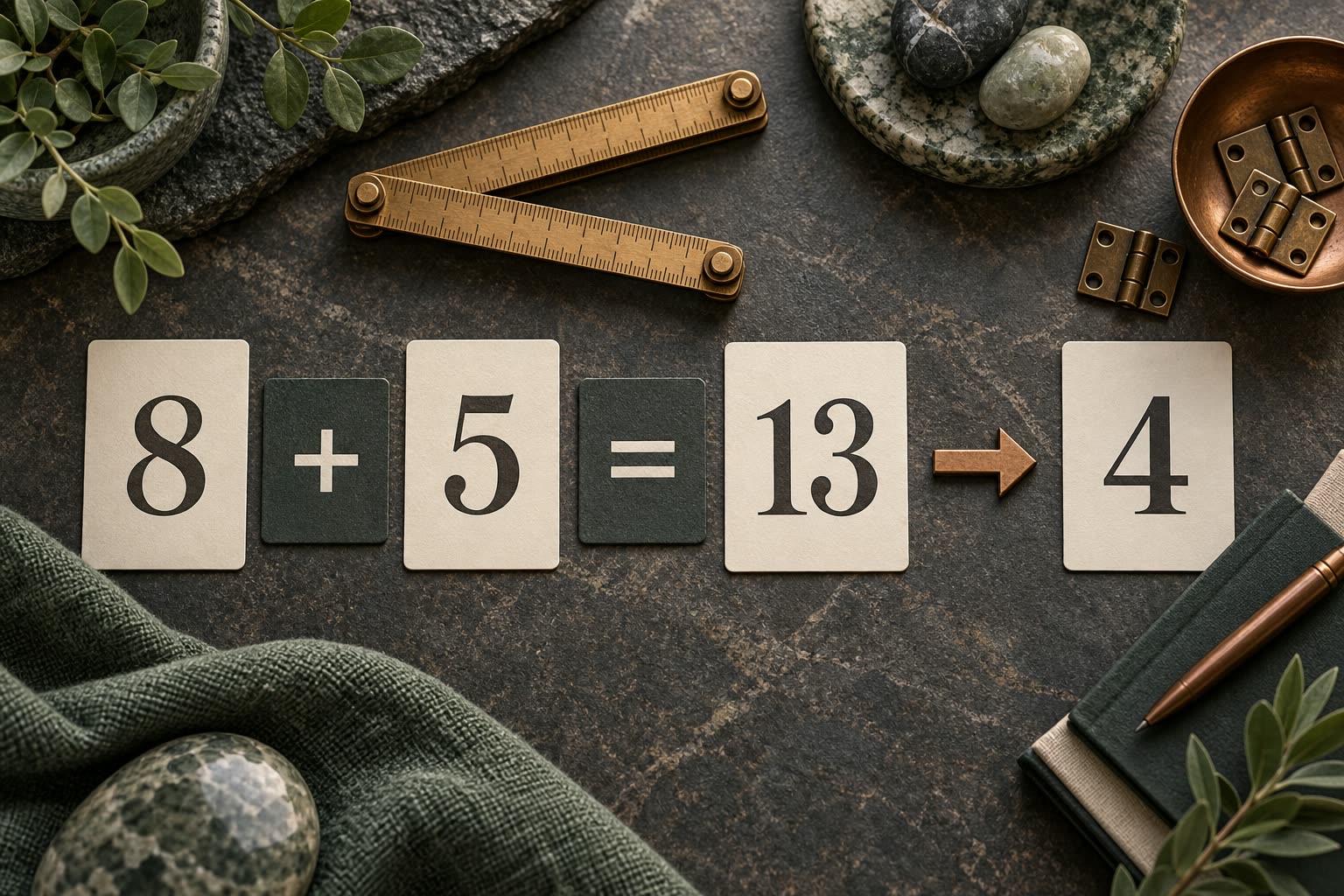
Numbers whose digits add to 13 all take this route to 4: 49, 58, 67, 76, 85 and 94. The order sets 85 apart from its reversal 58, because in 85 the position exists before the change, while in 58 the change comes first and produces new power.
What does angel number 85 mean: new opportunity, or a discipline to let go?
Numerology.com's 8 is a results-driven achiever. Its 5 "craves freedom and adventure" and can "adapt itself to thrive in different environments". With the 8 first, 85 describes change undertaken by someone who already has something to lose: a position, a business, a home or a hard-won habit.
Walmsley's entry of 15 July 2011 is the source of the most common reading. It says that "some old restraints and constraints will be shed in order to make way for auspicious new opportunities, advancements and/or promotions", that the changes will "bring long-term benefits", and that for anyone considering a spiritually based career "the timing is right to take up the initiative".
Andrews, writing on Numerologist.com in April 2023, reverses the direction. The 8 is read as rhythm and the 5 as freedom, and together they describe a practice, such as a training schedule or a strict daily routine, that once gave a person freedom and has since hardened. The root 4 is the Emperor, a foundation that no longer needs the old scaffolding.
| Source | Reading of 85 | What it rests on |
|---|---|---|
| Joanne Walmsley, Sacred Scribes (2011) | Restraints shed; opportunities, promotions and rising finances | Her attributes for 8 (karma, authority, wealth) and 5 (new opportunities, freedom, promotion), with 4 as the root |
| Blair Andrews, Numerologist.com (2023) | A freeing discipline has become a constraint and should end | Tarot cards: Strength for 8, the Hierophant for 5, Death for 13, the Emperor for 4 |
| Numerology.com digit meanings | No reading of 85 itself | Single-digit profiles: 8 as achiever, 5 as master of change, 4 as stability |
Both readings describe release from something. Walmsley places the constraint outside the reader and promises reward for leaving it; Andrews places it in the reader's own habits and promises nothing beyond a simpler foundation.
Is 85 a biblical number? Caleb at 85, the priests of Nob and Psalm 85
Two biblical stories give 85 as a count. In Joshua 14:10-12, Caleb tells Joshua, "I am this day fourscore and five years old", says he is "as strong this day as I was in the day that Moses sent me", and asks, "Now therefore give me this mountain", the hill country that Joshua then grants him as Hebron (14:13). In 1 Samuel 22:18, Doeg the Edomite, on Saul's order, kills "fourscore and five persons that did wear a linen ephod", the priests of Nob.
Caleb's request, a large change asked for out of long experience, happens to resemble the modern reading of 85, and the killing at Nob does not resemble it at all. Side by side, the two passages show why the number carries no fixed meaning in scripture, and why Bullinger's 1921 Number in Scripture, which has entries for seventy and for one hundred and twenty, has none for 85.
Psalm 85, attributed to the sons of Korah, asks God to restore the people and contains the line "Mercy and truth are met together; righteousness and peace have kissed each other" (85:10). Like every psalm number, 85 is a position that differs by edition, and the Greek Septuagint and Latin Vulgate count this psalm as 84.
Leaving a secure post: what 85 means for a career change
Walmsley's entry makes the most specific career claim for 85: that a spiritually based practice, profession or career can begin or expand now, that "all that you need will be provided by the angels and Universal Energies", and that others should not be allowed to block "necessary changes". Andrews's reading points the other way and, before anything new begins, asks which part of the old routine has finished its job.
The 8-5-4 order describes a career change made from security rather than necessity: a salaried specialist going freelance, a business owner selling a profitable line to start another, a teacher moving into corporate training. The 8 is what the person gives up or carries across, the 5 is the move and the 4 is the ordinary week that follows, with its new hours, income pattern and obligations. Walmsley's timing claim cannot be checked against anything, whereas notice periods, savings and signed offers can, and they set the real timetable for a move of this kind.

Is 85 a money sign, as Walmsley's reading claims?
The money promise comes from Walmsley, who writes that 85 means "your financial flow is increasing and improving". Andrews's reading does not mention money. Numerology.com ties extra prosperity to the 8s in a person's own chart, saying "the more 8s you have in your personal Numerology, the more opportunity, prosperity, and success you may find", which concerns birth dates and names rather than numbers seen by chance.
What 85 does describe is the shape of a large financial change: a sale, a move, a new loan or a change of employer made from an existing position. The 5 is the transaction and the 4 is what remains afterwards, the repayments, running costs and new routine. A promotion that raises pay but adds a long commute, or a house sale that frees capital but brings rent, is the kind of decision the 4 at the end of 85 points to.

When a job offer or an inheritance changes the household: 85 in love
Neither Walmsley nor Andrews writes about love in their readings of 85. Applied to a relationship, the digits describe a change that one partner's position makes possible: a job offer in another city, an inheritance that could buy a house, a decision to stop working to care for a parent. The 5 is the change and the 4 is the household that results, and the reading asks whether both people have agreed to that household and not only to the change.
Andrews's version fits couples in a different way. An arrangement that once protected the relationship, such as finances kept strictly separate after a painful divorce, can outlast its purpose, and the Death card in that reading marks the point at which such an arrangement is ended on purpose rather than left to break.

Why does 85 keep appearing while a decision is open?
Selective attention, which the APA Dictionary of Psychology defines as concentrating on certain stimuli while ignoring others, follows whatever is on a person's mind. During a big decision, the figures attached to it, prices, salaries, dates and distances, are already under attention, and a number that has also taken on spiritual meaning gets noticed wherever it occurs.
That combination is why a run of 85s can feel like a signal about timing. Walmsley's line that "the timing is right" makes a claim a sighting cannot support, since a decision's real dates sit in its contracts and notice periods. Kept in a journal beside the decision under way, the sightings record how often the choice was on your mind, which is information about the decision rather than about the number.
Opposite moves: how 85 differs from 58, 84 and 86
| Number | Arithmetic | What it asks |
|---|---|---|
| 85 | 8 + 5 = 13, then 4 | What settled arrangement does a change from an established position leave? |
| 58 | 5 + 8 = 13, then 4 | Which rules govern power that a change has produced? |
| 84 | 8 + 4 = 12, then 3 | Can existing results be kept up and explained? |
| 86 | 8 + 6 = 14, then 5 | How are resources moved toward care at home? |
| 13 | 1 + 3 = 4 | The karmic debt step read on its own |
| 4 | Single digit | Stability and routine without the change before it |
Eighty-four and 85 sit next to each other and move in opposite directions, since 84 keeps an arrangement going while 85 changes one and ends in a new routine. The neighbour 86 shares the leading 8 but reduces through 14, another of Decoz's karmic debt numbers, to 5. Its change is still under way at the end of the calculation, where the change in 85 has settled into a routine.
Frequently Asked Questions
What does 85 mean spiritually?
In modern angel-number writing, a change made from an established position. Joanne Walmsley (2011) reads it as old constraints giving way to new opportunities; Blair Andrews (2023) reads it as a discipline that has outlived its purpose.
Is 85 a karmic number?
It passes through 13, which Hans Decoz lists as a karmic debt number, but Decoz applies that label to the core numbers of a birth chart, not to numbers seen in daily life.
How is 85 different from 58, 84 and 86?
Fifty-eight has the same 13 and 4 with the order reversed, so its change comes first and produces new power. Eighty-four keeps an arrangement going instead of changing it, and 86 reduces to 5, so its change is still under way.
Who was 85 years old in the Bible?
Caleb, who at 85 asked Joshua for the hill country of Hebron (Joshua 14:10-12).
Sources
- (n.d.). Number 8 Meaning in Numerology. Numerology.com. Link
- (n.d.). Number 5 Meaning in Numerology. Numerology.com. Link
- (n.d.). Number 4 Meaning in Numerology. Numerology.com. Link
- (2011). Angel Number 85 (posted July 15, 2011). Sacred Scribes Angel Numbers. Link
- (2023). Angel Number 85: The Practice That Stopped Working Right (April 26, 2023). Numerologist.com. Link
- (n.d.). Karmic Debt Numbers (13, 14, 16 and 19; core numbers). World Numerology. Link
- (n.d.). The Master Numbers of Numerology (11 as "a seer"). Numerology.com. Link
- (2026). Major Arcana (Rider-Waite-Smith numbering). Wikipedia. Link
- (1921). Number in Scripture: Its Supernatural Design and Spiritual Significance, 4th edition, part II entries from seventy to one hundred and twenty. Eyre & Spottiswoode, London (public-domain text). Link
- (1611). Joshua 14:10-13. BibleGateway. Link
- (1611). 1 Samuel 22:18. BibleGateway. Link
- (1611). Psalm 85:10. BibleGateway. Link
- (2026). Psalm 85 (sons of Korah; Septuagint and Vulgate numbering). Wikipedia. Link
- (2018). Selective attention. APA Dictionary of Psychology. Link
About Our Editorial Process
Every KnowTheAngels guide separates calculation method, tradition context, and personal reflection. We cite where interpretations come from, present more than one view, and never present symbolic reading as prediction.
Read our editorial policy