What Does Angel Number 86 Mean When Work and Home Compete?
Money placed before home, the 14 and the 5, Joanne Walmsley's 2011 possession reading, the restaurant verb eighty-six and Psalm 86
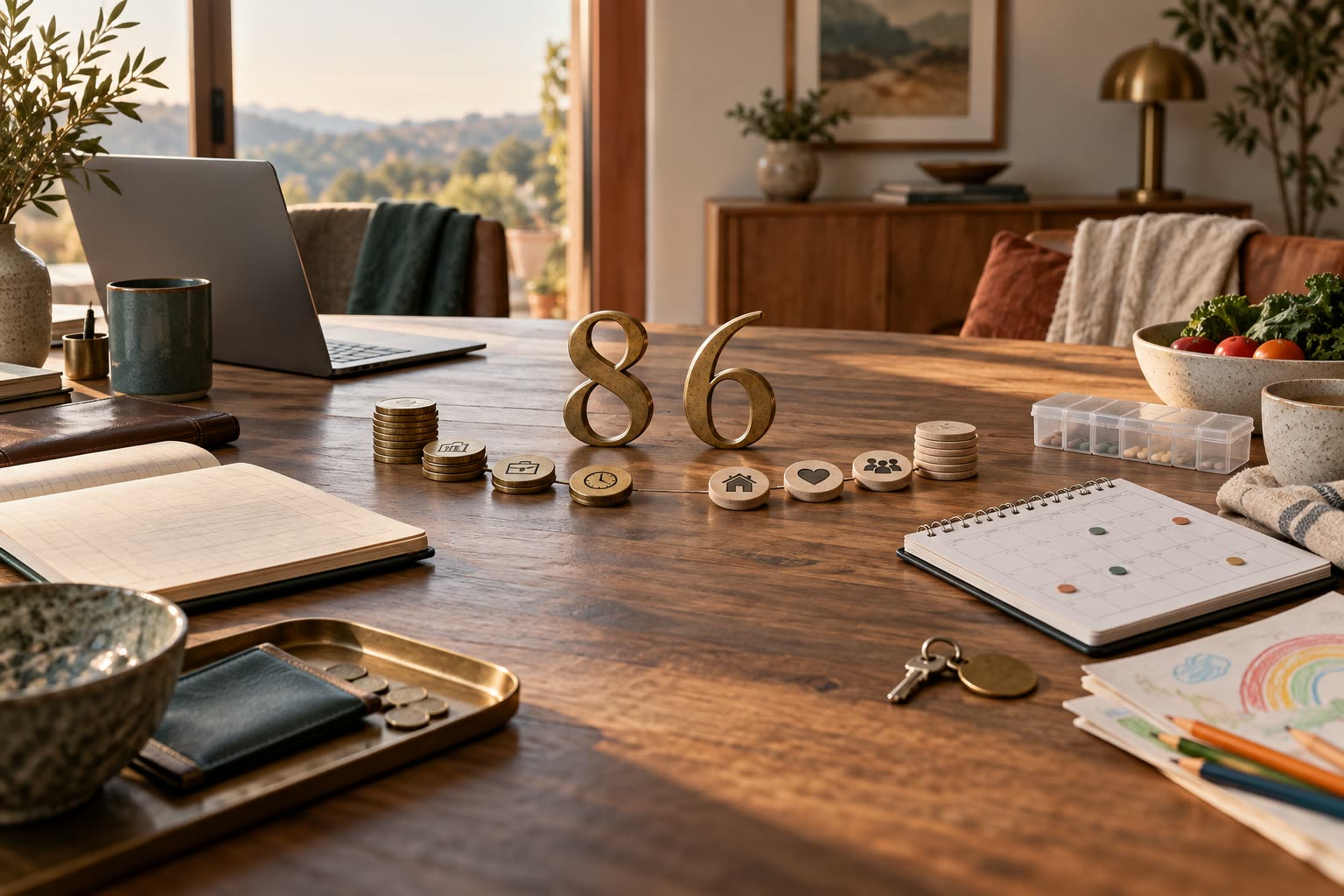
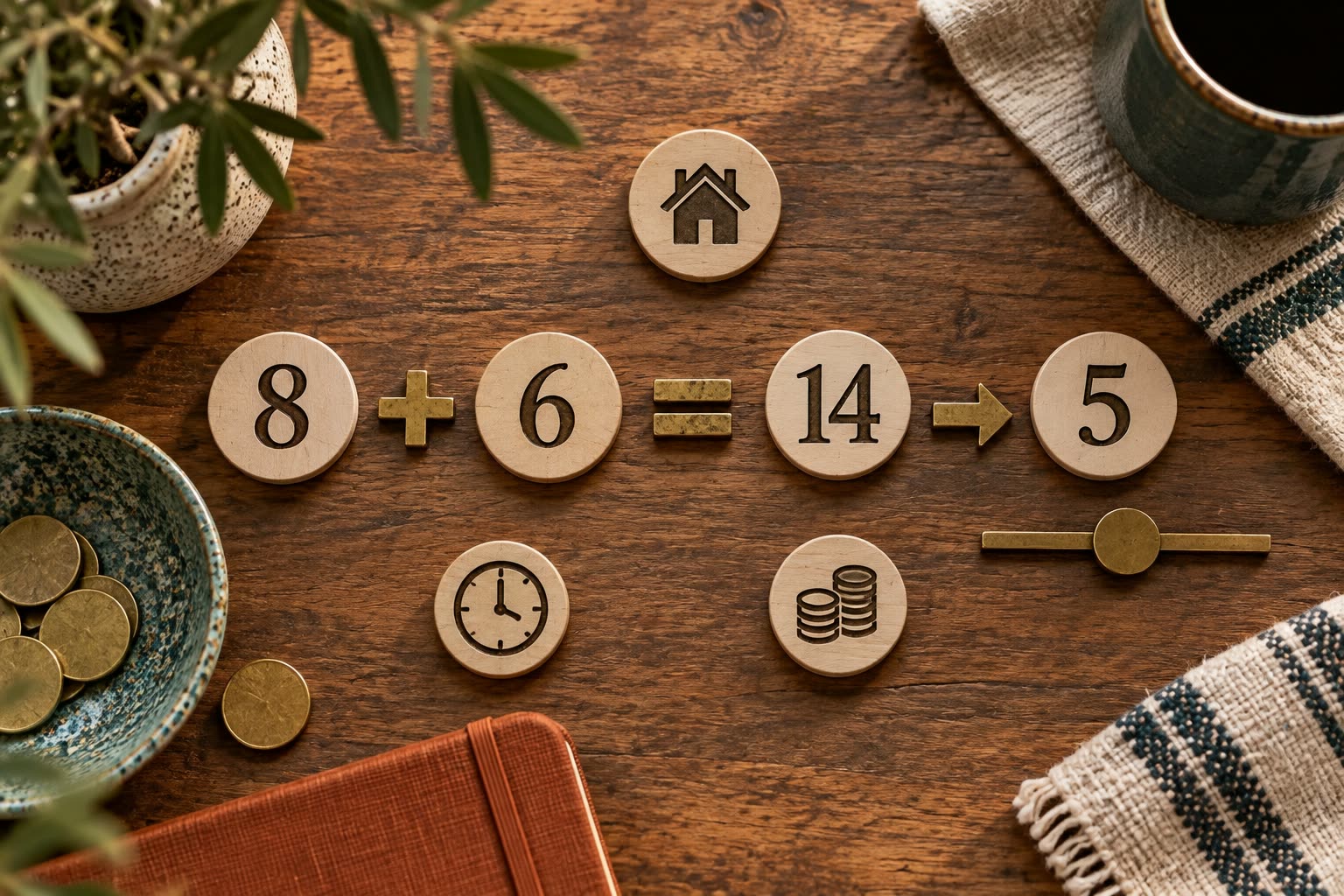
In most angel-number readings, 86 is a money-and-home number: 8, the digit tied to money and personal authority, comes before 6, the digit of home and family. The two add to 14 and then to 5, the digit of change, so readings of 86 describe money, work or possessions shifting inside a household.
The possession reading comes from Joanne Walmsley's Sacred Scribes entry of July 2011, which says that "a material possession or item is due to leave your life" and that prayers about home, family and money have been heard. Two other meanings reach readers through the same numeral: the American verb to eighty-six, meaning to throw out or refuse, first recorded in 1942, and Psalm 86, a prayer of David that asks God for "a sign of your favor".
Quick Facts
- Reduction
- 8 + 6 = 14, then 1 + 4 = 5
- Digits in order
- 8 (money, authority), then 6 (home, family)
- The 14 step
- A karmic debt number in Hans Decoz's charts
- Best-known reading
- Joanne Walmsley, Sacred Scribes, July 2011
- Slang
- To eighty-six: to refuse, remove or get rid of; first recorded 1942
- Psalm 86
- A prayer of David; numbered 85 in Greek and Latin Bibles
How do 8 and 6 become 14, and 14 become 5?
Eight plus six is 14, and one plus four reduces that to 5, the single digit where a Pythagorean reduction stops. Reversing the digits does not change the total, so 68 reaches the same 14 and 5; the order changes only which digit a reading starts from.
Walmsley's digit lists show why 86 is read as a money-and-home number. She gives the 8 "manifesting wealth and prosperity", "personal authority" and "giving and receiving". Her 6 carries "love and devotion to home and family", but also "the monetary and financial aspects of life" and "provision and providing". Money appears in both lists, which is why readings built on hers treat income and household as one subject: the 8 earns, and the 6 decides what the earning is for.
The middle total has a label of its own. In Hans Decoz's system 14 is one of four karmic debt numbers, with 13, 16 and 19, and he writes that it "arises from previous actions where human freedom has been abused". Decoz weighs a karmic debt when it stands behind one of a person's core chart numbers, such as the Life Path worked out from a birth date, and he describes it as a chance to grow rather than a punishment. His site also advises against karmic debt numbers in an address or phone number, but it says nothing about numbers a person only notices, so for a sighting the label describes the arithmetic of 86 rather than the person who saw it.
The reading ends on the final digit. Decoz calls 5 "the most vibrant, freedom-loving of all the numbers", always in search of change, which is why readings of 86 end on something moving: an item leaving, a work pattern changing, or money being spent on something new.
Does seeing 86 mean a possession is about to leave your life?
That idea has one traceable source. Walmsley's 2011 entry calls 86 a message "that a material possession or item is due to leave your life, and it will be your choice as to whether you wish to part with it or not." For a reader who already means to sell or clear something, she says the sale "will come about quickly" and adds that it is time to let go of the old.

Read without its last clause, the sentence sounds like a forecast of loss; with it, the decision stays with the owner. Her entry names no object, gives no timing and reports no cases, so it describes her reading rather than evidence that anything will go.
Whether an item should leave is settled by facts the number does not supply: who owns it, what it costs to store, insure or repair, whether anyone still uses it, and what it would cost to replace. A shared or inherited item adds the question of permission, because the other owners have a say however strongly one person reads the number.
Keep, repair, sell, donate, or discard?
The facts that decide whether an item stays or goes.
What the evidence supports
- Current use
Someone in the household still uses the item for a real task or need.
- Carrying cost
Storage, repair, insurance and moving costs are known.
- Ownership
The person deciding owns the item or has the other owners' agreement.
- Replacement
The cost of buying it again, if it is needed later, has been counted.
What remains limited
- A forecast
Seeing 86 does not show that an item will be lost, stolen or broken.
- Permission
A reading of a number gives no right to sell or give away another person's belongings.
- Sentimental value
A low resale price does not settle what an heirloom is worth to a family.
Where did the slang verb "eighty-six" come from?
Merriam-Webster records the verb eighty-six from 1942. Its senses are to refuse to serve a customer, to eject or ban someone, to take an item off a menu, and more broadly to reject or get rid of something. The dictionary calls the many popular origin stories unsubstantiated and judges the most probable explanation to be rhyming slang for nix, "to veto" or "to reject."
The slang and Walmsley's possession reading both concern something being removed, but nothing connects them. The verb belongs to restaurant and bar talk, where it is still used, and her entry never mentions it. For a cook or a server who hears "86 the salmon" on every shift, the number turns up because the job puts it there, which is an ordinary reason to notice it more than other numbers.
Which part of the work-home arrangement actually has to move?
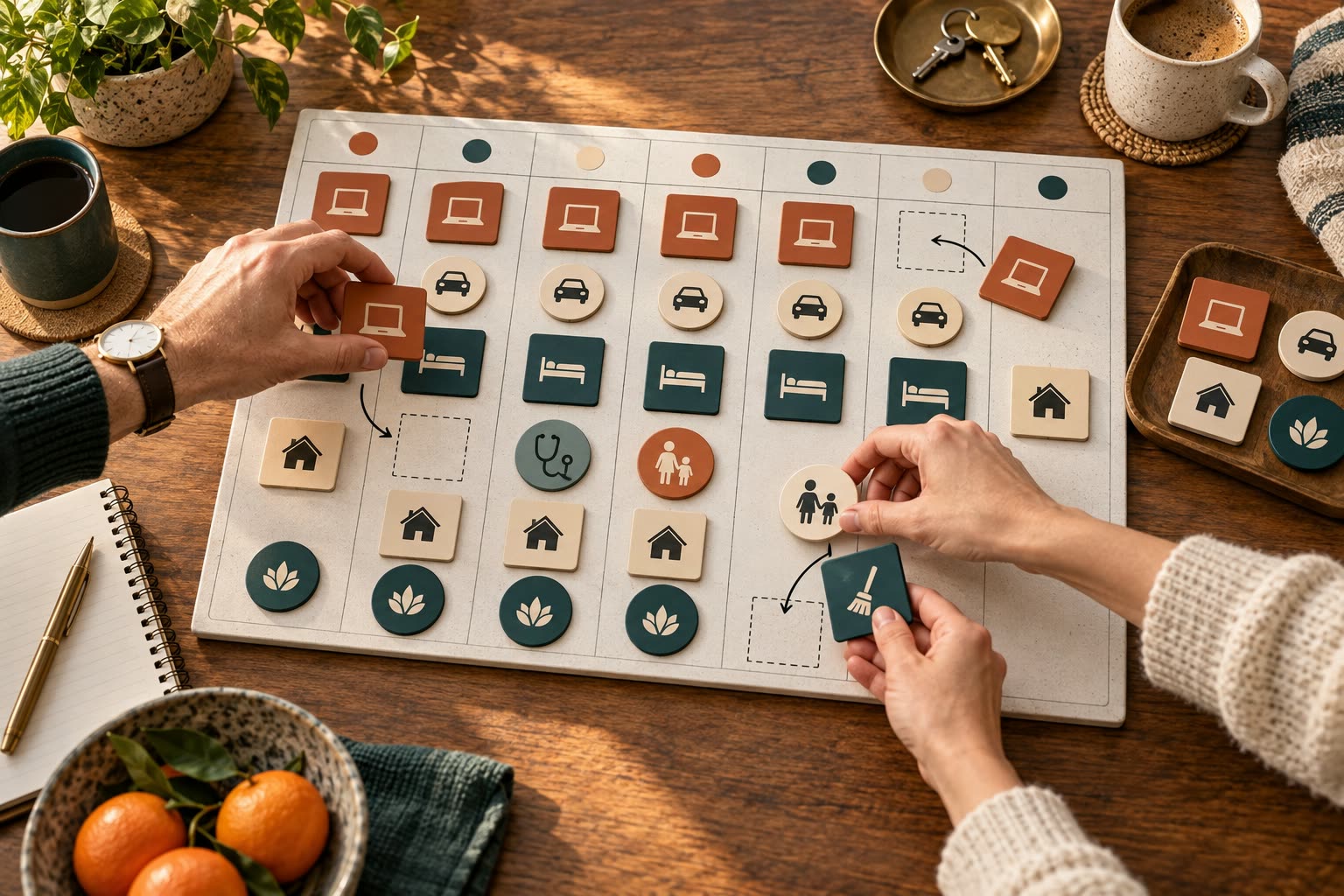
Applied to work and home, the order of the digits describes a household where the job comes first and the family gets what is left, with the 5 at the end asking for a changed arrangement. Long hours, a promotion that adds travel, or a new duty caring for a parent are the kinds of pressure this reading addresses.
The 5 is specific about the kind of answer: a changed input, not a resolution. Two protected evenings, a reassigned on-call rota or a written split of household tasks can be seen and checked, while a promise to be around more cannot.
| Pressure | Promise | Observable change |
|---|---|---|
| Work hours | I will be more present | Two evenings are protected and the on-call rule is reassigned |
| Household labor | I will help more | Tasks, standards, and ownership are written and divided |
| Caregiving | We will work it out | Appointments, transport, cost, and backup coverage have named owners |
| Money access | You do not need to worry | Both people can see the accounts, obligations, and review dates |
| Rest | I will slow down soon | One commitment is removed and recovery time appears on the calendar |
Some of the pressure sits outside the household, in an employer's shift pattern, a school timetable or a clinic's appointment hours. A change there needs the other party's agreement, which is why the right-hand column names who does what rather than what anyone intends.
Does the 8-before-6 order say anything about money and love?
On money, Walmsley's entry is reassuring. She writes that prayers about "your home and family life, as well as your monetary situation, have been heard" and asks readers to "release all fears of lack and loss as blessings are on their way". That is a devotional promise with no amount, date or source, and it cannot stand in for the rent figure or the repayment plan a worried household actually needs.
The digits frame a narrower money question: who earns (8), whom the income supports (6), and what has to change (5). In a household that means who can see the accounts, who can spend without asking, and what happens to the bills if the main earner falls ill or loses work.
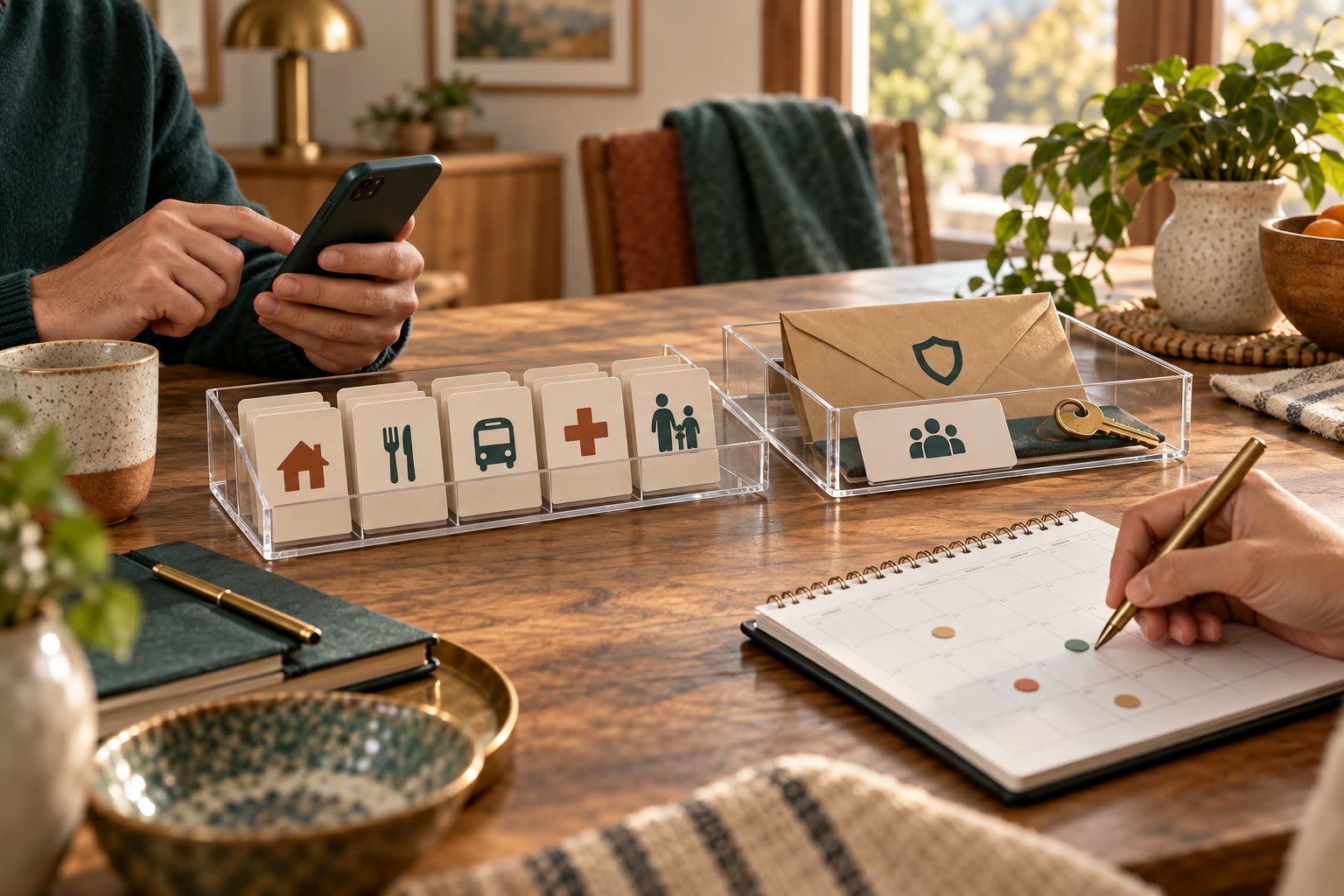
In a relationship, the same order describes one partner's income or authority organised around the other partner's home life. Walmsley's entry says nothing about romance or twin flames, and love readings of 86 that promise a reunion have no source in it. What the digits can frame is whether support comes with control: covering the rent while a partner retrains is care, while using that rent to decide whom they see is control.
Where money is withheld, spending is monitored or leaving feels unsafe, the situation calls for a local domestic-abuse service rather than an interpretation of a number.
Why do I keep seeing 86?
For some readers 86 is simply common. It is the international calling code for mainland China, so anyone who receives calls or messages from Chinese numbers sees +86 regularly, and in kitchens and bars the verb eighty-six is part of every shift.
Once a number has been linked with loss or money, attention picks it out. Psychologists call this selective attention, focusing on some stimuli while others are screened out, and it makes an 86 on a clock, a receipt or a number plate easier to spot than the numbers around it. A note of where each 86 appeared, kept alongside the days it did not, shows whether the repeated sightings gather around one worry or are scattered across ordinary places.
Is 86 a biblical angel number? What Psalm 86 asks for
The Bible does not treat 86 as a sign, and no angel appears in Psalm 86. The psalm is headed "A Prayer of David" and is the only psalm credited to David in Book III of the Psalter, Psalms 73 to 89. Greek and Latin Bibles, following the Septuagint and the Vulgate, number it 85.
Two verses explain why readers looking for signs find their way to it. Verse 11 asks, "give me an undivided heart to revere your name," and verse 17 asks, "Show me a sign of your favor." The psalmist asks God for that sign directly and does not say what form it will take. The psalm's number records its place in the collection, which is why Greek and Latin Bibles give the same prayer a different number, and neither numbering attaches a message to the digits 8 and 6.
Is 86 just 68 reversed, and how different are 85 and 87?
| Number | Sum and root | What the order describes |
|---|---|---|
| 86 | 8 + 6 = 14, root 5 | Money and authority placed before the household, ending on change |
| 68 | 6 + 8 = 14, root 5 | The household first, then the money or authority it calls for |
| 85 | 8 + 5 = 13, root 4 | A change in money or position that has to settle into a routine |
| 87 | 8 + 7 = 15, root 6 | A success examined before it reaches other people |
| 5 | Single digit | Change and freedom without the money-and-home story of 86 |
The closest comparison is 68, which shares every number in the calculation. In 68 the household comes first and money follows from it; in 86 money comes first and the question is what it does for the home. 85 starts from the same 8 but ends on 4, the digit of routine, so its change has to become a structure.
Eighty-six also differs from 87 in where the calculation lands. Both begin with 8, but 87 adds up to 6 rather than 5, so its reading ends on responsibility to other people instead of on change.
Frequently Asked Questions
Does seeing 86 mean I will lose something?
Not according to the reading the idea comes from. Joanne Walmsley's 2011 entry says a possession is "due to leave" but adds that "it will be your choice as to whether you wish to part with it or not"; nothing about 86 predicts theft, breakage or loss.
Is 86 a karmic number?
Not in itself. Its first total, 14, is one of Hans Decoz's four karmic debt numbers, and Decoz weighs that debt mainly through the core numbers of a birth chart, such as the Life Path. He says nothing about numbers a person only notices in daily life.
Does 86 mean money is coming?
Walmsley writes that "blessings are on their way", but her entry gives no amount or date and reports no cases. Nothing about 86 shows that money is on its way to a particular person.
Why does 86 mean to get rid of something?
That is American slang, recorded from 1942, for refusing service, taking an item off a menu or getting rid of something. Merriam-Webster judges rhyming slang for nix the most probable origin; the slang has no known link to angel numbers.
Sources
- (2011). Angel Number 86. Sacred Scribes, July 15, 2011. Link
- (n.d.). Karmic Debt Numbers. World Numerology. Link
- (n.d.). Karmic Debt Number 14. World Numerology. Link
- (n.d.). Numerology Meaning of Number 5. World Numerology. Link
- . Eighty-six: Definition and Word History. Merriam-Webster.com Dictionary. Link
- (2026). Telephone numbers in China. Wikipedia, country code 86. Link
- (2018). Selective attention. APA Dictionary of Psychology. Link
- (2021). Psalm 86:11, 17. Bible Gateway. Link
- (2026). Psalm 86. Wikipedia, attribution, Book III and Septuagint numbering. Link
About Our Editorial Process
Every KnowTheAngels guide separates calculation method, tradition context, and personal reflection. We cite where interpretations come from, present more than one view, and never present symbolic reading as prediction.
Read our editorial policy