What Do Repeating Ones Mean, and How Do 1, 11, 111, and 1111 Differ?
What Joanne Walmsley and Doreen Virtue say about 1, 11, 111 and 1111, why each run of ones reduces to its own length, and when 11 counts as a master number
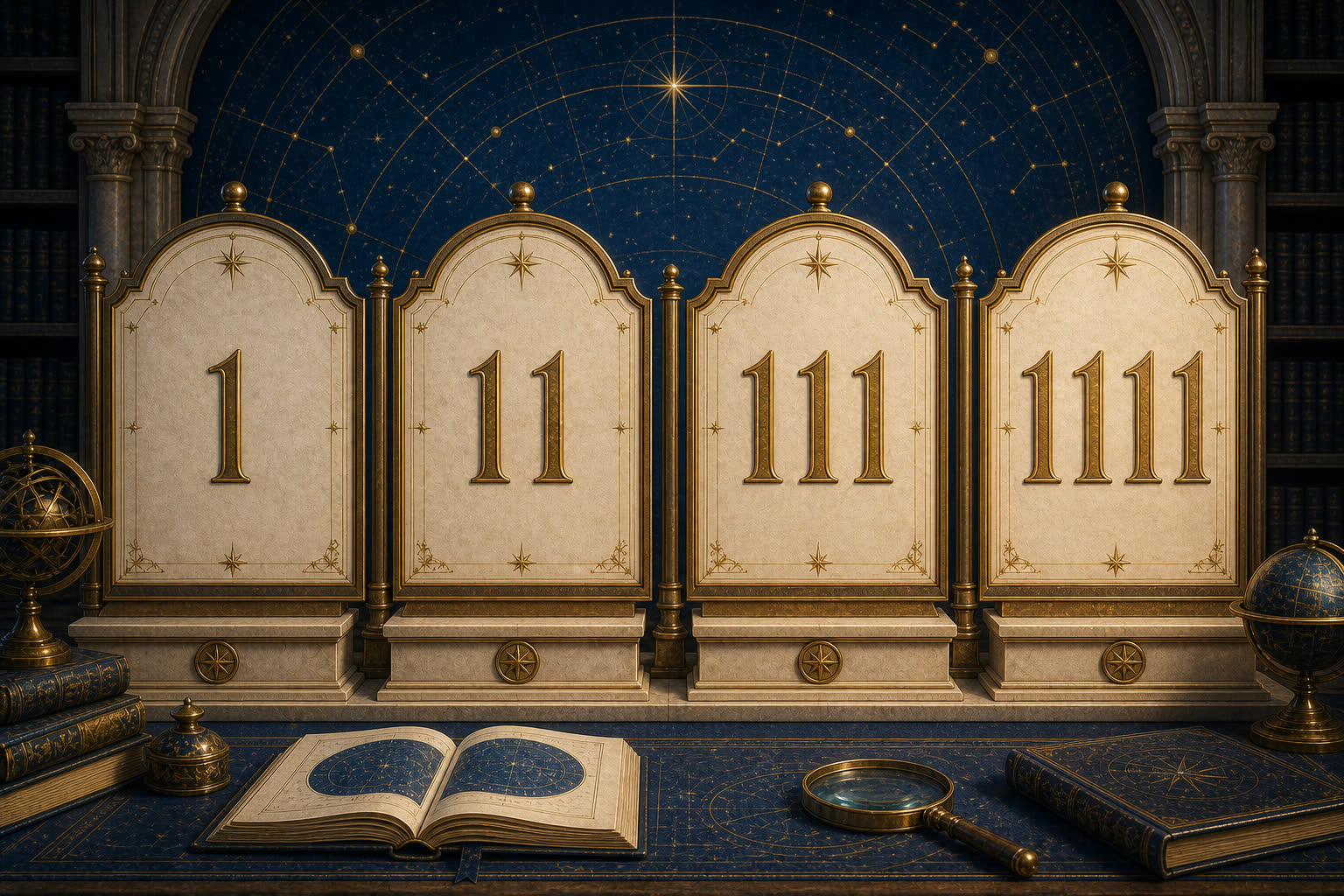
Repeating ones are 11, 111, 1111 and longer runs of the digit 1, and readers usually want to know whether the extra ones change anything. Numerology.com describes the single 1 as "a symbol of independence, confidence, and new beginnings", and every longer run starts from that digit.
Two layers answer the question differently. The angel-number layer, from Doreen Virtue's list of number sequences (1999) and Joanne Walmsley's Sacred Scribes posts, attaches the same instruction to every run: watch your thoughts. The numerology layer adds the digits, and because a run of ones adds up to its own length, 11, 111 and 1111 land on three different roots.
Quick Facts
- Digit sums
- 11 to 2; 111 to 3; 1111 to 4; nine 1s to 9
- Single 1 in numerology
- Independence, confidence and new beginnings (Numerology.com)
- Angel-number reading
- Watch your thoughts; they are taking form (Virtue 1999; Walmsley 2010)
- Is 11 a master number?
- In some chart calculations; not on the clock, says Numerology.com
- On the clock
- 1:11 and 11:11, each twice a day on a 12-hour display
Do 1, 11, 111 and 1111 carry different angel-number messages?
Mostly not. Joanne Walmsley's post on repeating 1s, published in August 2010, gives the single 1 the instruction "to watch your thoughts and focus upon your positive desires, rather than your negative fears". For 111 she writes "monitor your thoughts carefully and be sure to only think about what it is you really want", and for 1111 that "the Universe has just taken a snapshot of your thoughts and is manifesting your ideas into material form". Doreen Virtue's entry for 111 makes the same point, that thoughts are "manifesting into form at record speeds".
The pair, 11, is the one run she treats differently. Walmsley calls it "a 'karmic', Master Number" and ties it to intuition and "spiritual enlightenment", though even there she asks readers to pay attention to their repetitive thoughts. For the longer runs only the image changes: 111 is a thought to monitor and 1111 the flash of a camera catching thoughts in a snapshot. She also writes that 1111 "is most often the first sequence that appears to many people", after which other number sequences follow.

Why does each run of ones reduce to its own length?
Adding the digits of a run of ones simply counts them. Two 1s add to 2, three to 3 and four to 4, so up to nine ones the root of a run is its length, and nine 1s reduce to 9. The tenth 1 makes the sum 10, which reduces to 1, and the cycle starts again. Runs of ones therefore pass through every root in counting order, which no other repeated digit does: runs of fours reach all nine roots in the order 4, 8, 3, 7 and onward, while threes, sixes and nines stay inside 3, 6 and 9.
| Run | Digit sum | Root | Numerology.com on the root |
|---|---|---|---|
| 1 | 1 | 1 | Independence, confidence and new beginnings |
| 11 | 2 | 2, or master 11 in a chart | Partnership and balance, reached through diplomacy |
| 111 | 3 | 3 | "A communicator through and through" |
| 1111 | 4 | 4 | Practicality, hard work, discipline and responsibility |
Read with its root, each longer run carries the beginning of the 1 into a new setting: 11 toward another person, 111 toward something said or shown, and 1111 toward the structure that has to hold the start up. None of the three is a stronger 1, and a reading that treats 1111 as a louder 111 skips the sum that separates them.
When does 11 count as a master number, and when does it reduce to 2?
Only inside a chart. Numerology.com keeps 11, 22 and 33 as master numbers in particular chart positions: core numbers such as the Life Path and Birthday numbers, numbers derived from a name, and the Period, Pinnacle and Essence cycles. Master numbers "are never used when calculating either a Universal or Personal Year, Month, or Day number", which always reduce to one digit. The rules for master number 11 belong to those calculations.
The same source turns to the clock directly. Of the minute 11:11, which a 12-hour display shows twice a day, it says that a single minute is "too short-lived and widespread to affect us on the level that a true Master Number would." Walmsley's post takes the other side, calling 11 a master number with no calculation behind it.
The difference matters for ordinary sightings. A birth date that totals 11 under a method that keeps master numbers can be written as 11, while another method that reduces every total continues to 2. An apartment numbered 11 or a receipt for 11.00 has passed through no calculation at all, so calling it a master-number result depends on following Walmsley rather than the chart rules.
Do more ones make the message stronger?
Neither layer says so. The angel-number entries repeat one instruction at every length, and numerology moves the root with each added 1 rather than intensifying it. Length does change how noticeable a number is: a 12-hour clock shows 1:11 and 11:11 twice a day each, and four identical digits on a receipt or a licence plate stand out in a way that 1,284 does not.
Research on coincidences describes how that noticing turns into a question about causes. In a 2020 paper in Cognitive Psychology, Mark Johansen and Magda Osman define coincidences as surprising repetitions that look unlikely by chance but are put down to chance because no more plausible cause has been found, and they argue that judging something a coincidence flags a possible unknown cause. Their experiments used coincidences people recorded in diaries and did not test any angel-number meaning. Frequency also needs a denominator. Three sightings across a day of checking clocks, invoices and account screens differ from three sightings in a week when few numbers were in view.
What can a reader note after seeing 1, 11, 111 or 1111?
Used as prompts, the four roots follow a single start through its first stages: the 1 asks what is beginning, the 11 who else it involves, the 111 whether it has been said aloud or shown to anyone, and the 1111 what will support it. A number journal with the setting written beside each sighting shows whether the same start keeps coming up or whether unrelated moments have been grouped together.
Frequently Asked Questions
Why does 111 reduce to 3?
Because 1 + 1 + 1 = 3. A run of ones adds up to its own length, so 11 reduces to 2, 111 to 3 and 1111 to 4, and the pattern holds until nine 1s reach 9.
Is 11:11 the same as 1111?
The digits are the same and both add to 4, but the clock form is read differently: each half is 11, and the halves add to 22. Numerology.com treats the minute as too brief to act as a master number.
Are repeating ones a sign of manifestation?
That reading comes from Virtue and Walmsley, who tie every run of ones to thoughts taking form. It is an instruction to watch one's thoughts, and neither writer offers a way to test the claim that a wish is coming true.
Sources
- (n.d.). Number 1 Meaning in Numerology. Numerology.com. Link
- (n.d.). Number 2 Meaning in Numerology. Numerology.com. Link
- (n.d.). Number 3 Meaning in Numerology. Numerology.com. Link
- (n.d.). Number 4 Meaning in Numerology. Numerology.com. Link
- (n.d.). Master Numbers 11, 22, and 33. Numerology.com (chart positions that keep master numbers; 11:11 on the clock). Link
- (2010). Angel Numbers - Number Sequences - Repeating 1's 1 11 111 1111. Sacred Scribes, posted August 26, 2010. Link
- (2008). Number Sequences from the Angels. Spirit Library, posted August 18, 2008, excerpt from Healing with the Angels (entries for 111, 666, 6's and 9's, 8's and 9's). Link
- (1999). Healing with the Angels: How the Angels Can Assist You in Every Area of Your Life. Hay House, Carlsbad, CA, 1999 (ISBN 1-56170-640-X); Open Library record. Link
- (2020). Coincidence judgment in causal reasoning: How coincidental is this?. Cognitive Psychology 120:101290. Link
About Our Editorial Process
Every KnowTheAngels guide separates calculation method, tradition context, and personal reflection. We cite where interpretations come from, present more than one view, and never present symbolic reading as prediction.
Read our editorial policy