What Does the Reversed Clock Pattern 12:21 Mean?
A palindrome of 12:12's digits: 6 from the digits and master number 33 from the halves, Cheiro's Sacrifice and Crown of the Magi, and the angel Haamiah on the French lists
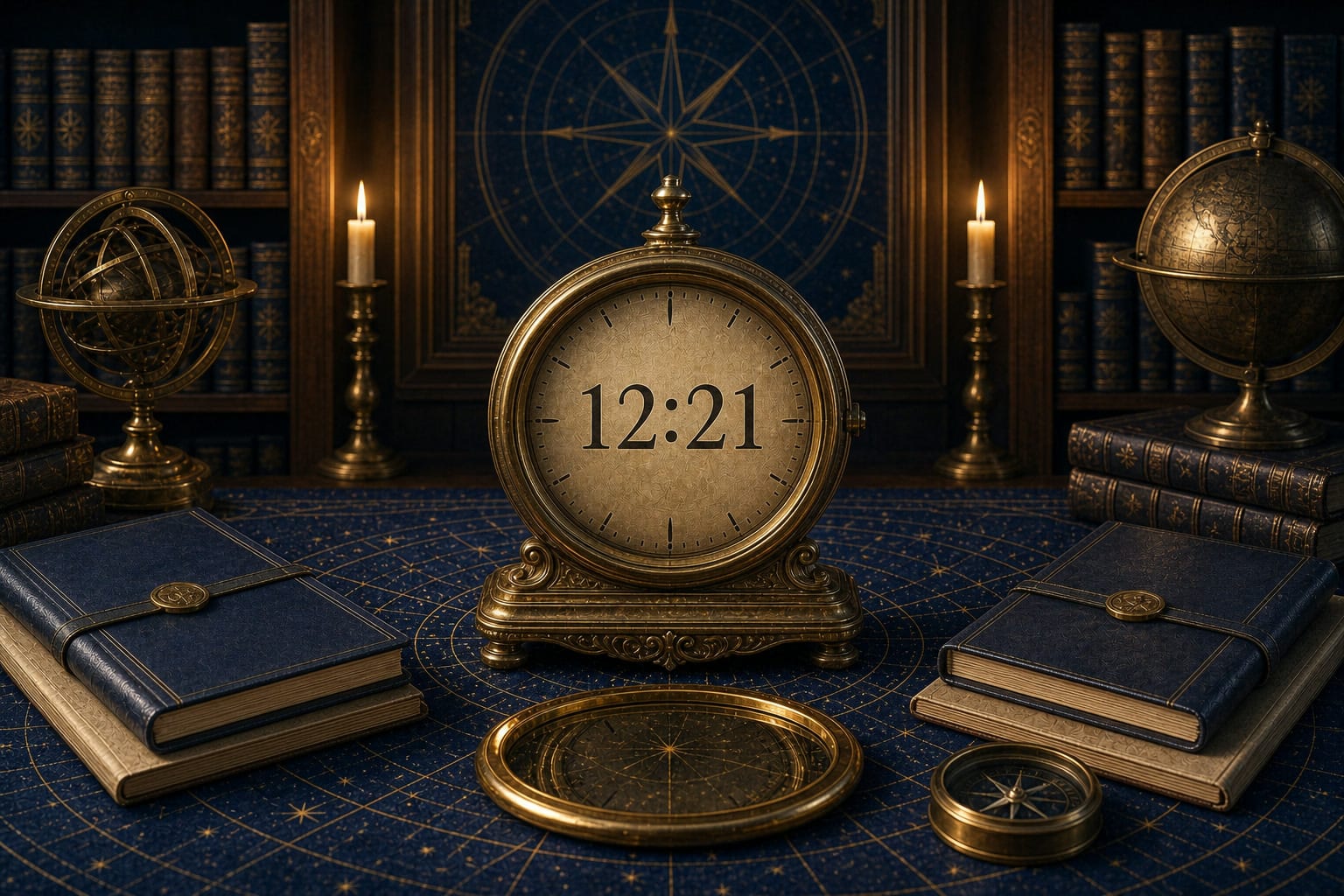
12:21 reads the same backwards and forwards: 1-2-2-1. It uses the same four digits as 12:12, but its minute reverses the hour instead of repeating it, and French mirror-hour writers put such times in a group of their own, the heures inversées or reversed hours. Jade Nohemia's 2026 guide draws the contrast this way: double hours such as 11:11 "call", while a reversed hour is "a reply: a message coming back, a loop closing".
Numerology reaches one root by two routes. The digits add to 6 (1 + 2 + 2 + 1), the number Numerology.com ties to "the ability to support, nurture, and heal", and the halves add to 33 (12 + 21), a master number that reduces to 6 in turn. The compound numbers 12 and 21, the tarot cards that share their numbers, and the angel the French lists assign to the minute add three more layers, each from its own source.
Quick Facts
- Pattern
- Palindrome 1-2-2-1, a reversed hour
- Digit total
- 1 + 2 + 2 + 1 = 6
- Halves added
- 12 + 21 = 33, a master number, then 6
- Compound numbers
- 12, Cheiro's Sacrifice; 21, his Crown of the Magi
- Mirror-hour angel
- Haamiah (12:20 to 12:40)
- On a 24-hour clock
- Midday only; the night minute reads 00:21
Is 12:21 a mirror hour or a reversed hour?
Mirror hours in the strict sense repeat the hour in the minutes, as 12:12 does. 12:21 belongs to the reversed hours, whose minutes give the hour's digits in reverse order. A 24-hour clock has 16 palindromic times, and leaving out 00:00 and the doubles 11:11 and 22:22 leaves 13 reversed hours, from 01:10 to 23:32; Nohemia's list gives the same 13. Two of them use only the digits 1 and 2: 12:21 and its partner 21:12, which comes round just under nine hours later.
Both groupings are a modern convention of French heures miroirs writing, which Nohemia's guide presents as an older number grammar handed "a new stage" by the digital clock. The palindrome exists only on a four-digit display, so the reversed-hour label describes how these sites sort the minutes, not an older teaching about them.
What is the numerology reduction of 12:21: 6 or 33?
Every standard route through 12:21 ends at 6, and one of them passes through a master number on the way.
| Route | Calculation | Result |
|---|---|---|
| Four digits | 1 + 2 + 2 + 1 | 6 |
| Halves added | 12 + 21 = 33, then 3 + 3 | 33, then 6 |
| Each half reduced | 1 + 2 = 3 and 2 + 1 = 3, then 3 + 3 | 6 |
The middle route is where 12:21 parts from 12:12. The halves of 12:12 add to 24, an ordinary number, while the halves of 12:21 add to 33, one of the three master numbers Hans Decoz recognizes. Decoz calls 33 "the Master teacher and the most spiritually evolved of all numbers", and French writers on 12:21, among them Astroya and Victoria Chevalier of Carré d'info, read it as a second layer beside the 6. Numerologists who hold master numbers unreduced stop at 33 and those who reduce fully arrive at 6, so the two readings differ in emphasis and share one root.
The root itself is the number of care. Numerology.com describes the 6 as "unconditional love and the ability to support, nurture, and heal", and Decoz calls it the motherhood/fatherhood number, "all about sacrifice, healing, protecting, and teaching others". Both routes through 12:21 therefore point to responsibility for other people, and the 33 adds Decoz's teaching role to it.
Why do 12 and 21 pull in opposite directions in the tarot and in Cheiro?
Read as compound numbers, the two halves of 12:21 come from opposite ends of Cheiro's scale. In his Book of Numbers, published in London in the 1920s, 12 is "the Sacrifice" or "the Victim", a number that "foreshadows one being sacrificed for the plans or intrigues of others", and 21 is "the Crown of the Magi", a number of "advancement, honours, elevation in life, and general success" reached "only after long initiation and tests of determination". Cheiro held that these meanings were first given in pictures that survive in the tarot, and he describes 21 by "the picture of 'the Universe'", the last numbered trump, which A. E. Waite's 1910 deck calls the World. Card XII in the same series is the Hanged Man, so the tarot runs the two halves of 12:21 from a figure hanging upside down to the card that closes the series.
French reversed-hour writers turn that contrast into a story. Resfmiroir (2024) reads 12 as "the complete cycle" and 21 as "accomplishment", so the minute is taken as a cycle that closes on a result. The angel-number compounds give a quieter version: 12 puts initiative (1) before partnership (2), 21 puts partnership before initiative, and in 12:21 the first order is answered by the second.
Neither layer names a particular sacrifice or reward. Cheiro applied his compound numbers to names and dates, so applying them to a minute that every clock shows each day is a modern extension. Inside numerology the sacrifice theme returns through the root: Decoz's phrase for the 6, "all about sacrifice", echoes Cheiro's 12.
Haamiah or Aniel: which angel do the lists give 12:21?
The French lists give 12:21 to Haamiah. The twenty-minute rota that follows Lazare Lenain's 1823 order of the 72 Kabbalistic angel names assigns 12:20 to 12:40 to the 38th name, Haamiah, and both Astroya and Carré d'info (February 2026) name him for this minute. Astroya calls Haamiah the "gardien de la vérité", the guardian of truth, and reads his message at 12:21 as a caution against hidden intentions and false appearances; Heure-Miroir.eu lists his themes as "rituels, vérité, amour divin" (rituals, truth, divine love).
Because the rota changes angel every twenty minutes, 12:12 and 12:21 fall on either side of a boundary: 12:12 sits in Aniel's slot, 12:00 to 12:20, and 12:21 in Haamiah's. The assignment follows the rota's arithmetic and not the digits, so at 12:19 the same lists name Aniel.
Does 12:21 mean a twin flame or someone thinking of you?
Some reversed-hour sites say so. Resfmiroir writes that 12:21 "could be a sign that you are about to meet your twin flame, or that your current relationship is about to move to the next level", and Astroya reads the minute as a relationship looking for balance between what each person gives and receives. Both are modern spiritual interpretations, and neither cites an older source for tying a clock time to a particular person.
The numerology behind these twin-flame and relationship readings is narrower. The 6 concerns care and shared responsibility, and the 1-2-2-1 order places two 2s, the partnership digit, between two 1s, so the reading fits a question about whether care in a relationship runs both ways. It carries no information about another person's feelings, about whether a meeting will happen, or about whether to stay in or leave a relationship; those depend on what the people involved say and do.
Why do I keep seeing 12:21 around midday?
12:21 comes round at the same point in the day, so anyone with a fixed routine meets it often. A 12-hour clock shows it twice, twenty-one minutes after noon and after midnight. A 24-hour clock shows the night-time minute as 00:21, so there 12:21 is a midday reading, at the time many people stop for lunch.
Memory does the rest. Arnold Zwicky's term "frequency illusion" names the sense that something noticed once is suddenly everywhere, and Michael Shermer's "patternicity" is the wider tendency to find meaningful patterns in meaningless noise. A palindrome is easy to spot, so 12:21 is remembered where 12:23 is forgotten, although each minute comes round exactly as often.
Frequently Asked Questions
What does 12:21 mean spiritually?
French reversed-hour writers read it as a cycle closing on a result, building on Resfmiroir's readings of 12 as "the complete cycle" and 21 as "accomplishment". Numerology adds care (6) and the master number 33. Neither layer shows that the minute carries a message.
Is 12:21 a mirror hour?
Strictly, no. Mirror hours repeat the hour in the minutes; 12:21 reverses it, and the French lists call it a reversed hour (heure inversée). Both groupings are modern conventions.
What is the difference between 12:12 and 12:21?
Both use the digits 1 and 2 twice and reduce to 6. 12:12 repeats 12, so its halves add to 24; 12:21 reverses it, so its halves add to the master number 33. The angel lists split them too, giving 12:12 to Aniel and 12:21 to Haamiah.
Which angel is linked to 12:21?
Haamiah, the 38th of the 72 Kabbalistic names in Lazare Lenain's 1823 order, whose twenty-minute slot on the French rota runs from 12:20 to 12:40.
Does 12:21 mean someone is thinking about me?
No clock time can show what another person thinks or feels. The 6 in 12:21 concerns care running both ways, which is a question about the relationship as it already stands.
Sources
- (2026). Reversed Mirror Hours: 01:10, 12:21 and the Rest. Nohemia, June 10, 2026, updated June 24, 2026. Link
- (n.d.). Number 6 Meaning in Numerology. Numerology.com. Link
- (n.d.). Numerology Meaning of number 6. World Numerology. Link
- (n.d.). Master Numbers 11, 22 and 33. World Numerology. Link
- (n.d.). 12h21 : signification de cette heure inversée. Astroya.fr (Haamiah, 12h20 to 12h40; 12 + 21 = 33). Link
- (2026). 12H21 signification : heure miroir inversée, message et véritable interprétation. Carré d'info, February 23, 2026. Link
- (c. 1926). Cheiro's Book of Numbers. Herbert Jenkins, London; the tarot pictures and compound numbers 12 and 21 on pp. 80-82 of the scanned edition. Link
- (1910). The Pictorial Key to the Tarot. William Rider & Son; Part II, cards XII (The Hanged Man) and XXI (The World); Project Gutenberg. Link
- (2024). 12:21 p.m.: Decoding the messages hidden behind this time. Resfmiroir, October 25, 2024. Link
- (2026). Lazare Lenain. Wikipédia (French), on La Science cabalistique (1823) and its 72 twenty-minute divisions. Link
- (n.d.). Les 72 Anges Gardiens Kabbalistiques : liste complète. Order of the 72 names, Aniel 37th and Haamiah 38th. Link
- (2019). Frequency illusion in the OED. Language Log account of Arnold Zwicky's 2005 term and the Oxford English Dictionary definition. Link
- (2008). Patternicity: Finding Meaningful Patterns in Meaningless Noise. Scientific American. Link
About Our Editorial Process
Every KnowTheAngels guide separates calculation method, tradition context, and personal reflection. We cite where interpretations come from, present more than one view, and never present symbolic reading as prediction.
Read our editorial policy