111 vs 1111: Different Meanings or the Same Repeating Ones?
Shared ones, different digit totals, and overlapping manifestation readings.
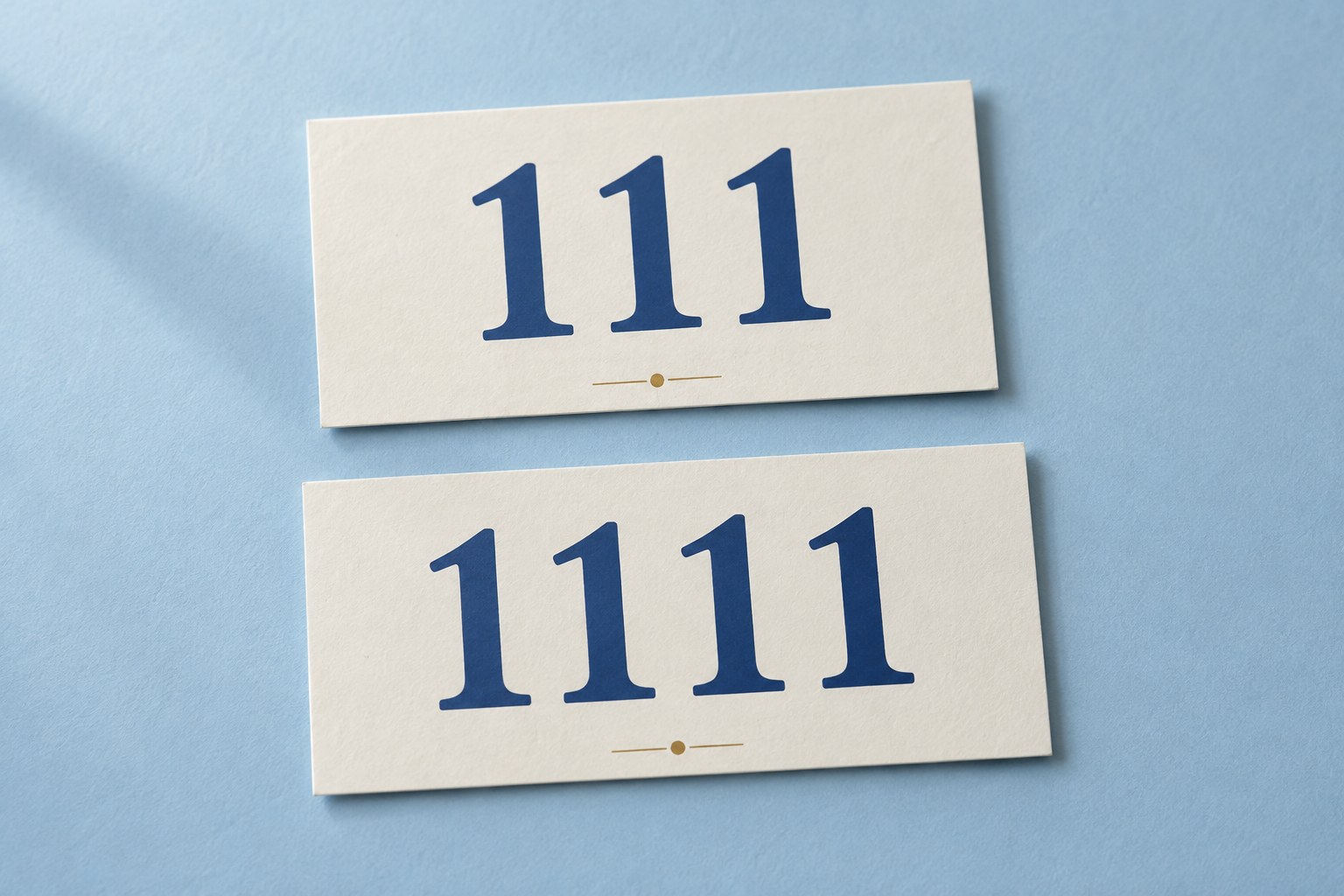
The clearest difference between 111 and 1111 is mathematical: three ones add to 3, and four ones add to 4. The interpretation changes with the method, so their shared digit and different totals need separate explanations.
In modern angel-number writing, authors can give the two sequences separate entries while attaching similar thought-focused interpretations to both.
That overlap leaves no established rule that 111 calls for one small action while 1111 requires a review of every part of life. The comparison below separates the calculations, the authors' claims, and the clock formats that can make the two sequences seem interchangeable.
Quick Facts
- Repeated digit
- 1 in both sequences
- Digit totals
- 111 = 3; 1111 = 4
- Pair-grouping alternative
- 11 + 11 = 22, with a single-digit root of 4
- Clock forms
- 1:11 and 11:11; a leading zero changes the display
- Claim boundary
- Interpretation is not evidence of manifestation speed
What changes when 111 gains a fourth 1?
111 and 1111 belong to the same repeating-ones pattern, but the extra digit changes their total. Treating both as simply a louder version of 1 misses that numerical difference.
Hans Decoz's single-digit account describes 1 through independence, initiative, and the drive to begin. Those associations explain why a beginning appears in readings of both sequences, rather than belonging exclusively to the shorter one.
A reading of angel number 111 may develop the expression associated with its total of 3. A reading of angel number 1111 can instead develop the discipline associated with its total of 4.
The move from expression to structure is an interpretation of the totals. It does not measure the size of a person's problem, establish which sequence arrived at the right moment, or make four ones a superior sign.
One occurrence of 1111 contains more digits than one occurrence of 111, but it remains one occurrence, so sequence length does not establish how often a message has been repeated.
Why does 111 total 3 while 1111 can be read as 4 or 22?
Straight digit addition gives 1 + 1 + 1 = 3 and 1 + 1 + 1 + 1 = 4. Both totals are already single digits, so neither needs a second reduction step.
| Input and rule | Working | Result |
|---|---|---|
| 111: add each digit | 1 + 1 + 1 | 3 |
| 1111: add each digit | 1 + 1 + 1 + 1 | 4 |
| 1111: split into two pairs, then add | 11 + 11 | 22 |
| Reduce the pair total to one digit | 2 + 2 | 4 |
The table separates two operations that are often treated as the same calculation. Adding the digits never produces 22; grouping 1111 into two eleven-valued parts does.
Whether 22 stays whole depends on the numerology rule being used. Decoz's master-number account limits the special status of 11, 22, and 33 to core positions in a personal chart, such as a Life Path or Expression number.
An observed 1111 on a receipt does not supply a birth date, full name, or chart position. Splitting that label into two 11s can be a symbolic reading, but it does not establish that its observer has master number 11 or master number 22 in their chart.
This distinction matters when an explanation calls 1111 a Master Builder sign. In Decoz's system, the Master Builder label belongs to 22 in the relevant chart context, rather than automatically to every four-one sighting.
Numerology.com associates 3 with communication and creative expression, while its account of 4 stresses practicality, work, discipline, and responsibility. These are interpretive portraits of the totals, not a sequence of events that must happen to the observer.
For example, a new project could involve both describing an idea and arranging the time to complete it. Calling the first concern a 3 theme and the second a 4 theme is an editorial application of those portraits; the arithmetic itself does not select one task or prescribe a schedule.
Do 111 and 1111 carry different manifestation promises?
Doreen Virtue's entry for 111 in “Number Sequences from the Angels” connects the number with thoughts taking form quickly. The introduction gives both 1:11 and 11:11 as clock examples of encountering the pattern, so her account does not draw a strict boundary between the two displays.
Joanne Walmsley's dedicated 1111 entry describes 1 as amplified four times and uses gateway, awakening, and snapshot-of-thoughts language. Her framing gives the four-digit sequence a separate entry, while retaining much of the thought-focused subject associated with 111.
Both accounts therefore support overlapping manifestation interpretations. Their language does not supply a controlled comparison of how quickly wishes associated with 111 or 1111 come true.
What the two manifestation accounts establish
What the evidence supports
- Named belief
Virtue connects 111 with thoughts taking form; Walmsley gives 1111 an amplified-1 reading.
- Overlapping examples
Virtue's introduction includes 1:11 and 11:11 rather than reserving the longer display for a different life task.
What remains limited
- Relative strength
Neither cited account establishes that one sequence produces better or faster outcomes.
- Required response
The distinction between one action and a whole-life review does not follow from the quoted clock examples or digit addition.
Walmsley's use of “amplified” describes her interpretation of repetition; it does not quantify a force or demonstrate that another digit improves an outcome.
A manifestation reading can carry personal significance without becoming evidence that a job offer, relationship, or payment is imminent. Those outcomes require information about the people, agreements, and events involved, which neither sequence contains.
Is seeing 1:11 different from seeing 11:11?
On a 12-hour clock, 1:11 and 11:11 each occur twice per day. The longer-looking time is not less available on that display, although a person's routine may expose them to one more often than the other.
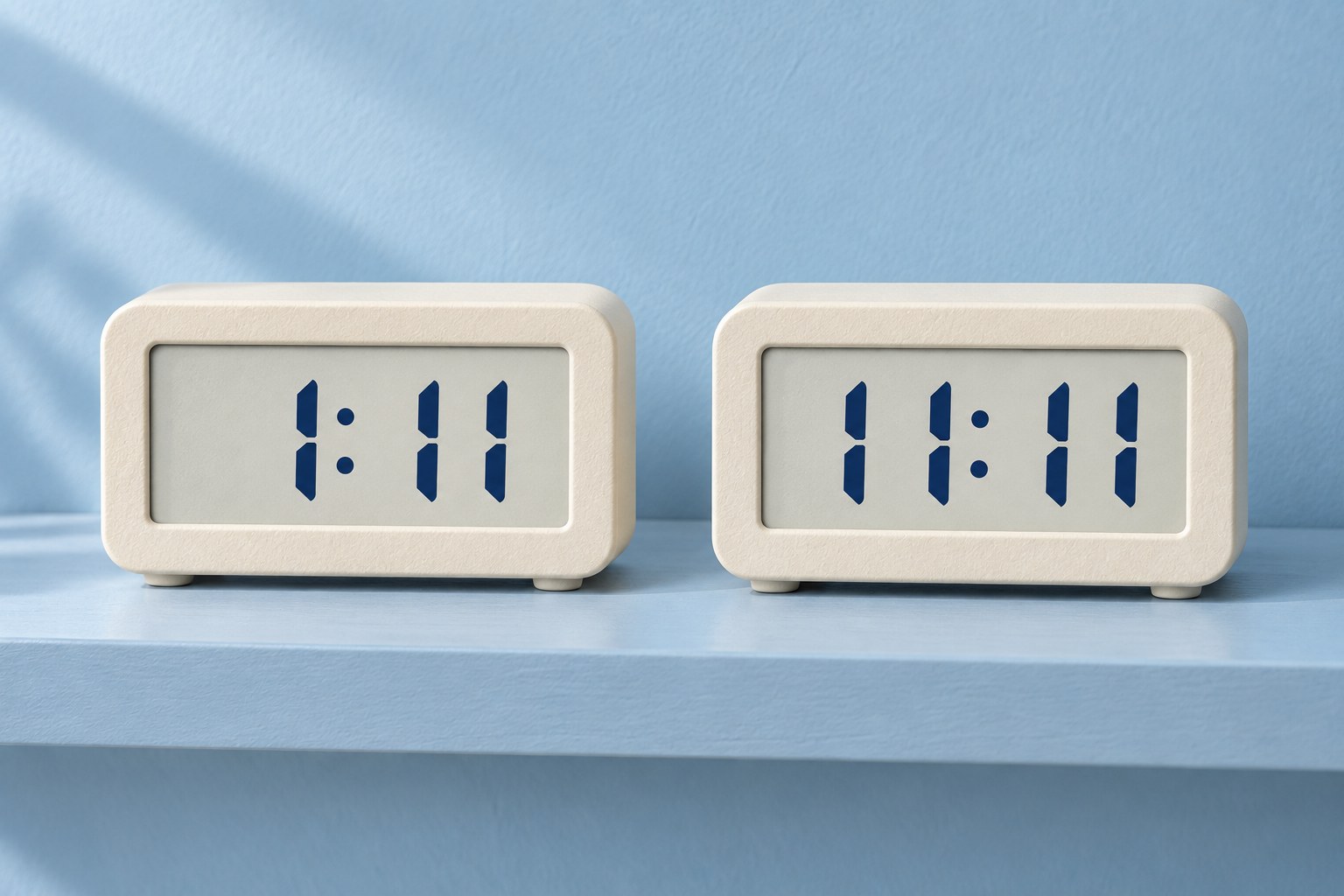
The hour creates the visible difference: 1:11 has three ones, and 11:11 has four. With the colon removed, the first resembles 111 and the second resembles 1111.
A leading zero complicates that identification. The time 01:11 is the same hour and minute as 1:11, yet its written form is 0111 rather than 111.
| Displayed time | Digits without the colon | Sum of all displayed digits |
|---|---|---|
| 1:11 | 111 | 1 + 1 + 1 = 3 |
| 01:11 | 0111 | 0 + 1 + 1 + 1 = 3 |
| 11:11 | 1111 | 1 + 1 + 1 + 1 = 4 |
Padding changes the visible sequence but not the total in this example, because adding zero leaves the sum unchanged. Counting four display characters as four ones would produce the wrong result for 01:11.
The 11:11 mirror time also repeats the hour as the minute, giving it a visual relationship that 1:11 lacks. A mirror-time interpretation concerns that hour-minute pairing; a whole-number interpretation concerns the digit sequence after the separator is removed.
An appointment at 1:11 and a regular late-morning phone check can account for different exposure to these minutes. An account of how often each was noticed would need those opportunities as well as the memorable sightings; recalling only the matches cannot establish which pattern occurs unusually often.
What if 111 and 1111 appear around the same decision?
Seeing both sequences does not require choosing which one overrules the other. Their shared ones and different totals can supply two symbolic perspectives, but neither identifies the decision's correct outcome.
In a hypothetical work example, someone notices 111 while preparing a proposal and 1111 while arranging its delivery. The expression associated with 3 could describe the proposal's wording, while the discipline associated with 4 could describe the time and resources needed to complete it.
That comparison is useful only as a reflection on those actual concerns. The sightings do not prove that the proposal will be accepted, and their order does not establish a spiritual progression from starting to succeeding.
The same boundary applies to relationships. A 3-themed reading might focus on an unspoken conversation, while a 4-themed reading might focus on keeping an agreement; neither number reveals another person's feelings or confirms a destined partnership.
Where a reader interprets both as manifestation numbers, the named writer's method explains the overlap better than a hierarchy of power. Different authors can emphasize thoughts, awakening, expression, or structure without creating a shared rule that one sequence replaces the other.
The practical distinction remains in the situation itself: unclear wording requires a different response from an unworkable timetable. Evidence about the wording or timetable can resolve that difference, whereas the extra 1 cannot.
Sources
- (n.d.). The Numerology Meaning of Single Digit Numbers 1–9. World Numerology, section on 1. Link
- (n.d.). Master Numbers 11, 22, 33. World Numerology, core-number rule and 22 discussion. Link
- (n.d.). Number 3 Meaning in Numerology. Numerology.com, expression and communication. Link
- (n.d.). Number 4 Meaning in Numerology. Numerology.com, practicality and discipline. Link
- (2008). Number Sequences from the Angels. Spirit Library, August 18, 2008, introduction and entry 111. Link
- (2025). Angel Number 1111. Sacred Scribes, first posted 2012, revised November 8, 2025. Link
About Our Editorial Process
Every KnowTheAngels guide separates calculation method, tradition context, and personal reflection. We cite where interpretations come from, present more than one view, and never present symbolic reading as prediction.
Read our editorial policy