What Does Seeing 15:15 Mean for Emotional Balance?
How 15:15 reduces to 6 and to 3, where the Ariel and Devil-card readings come from, and why its love readings disagree
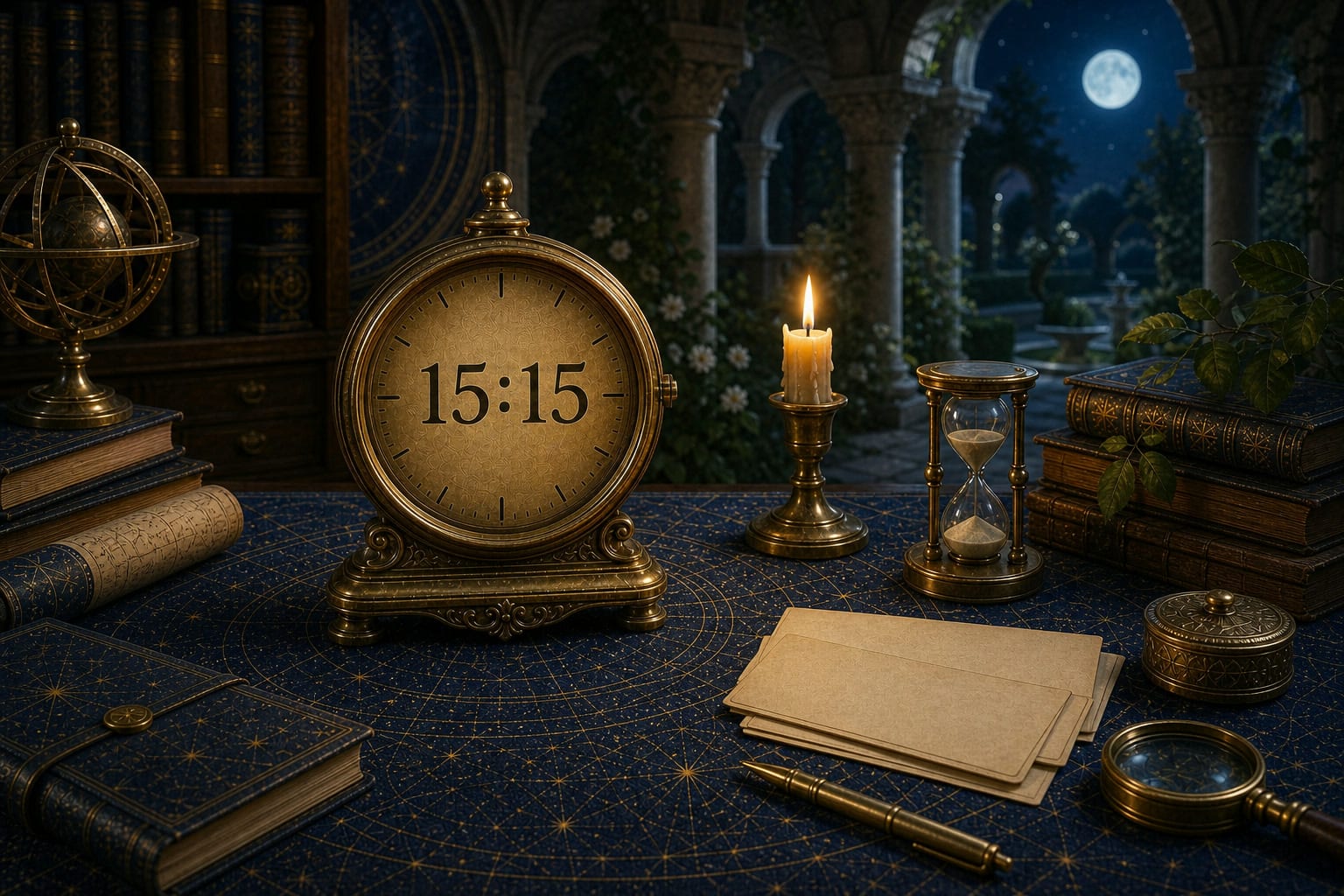
15:15 is a mirror hour only on a 24-hour clock; a phone set to 12-hour time shows the same moment as 3:15 p.m. Its spiritual meanings come from mirror-hour lists, the French heures miroirs, which write the time as 15h15.
Two separate readings meet in it. Numerology reduces each 15 to 6, which Hans Decoz calls the most harmonious number and links with care, and the full display to 3, the number of expression. The mirror-hour lists add the angel Ariel and tarot card XV, The Devil, and read the hour as one of passion and desire.
Angel Number 15 covers the number on its own, away from the clock. Each meaning of the clock time can be traced to a named system, and none of them turns a glance at a clock into a message.
Quick Facts
- Display
- 15:15 on a 24-hour clock; 3:15 p.m. on a 12-hour clock
- Each half
- 1 + 5 = 6
- Whole display
- 1 + 5 + 1 + 5 = 12, which reduces to 3
- Mirror-hour angel
- Ariel, listed for 15:00 to 15:20
- Tarot trump
- XV, The Devil
- Related numbers
- 15, 6 and 3
Why is 15:15 a mirror hour on only some clocks?
15:15 mirrors only in 24-hour time. The hour and the minutes are the same pair of digits, 15 and 15, but a clock set to 12-hour time shows the same moment as 3:15 p.m., where nothing repeats. A reader with a 12-hour phone meets 15:15 on departure boards, car dashboards, work systems and any device set to the 24-hour format.
The 24-hour display is also why 15:15 has a place in mirror-hour lists, which give an entry to each of the 24 doubled times from 00:00 to 23:23 and write this one as 15h15 in French. Their entry for 15:15 combines three older systems: numerology, the 72 angel names of Kabbalah, and the numbered tarot trumps.
Why does 15:15 carry both a care number and an expression number?
The arithmetic gives two answers, depending on what is added. Each half is 15, and 1 + 5 = 6. The whole display is 1 + 5 + 1 + 5 = 12, and 1 + 2 = 3. Adding the two halves as whole numbers reaches the same root, since 15 + 15 = 30 and 3 + 0 = 3.
| What is added | Calculation | How Hans Decoz describes the root |
|---|---|---|
| Each half, 15 | 1 + 5 = 6 | Loving and caring, responsible for others; he calls 6 the most harmonious number |
| Whole display, 15:15 | 1 + 5 + 1 + 5 = 12, then 3 | A need to express feelings, ideas and vision, with charm and joie de vivre |
| Both halves as numbers | 15 + 15 = 30, then 3 | The same root as the whole display |
The emotional-balance reading of 15:15 comes from putting these two roots side by side. In Decoz's account, the number 6 belongs to the caretaker who puts other people's needs first, with a shadow of self-sacrifice that lets others take advantage. He describes the number 3 as the creative child with a passionate need to express feelings and ideas. Read together, 15:15 sets care beside saying what you feel, and the two roots point to different situations: a duty carried quietly, or something that has not yet been said.
Why do angel calendars set Ariel over 15:00 to 15:20?
Mirror-hour lists name Ariel for 15:15, and the name comes from the time of day, not from the doubled digits. The lists borrow a modern angel-calendar table that takes the 72 three-letter names Kabbalistic tradition reads from Exodus 14:19-21 and gives each name a 20-minute period of the day, beginning with Vehuiah at midnight. The regency calendar published by France Minéraux sets Ariel, number 46 in the sequence, over 15:00 to 15:20. The count checks: 15:00 is 900 minutes after midnight, 45 periods of 20 minutes, so the 46th name begins at 15:00.
Because the period runs for 20 minutes, 15:07 and 15:19 fall under the same angel as 15:15, and the mirror adds nothing to the assignment. The name Ariel also has a history outside this table: Isaiah 29 uses it as a name for Jerusalem, and later writers built separate angel traditions on it. Astrofame's 15:15 entry describes its Ariel as "the revealing God" and links him with intuition and revelation, which is the calendar's meaning for position 46, not the biblical one.
Why is 15:15 called an hour of passion?
The passion reading comes from tarot. Mirror-hour lists match each hour to the tarot trump with the same number, and trump XV is The Devil, fifteenth in the Rider-Waite deck that A. E. Waite described in 1910 and, as Le Diable, in the older Tarot of Marseilles. Astrofame's 15:15 entry reads the card as desire and passion to be channelled, adds a warning about temptation, and titles the time "the mirror hour of passion".
The Devil is card XV only because it is the fifteenth trump, so the pairing rests on the number 15 alone, and angel number 15 read away from the clock can be set against the same card. The next trump, XVI, The Tower, is the card the lists give to 16:16.
That leaves 15:15 with two readings that pull in different directions. Numerology's pair of 6s describes steady care and commitment, while the Devil card, as the lists tell it, describes desire and temptation. They come from different systems, and the time on the clock gives no reason to prefer one.
Does 15:15 point to a twin flame, a new passion or care in an existing bond?
Love readings of 15:15 split along the same line. Astrofame's entry expects powerful encounters or a rekindled passion and warns against unhealthy relationships. A reading built on the two 6s points instead to care inside a bond that already exists, the protective, responsible role Decoz describes, including its risk of giving so much that the giver is taken for granted.
Neither reading can say anything about a particular person. The time cannot show whether someone is thinking of you or whether a relationship will begin, and neither Astrofame's entry nor Decoz's number meanings make a twin-flame claim for 15:15. Where the two readings help is in the questions they raise about an attraction already under way: whether the pull is exciting, and whether it could hold up as everyday care.
Why does 15:15 keep turning up in an afternoon routine?
The usual reason is routine. A fixed afternoon schedule, such as a school pickup, a mid-afternoon break or the end of an early shift, puts people in front of a screen at the same minutes each day. Once a time has been noticed, it is also easier to notice again: the linguist Arnold Zwicky named this the frequency illusion in 2005, the sense that something you have just noticed happens "all the time".
The Lyon municipal library's Guichet du Savoir service gave the ordinary view in a January 2025 answer: mirror hours are times with symmetrical digits and carry no meaning beyond the one people give them. Writing down where each 15:15 sighting happened shows quickly whether they cluster around one daily task. If they do, routine accounts for the repetition, and choosing between the care reading and the passion reading becomes a question about the reader's situation rather than about the clock.
Frequently Asked Questions
What does 15:15 mean on a clock?
In numerology each 15 reduces to 6, a number of care and harmony, and the whole display reduces to 3, a number of expression. Mirror-hour lists add the angel Ariel and tarot card XV, The Devil, and read the time as an hour of passion.
Is 15:15 a mirror hour?
Yes, on a 24-hour clock, where the hour and the minutes are both 15. On a 12-hour clock the same moment is 3:15 p.m. and nothing repeats.
What angel is linked to 15:15?
Ariel, number 46 in the list of 72 Kabbalistic angel names. Angel-calendar tables give Ariel the whole period from 15:00 to 15:20, so the assignment is not specific to 15:15.
Why does each 15 reduce to 6 but 15:15 reduce to 3?
Each 15 on its own is 1 + 5 = 6. The full display adds all four digits, 1 + 5 + 1 + 5 = 12, and 12 reduces to 3.
What does 1515 mean in numerology?
Written as one number, 1515 adds to 1 + 5 + 1 + 5 = 12, which reduces to 3, the root Hans Decoz ties to expressing feelings, ideas and vision. Without the colon, 1515 loses the second root the clock time gets from reducing each 15 to 6, Decoz's number of care.
Sources
- (accessed September 2026). Numerology Meaning of number 6. World Numerology. Link
- (accessed September 2026). Numerology Meaning of number 3. World Numerology. Link
- (accessed September 2026). 15:15, the mirror hour of passion. Astrofame mirror-hour series: angel Ariel (15:00 to 15:20), tarot card XV The Devil, numerology 3. Link
- (accessed September 2026). Calendrier des Régences des Anges. Daily table of 72 twenty-minute angel periods, Vehuiah at 00:00, Ariel (46) at 15:00, Vehuel (49) at 16:00. Link
- (accessed September 2026). Shem HaMephorash. Wikipedia: the 72 three-letter names read from Exodus 14:19-21, and Johann Reuchlin's treatment of them as angel names. Link
- (ancient). Isaiah 29:1-2. Ariel as a name for Jerusalem (NRSVUE on BibleGateway). Link
- (1910). The Pictorial Key to the Tarot. William Rider & Son; online text at sacred-texts.com. Link
- (accessed September 2026). The Devil (tarot card). Wikipedia: The Devil as trump XV, Le Diable in the Tarot of Marseilles. Link
- (2005). Just between Dr. Language and I. Language Log, August 7, 2005: coins the terms frequency illusion and recency illusion. Link
- (2025). J'aimerais savoir quelle est l'origine des heures miroir. Librarian answer of January 11, 2025. Link
About Our Editorial Process
Every KnowTheAngels guide separates calculation method, tradition context, and personal reflection. We cite where interpretations come from, present more than one view, and never present symbolic reading as prediction.
Read our editorial policy