What Does Angel Number 15 Mean When Initiative Meets Change?
The 1 + 5 = 6 reading, tarot card XV, Cheiro's money claims, the Lo Shu square and the Hebrew numeral convention
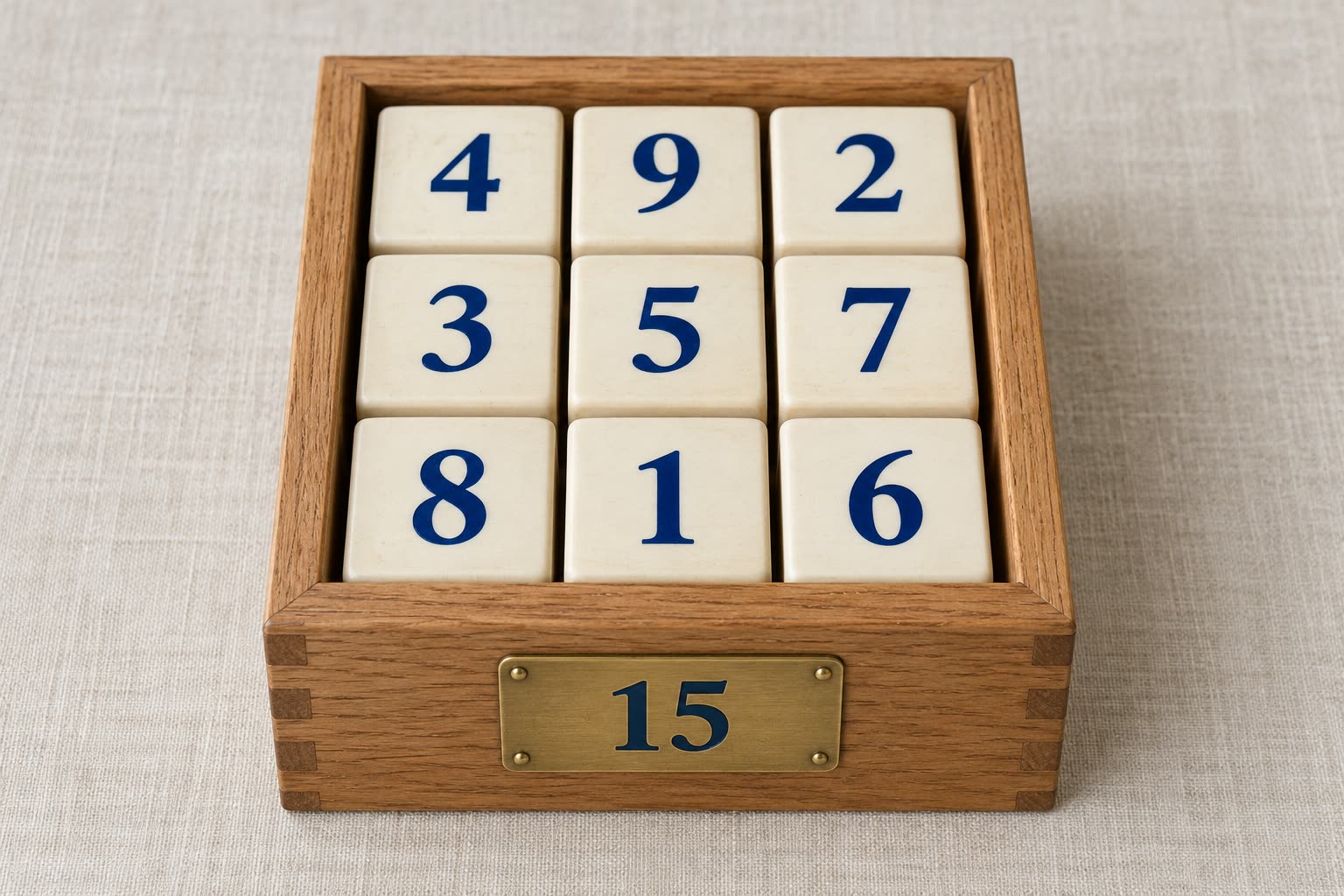
Angel number 15 combines two different emphases in contemporary numerology: 1 and 5 are associated with independence and freedom, while their sum, 6, is associated with care. Modern writers use that contrast to discuss choices that affect other people.
Older sources do not supply one agreed meaning. Tarot assigns XV to The Devil, Cheiro associates compound 15 with persuasion and favors, and the Lo Shu square makes fifteen an exact arithmetic total.
Quick Facts
- Reduction
- 1 + 5 = 6
- Digits
- 1 (independence) and 5 (freedom, change)
- Tarot card
- XV, The Devil
- Cheiro's compound 15 (1926)
- Magic, eloquence, and "money, gifts, and favours"
- Magic square
- Every line of the 3 × 3 Lo Shu square adds to 15
- Hebrew numeral
- ט״ו (9 + 6), written instead of yod-he
Why does 15 reduce to 6, and what happens when it becomes 51?
Numerology reduces 15 by adding its digits: 1 + 5 = 6. Compound-number readers may keep the original 15 in view as well, because reduction discards the written digits and retains only their total.
Numerology.com describes one as independent and pioneering.
Its profile of five emphasizes freedom, adventure and variety. Six receives caring, nurturing and protective associations.
| Element | Numerology.com association | Interpretive role |
|---|---|---|
| 1 | Independence and beginnings | A person's own initiative |
| 5 | Freedom and variety | The attraction of change |
| 6, the sum | Care and protection | Effects on other people |
A contemporary writer can compare freedom with care without treating the total as proof that someone will move from independence into domestic responsibility.
A hypothetical offer to work in another city illustrates the contrast: the applicant may value novelty, while a partner has a different preference about moving. That is a concrete decision involving two people, not a situation diagnosed by seeing 15.
The reversal 51 has the same total, because 5 + 1 also equals 6. Changing the written order does not establish whether a decision comes before a change or follows it.
A compound-number author can assign different interpretations to 15 and 51. The distinction comes from the original numbers and that author's reading, not from additive reduction.
Tarot card XV: why Waite and Bunning read The Devil differently
Card XV of the tarot's major arcana is The Devil. In the Rider-Waite-Smith deck, a horned figure sits above a man and woman chained to a pedestal.
Waite's divinatory list includes violence, force and fatality, with a qualification about what he calls predestined.
Joan Bunning's Learning the Tarot instead develops bondage, materialism, ignorance and hopelessness as psychological themes.
These descriptions are related to the same card but do not say the same thing. Bunning's examples, including accepting an unwanted situation and obsession, place more emphasis on a person's perceived limits than Waite's fatality vocabulary does.
Placed beside Numerology.com's freedom-and-care profiles, Bunning's interpretation raises a specific contrast: an attractive choice may later feel difficult to leave. That comparison is a synthesis of two systems, not evidence that the digits identify a dependency.
Temperance is card XIV. The Tower is card XVI.
Their positions next to XV establish the deck's sequence, rather than a timeline in which moderation necessarily becomes attachment and then collapse.
Cheiro's compound 15 and the square with an exact total
In Cheiro's Book of Numbers, the compound 15 is associated with occult significance, eloquence, music, art and personal magnetism. Cheiro calls it fortunate for obtaining money, gifts and favors from others.
His interpretation changes with accompanying numbers: he describes 15 as powerful beside a fortunate single number, but assigns it a darker character beside 4 or 8. Those conditions belong to his compound-number system, not to arithmetic properties of fifteen.
The money claim is a documented example from 1926, rather than an established first origin of modern manifestation teaching. Cheiro's emphasis on influence over other people also differs from a claim that wishes alone produce income.
The Lo Shu square offers a separate, checkable use of 15. It places 1 to 9 in a three-by-three grid whose rows, columns and diagonals all have the same sum.
| Left | Center | Right | Row total |
|---|---|---|---|
| 4 | 9 | 2 | 15 |
| 3 | 5 | 7 | 15 |
| 8 | 1 | 6 | 15 |
The middle cell is 5, and each opposite pair sums to 10: 4 + 6, 9 + 1, 2 + 8 and 3 + 7. Adding the center to any of those pairs explains the four lines through the center.
The remaining outer rows and columns also total 15. All nine cells sum to 45, so three equal row totals must each be 15; in this arrangement all eight lines satisfy that condition.
Agrippa's Three Books of Occult Philosophy, Book II, chapter 22, presents a three-by-three square as the table of Saturn, with lines totaling fifteen and all entries totaling forty-five. The arithmetic can be verified independently of that planetary attribution.
A repeated total in a magic square is therefore different from Cheiro's fortunate-number claim. One is a property of a specified arrangement; the other is a traditional interpretation of a compound number.
Fifteen in scripture and the Hebrew spelling tet-vav
Two biblical passages report fifteen additional years for Hezekiah: 2 Kings 20:6 and Isaiah 38:5. They describe a promise to a named king in a particular narrative, rather than a general promise attached to fifteen.
Psalms 120 through 134 comprise fifteen Songs of Ascents. Mishnah Sukkah 5:4 connects that group with fifteen Temple steps on which Levite musicians stood during the water-drawing celebration.
The connection is explicit in the Mishnah's wording: the steps correspond to the fifteen Songs of Ascents. That supports the specific comparison of counts without making every occurrence of fifteen a symbol for prolonged life or worship.
Hebrew letters also function as numerals, but fifteen uses a special spelling. Instead of yod-he, whose values would be 10 + 5, the convention uses tet-vav, ט״ו, with values 9 + 6.
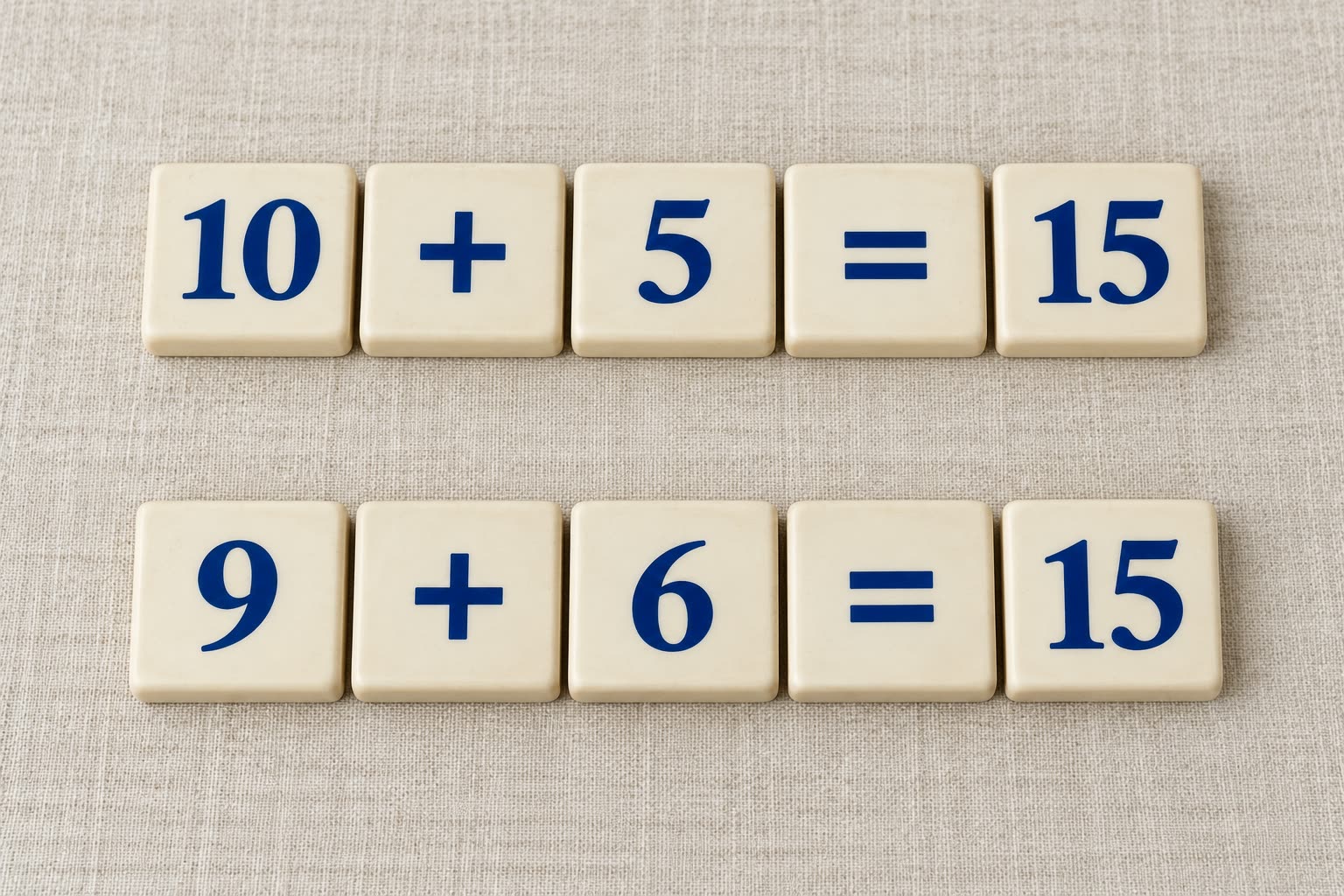
The substituted letters avoid writing a sacred name.
The quantity remains fifteen even though the written components differ.
Tu B'Av names the fifteenth day of Av using that numeral convention. Its date and spelling explain a historical association with fifteen without supplying an angel-number message.
These examples answer the biblical question through distinct evidence: years in a narrative, a group of psalms, a corresponding set of steps and a writing practice. Combining them into a universal biblical code would add a rule that these passages do not provide.
What do love readings and Tu B'Av actually have in common?
Numerologist.com applies 15 to a connection moving from excitement toward commitment. That interpretation combines the freedom associations of 1 and 5 with the care associated with their sum, 6.
Jewish tradition supplies a different connection between fifteen and courtship. Mishnah Taanit 4:8 names the fifteenth of Av and Yom Kippur as exceptionally joyous occasions when Jerusalem's young women danced in vineyards and addressed prospective husbands.
The passage also specifies borrowed white clothes so that someone without her own would not be embarrassed. This detail places care for participants within a courtship setting; it is not a claim about digit reduction.
| Situation | What is observable | What 15 cannot establish |
|---|---|---|
| New attraction | What each person has said about the connection | That feelings are mutual |
| A proposed move | Who wants to move and who has agreed | That independence requires the other person to relocate |
| A restless period | Which expectations or commitments are disputed | That novelty or continuity is automatically right |
The modern reading and the Mishnah both permit discussion of relationships, but through different routes. One interprets number profiles; the other records a dated communal practice.
Astrology.com's twin-flame entry assigns 15 a harmonious-union meaning. Its claim adds a contemporary spiritual interpretation, not evidence of a particular person's consent or a promised reunion.
A disagreement about travel or living arrangements still has identifiable participants and stated preferences. Calling the relationship a twin-flame connection does not resolve those differences.
Career and money: freedom, duties and Cheiro's persuasion claim
A modern 15 reading may place the freedom of a new role beside its responsibilities to other people. The comparison comes from the 1, 5 and 6 profiles, not an ability to predict which opportunity will succeed.
- A promotion may add authority and responsibility for a team's work.
- Freelance work may offer control over projects while retaining deadlines and client commitments.
- A relocation can benefit an applicant while changing another household member's plans.
These examples make the tension concrete without assigning it to everyone who encounters fifteen. The actual duties depend on the role and the agreement, not the numeral.
Cheiro's money language concerns favors received from other people through personal influence. That makes his claim different from a guarantee of wealth produced by positive thinking.
A proposed fee, an accepted offer and a received payment require different evidence. Fifteen does not establish any of them.
Freedom also appears in Life Path 5 profiles, while the care theme appears in a different chart result. Life Path 6 concerns care and responsibility within a birth-date calculation, whereas an incidental 15 is not a Life Path result.
Why does 15 keep appearing in quarter hours and prices?
Fifteen is built into timekeeping: a quarter hour is fifteen minutes and a clock reaches :15 once an hour. In 24-hour notation, the full time 15:15 is 3:15 in the afternoon.
The complete clock pattern is different from a lone 15 on an appointment slip or a 15-percent calculation. These settings have their own rules for generating the number.
Arnold Zwicky's 2005 account calls heightened noticing followed by an impression of unusual frequency the frequency illusion. Once a number is salient, remembering its appearances more readily can change the apparent pattern.
A number journal can record the setting and occasion of a sighting. To assess frequency, the relevant comparison would also include the opportunities to encounter fifteen and the other numbers present.
For a personal reflection, the record can preserve which known choice raised questions about freedom and care, without making its date a deadline for either.
Is angel number 15 a bad sign because of The Devil?
The alarming card name does not make fifteen a universal curse. Bunning's reading concerns attachment and perceived constraint, whereas Cheiro's unfavorable interpretation depends on accompanying 4 or 8.
These are source-specific conditions, not a verdict about a receipt, birthday or clock display. Seeing fifteen by itself supplies none of the card-reading context or the compound-number combination those interpretations use.
Frequently Asked Questions
Is 15 a manifestation or money number?
Cheiro's 1926 entry associates compound 15 with money, gifts and favors obtained through other people. That attributed claim does not establish that seeing fifteen produces income or fulfills a wish.
Why is the Hebrew numeral for 15 written with 9 and 6?
The convention uses tet-vav, ט״ו, to avoid the sacred-name sequence that would result from yod-he, 10 + 5. Both combinations have the same numerical total.
What is the difference between angel numbers 15 and 51?
Both reduce to 6. A writer may give the visible compounds different meanings, but reversing their digits does not prove that a decision and a change happen in reverse order.
Is 15 a lucky number?
Cheiro calls it lucky under specified number combinations, while Taanit 4:8 associates the fifteenth of Av with joy and courtship. These are different traditional associations rather than evidence that an incidental fifteen brings luck.
Sources
- (n.d.). The Number 1 in Numerology. Numerology.com. Link
- (n.d.). The Number 5 in Numerology. Numerology.com. Link
- (n.d.). The Number 6 in Numerology. Numerology.com. Link
- (1910). The Pictorial Key to the Tarot. William Rider & Son; divinatory meanings of trump 15, quoted in the Wikipedia article The Devil (tarot card). Link
- (1995–2021). The Devil. Learning the Tarot. Link
- (1926). Cheiro's Book of Numbers, compound number 15 (p. 81 in the revised edition). Herbert Jenkins; scanned text at Internet Archive. Link
- (2026). Lo Shu Square. Wikipedia. Link
- (1533; English 1651). Three Books of Occult Philosophy, Book II, chapter 22 (the table of Saturn). Esoteric Archives. Link
- (n.d.). 2 Kings 20:6 and Isaiah 38:5 (fifteen years added to Hezekiah's life). Sefaria. Link
- (c. 200 CE). Sukkah 5:4 (the fifteen steps and the fifteen Songs of Ascents). Sefaria, William Davidson translation. Link
- (c. 200 CE). Taanit 4:8 (the fifteenth of Av). Sefaria, William Davidson translation. Link
- (2026). Hebrew numerals, section Key exceptions. Wikipedia. Link
- (n.d.). Angel Number 15. Numerologist.com. Link
- (n.d.). 15 Angel Number Meaning. Astrology.com. Link
- (2005). Just between Dr. Language and I. Language Log, August 7, 2005 (coins the term frequency illusion). Link
About Our Editorial Process
Every KnowTheAngels guide separates calculation method, tradition context, and personal reflection. We cite where interpretations come from, present more than one view, and never present symbolic reading as prediction.
Read our editorial policy