What Does Seeing 23:23 Mean for Change and Curiosity?
The last mirror hour before midnight: why each 23 reduces to 5, how the whole time reaches 1 through 10, and where the Royal Star and Haiaiel readings come from
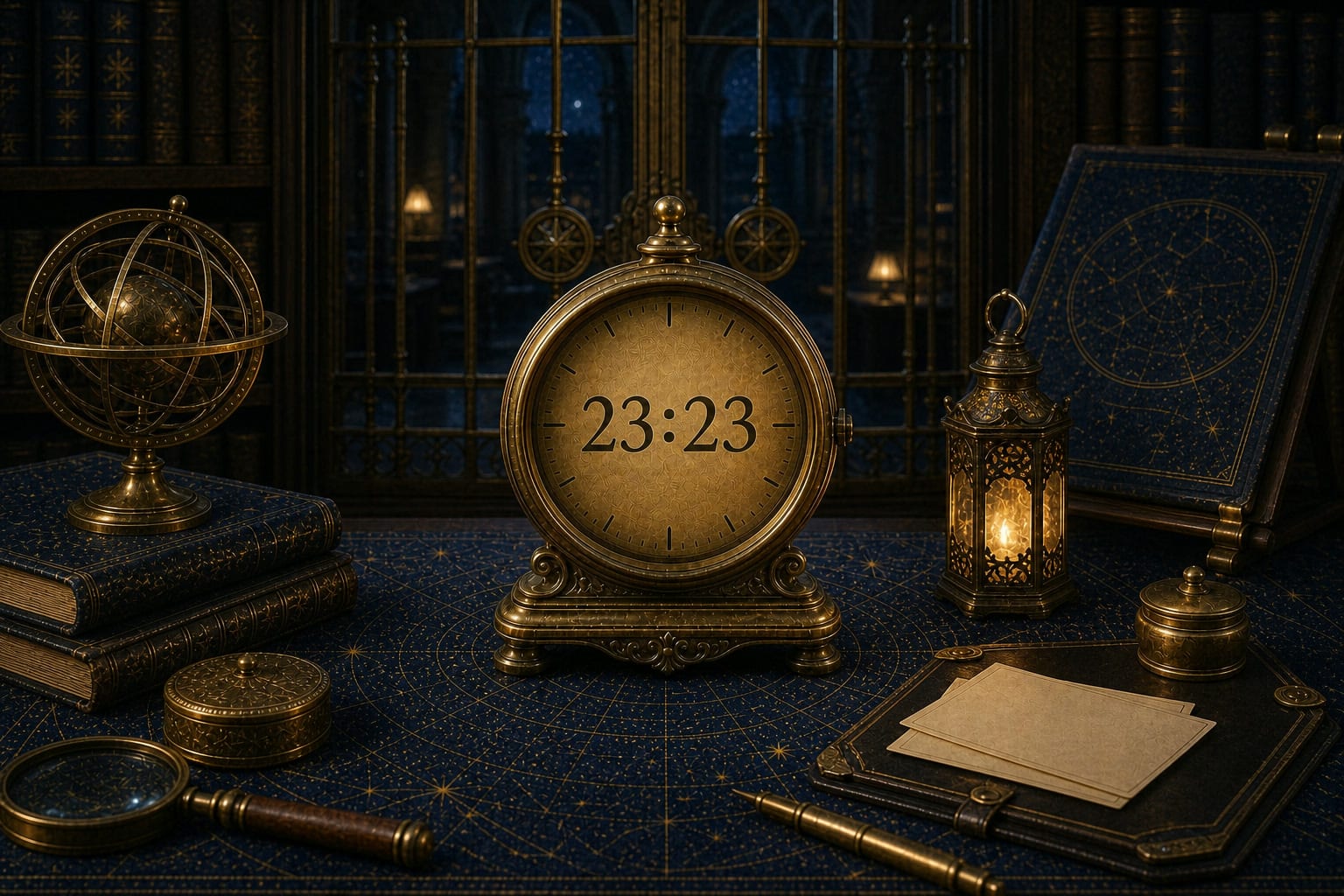
23:23 is the final mirror hour of the day. Because 23 is the highest hour a 24-hour clock shows, no later time repeats its hour in its minutes, and the next doubled reading is 00:00. On a 12-hour clock the same minute appears as 11:23 PM, so 23:23 only exists for people reading a phone, computer or clock set to 24-hour time.
Numerology gives the time two layers: each 23 reduces to 5, and the full display reduces through 10 to 1. Two other sources add readings of their own. Cheiro read 23 as a promise of success and protection, and French mirror-hour websites assign it the angel Haiaiel from the 72 angel names of Christian Kabbalah.
Quick Facts
- Clock display
- Visible only in 24-hour time; 11:23 PM in 12-hour time
- Position in the day
- The last of the 24 mirror hours; the next is 00:00
- Each half
- 2 + 3 = 5
- Full reduction
- 1, reached through 2 + 3 + 2 + 3 = 10
- Cheiro's name for 23
- The Royal Star of the Lion
- Angel in French lists
- Haiaiel, 71st of the 72 names (23:20 to 23:40)
Why is 23:23 the last mirror hour of the day?
A mirror hour needs the minutes to repeat the hour, and the hour on a 24-hour clock runs from 00 to 23. That gives exactly 24 mirror hours a day, one for each hour, and 23:23 is the last of them. After it the clock runs through 23:59 without another doubled pair until 00:00 starts the list again.
Only the 24-hour format makes the pattern visible. A 12-hour clock shows 11:23 at the same moment, so 23:23 belongs to places where the 24-hour clock is the everyday standard, such as France and most of continental Europe. The French name for the set, heures miroirs, is the term used by the books and websites that publish angel and message lists for these times. Readers on 12-hour phones meet the digits instead as the number 2323.
How do the two 5s of 23:23 end at 1?
Each half is reduced on its own first: 2 + 3 = 5 for the hour and 5 again for the minute. Adding all four digits gives 2 + 3 + 2 + 3 = 10, and 10 reduces again to 1 + 0 = 1. Adding the halves as whole numbers takes the same path, since 23 + 23 = 46, then 4 + 6 = 10 and 1 + 0 = 1.
| Step | Calculation | Result |
|---|---|---|
| Hour | 2 + 3 | 5 |
| Minute | 2 + 3 | 5 |
| All four digits | 2 + 3 + 2 + 3 | 10 |
| Second reduction | 1 + 0 | 1 |
| Halves as numbers | 23 + 23 = 46, 4 + 6 = 10, 1 + 0 | 1 |
The two layers pull in different directions. Numerology.com describes the number 5 through curiosity and a craving for freedom and adventure, calling it "a master of change". Its description of 1 centres on independence, confidence and new beginnings. In a numerology reading, then, the two 5s describe restlessness and open options, and the full root of 1 describes the moment one option is chosen and started, such as handing in notice or booking a ticket.
Angel number 23 on its own stops at 5. The 1 exists only because the clock shows 23 twice.
Should a 23:23 sighting push you to change course?
Mirror-hour websites tend to read 23:23 as encouragement to change course; Astrofame, for example, calls it the hour of courage and renewal. The numbers support a narrower use. In relationships, the 5s describe a wish for room and variety and the 1 describes independence, so the time fits questions about how much freedom each person keeps inside a commitment more than questions about ending it.
In a career change, 23:23 fits the gap between wanting something different and taking the first concrete step, such as sending one application. A decision reached at 23:23 is also reached late at night, and looking at it again in the morning, with the same facts on the table, shows whether the change still looks right once you are rested.
Is a 23:23 sighting at bedtime a sign or a habit?
23:23 falls in the half hour before midnight, when a phone on the bedside table is often the only clock in view. If you check the time in bed most nights, a regular bedtime somewhere between 23:00 and 23:45 is enough to produce frequent sightings.
Expectation shapes what gets counted. Raymond Nickerson's 1998 review of confirmation bias in the Review of General Psychology describes how people seek out and weigh evidence in ways that favour a belief they already hold. Once 23:23 feels meaningful, each sighting counts as support, and the nights you saw 23:18 or 23:40 are never counted against it.

Writing down the time you picked up the phone and what you were doing, for a few nights, settles the question for your own case. If 23:23 lines up with a bedtime habit, the pattern describes that habit, and the 5 and 1 readings are a frame you can choose to apply to it.
What did Cheiro mean by the Royal Star of the Lion?
The Irish palmist Cheiro, born William John Warner, gave compound numbers names and pictures in Cheiro's Book of Numbers. He called 23 "the Royal Star of the Lion" and described it as "a promise of success, help from superiors and protection from those in high places".
That reading is warmer than the upheaval stressed in mirror-hour writing, and it has a different subject. Cheiro applied compound numbers to names and dates, where 23 described a person's prospects. Carried over to a clock time, it becomes a theme about help from others at a turning point, such as asking a manager or mentor for support before a change instead of making it alone.
Why do mirror-hour lists give 23:23 to Haiaiel and the Fool?
French mirror-hour sites name Haiaiel as the angel of 23:23. Source Sacrée calls Haiaiel the 71st angel of the Kabbalah, and Cristina Balan's December 2025 page on perversnarcissique.org gives the same name. The list itself goes back to the 72 three-letter names formed from Exodus 14:19-21, which the Christian Kabbalist Johann Reuchlin (1455-1522) read as the names of angels.
Mirror-hour lists spread those 72 names across the day at 20 minutes each. That places the 71st name over 23:20 to 23:40 and leaves only Mumiah, the 72nd, for the last 20 minutes before midnight. The lists give no author or book for the 20-minute division, and under it Haiaiel covers 23:31 as fully as 23:23.
Tarot pairings run out before 23. The major arcana stop at 22 cards, so no card carries the number 23; Source Sacrée resolves this by sending 23h23 to the Fool, the card that sits outside the numbered sequence, a choice the arithmetic of 23 does not dictate.
Frequently Asked Questions
What does 23:23 mean on a clock?
The two 23s reduce to 5 each, and the whole time reduces through 10 to 1, which readers connect with change and with the first step that starts it. Cheiro's Royal Star reading and the Haiaiel attribution sit on top of that arithmetic, and none of these readings predicts an event.
Is 23:23 a mirror hour?
Yes, and it is the last one of the day. The 24 mirror hours run from 00:00 to 23:23, one per hour, and a 12-hour clock shows 11:23 at that moment instead.
Does 23:23 mean someone is thinking of me?
No clock time can report another person's thoughts. The 5 and 1 in 23:23 describe your own questions about freedom and first steps, and any answer about another person comes from talking to them.
Sources
- (n.d.). Number 5 Meaning. Numerology.com. Link
- (n.d.). Number 1 Meaning. Numerology.com. Link
- (1935). Cheiro's Book of Numbers, compound numbers section, pp. 126-133. Herbert Jenkins, London. Link
- (n.d.). Heure miroir 23h23. Source Sacrée. Link
- (2025). Mirror hour 23:23: Meaning and angelic messages. perversnarcissique.org. Link
- (n.d.). 23:23 mirror hour: the hour of courage and renewal. Astrofame. Link
- (2026). Shem HaMephorash. Wikipedia. Link
- (2026). Major Arcana. Wikipedia. Link
- (2026). 24-hour clock. Wikipedia. Link
- (1998). Confirmation Bias: A Ubiquitous Phenomenon in Many Guises. Review of General Psychology 2(2), 175-220. Link
About Our Editorial Process
Every KnowTheAngels guide separates calculation method, tradition context, and personal reflection. We cite where interpretations come from, present more than one view, and never present symbolic reading as prediction.
Read our editorial policy