Angel Number 23: The Royal Star, Psalm 23 and Repeated Sightings
Root 5, Cheiro's fortunate compound, two psalm numbers and the attention behind the 23 enigma
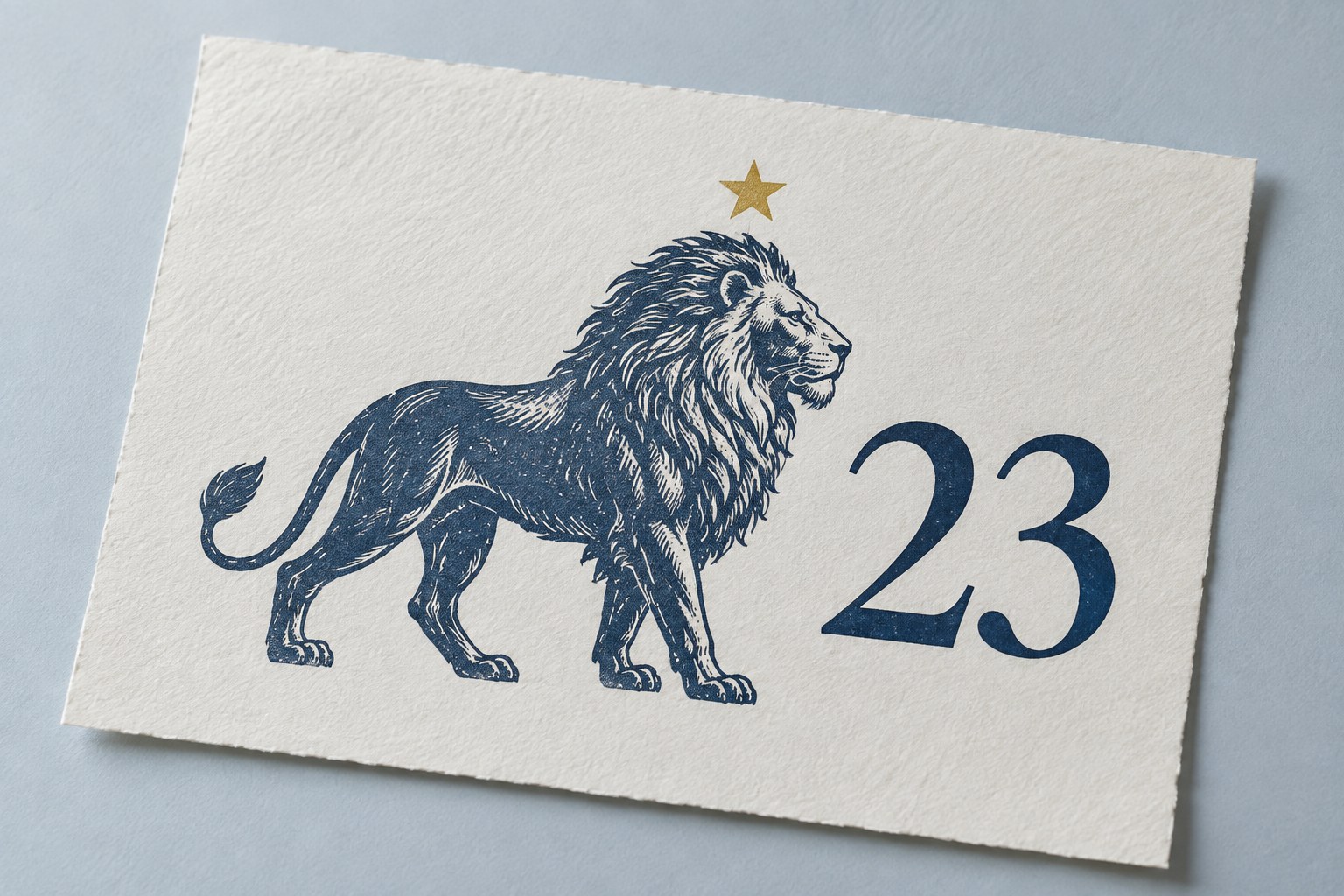
Angel number 23 has no single meaning shared by its sources. Adding its digits gives 5, but that calculation does not establish Cheiro's promise of success or turn Psalm 23 into a message about a sighting.
The distinction matters when 23 appears repeatedly: a number on a receipt, the title of a psalm and a compound in a numerology book are different uses of the same numeral.
Quick Facts
- Digit sum of 23
- 2 + 3 = 5
- Reversed numeral 32
- 3 + 2 = 5, the same root
- Cheiro's compound 23
- The Royal Star of the Lion
- Shepherd psalm numbering
- Hebrew 23; Greek and Latin 22
- Whole display 23:23
- 2 + 3 + 2 + 3 = 10; root 1
Does 23 put listening before speaking? What root 5 establishes
The reduction of 23 stops at 5 because 2 + 3 = 5. Reversing the digits gives 3 + 2 = 5, so addition alone cannot make 23 a listening-first number and 32 a speaking-first number.
Numerology.com's modern profiles associate 2 with cooperation and sensitivity. Its account of 3 emphasizes expression and communication.
The number 5 profile emphasizes freedom, variety and adaptability.
Those associations supply a vocabulary for interpretation, rather than a sequence of required actions. Blair Andrews' reading of 23 describes quiet insight and the urge to express working together; that combination does not establish a rule that every conversation must follow the digits' order.
| Number | Digit calculation | What the calculation establishes |
|---|---|---|
| 23 | 2 + 3 = 5 | Root 5, with visible digits 2 and 3 |
| 32 | 3 + 2 = 5 | The same root, with the digits reversed |
| 14 | 1 + 4 = 5 | Root 5, with different visible digits |
| 41 | 4 + 1 = 5 | Root 5, despite a different compound |
| 50 | 5 + 0 = 5 | Root 5, without digits 2 or 3 |
Root 5 therefore places 23 among several numbers with the same reduced total. It does not erase the separate compound descriptions that an author may assign to 14 or 32.
A Life Path 5 has another input: a date of birth calculated under a stated method. Seeing 23 on a sign does not calculate that chart position, even though the displayed number also reduces to 5.
Is 23 lucky? What Cheiro's Royal Star of the Lion promises
Cheiro calls compound 23 the Royal Star of the Lion in chapter XIII of his Book of Numbers. He associates it with success, assistance from superiors and protection from people in high places.
The reference to superiors makes this interpretation more specific than a general claim that change is coming. Cheiro describes favorable help from someone with influence, rather than deriving a communication problem from the digit 3.
His book distinguishes single-digit descriptions from the hidden influences he attributes to compounds. A name or date calculation that produces 23 belongs to that book's Chaldean approach; an incidental sighting is a different input.
Within the same compound list, Cheiro groups 32 with 14 and 23 through an affinity with single 5. His favorable description of 32 also depends on keeping one's own judgment, rather than allowing other people's opinions to overturn it.
That contrast shows why equal roots need not produce identical readings in a compound-number system. It also prevents a false agreement: Cheiro's patronage claim and the modern cooperation-expression combination answer different questions.
The title names a symbol in Cheiro's entry; the cited passage does not identify a particular astronomical star or establish an ancient origin for the phrase. An association with the star Regulus would need its own evidence.
Calling 23 fortunate reports Cheiro's belief, not an observed improvement in anyone's odds. His passage supplies neither a date for future help nor evidence that a person who notices 23 has a benefactor.
Psalm 23 or Psalm 22: why the Bible's numbering matters
The familiar biblical connection is Psalm 23, whose opening calls the Lord a shepherd. The psalm's account of guidance, provision and company in danger belongs to its words, rather than to a numerological definition of twenty-three.
In the King James Version, verse 4 places the speaker in the valley of the shadow of death and names the shepherd's rod and staff as sources of comfort. A contemporary devotional association between seeing 23 and that passage is an application of the poem, not a promise made by its chapter number.
| Text tradition | Number for the shepherd psalm | What stays the same |
|---|---|---|
| Hebrew numbering, followed by the KJV | Psalm 23 | The identity of the shepherd psalm |
| Greek Septuagint numbering | Psalm 22 | The same psalm, with translation differences |
| Latin Vulgate numbering | Psalm 22, Dominus regit me | The same psalm, with translation differences |
The Greek and Latin collections number this psalm differently because the surrounding psalms are grouped differently. A changed number does not create a different shepherd poem, although translations need not use identical words.
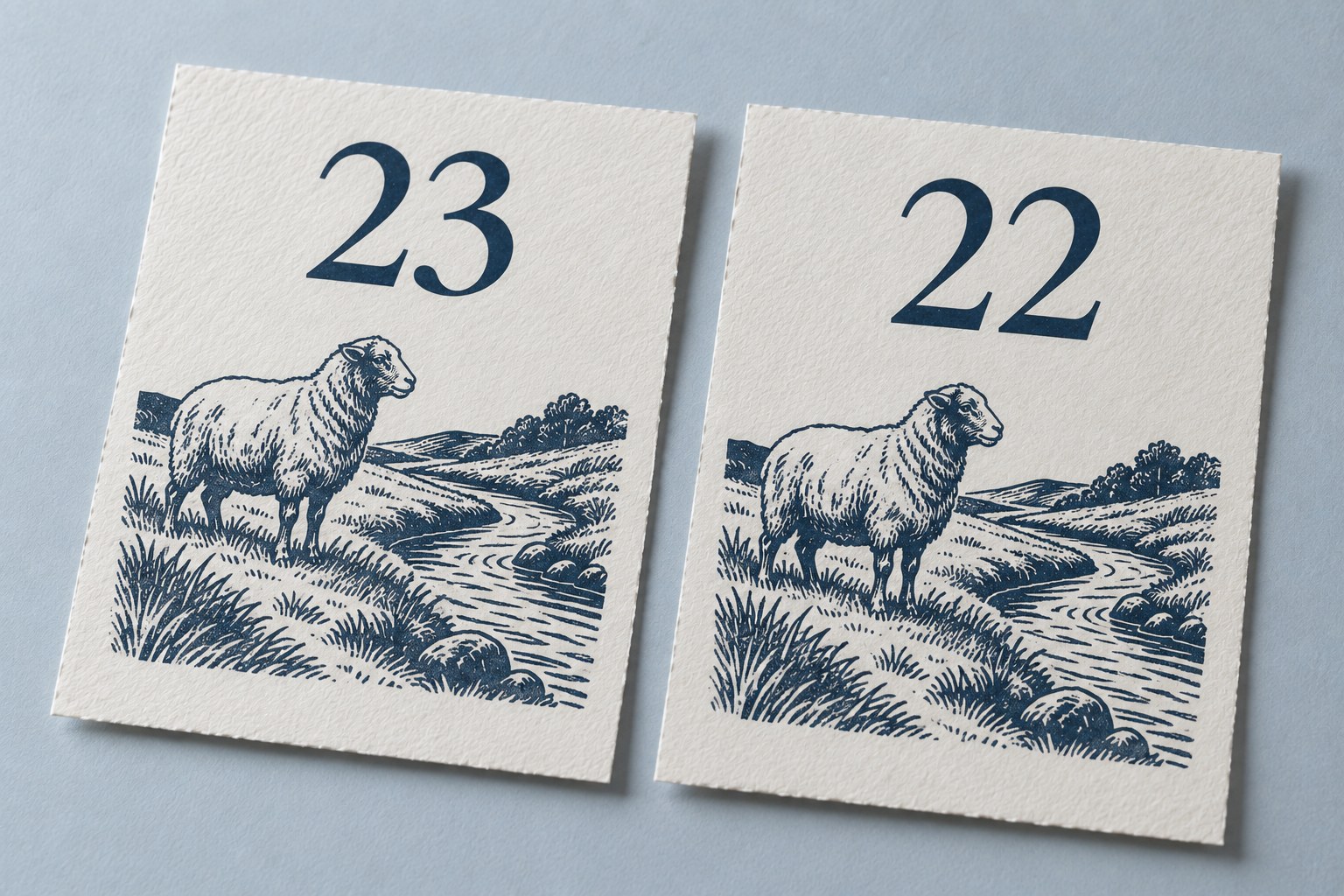
This distinction explains why Psalm 23 can inform a faith-based reflection without establishing a universal meaning for an observed 23. The passage gives its own reasons for comfort, regardless of the numeral attached to it.
Why do I keep seeing 23? The enigma and its missing nonmatches
The 23 enigma is a cultural story about finding connections involving twenty-three. Robert Anton Wilson retold an anecdote in which William Burroughs linked two accidents through the number 23 and the name Captain Clark.
The encyclopedia account records Wilson's retelling; it does not independently verify the accidents. The story is relevant here because it gives this particular number a ready-made narrative into which later coincidences can fit.
Wilson's comment that looking for something makes it easier to find shifts the explanation toward attention. The American Psychological Association defines selective attention as focusing on some stimuli while others remain in the background.
After 23 becomes interesting, a receipt total or a date containing it may stand out among many numbers. Remembering those matches without the nonmatches leaves out the denominator needed to judge how unusual the pattern is.
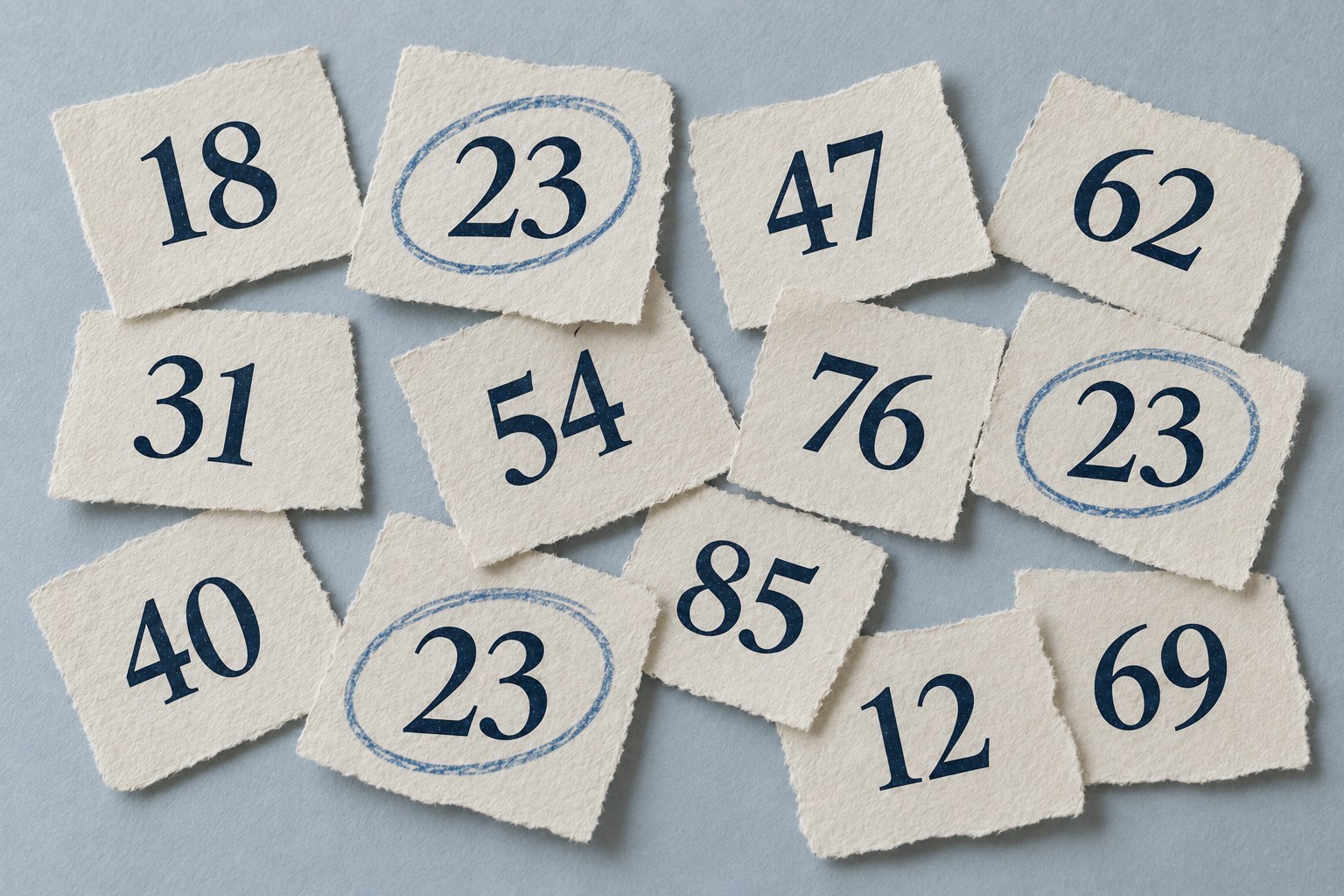
A match also depends on the rule used to find it: exactly 23 is narrower than 23 appearing inside a longer number. Accepting reversed 32, sums of unrelated digits and selected dates adds more opportunities after the search has begun.
The clock form 23:23 makes that rule visible. Each half reduces to 5, but the full display totals 10 and reduces to 1.
The same minute appears as 11:23 PM on a 12-hour display, where the printed digits are different. The repeated pattern belongs partly to the chosen format, rather than changing the moment being shown.
A cluster around one conversation cannot by itself distinguish angelic communication from attention: an emotionally important subject can influence what is noticed and remembered. The pattern may have personal meaning without providing that causal test.
23 in love and career: where the interpretations stop
A love reading based on Andrews' combination can connect receptive attention with expressing a thought. Applied to a couple discussing a move, it concerns whether both positions are heard and stated; it does not establish that agreement will follow.
A changed agreement is not a necessary result of 2 + 3 = 5. The arithmetic supplies a root, while a changed arrangement requires actual choices by the people involved.
A renewed promise, an apology and an agreed responsibility are different observable events. Calling one of them leverage requires context about the exchange; seeing 23 does not show that a partner is manipulating someone.
Claims about twin flames introduce another leap, from symbolic associations to a destined relationship. Neither the cited digit profiles nor Cheiro's compound entry establishes another person's feelings, consent or a reunion date.
In career readings, Cheiro's reference to help from superiors might be associated with a mentor, supervisor or sponsor. An actual introduction or offer gives that association a concrete context, whereas a sighting supplies no evidence that the help exists.
Two uses of 23 with different evidence
What the evidence supports
- Calculated compound
Cheiro's chapter XIII explicitly assigns a fortunate interpretation to compound 23.
- Observed numeral
A receipt or display establishes where 23 appeared, not why it appeared.
What remains limited
- An author's prediction
The cited compound entry reports a divinatory claim, without measuring whether its promised help occurs.
- A sighting's interpretation
Applying that entry to an incidental number adds a step the calculation did not establish.
For a career change, the modern root 5 association names adaptability; it does not identify which job fits or whether an offer is reliable. That gap is the limit of the interpretation, rather than a hidden instruction to act.
Sources
- . Angel Number 23 Meaning: The Mirror and the Maker. Numerologist.com. Link
- . The Number 2 in Numerology. Numerology.com. Link
- . The Number 3 in Numerology. Numerology.com. Link
- . The Number 5 in Numerology. Numerology.com. Link
- . Cheiro's Book of Numbers, chapter XIII, compound entries 23 and 32. Herbert Jenkins, London; Indian edition, D. B. Taraporevala Sons, Bombay. Link
- (1611). Psalm 23:1-6 (King James Version). BibleGateway. Link
- . Psalm 23 (numbering in the Septuagint and Vulgate). Wikipedia. Link
- . 23 enigma (Burroughs, Wilson, Illuminatus!, Cosmic Trigger, The Number 23). Wikipedia. Link
- (2018). Selective attention. APA Dictionary of Psychology. Link
About Our Editorial Process
Every KnowTheAngels guide separates calculation method, tradition context, and personal reflection. We cite where interpretations come from, present more than one view, and never present symbolic reading as prediction.
Read our editorial policy