Christian Boy Names Starting With A: Three Men Named Ananias and Two Saint Anthonys
Which man each A name recalls, from the three Ananiases of Acts and the two Saint Anthonys to Abraham, Aaron, Andrew and the saints Augustine and Ambrose.
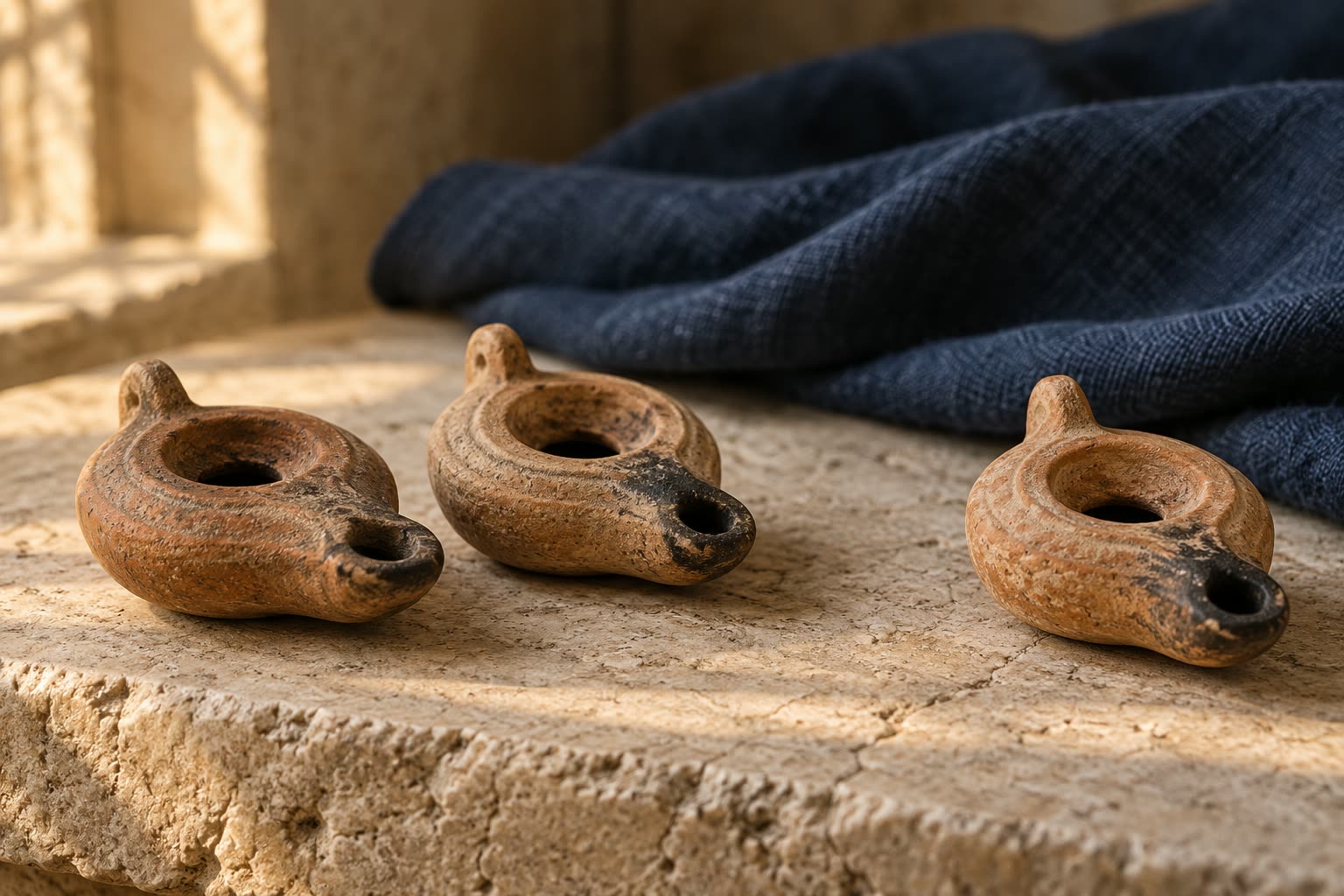
Acts gives the name Ananias to three different men: one dies after lying about money in Acts 5, one lays hands on Saul in Acts 9 so that he may regain his sight, and one is the high priest who has Paul struck in Acts 23. A boy named Ananias can honor the second man while sharing a name with the first.
Anthony splits the same way, between a hermit in Egypt who died in 356-357 and a friar born in Lisbon in 1195. Abraham, Aaron, Andrew, Apollos, Amos, Asher and Absalom come from scripture with a cited passage, and Augustine and Ambrose are tied together by one recorded baptism.
Two common glosses need a caution: Behind the Name calls Aaron most likely Egyptian in origin, with "exalted" only one theory, and says the h in Anthony comes from a mistaken link to the Greek word for flower.
Quick Facts
- Three men named Ananias
- Acts 5:1-5, Acts 9:10-17, and Acts 23:2 with 24:1
- Two Saint Anthonys
- Anthony of Egypt (died 356-357) and Anthony of Padua (died 1231)
- Renamed by God
- Abram to Abraham in Genesis 17:5
- Meaning stated in the verse
- Asher, from Leah's "Happy am I!" in Genesis 30:13
- Baptism linking two saint names
- Ambrose baptized Augustine at Milan at Easter 387
Which Ananias does the name recall?
Two of the three men named Ananias in Acts could hardly differ more. The first keeps back part of a sale price and falls dead when Peter confronts him, while the second is a disciple in Damascus whom the Lord sends to lay hands on Saul.
| Passage | Who he is | What the text records | What a namesake would carry |
|---|---|---|---|
| Acts 5:1-5 | Husband of Sapphira | Sells property with his wife's consent, keeps back part of the proceeds, and dies after Peter says he lied to God | A warning about deceit rather than an example |
| Acts 9:10-17 | A disciple in Damascus | Answers the Lord with "Here I am, Lord," objects that Saul has harmed believers, then goes, lays hands on him and calls him "Brother Saul" | Obedience despite fear, and a welcome given to a former persecutor |
| Acts 23:1-3; 24:1 | The high priest | Orders Paul struck on the mouth, is called a "whitewashed wall" by Paul, and five days later travels to Caesarea to accuse him | An opponent of Paul in a trial scene |
Of the three, only the Damascus disciple acts in a way a namesake would want to carry. His objection in Acts 9:13-14 is part of the account: he knows what Saul has done to believers in Jerusalem and goes to him anyway.
Ananias is the Greek form, Hananias, of the Hebrew name Hananiah, according to Behind the Name. Daniel 1:6-7 lists a Hananiah among Daniel's companions, the young man the palace master renamed Shadrach, so the same Hebrew name sits under both the Old Testament and the New Testament forms.
In Acts 9:17 Ananias greets the apostle as "Brother Saul," so the name Saul is still in use after the Damascus road, a detail that bears on the separate question of Saul and Paul.
Anthony of Egypt or Anthony of Padua?
The saint known as Anthony of Padua was not baptized Anthony. The Catholic Encyclopedia records that he was born in Lisbon in 1195, baptized Ferdinand, and took the name Anthony when he left the Canons Regular of St. Augustine to join the Friars Minor.
The older saint, Anthony of Egypt, also called Anthony the Great, was born at Coma near Heracleopolis Magna about the middle of the third century and withdrew from ordinary life around 270. Behind the Name credits him with making Anthony a regular name in the Christian world.
The sources disagree on how far his role went: Behind the Name says he founded Christian monasticism, while the Catholic Encyclopedia says he was probably not the first Christian hermit but became the recognized leader of the hermits.
| Detail | Anthony of Egypt | Anthony of Padua |
|---|---|---|
| Born | Coma, near Heracleopolis Magna in Egypt, about the middle of the third century | Lisbon, 1195 |
| How he came to be called Anthony | Known by this name in the Life that the Catholic Encyclopedia treats as probably written by Athanasius | Baptized Ferdinand; took the name Anthony on joining the Friars Minor |
| Way of life | Hermit; spent his last forty-five years on a mountain near the Red Sea where the monastery Der Mar Antonios stands | Canon Regular of St. Augustine, then a Franciscan friar and preacher |
| Died | 356-357, the date Jerome gives | 13 June 1231, aged thirty-six, after retiring to Camposanpiero near Padua |
| Effect on the name, per Behind the Name | Made it a regular Christian name | Reinforced its popularity in the Middle Ages; patron saint of Portugal |
The spelling question has a separate answer. Behind the Name traces Anthony to the Roman family name Antonius, of unknown Etruscan origin, and says the h was added in the 17th century because the name was wrongly linked to Greek anthos, "flower."
Antony and Anthony are therefore one name, and the form without the h is the older spelling. No sourced meaning survives for Antonius, so a "flower" gloss repeats the same mistake that produced the h.
Abraham and Aaron: a name God changed and a brother who spoke for Moses
Abraham's meaning is explained in the same verse that gives him the name. In Genesis 17:5 God says, "No longer shall your name be Abram, but your name shall be Abraham, for I have made you the ancestor of a multitude of nations."
The NRSVUE footnotes give Abram as "exalted ancestor" and Abraham as "ancestor of a multitude." Those notes explain the wordplay in the verse, so Abraham's meaning comes from the text itself rather than from a modern dictionary.
Aaron enters the story as a speaker. When Moses resists his calling in Exodus 4:14-16, God answers that Aaron "can speak well" and "shall serve as a mouth for you."
Exodus 28:1 then sets Aaron and his sons Nadab, Abihu, Eleazar and Ithamar apart to serve as priests. The name therefore carries two roles from the text: spokesman for his brother and, as Behind the Name puts it, the first high priest of the Israelites.
The meaning is less settled than the roles. Behind the Name says the Hebrew Aharon is most likely of unknown Egyptian origin, and it lists "high mountain" and "exalted" as other theories rather than established meanings.
The same source dates Aaron's use as an English given name to the Protestant Reformation.
Andrew, Apollos and Amos are each known for one act
Andrew's act is bringing his brother. John 1:40-42 says he was one of two who followed Jesus after hearing John, and that "he first found his brother Simon" and brought him to Jesus.
Andrew comes from Greek Andreas, from andreios, "manly, masculine," in Behind the Name's derivation. It adds that a Greek name like this was probably a nickname or a translation of his real Hebrew name, which is not known.
Later tradition supplies more than the Gospel does. The X-shaped cross is a legend in Behind the Name's account, which also notes that Andrew is regarded as the patron of Scotland, Russia, Greece and Romania.
Apollos is remembered through the way Paul describes him. In 1 Corinthians 3:4-6 Paul rejects the slogans "I belong to Paul" and "I belong to Apollos," then writes, "I planted, Apollos watered, but God gave the growth."
Acts 18 adds that Apollos spoke accurately but knew only the baptism of John, so Priscilla and Aquila explained the way of God to him more accurately. For a namesake, Apollos is a capable teacher who accepted correction.
Amos describes himself by his work. In Amos 7:14-15 he answers Amaziah, "I am no prophet nor a prophet's son, but I am a herdsman and a dresser of sycamore trees," and says the Lord took him from following the flock.
The NRSVUE notes that "I am" can also be read "I was," which changes whether Amos rejects the title of prophet or only describes his past. Either reading gives the name a working man called away from his flock.
What do Asher and Absalom show about a name's meaning and its story?
Asher's meaning sits in the naming verse itself. In Genesis 30:13 Leah names him after declaring that the women will call her happy, and the NRSVUE note on the name reads, "That is, happy."
Absalom's best-known verse says nothing about what his name means. In 2 Samuel 18:33 David weeps over him and cries, "Would I had died instead of you, O Absalom, my son, my son!"
David mourns a son who had rebelled against him. In 2 Samuel 15:10-12 Absalom sends secret messengers through the tribes of Israel to announce "Absalom has become king at Hebron!", and in 18:9-15 his head catches in an oak, Joab thrusts three spears into his heart, and ten of Joab's armor-bearers kill him.
The two names reach a family by different routes. With Asher the meaning can be quoted straight from scripture, while Absalom brings the story of a son who declared himself king against his father, was killed during that revolt, and was still mourned by David.
Augustine and Ambrose: a convert and the bishop who baptized him
Augustine and Ambrose are joined by one recorded event. At the beginning of Lent in 387 Augustine went to Milan with his son Adeodatus and his friend Alypius, and the Catholic Encyclopedia records that Ambrose baptized him on Easter Day, or at least during Eastertide.
Augustine was born at Tagaste, in the Roman province of Numidia, on 13 November 354, served as bishop of Hippo from 396, and died on 28 August 430. Before his conversion he had become a regular listener at Bishop Ambrose's preaching in Milan, so the baptism followed months of listening to Ambrose preach.
That single baptism makes the pair unusually easy to use together, for brothers or for a first and middle name.
Adriel, Ariel and Azariah: the men behind names linked to angels
In the Hebrew Bible, Adriel, Ariel and Azariah are each the name of a man.
- Adriel: in 1 Samuel 18:19, Saul's daughter Merab, who should have been given to David, is given to Adriel the Meholathite as a wife. His name is often mistaken for an angel's.
- Ariel: Ezra 8:16 lists a man named Ariel among the leaders Ezra sent for. The later angel traditions attached to the name are a separate subject.
- Azariah: Daniel 1:7 records that Daniel's companion Azariah was renamed Abednego, and the king who reigned fifty-two years in Jerusalem appears as Azariah in 2 Kings 15:2 and as Uzziah in 2 Chronicles 26:3. In the Book of Tobit, the angel Raphael travels under the name Azariah.
Frequently Asked Questions
What does Ananias mean?
Behind the Name explains Ananias only as Hananias, the Greek form of the Hebrew name Hananiah, and gives no separate meaning for the Greek form. The Book of Tobit page glosses Hananiah as "the LORD has been gracious," and of the three men named Ananias in Acts, the disciple of Acts 9:10-17 is the one who welcomed Saul.
Is Anthony spelled with an h?
Both spellings are in use. According to Behind the Name, the h was added in the 17th century through a mistaken link to Greek anthos, "flower," and lists Antony as the variant without it.
Sources
- (2021). Genesis 17:5; Exodus 4:14-16; 28:1; John 1:40-42; Acts 5:1-5; 9:10-17; 23:1-3; 24:1; 1 Corinthians 3:4-6; Amos 7:14-15; Genesis 30:13; 2 Samuel 18:33 (NRSVUE). Bible Gateway. Link
- (2021). 2 Samuel 15:10-12; 18:9-15 (NRSVUE). Bible Gateway. Link
- (2021). Daniel 1:6-7; 1 Samuel 18:19; Ezra 8:16 (NRSVUE). Bible Gateway. Link
- (2021). Acts 18:1-28 (NRSVUE). Bible Gateway. Link
- (1611). 2 Kings 15:2; 2 Chronicles 26:3 (KJV). Bible Gateway. Link
- (1907). St. Anthony. New Advent. Link
- (1907). St. Anthony of Padua. New Advent. Link
- (1907). St. Augustine of Hippo. New Advent. Link
- (n.d.). Ananias: Meaning and History. Behind the Name. Link
- (n.d.). Anthony: Meaning and History. Behind the Name. Link
- (n.d.). Aaron: Meaning and History. Behind the Name. Link
- (n.d.). Andrew: Meaning and History. Behind the Name. Link
About Our Editorial Process
Every KnowTheAngels guide separates calculation method, tradition context, and personal reflection. We cite where interpretations come from, present more than one view, and never present symbolic reading as prediction.
Read our editorial policy