What Happens in the Book of Tobit, and Who Is the Angel Raphael?
The story of Tobit, Tobias, and Sarah, the angel who travels as Azariah, and why Catholic, Orthodox, and Protestant Bibles treat the book differently
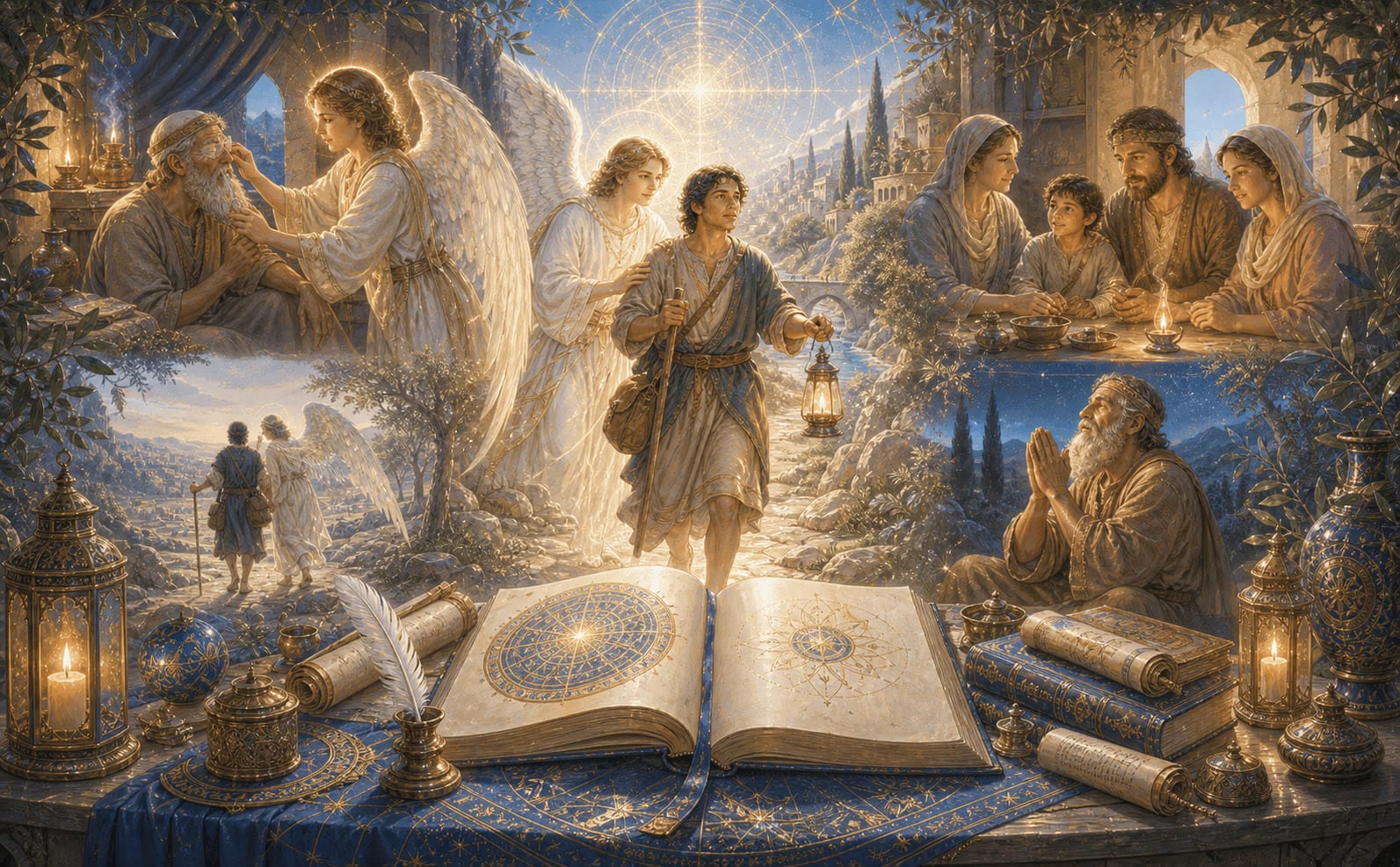
The Book of Tobit is a fourteen-chapter Jewish story in which the angel Raphael, travelling under the name Azariah, guides young Tobias from Nineveh to Media, frees his bride Sarah from the demon Asmodeus, and cures the blindness of Tobias's father, Tobit.
No one in the story knows he is an angel until chapter 12, when he says, "I am Raphael, one of the seven angels who stand ready and enter before the glory of the Lord" (Tobit 12:15).
Catholic and Orthodox Bibles print Tobit in the Old Testament. Jewish Bibles do not include it, and Protestant Bibles either omit it or place it in a separate Apocrypha section.
Quotations below follow the NRSVUE, which translates the longer Greek text of Codex Sinaiticus. Where the King James or Douay-Rheims wording changes the meaning of a verse, the difference is shown.
Quick Facts
- Where it sits
- Catholic and Orthodox Old Testament; Protestant Apocrypha; not in the Hebrew Bible
- Likely written
- About 225 to 175 BCE, by most scholarly estimates
- Oldest copies
- Four Aramaic and one Hebrew manuscript from Qumran Cave 4 (4Q196-200)
- The angel
- Raphael, travelling as "Azariah, the son of the elder Hananiah" (5:13)
- Places
- Nineveh, the Tigris River, Ecbatana in Media, and Rages
- Key verses
- 3:16-17, 5:4-13, 6:2-9, 8:2-3, 11:11-14, 12:15, 12:19
What happens in the Book of Tobit?
Tobit opens with two people asking God to let them die on the same day, in different cities. Tobit, an exiled Israelite in Nineveh, has gone blind, and Sarah, in Ecbatana in Media, has lost seven husbands to a demon, each on the wedding night (Tobit 3:1-15).
The narrator then says both prayers "were heard in the glorious presence of God" and that Raphael was sent to heal them both (3:16-17). So the reader knows who the helpful stranger is two chapters before he appears, and no character finds out until chapter 12.
Tobit's blindness has an unusual cause. He had been burying executed Israelites against the king's order, and after one burial he slept in his courtyard, where sparrow droppings fell into his eyes and left white films that the physicians' ointments only made worse (2:9-10).
The story of Tobit by chapter
Chapter and verse numbers follow the NRSVUE.
- Chapters 1-2Tobit buries the dead in Nineveh and loses his sight
A righteous man suffers because of his good deeds
- Chapter 3Tobit and Sarah pray; Raphael is sent to heal both
The reader learns the angel's name at the start
- Chapters 4-5Tobias is sent to Rages to collect ten talents of silver left with Gabael, and hires "Azariah" as a guide
The disguise begins (5:4-13)
- Chapter 6A fish attacks in the Tigris; its heart, liver, and gall are kept; Raphael proposes Sarah as a wife
The two cures and the marriage plan are set up
- Chapters 7-8Tobias marries Sarah in Ecbatana; smoke drives Asmodeus to Egypt, where Raphael binds him
Sarah's prayer is answered
- Chapters 9-10Raphael collects the silver while the wedding feast runs fourteen days
The original errand is finished by the guide
- Chapter 11Back in Nineveh, the fish's gall cures Tobit's eyes
Tobit's prayer is answered
- Chapter 12Raphael refuses payment, reveals who he is, and ascends
The disguise ends once the work is done
- Chapters 13-14Tobit's hymn, his last advice, and the family's move to Media
The story widens to Jerusalem and the end of Nineveh
The ending reaches past the family. Tobit's hymn in chapter 13 looks toward a rebuilt Jerusalem, and before he dies he tells Tobias to take his children to Media because Nineveh will be destroyed (14:4).
Why does Raphael call himself Azariah son of Hananiah?
Raphael enters the plot as a hired guide. Tobias goes out to find someone who knows the road to Media, meets "the angel Raphael standing in front of him," and does not perceive "that he was an angel of God" (5:4).
Tobit wants to know the stranger's family before trusting him with his only son. The answer is "I am Azariah, the son of the elder Hananiah, one of your relatives" (5:13), and Tobit, relieved to hear a good family name, agrees to pay him a drachma a day.
Both names are built on the divine name. Azariah means "the LORD has helped" and Hananiah "the LORD has been gracious," so the alias can be read as a quiet description of what the traveller is doing while he hides who he is.
The Hebrew name Raphael means "God heals," which matches the task the narrator gives him in 3:17. Outside the Book of Daniel, which names Gabriel and Michael, he is the only angel given a personal name anywhere in the Catholic Old Testament.
Readers often ask whether an angel lied. The book does not treat the alias as a fault, and when Raphael explains himself in chapter 12 he speaks about his mission, not his borrowed name.
Tobit's farewell carries the book's gentle irony. He tells his weeping wife Anna that "a good angel will accompany him" (5:22), not knowing that one already is.
Later church tradition built the figure of Archangel Raphael, patron of travellers and the sick, out of these chapters. Tobit itself calls him an angel and "one of the seven," and it gives him no feast day, symbol, or prayer.
What were the fish's heart, liver, and gall used for?
On the first night out, a large fish leaps from the Tigris and tries to swallow Tobias's foot. Raphael tells him to catch it, cut it open, and keep the gall, heart, and liver because they "are useful as medicine" (6:2-5). Tobias roasts and eats part of the fish and keeps the rest salted for the road (6:6). Only later does he ask what the organs are for.
Raphael gives two separate uses. Burned, the heart and liver make a smoke that drives a demon or evil spirit away from the person it troubles, and the gall, smeared on eyes covered with white films, heals them (6:7-9).
| Part | Raphael's instruction | Where it is used | What happens |
|---|---|---|---|
| Heart and liver | Burn them on the embers of incense (6:8; 6:17) | The bridal chamber in Ecbatana (8:2) | Asmodeus flees "to the remotest parts of Egypt," and Raphael binds him there (8:3) |
| Gall | Smear it on eyes with white films (6:9; 11:8) | Tobit's courtyard in Nineveh (11:10-13) | The films peel away and Tobit sees his son |
| The rest of the fish | Roast some and salt the rest (6:6) | Camp beside the Tigris | Food for the road |
Two details are easy to miss. Tobias applies both remedies with his own hands, and the smoke does not finish the demon off: Raphael has to follow Asmodeus to Egypt and bind him "hand and foot" (8:3).
The eye cure is physical and it hurts. The gall stings, Tobias peels the white films from the corners of his father's eyes, and Tobit cries out that he can see his son, "the light of my eyes" (11:11-14).
The fish is not the whole remedy. Raphael also tells the couple to stand and pray before they sleep (6:18), and they do, asking that they "may find mercy" and "grow old together" (8:4-8).
Who is Asmodeus, and why were Sarah's husbands dying?
Asmodeus is the "wicked demon" who killed each of Sarah's seven husbands in the bridal chamber before the marriage was consummated (3:8). When her father's maid taunts her for it, Sarah thinks of hanging herself and prays instead (3:7-10).
The NRSVUE text gives no motive; Tobias only says the demon kills anyone who tries to approach her (6:15). The Latin Vulgate supplies one, saying the devil has power over men who marry while shutting God out of their minds and giving way to lust (Tobias 6:17, Douay-Rheims).
The name probably comes from Persia. The Jewish Encyclopedia derives it from the Avestan aeshma-daeva, "demon of wrath," and the same figure returns in the Babylonian Talmud as Ashmedai, king of the demons, in a story about Solomon (Gittin 68a).
In Tobit itself the demon never speaks. He appears only through the deaths he has caused, and he is dealt with by smoke, prayer, and one angel's pursuit.
What does Raphael reveal about himself in chapter 12?
The disclosure comes when Tobit and Tobias try to pay the guide half of everything he brought back (12:1-5). Raphael takes them aside, tells them to bless God and give alms, and then explains what he has been doing all along (12:6-14).
He says that when Tobit and Sarah prayed, and whenever Tobit buried the dead, he brought the record of it "before the glory of the Lord" (12:12). He was sent to test Tobit, and at the same time to heal him and Sarah (12:13-14).
Then comes the line most readers remember: "I am Raphael, one of the seven angels who stand ready and enter before the glory of the Lord" (12:15). Father and son fall on their faces in fear, and he tells them not to be afraid (12:16-17).
Tobit never explains the number seven. A close parallel is the seven angels in Revelation who "stand before God" (Revelation 8:2). Another is the Greek text of 1 Enoch 20, which lists seven holy angels and includes Raphael among them.
He also explains why no one noticed anything strange at meals: "I was not really eating anything, but what you saw was a vision" (12:19). That sets him apart from the three visitors at Mamre in Genesis, who eat the meal Abraham serves (Genesis 18:8).
| Verse | Longer Greek (NRSVUE) | Shorter Greek (King James, 1611) | Latin Vulgate (Douay-Rheims) |
|---|---|---|---|
| 12:15 | "one of the seven angels who stand ready and enter before the glory of the Lord" | "one of the seven holy angels, which present the prayers of the saints, and which go in and out before the glory of the Holy One" | "one of the seven, who stand before the Lord" |
| 12:19 | "I was not really eating anything, but what you saw was a vision" | "I did neither eat nor drink, but ye did see a vision" | "I seemed indeed to eat and to drink with you: but I use an invisible meat and drink, which cannot be seen by men" |
The shorter Greek gives the seven a task, presenting "the prayers of the saints," the same image Revelation 8:3-4 uses for an angel offering incense. The Vulgate turns the missing meals into invisible food, and Thomas Aquinas quotes that wording when he argues that angels in visible form do not truly eat (Summa Theologiae, part 1, question 51, article 3).
Raphael ends by telling them to write down everything that has happened, and then he ascends; when they stand up, they can no longer see him (12:20-21).
Why is Tobit in Catholic and Orthodox Bibles but not in Protestant ones?
Tobit never entered the Hebrew Bible. Jews copied it in Aramaic, Hebrew, and Greek, but the rabbinic canon that became the Tanakh does not include it, and Jewish Bibles today leave it out.
Christians knew the book mainly through the Greek Septuagint, and early writers quoted it freely. Polycarp's letter to the Philippians, from the early second century, repeats Tobit's teaching that almsgiving saves from death (Tobit 4:10; 12:9).
Jerome translated it while recording the objection. His prologue says "the Hebrews exclude" the book "from the catalogue of Divine Scriptures," and that he did the work at the request of two bishops.
Western councils at Hippo in 393 and Carthage in 397 listed Tobit among the scriptures. The Council of Trent fixed it in the Catholic canon on 8 April 1546, naming "Tobias" in its list of Old Testament books.
The Protestant split turned on the Hebrew canon. Luther's 1534 Bible moved Tobit into a separate section headed Apocrypha, "books not held equal to Holy Scripture, and yet useful and good to read."
The Church of England took a similar position in Article VI of the Thirty-Nine Articles (1571). It reads "the Book of Tobias" and the others "for example of life and instruction of manners," but does not use them "to establish any doctrine." That is why the 1611 King James Bible printed Tobit in an Apocrypha section between the Testaments. Many later Protestant Bibles dropped the section entirely.
Where Tobit sits in each tradition
The same fourteen chapters carry different authority depending on which Bible holds them.
Copied and read in antiquity, excluded from the rabbinic canon
Fixed by the Council of Trent in 1546
Counted among the books "that are read" (anagignoskomena)
Useful to read, not equal to scripture (1534)
Not used to establish doctrine (Article VI)
Available in study Bibles and editions with the Apocrypha
The label a reader uses, deuterocanonical or apocryphal, therefore says which Bible they are holding. The story inside is the same in both.
Which Tobit text do Bibles translate, and what did the Dead Sea Scrolls add?
Tobit survives in several ancient forms that differ enough to change what a verse says, as the chapter 12 comparison shows. Most English readers meet it through Greek, but the Greek is itself a translation.
The two main Greek forms are called GI and GII. GI is the shorter text of Codex Vaticanus and Codex Alexandrinus and stands behind the King James Apocrypha, while GII is the longer text of Codex Sinaiticus, which the NRSVUE and the Catholic NABRE follow.
For a long time many scholars treated the shorter GI as the older text. The Dead Sea Scrolls changed that. Cave 4 at Qumran held five copies of Tobit, four in Aramaic (4Q196-199) and one in Hebrew (4Q200), copied roughly between 100 BCE and 50 CE. Joseph Fitzmyer, who published them in 1995, found that they side with the longer Sinaiticus text.
The fragments settled that Tobit was first written in a Semitic language, not Greek. They did not settle which one, and scholars still disagree; the four Aramaic copies against one Hebrew copy are one reason many lean toward Aramaic.
- Qumran fragments (4Q196-200): the oldest surviving copies, partial, and closest to the longer Greek.
- GII, Codex Sinaiticus (4th century): the longer Greek, used by the NRSVUE and NABRE, with gaps in chapters 4 and 13 that translators fill from the Old Latin, made from a very similar Greek text, or from the shorter Greek.
- GI, Codex Vaticanus and Codex Alexandrinus (4th and 5th centuries): the shorter Greek, used by the 1611 King James Apocrypha.
- Old Latin: translations of a longer Greek text, older than Jerome's.
- Vulgate (around 400): Jerome's fast translation from an Aramaic copy, used by the Douay-Rheims.
Jerome's Latin is a separate line of descent. He had a speaker of Aramaic read the lost Aramaic copy aloud in Hebrew, dictated the Latin to a scribe, and finished in what he calls "the work of one day." That method explains why the Vulgate carries material found in no Greek copy, such as three nights of prayer before the marriage and the dog that runs ahead and shows "his joy by his fawning and wagging his tail" at the homecoming (Tobias 11:9, Douay-Rheims).
How did Tobit shape guardian-angel and wedding traditions?
Tobit is the fullest biblical picture of an angel who travels with one person, protects him, and carries his prayers to God. Each of those three details has a verse: the companion on the road (5:22), the rescue from harm (8:3), and the prayers brought before God (12:12).
Catholic teaching on guardian angels cites Tobit 12:12 directly. It appears in the note to the Catechism's statement that "from its beginning until death, human life is surrounded by their watchful care and intercession" (Catechism of the Catholic Church 336, note 202).
The text itself stops short of calling Raphael Tobias's guardian. He is sent for one task, answers two prayers, and leaves when it is finished, so readers who hold the later belief usually treat Tobit as its biblical model rather than its statement.
Jewish practice kept Raphael close to protection without reading Tobit as scripture. In the bedtime Shema, Jewish prayer places Michael on the right, Gabriel on the left, Uriel in front, and Raphael behind the one going to sleep.
At weddings the influence is direct. The Catholic Order of Celebrating Matrimony offers two Tobit passages as Old Testament readings: Raguel's blessing of the marriage (7:6-14) and the couple's prayer on their wedding night (8:4b-8).
Tobias's prayer fits the occasion because it rests on Genesis 2:18, "It is not good that the man should be alone," and asks only that the two of them "grow old together" (8:6-7).
The Vulgate added a stricter custom. Its three nights of prayer before consummation (Tobias 6:18-22) gave the name "Tobias nights" to a medieval practice of delaying consummation after the wedding.
Is the Book of Tobit history or a story?
Most modern scholars read Tobit as a religious story rather than a historical record, and the text supplies the reasons itself.
Tobit says that as a young man he saw his tribe desert the house of David (1:4), which happened around 930 BCE, yet he is taken captive in the days of Shalmaneser (1:2), who ruled Assyria in the 720s BCE, and his son lives to hear of Nineveh's fall in 612 BCE (14:15). The book also calls Sennacherib the son of Shalmaneser (1:15), though Sennacherib's father was Sargon II.
It borrows a famous outside character as well. Ahikar, the wise courtier of the Aramaic Story of Ahikar, known from a fifth-century BCE papyrus found at Elephantine in Egypt, appears as Tobit's nephew and speaks up for him at court (1:21-22).
For Catholic and Orthodox readers, calling it a story does not take it out of scripture. The Catechism and the wedding readings use Tobit for what it teaches about prayer, almsgiving, and marriage, and none of those uses depends on its dates.
Frequently Asked Questions
Is Raphael called an archangel in the Book of Tobit?
Tobit calls him an angel and "one of the seven" (12:15), never an archangel. That title comes from later tradition, and the Catholic calendar now keeps his feast on September 29 with Michael and Gabriel.
Where did the fish in Tobit come from?
From the Tigris River. It leaps out while Tobias is washing his feet on the first night of the trip (6:2-3).
Is there a dog in the Book of Tobit?
Tobias's dog sets out with him and Raphael (6:2) and comes home with them (11:4). In the Latin Vulgate it runs ahead at the homecoming wagging its tail (Tobias 11:9).
Is the Book of Tobit part of the Apocrypha?
It depends on the Bible. Protestant editions that print it put Tobit in an Apocrypha section, while Catholic and Orthodox Bibles place it in the Old Testament.
Why is Tobit not in the Jewish Bible?
The rabbinic canon that became the Tanakh did not include it, even though Jews copied Tobit in Aramaic and Hebrew, as the Qumran fragments show. Jerome already noted in about 400 that "the Hebrews exclude" it.
What is the main message of the Book of Tobit?
Within the story, God hears the prayers of people who suffer while doing right. Raphael's own summary praises prayer, almsgiving, and burying the dead (12:8-13).
Sources
- . New Revised Standard Version Updated Edition (NRSVUE). Bible Gateway. Link
- (1611). King James Version, Apocrypha. King James Bible Online. Link
- (1609). Douay-Rheims Bible (Challoner revision). DRBO.org. Link
- (c. 400). Prologue to Tobit, translated by Kevin P. Edgecomb (2006). Tertullian Project. Link
- (1995). 4Q196-200: 4QpapTobit a ar, 4QTobit b-d ar, and 4QTobit e. Discoveries in the Judaean Desert 19 (Oxford: Clarendon Press), pp. 7-76
- (2017). Aramaic Tobit at Qumran. Ancient Jew Review. Link
- (1546). Fourth Session, Decree Concerning the Canonical Scriptures. Hanover Historical Texts Project. Link
- (1571). Articles of Religion, Article VI. Church Society. Link
- (1912). Book of Tobias. Catholic Encyclopedia, vol. 14. Link
- (1906). Æshma (Asmodeus, Ashmedai). JewishEncyclopedia.com. Link
- (c. 1270). Summa Theologiae I, q. 51, a. 3, reply to objection 5. New Advent. Link
- (1997). Paragraph 336 and note 202. St. Charles Borromeo Catholic Church. Link
- . Order of Celebrating Matrimony: Biblical Readings (Tobit 7:6-14; 8:4b-8). Liturgy Office. Link
- (2007). Tobit: To the Reader (the two Greek versions and the gaps in Codex Sinaiticus). A New English Translation of the Septuagint (NETS), Oxford University Press. Link
- . Shalmaneser V, king of Assyria (reigned 726-721 BCE). Britannica. Link
About Our Editorial Process
Every KnowTheAngels guide separates calculation method, tradition context, and personal reflection. We cite where interpretations come from, present more than one view, and never present symbolic reading as prediction.
Read our editorial policy