What Does Life Path 1 and 6 Compatibility Mean in Numerology?
How two numerology symbols are paired, and why household work cannot be assigned by a birth-date result
Life Paths 1 and 6 are usually described as a favorable numerology match. Numerology.com pairs the 1's initiative with the 6's care, while Hans Decoz says the relationship can work when both people respect their different priorities.
How a 1-6 pair shares a home therefore depends on agreements and conduct, not on either birth-date result. The familiar achiever-and-caretaker story can make unpaid work look predetermined even though the calculation cannot identify who plans, follows up, responds to family needs, or gives up time for personal goals.
The useful question is whether initiative and care move in both directions. That requires looking at the work each person actually owns, including tasks that are easy to miss because they happen before a visible chore begins.
Quick Facts
- Practitioner reading
- Numerology.com describes 1 and 6 as a potentially favorable pairing
- Life Path 1 theme
- Initiative and self-direction in the cited numerology convention
- Life Path 6 theme
- Care, support, and responsibility in the cited convention
- What the calculation cannot show
- Who actually manages the home, provides care, or makes sacrifices
- Useful real-world check
- Recurring tasks, time, decisions, and agreements, regardless of number
Why is a 1 and 6 pairing read as favorable?
Both cited practitioners give 1 and 6 a favorable reading, and each explains it differently.
Numerology.com contrasts the 1's fast, protective style with the 6's capacity for love and compromise. Hans Decoz focuses on different priorities and says the match can be harmonious when each person values the other's qualities.
Numerology.com's account also carries its own caution: a 6 may sacrifice too much, while a 1 may mistake compromise for weakness. That warning belongs to the publisher's symbolic interpretation.
It is not evidence that the person with 6 is doing more work in a particular household.
Decoz describes the same pair without assigning one person every caring task. His emphasis on differing priorities leaves open who earns more, who wants more independence, and who keeps the relationship organized.
The sources agree on a favorable label but do not supply a fixed household script.
These are practitioner interpretations of number symbols.
A favorable numerology label is not a finding about safety, fairness, or durability. A birth-date result gives the comparison its two labels but cannot measure either person's conduct.
What do 1 and 6 represent?
In the cited Numerology.com material, Life Path 1 carries a theme of direction and action. Life Path 6 is associated with support, family, and responsibility in its number 6 profile.
In modern numerology, these meanings are conventions attached to numbers. The initiative-and-care contrast can describe two priorities in the same person as well as a difference between partners.
| Numerology convention | Question it can raise | What it cannot establish |
|---|---|---|
| 1: initiative | How are goals and decisions started? | That the person with 1 puts work before home |
| 6: care and responsibility | How is support noticed and shared? | That the person with 6 cooks, plans, or gives more |
| 1 and 6 together | How do goals and care affect each other? | Whether these two people are compatible in practice |
The table separates three layers that are often collapsed: the symbol a practitioner uses, the question prompted by that symbol, and the facts that remain unknown. The question may be useful even when the stereotype is wrong.
- Initiative is not authority. Starting a plan does not give one person the final say.
- Care is not permanent availability. Supporting a partner does not assign every domestic or emotional task.
- Difference is not imbalance. Two people can contribute in unlike ways and still be satisfied, provided both can see and revise the arrangement.
When is a 6 not a Life Path 6?
A 6, or a 1, counts in this comparison only as a Life Path calculated from the full birth date. Being born on the 1st or 6th supplies a Birthday Number, which is a different chart position and does not establish this pairing.
Our Life Path calculator adds all date digits together, then reduces the total while preserving 11, 22, and 33 if encountered. The fictional dates below show ordinary results without a master-number ambiguity.
| Example birth date | Full-date sum | Life Path |
|---|---|---|
| January 1, 2006 | 1 + 1 + 2 + 0 + 0 + 6 = 10; 1 + 0 = 1 | 1 |
| January 3, 2000 | 1 + 3 + 2 + 0 + 0 + 0 = 6 | 6 |
The pair stays 1 and 6; adding 1 + 6 to get 7 would create a different calculation. A compatibility comparison considers the two individual results rather than replacing them with their sum.
Decoz uses a different sequence: reduce month, day, and year separately, preserving master numbers, then combine them. For November 11, 2009, his components are 11 + 11 + 11 = 33, while the full-digit total is 24, which reduces to 6.
A 33/6 reading therefore needs its method stated before it is compared with a plain 6 reading. The master 33 convention adds an interpretive layer, but neither calculation measures how much care a person supplies.
Who carries the work at home?
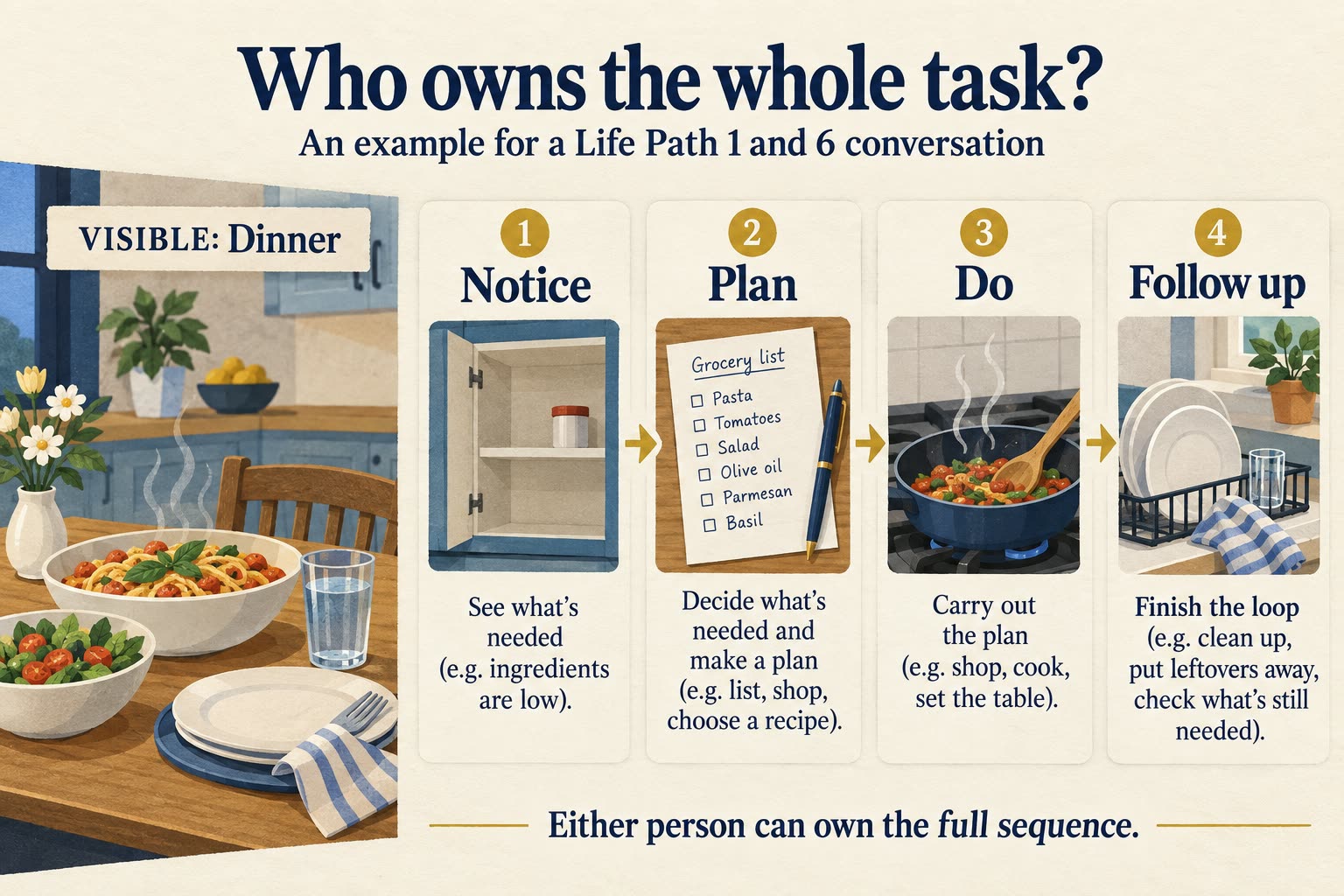
Here, household and emotional work includes recurring planning, checking in, remembering, and following up as well as visible chores. A meal may involve choosing it, noticing that ingredients are low, shopping, cooking, and cleaning.
Numerology does not calculate any of those steps.
Sociologist Allison Daminger separates the cognitive work of anticipating needs, finding options, deciding, and monitoring from the physical execution of housework. Her research concerns household labor, not Life Path numbers; it gives us a way to name work that the caregiver stereotype tends to leave vague.
Planning an appointment and reassuring an upset partner are also different kinds of work. Here, mental load refers to keeping track of tasks, while emotional support refers to listening, checking in, and responding to feelings.
Someone can carry one of those responsibilities without carrying all of them. A task inventory is more informative when it records each separately instead of calling every contribution care.
Suppose one partner cooks most meals while the other arranges appointments, keeps track of family messages, and handles a changing work schedule.
Looking only at the visible meal would miss the coordination work; looking only at the calendar would miss the repeated kitchen work. The two numbers cannot tell which effort is heavier or whether either person agreed to the arrangement.
| Area | Work to notice | Question for both people |
|---|---|---|
| Daily home | Planning meals, shopping, cooking, cleaning | Who owns each step, and how often? |
| Family coordination | Messages, appointments, transport, follow-up | Who remembers and rearranges plans when something changes? |
| Relationship care | Starting difficult talks and following through | Can either person ask for support without carrying the whole conversation? |
| Personal time | Protecting rest, friendships, study, and individual goals | Does each person have time that does not depend on the other approving it? |
Ownership means noticing, planning, doing, and following up.
A person who waits to be told what to do may help with a task without owning it. This distinction matters because a long list of occasional help can hide one person's responsibility for making sure the whole system works.
The inventory belongs to the two people, not to a numerology role.
It can reveal an uneven arrangement, a balanced one, or work that the usual 1-6 story never mentions. It can also show that the person with Life Path 1 is carrying most of the care or that the person with Life Path 6 is driving the largest goal.
When do goals and care compete?
A new job, a sick relative, a course of study, or a change in working hours can shift both paid and unpaid work. In a 1-6 reading, those situations give the initiative-and-care contrast a concrete subject, but the numbers do not predict who will make a sacrifice.
Imagine that one partner accepts a six-week work project with evening calls.
The immediate issue is not whether that person is the 1. It is who will cover dinner, transport, family messages, and the conversations delayed by those calls.
If one person's project repeatedly takes priority, the relevant evidence is whose appointments move, whose plans wait, and whether that pattern was agreed. The person with 1 is not automatically the ambitious partner, and the person with 6 is not automatically the support crew.
Trace one temporary change from promise to follow-up
A specific change reveals more than a general claim that both people help.
- Name the changed work
- Input
- The six-week project and the tasks it displaces
- Action
- List the meals, transport, messages, appointments, and check-ins that now need another owner
- Result
- Both people can see the full request rather than only the paid work
- Name the limit
- Input
- Available time, health, income, and outside help
- Action
- Identify what can move, what cannot move, and what requires another solution
- Result
- Care is planned within real capacity instead of assumed
- Set the return point
- Input
- An end date and the work added during the change
- Action
- Agree when responsibilities return or are reviewed
- Result
- A temporary accommodation is less likely to become a permanent default
Time, income, health, and access to help all affect what each person can take on. A clear agreement names the work, its limit, and the date when the arrangement will be reviewed.
Can the caring person still be the one with Life Path 1?
Yes, a person may identify with the initiative theme in numerology and still be the one who remembers birthdays, arranges care, or pauses a goal for the household. Another person may identify with the 6 theme and still protect independent work, make quick decisions, or dislike domestic routines.
For example, a person with 1 may manage an elderly relative's appointments while the person with 6 takes an intensive course. If those responsibilities later reverse, their dates have not changed; their circumstances and choices have.
A freely chosen specialty can be useful: one person may enjoy cooking and the other prefer handling appointments. The question is whether the arrangement remains voluntary when work grows, a deadline changes, or one person needs a break.
Saying "you are the caring one" can obscure that change because it treats a temporary contribution as an identity. A preference can be renegotiated; a role presented as fate gives the other person less room to ask.
Can a 1-6 reading settle who does more of the work?
A favorable reading cannot settle a dispute about workload, but a record of recurring tasks can show where a conversation needs to begin. You may find a balanced arrangement, invisible contributions on both sides, or one task that neither person has clearly accepted.
The 5-6 comparison frames care alongside freedom. A 6-6 comparison considers what happens when both symbolic profiles emphasize responsibility.
With 1 and 6, the distinctive tension is whether pursuing an individual goal leaves room for the other person's care, goals, and rest.
The useful result is an agreement both people can describe in the same terms: which work is theirs, what help is available, and when the arrangement can change.
Frequently Asked Questions
Are Life Paths 1 and 6 compatible?
Numerology.com presents 1 and 6 as a favorable pairing of initiative and care. That is its interpretive convention, not evidence that a particular relationship will be balanced or lasting.
Does Life Path 6 always carry the household work?
No. A Life Path 6 label does not show who plans, cooks, follows up, or cares for others; those duties have to be identified from what people actually do.
How should a 1-6 pair divide emotional labor?
The numbers cannot allocate tasks. The people involved can compare recurring work, available time, and what each has agreed to do; either person may be carrying more than the standard numerology story suggests.
Sources
- . Your Numerology Compatibility Guide. Numerology.com. Link
- . Numerology Life Path 1 Compatibility. Numerology.com. Link
- . Number 6 Meaning in Numerology. Numerology.com. Link
- . Relationship Numerology – Discover Compatibility. World Numerology. Link
- (2019). The Cognitive Dimension of Household Labor. American Sociological Review; author research summary. Link
- . Life Path Number ? Free Calculator & Complete Guide. World Numerology. Link
About Our Editorial Process
Every KnowTheAngels guide separates calculation method, tradition context, and personal reflection. We cite where interpretations come from, present more than one view, and never present symbolic reading as prediction.
Read our editorial policy