How Do You Calculate a Name Number From a Chosen Spelling?
Enter a name in either the Pythagorean or Chaldean system, see each letter’s value and reduction path, and understand why the two tables give different results
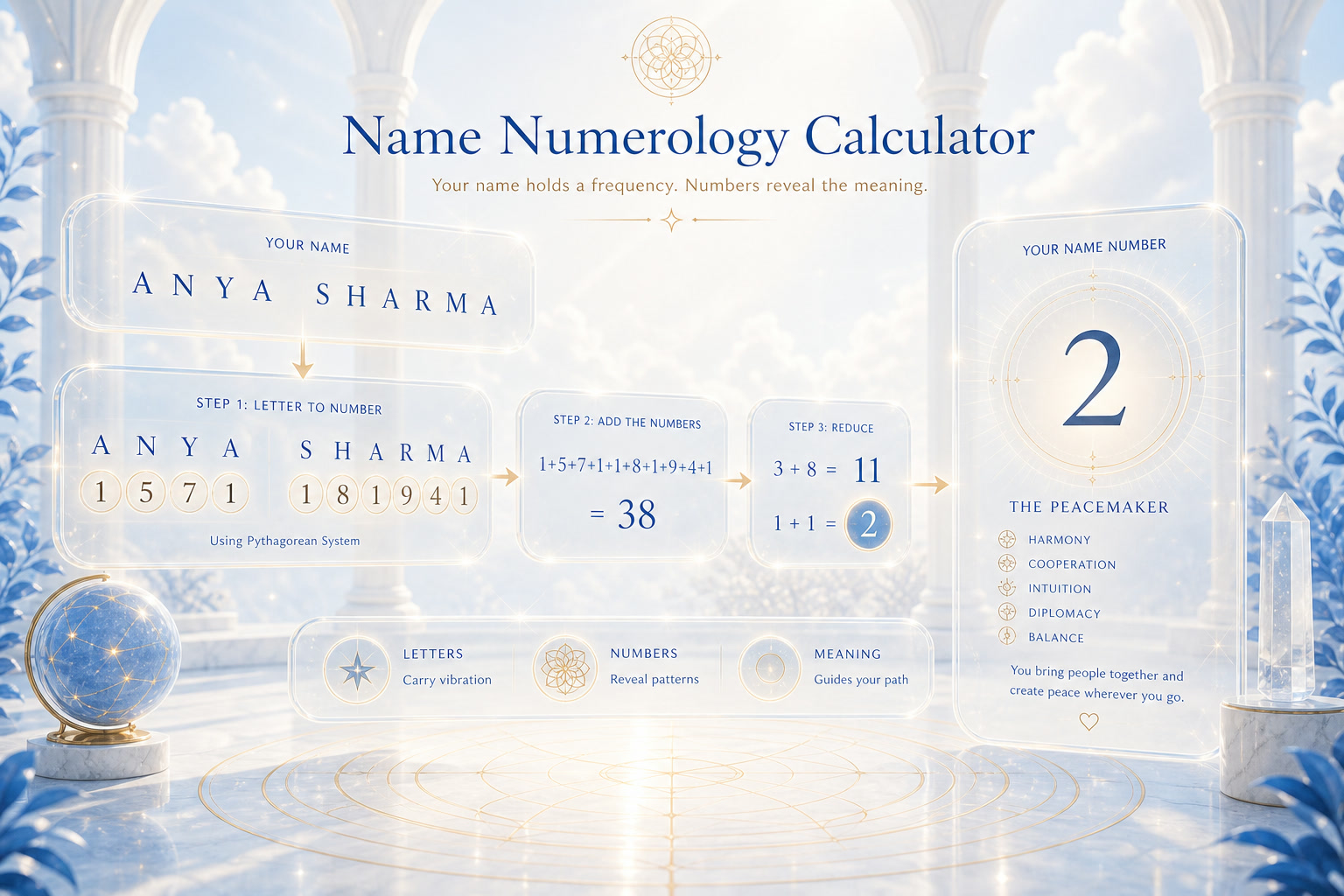
This tool organizes your input for reflection. It does not prove angel contact, predict an outcome, or replace your judgment.
This calculator takes one name typed in Latin letters and one system choice, Pythagorean or Chaldean, then adds each letter’s assigned value and reduces the total to a single digit or a master number (11, 22, or 33).
The two systems give the same name different numbers because they assign values by different rules. The Pythagorean table follows alphabetical position, cycling 1 through 9, while the Chaldean table assigns letters by sound, using only 1 through 8.
Quick Facts
- Input
- One name in Latin letters plus a system choice (Pythagorean or Chaldean)
- Calculation
- All letter values added, then reduced to a single digit or master number (11, 22, 33)
- Pythagorean basis
- Letters assigned by alphabetical position, cycling 1 through 9
- Chaldean basis
- Letters assigned by sound, values 1 through 8 only
- Text handling
- Characters outside A through Z are dropped, including accented letters
One name, two systems, one reduced number
The input is one text field labelled ‘Enter full name’ and two radio buttons: Pythagorean (selected by default) and Chaldean. Every letter is converted to a number from the chosen system’s table, the values are added, and the total is reduced by repeated digit sums.
Reduction stops at a single digit or at 11, 22, or 33. These three master numbers are always preserved; there is no option to turn this off.
The result panel displays the final number, the system used, and a reduction path such as ‘Sum = 64 → 6 + 4 = 10 → 1 + 0 = 1.’ It also lists every letter with its assigned value so the arithmetic can be checked.
Under the number the panel shows a one-line theme taken from the site’s own list of Life Path themes, and a link to the Pythagorean and Chaldean systems page. The theme line is the site’s wording, not a publisher’s.
A name number is a reading of one written form of a name. It describes a traditional association with that number and does not establish a person’s identity, character or future.
The Pythagorean and Chaldean letter tables
In the Pythagorean system, each letter’s value follows its position in the Latin alphabet: A = 1 because it is first, B = 2, and so on up to I = 9, then the cycle restarts with J = 1 through Z = 8. Blair Andrews of Numerologist.com describes this as pure sequence: “The letter’s position in the alphabet determines its number.”
The Chaldean system works differently. Andrews writes that instead of following alphabetical order, it “assigns each letter to the number whose vibrational quality best matches that letter’s sound.”
| Value | Pythagorean | Chaldean |
|---|---|---|
| 1 | A J S | A I J Q Y |
| 2 | B K T | B K R |
| 3 | C L U | C G L S |
| 4 | D M V | D M T |
| 5 | E N W | E H N X |
| 6 | F O X | U V W |
| 7 | G P Y | O Z |
| 8 | H Q Z | F P |
| 9 | I R | (no letter assigned) |
The Chaldean table has no 9 column. In the Chaldean tradition, Andrews writes, “9 is considered sacred, the number of completion,” and it has a mathematical property that supports this: add 9 to any single digit and reduce, and the original digit returns.
Nine can still appear as a calculated result. In the worked example below, JANICE MAY BARKER reaches a Chaldean total of 9 even though no letter carried that value.

JANICE MAY BARKER calculated both ways
Andrews uses the name JANICE MAY BARKER to demonstrate both systems. In the Pythagorean table, each letter converts by alphabetical position.
JANICE: J(1) + A(1) + N(5) + I(9) + C(3) + E(5) = 24. MAY: M(4) + A(1) + Y(7) = 12.
BARKER: B(2) + A(1) + R(9) + K(2) + E(5) + R(9) = 28. The three parts add to 24 + 12 + 28 = 64, which reduces 6 + 4 = 10, then 1 + 0 = 1.
The Chaldean table changes most of the letter values. The full calculation: J(1) + A(1) + N(5) + I(1) + C(3) + E(5) + M(4) + A(1) + Y(1) + B(2) + A(1) + R(2) + K(2) + E(5) + R(2) = 36, which reduces 3 + 6 = 9.
| System | Letter-value total | Reduction | Name number |
|---|---|---|---|
| Pythagorean | 64 | 64 -> 10 -> 1 | 1 |
| Chaldean | 36 | 36 -> 9 | 9 |
Several letters drive the gap between 64 and 36. I is 9 in Pythagorean but 1 in Chaldean; R is 9 versus 2; Y is 7 versus 1.
Andrews notes that the Chaldean 9 “arrived through calculation rather than assignment,” a distinction the tradition treats as carrying extra weight.
Three differences that change which number you get
Andrews identifies three structural differences between the systems beyond the letter values themselves.
| Difference | Pythagorean | Chaldean |
|---|---|---|
| Assignment basis | Alphabetical position | Sound vibration |
| Value range | 1 through 9 | 1 through 8 (9 withheld) |
| Which name to use | Full birth-certificate name | Name most commonly used now |
The assignment basis explains why the same letter carries a different number in each system. F is 6 in Pythagorean (the sixth letter) and 8 in Chaldean (the sound of F was associated with 8).
The range difference compresses 26 letters into 8 possible values in Chaldean versus 9 in Pythagorean. Andrews notes this “changes the distribution of numbers in any given name, making certain totals more or less likely in each system.”
The name choice is the largest practical difference. Andrews writes that the Pythagorean system “always uses the full name on your birth certificate,” while the Chaldean system “uses the name you are most commonly known by right now.”
Someone who goes by a different name from what appears on the birth certificate would use entirely different letters in each system, not just different values for the same letters.
What happens to accents, spaces, and non-Latin characters
The calculator converts the input to capitals and removes every character outside A through Z. Spaces, hyphens, apostrophes, and digits do not count.
A letter typed as a single accented character is also dropped without any message. The e with an acute accent, the n with a tilde, and letters from Greek, Hebrew, Arabic, or Cyrillic alphabets are all removed before the calculation starts.
There is no transliteration step. A name must be typed in unaccented Latin letters for every letter to be counted.
The difference matters. If JOSÉ is typed with the accent, only J, O, and S enter the Pythagorean calculation: 1 + 6 + 1 = 8.
Without the accent (JOSE), all four letters count: J(1) + O(6) + S(1) + E(5) = 13, reduced to 4. A single dropped letter changed the result from 8 to 4.

Where to find vowel-only and consonant-only totals
This calculator adds all letters together, vowels and consonants alike. It does not produce a vowel-only total or a consonant-only total.
The soul urge calculator isolates the vowels. The personality number calculator isolates the consonants.
The expression number calculator also produces a full-name total, framed as an Expression Number within the numerology chart-role system. In those vowel and consonant tools, Y is counted as a consonant.
Frequently Asked Questions
Does the result change if I use a nickname instead of my full name?
Yes, because different letters produce a different total. In the Pythagorean tradition the birth-certificate name is the standard input, while in the Chaldean tradition the name in everyday use is preferred.
What happens if my name has an accent or non-Latin characters?
The calculator drops every character outside plain A through Z, including accented letters, without a warning. Type the name in unaccented Latin letters for every letter to count.
Why does the Chaldean table skip the number 9?
In the Chaldean tradition, 9 is treated as sacred and withheld from ordinary letter assignments. It can still appear as a calculated result when a name’s letter values reduce to 9.
Sources
- (2020). Pythagorean vs Chaldean Numerology: How the Two Systems Differ. Numerologist.com, letter charts and worked example sections. Link
About Our Editorial Process
Every KnowTheAngels guide separates calculation method, tradition context, and personal reflection. We cite where interpretations come from, present more than one view, and never present symbolic reading as prediction.
Read our editorial policy