What Your Personal Year Number Means, and When It Actually Changes
The nine-year arc, the three competing turnover dates, and what the arithmetic settles that the traditions do not
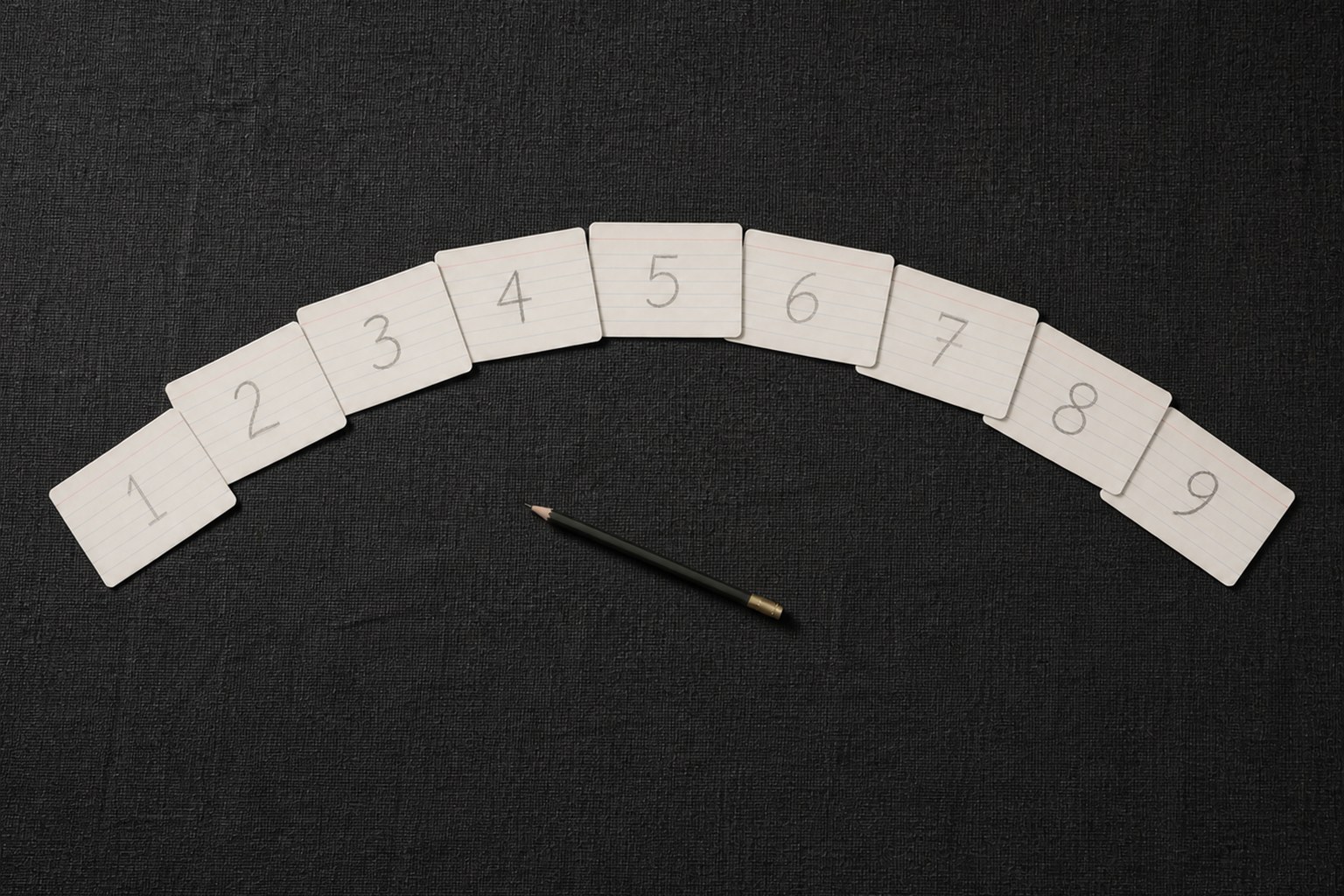
Your personal year is the one number in a numerology chart designed to expire.
It is built from your birth month, your birth day, and the calendar year you are asking about, so it moves when the calendar moves while the rest of the chart stays where it is.
The disagreement starts immediately after that. Some practitioners turn the number over on the first of January, some on your birthday, and some describe a slide that begins in October and finishes in the first week of the new year.
The calculation itself has only one moving part, and that settles more of the argument than the traditions do.
We ran it across all 366 possible birthdays. Every one advances exactly one step each January, so nobody's cycle drifts out of step with anybody else's.
Quick Facts
- What it measures
- One calendar year of timing, not identity
- Inputs
- Birth month, birth day, and the calendar year in question
- Range
- 1 through 9, restarting every ninth year
- Universal year for 2026
- 1, so 2025 closed the previous arc
- Turnover date
- Disputed: the first of January, the birthday, or a gradual autumn shift
- Master numbers
- A 22 personal year is arithmetically unreachable in 2026, 2027 and 2028
What a personal year actually measures
Take a birthday of 14 March and ask about 2026.
March gives 3, the day 1 + 4 gives 5, and 2026 gives 2 + 0 + 2 + 6 = 10, which reduces to 1. Those three add to 9.
That birthday is in a 9 year for 2026.
A 9 is read as release and clearing, the last position in the arc before it starts over. Whether that reading is useful is a separate question from whether the arithmetic is right.
Notice what never entered the sum. The birth year is absent, and that single omission is what stops this from being an identity reading.
A timing number and an identity number answer different questions, and a reading gets into trouble the moment it lets one of them speak for the other.
A life path uses the whole birth date and never changes. A personal year drops the birth year and is rebuilt from scratch every twelve months.
One consequence follows immediately. Two people born on 14 March forty years apart share the same personal year every year of their lives, while sharing almost nothing else in the chart.
Why the number changes on a date nobody agrees on
Three conventions are in circulation, and for part of every year they give the same person different numbers.
The most common runs the personal year from the first of January to the end of December, which keeps it lined up with the calendar year already sitting inside the calculation.
The second runs it birthday to birthday, on the reasoning that a personal cycle ought to begin on the date that made it personal.
The third treats it as no switch at all. In that account the change is gradual, beginning around the middle of October and finishing in the first week of January.
| Convention | The year starts | What it commits you to |
|---|---|---|
| Calendar year | 1 January | The number matches the year in the sum, and a late-December birthday gets no special treatment |
| Birthday to birthday | Your birthday | A number named after 2026 is applied to months that belong to 2025 or 2027 |
| Gradual shift | Mid-October, complete by early January | Roughly ten weeks where two readings are both said to be partly active |
The calendar convention has the arithmetic on its side. The calendar year is the only input that moves, and it moves on the first of January.
The birthday convention has the better story and the weaker sum, because it asks a number to begin on a date the calculation never consulted.
None of that makes the birthday convention useless. It makes it a choice about how to read the number rather than a claim about how the number is built.
Pick one convention before you start, write down which one, and keep it. Switching partway through is how the same twelve months end up read twice with two different answers.
How the nine years run, 1 through 9
The arc is agricultural in shape, and modern sources describe it in nearly the same order.
A 1 plants, a 5 disturbs, an 8 collects, and a 9 clears the ground.
- 1, beginning. The position where something is started rather than continued, and the one most often mistaken for a promise that it will work.
- 2, patience. Slow, relational, and dependent on other people's timing, which is why it frustrates anyone still moving at the pace of the 1.
- 3, expression. Output, visibility, and social energy, with scattering as the named risk.
- 4, structure. The unglamorous position where systems, habits, and paperwork get built.
- 5, disruption. Movement, change, and restlessness, read as loosening rather than as damage.
- 6, obligation. Home, family, and responsibility, including the kind that arrives without being asked for.
- 7, withdrawal. Study, solitude, and review, which reads as a stall to anyone expecting momentum.
- 8, return. The position where earlier structure either pays or fails to, in money, standing, or authority.
- 9, release. Endings, clearing, and letting go of what the previous eight years finished with.
Two positions cause most of the misreadings. A 4 gets treated as a bad year because it is slow, when the description is that a later 8 collects on whatever the 4 built.
A 9 gets the opposite treatment. It is read as loss when the word used is release, and those are not the same claim.
The arc is a description, not a schedule. Nothing in the method says a 5 year has to contain a move, or that an 8 year has to contain money.

What to do with the year you are actually in
The practical question is not what the year means. It is which kind of effort is likely to run uphill for the next twelve months.
A 1 year rewards starting something before you are certain, and a 4 year rewards finishing the unglamorous half of something already begun.
A 7 is the position people argue with hardest, because it asks for review at the moment momentum finally feels available.
One way to group the nine into something usable
An editorial grouping rather than a traditional one, offered because nine separate readings are hard to act on.
Starting, structuring, and collecting. Effort spent on construction tends to hold
Waiting, obligation, and review. Pushing for visible progress tends to cost more than it returns
Expression, disruption, and release. Holding tightly to a fixed plan tends to be the expensive move
None of that is a schedule anyone has to obey. It is a way of noticing which kind of effort is swimming against the description, so the choice to push anyway is at least a choice.
The test worth applying is whether the reading changed anything. If a 4 year gets the paperwork finished, it earned its place.
If it only makes a decision already taken feel better, it did not.
Everyone turns the page in the same January
Only one input moves, so the consequence is mechanical rather than mystical.
The calendar year reduces to 1 in 2026, 2 in 2027, 3 in 2028, and on to 9 in 2034 before starting again.
Every personal year therefore advances by exactly one each January. We checked that against all 366 possible birthdays and found no exception.
What that rules out is drift.
Two people four steps apart in the arc stay four steps apart for as long as both are alive, because the thing that moves them is the same calendar for both.
The restart is shared as well. 2026 reduces to a universal 1, so the arc that closed in 2025 began again in the same January for everyone, whatever their birthday.
The individual part of a personal year is only its offset. The rhythm underneath belongs to the calendar, not to the person.

Which personal years can be master numbers, and which cannot
A personal year is normally taken all the way down to a single digit, and most sources never raise the question of stopping at 11 or 22.
The arithmetic answers it anyway. Each of the three inputs reduces to 9 at most, so the largest total available in any year is 27.
In 2026 the calendar year contributes 1, which caps every possible total at 19.
A 22 personal year is therefore unreachable for every person alive in 2026, no matter which practitioner is doing the reading. The same holds in 2027 and 2028.
An 11 is reachable, but how often depends on the year rather than on the person. It comes up for 39 of the 366 birthdays in 2026 and for only 8 of them in 2034.
That swing is the reason to be careful with a preserved 11 here. A master number in a birth chart is a fixed property of a person, while an 11 personal year is an accident of which calendar year is being asked about.
Does a personal year override your life path?
No, and the two are not answering the same question.
A life path is fixed from the full birth date and describes a pattern across a life. A personal year drops the birth year and describes one twelve-month stretch.
When the two appear to contradict each other, the usual cause is scale rather than conflict.
Read the life path for what the pattern tends to be, and the personal year for what these particular twelve months are asking. A reading that needs one of them to overrule the other has stopped using either of them properly.
Frequently Asked Questions
When does my personal year actually change?
That depends on which convention you follow, and all three are in current use.
The calendar-year convention changes it on the first of January and has the arithmetic behind it, since the calendar year is the only moving input. Birthday-to-birthday and the gradual autumn shift are interpretive choices layered on top of the same number.
How is a personal year different from a life path?
The life path uses your full birth date, including the year, and never changes.
A personal year leaves the birth year out and uses the current calendar year instead, so it is recalculated every twelve months. One describes a pattern across a life and the other describes a stretch of it.
What is a universal year?
It is the calendar year reduced on its own, without any birthday attached.
2026 gives 2 + 0 + 2 + 6 = 10, which reduces to 1, so 2026 is a universal 1 year. It is the shared input that pushes every personal year forward by one each January.
Can I have a personal year 11 or 22?
An 11 is possible in any year, but a 22 is not.
In 2026 the highest total any birthday can reach is 19, which rules a 22 out entirely, and the same is true in 2027 and 2028. An 11 turns up for 39 of the 366 birthdays in 2026 and for 8 of them in 2034.
Does everyone restart at 1 in the same year?
The push forward is shared, but the starting position is not.
Everyone advances one step each January, so nobody drifts. Where you are in the arc depends on your birth month and day, which is why two people can be in a 1 year and a 6 year during the same calendar year.
Does a 9 personal year mean something bad is going to happen?
No. The word the tradition uses is release, not loss.
A 9 is described as the closing position of the arc, where things that have finished are cleared rather than carried forward. Nothing in the method predicts an event, and a year read as a forecast has left the method behind.
Sources
- (2001). Numerology: Key to Your Inner Self. Avery Publishing
- (1981). Numerology: The Complete Guide. Newcastle Publishing
- (2026). Numerology. Encyclopaedia Britannica
About Our Editorial Process
Every KnowTheAngels guide separates calculation method, tradition context, and personal reflection. We cite where interpretations come from, present more than one view, and never present symbolic reading as prediction.
Read our editorial policy