What Does Angel Number 789 Mean as a Closing Sequence?
The last run of three counting digits: what Decoz, Walmsley and Andrews say about its 7, 8 and 9, why 7 + 8 + 9 = 24 comes back to 6, and how 789 differs from 999
Angel number 789 is the last possible run of three consecutive single digits; after the 9 there is no single digit left to count. Blair Andrews at Numerologist.com calls it "the summit triple", "the final three rungs of the ladder that the counting numbers make".
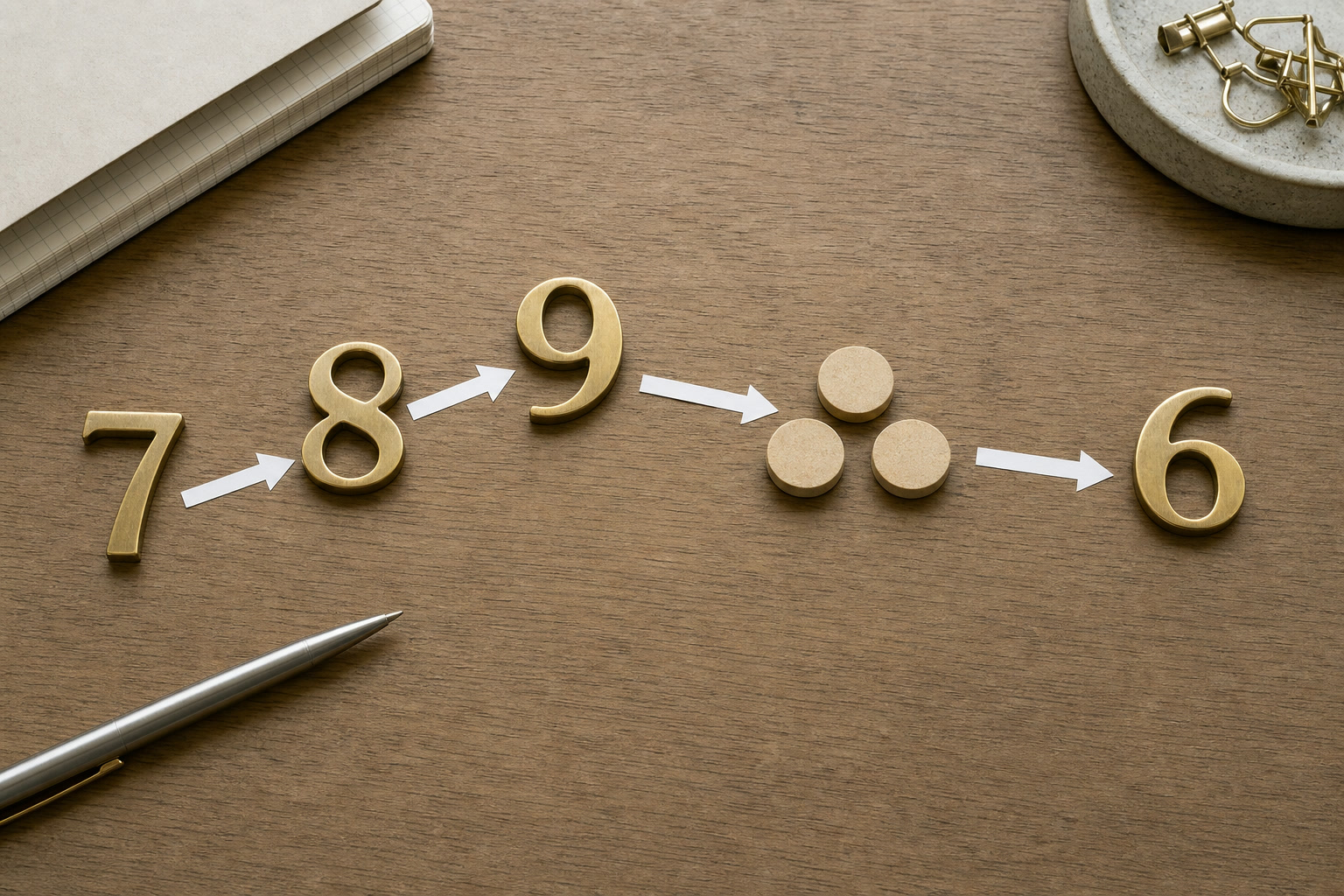
The digits in order are the 7 of study and inner inquiry, the 8 of material results and authority, and the 9 of completion. Their total is 24, and 2 + 4 = 6, so a sequence that climbs to the end of the digits adds up to the number of home and responsibility.
Quick Facts
- Digits
- 7 (inquiry), 8 (results and authority), 9 (completion)
- Reduction
- 7 + 8 + 9 = 24; 2 + 4 = 6
- Position
- The last run of three consecutive single digits
- Two modern readings
- A prompt toward life-purpose work (Walmsley); a climb already won (Andrews)
- On the clock
- Never: clock minutes stop at 59
Won, sustained, completed: what 789 means to Andrews and Walmsley
Andrews reads the three digits as victory, rhythm and completion, and sums up a person at the top of the run in three words: "Won. Sustained. Completed." In her account 789 "tends to show up in a life that has done more than it gives itself credit for. The victory has already happened."
Walmsley's entry of 15 December 2011 looks forward instead. She gives the 7 "spiritual awakening and development", the 8 "manifesting positive abundance" and the 9 "endings and conclusions", and addresses readers unsure of their direction: "If you have been feeling unclear or confused about your true life purpose, Angel Number 789 is a strong prompt to listen to your intuition and follow its guidance."
| Digit | Decoz | Walmsley (2011) | Andrews (2026) |
|---|---|---|---|
| 7 | "The seeker, the thinker, the analyst" | "Spiritual awakening and development" | Victory: something won |
| 8 | "Career, business, finances, and authority" | "Manifesting positive abundance" | Rhythm: the win sustained |
| 9 | "The completion of an era" | "Endings and conclusions" | Completion of the cycle |
One reading looks back and the other ahead. Andrews' fits someone who has reached a result and keeps treating it as unfinished; Walmsley's fits someone weighing a move toward purpose-driven work they have not yet taken up.
Why does a climb to 9 add up to 6? The rows 123, 456 and 789
Three times the middle digit gives the total, 3 × 8 = 24, and 2 + 4 = 6; the intermediate total is the two-digit 24. The rows 1-2-3, 4-5-6 and 7-8-9 all share that root, because each digit of 4-5-6 is three more than the matching digit of 1-2-3, and each digit of 7-8-9 three more again, so each row totals nine more than the one before: 6, 15, 24.
Andrews builds her reading on that 6, which she treats as love: "Victory without love curdles into pride. Rhythm without love becomes a pleasant but meaningless loop. Completion without love is simply an ending." Decoz's description of the 6 is more practical, a number "all about sacrifice, healing, protecting, and teaching others".
Read with Decoz's 6, the 9 at the end of 789 is a completion that leaves something for other people: a trained successor, a finished book, a household run well enough that the next generation can take it over.
Teaching, succession and a life purpose: 789 in career and money
Decoz writes that the 8, "more than any other number, emphasizes the areas of career, business, finances, and authority", and it sits in the middle of 789 between inquiry and completion. His 6 names teaching outright, so the 6 under 789 fits the move from doing a job to training others in it.
Walmsley points the same energy at a vocation: her entry encourages spiritually based practice or work and assures the reader that material needs will be met while they pursue it. That assurance is devotional; the digits make no forecast about pay, and a move into teaching, counselling or healing work is still decided by its income and its costs.
For a career change read through Andrews' climb, the question is what the finished work is now for. A senior specialist writing down a method before retiring, a founder handing the keys to a successor and a teacher taking a first class all match the 7, 8 and 9 with the 6 underneath.

Love at the summit: what 789 means for a long relationship
"789 is not telling you that love is about to arrive," Andrews writes. "It is showing you that the climb you already completed was always aimed at the heart." Her love at the summit belongs to an established life, and she separates it from "the love of a life still forming itself".
For a long partnership, that reading fits the stage after a large shared effort is finished, such as paying off a mortgage or seeing children leave home, when the couple decides what the years of work were for. Walmsley's entry is about life purpose and says nothing on romance.
Andrews' reading points away from new arrivals of any kind, including the twin-flame reunion some readers look for in 789, and Walmsley's entry does not mention twin flames either.
789 or 999: how do the two closing numbers differ?
Both end on 9, but they add up differently. Three nines total 27, which reduces to 9, so 999 stays on the completion number all the way down, and Doreen Virtue's 1999 list gives it as "Completion", the end of a big phase in personal or global life. Her list has no entry for 789. For sequences of three or more digits she suggests blending the meanings of each pair of digits or, "if you feel guided", adding the digits until one remains, and the second method turns 789 into 6. So 789 ends on 9 but adds up to 6, and both modern readings of it carry something forward past the ending.
| Number | Sum | Root | Usually read as |
|---|---|---|---|
| 456 | 15 | 6 | A built life meeting change |
| 789 | 24 | 6 | A finished climb whose result serves someone |
| 999 | 27 | 9 | The end of a phase |
A reader deciding between them can use the situation: work that is complete and still in use, or being passed on, fits 789; a chapter that is simply over fits 999.
Where does 789 turn up? Calculators, prices and never the clock
789 never appears on a clock, because the minutes stop at 59. It does appear on keypads: calculators and computer number pads put 7, 8 and 9 on the top row, while telephone keypads, which follow the ITU E.161 layout with 1, 2 and 3 on top, put them on the third row. Prices such as 7.89 and house numbers supply the rest.
After a number has caught someone's attention, it seems to come up more often than it actually does, the effect Arnold Zwicky called the frequency illusion. Logging each 789 in a number journal, with where it appeared, shows whether the sightings cluster around a finished piece of work or around a calculator at the till.
Frequently Asked Questions
What does 789 mean spiritually?
Joanne Walmsley reads it as a strong prompt to follow your intuition toward your life purpose, often in spiritually based work. Blair Andrews reads it as a climb already completed, with love at the top.
Does 789 mean something is ending?
It ends on 9, the completion digit, but reduces to 6, so neither modern reading treats it as a bare ending. Andrews reads a cycle completed and carried into love; for an ending with nothing carried forward, 999 is the closer number.
Is 789 a sign of money coming?
Not as a forecast. Walmsley's entry says the angels are helping the reader "manifest financial supply" while they serve their soul mission, and Decoz's 8 is the number of career, business and finances; neither source names a sum, a date or a source of money.
Sources
- (2011). Angel Number 789 (posted December 15, 2011). Sacred Scribes Angel Numbers. Link
- (2026). Angel Number 789 (published March 26, 2023, updated May 21, 2026). Numerologist.com. Link
- (n.d.). Numerology Meaning of Number 6. World Numerology. Link
- (n.d.). Numerology Meaning of Number 7. World Numerology. Link
- (n.d.). Numerology Meaning of Number 8. World Numerology. Link
- (n.d.). Numerology Meaning of Number 9. World Numerology. Link
- (1999). Healing with the Angels, number-sequence chapter: entry for 999 and the rule for adding longer sequences. Hay House; excerpt at Spirit Library. Link
- (2026). Telephone keypad: the ITU E.161 layout with 1, 2 and 3 on the top row, and the calculator layout with them on the bottom row. Wikipedia. Link
- (2026). Frequency illusion (term coined by Arnold Zwicky in 2005). Wikipedia. Link
About Our Editorial Process
Every KnowTheAngels guide separates calculation method, tradition context, and personal reflection. We cite where interpretations come from, present more than one view, and never present symbolic reading as prediction.
Read our editorial policy